
Recent Posts
ASTM B584 Decoded: Your Guide to Bronze Castings & Why the Right Bushings Matter
For engineers, procurement specialists, and maintenance managers, specifying the correct bronze alloy is a critical decision that impacts performance, durability, and total cost of ownership. Amidst a sea of material grades and standards, ASTM B584 stands as the authoritative compass for copper alloy sand castings used in countless general applications.
This article breaks down what ASTM B584 is, explores its most pivotal alloys for bearing and bushing applications, and explains why a deep understanding of this standard is the foundation of MYWAY’s superior bushing solutions.

Table of Contents
1. What is ASTM B584? More Than Just a Number
ASTM B584, formally titled “Standard Specification for Copper Alloy Sand Castings for General Applications,” is a comprehensive material standard published by ASTM International. It consolidates specifications for a wide range of cast copper-based alloys, primarily used in components produced via sand casting methods.
Its primary purpose is to ensure consistency, reliability, and performance by defining strict requirements for:
Chemical Composition: Precise ranges for all alloying elements (Copper, Tin, Lead, Zinc, etc.) for each grade.
Mechanical Properties: Benchmark values for tensile strength, yield strength, and elongation.
Manufacturing Quality: Guidelines for producing sound, high-integrity castings suitable for demanding mechanical parts.
For a manufacturer like MYWAY, ASTM B584 isn’t just a reference; it’s the baseline engineering language we use to select and qualify materials for components that must withstand friction, load, and harsh environments.
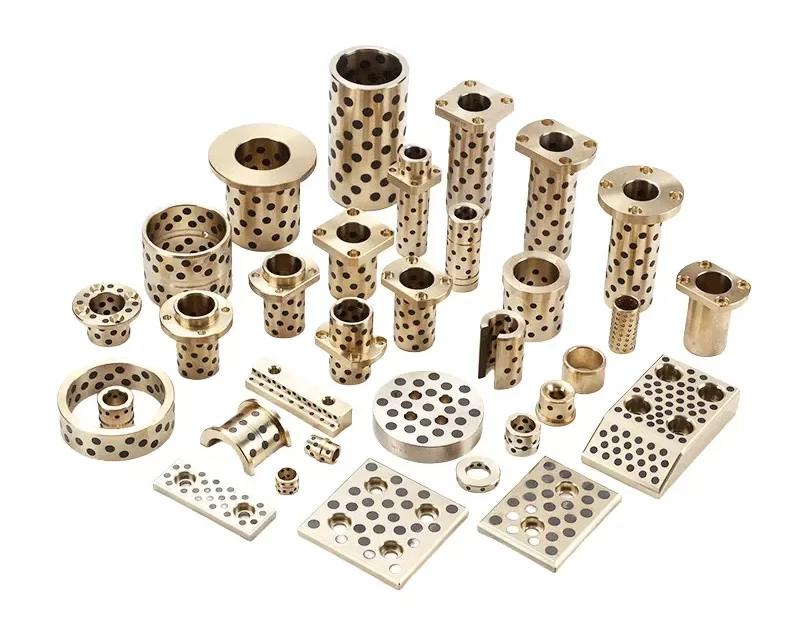
2. Inside the Standard: Key Alloys for Bushings and Bearings
ASTM B584 catalogues dozens of alloys, but a few are particularly renowned for their exceptional wear resistance and anti-friction properties—making them the darlings of the bushing world. The standard organizes them into logical groups like Leaded Red Brass, High-Lead Tin Bronze, and High-Strength Yellow Brass.
Here’s a closer look at some of the most critical workhorse alloys:
| Alloy Type | UNS Number | Common Name / Key Characteristic | Typical Applications |
|---|---|---|---|
| Leaded Red Brass | C83600 | 85-5-5-5 Bronze / Excellent all-round castability & machinability | General-purpose bearings, bushings, valve bodies, pump components |
| High-Lead Tin Bronze | C93200, C93800 | High-Lead Bearing Bronze / Superior wear resistance and load capacity | Heavy-duty bearings, industrial machinery bushings, stern tubes |
| High-Strength Yellow Brass | C86300 | Manganese Bronze / Very high strength and hardness | Gears, heavy-duty wear plates, nut screws |
Spotlight on the “85-5-5-5” All-Star: C83600 / ZCuSn5Pb5Zn5
Perhaps the most iconic alloy in the standard is UNS C83600, the “85-5-5-5” or “Ounce Metal”. Known in China as ZCuSn5Pb5Zn5, it is a testament to perfect balance.
Composition: Its name reveals its classic makeup: approximately 85% Copper, 5% Tin, 5% Lead, and 5% Zinc.
The Performance Triad: This blend creates a unique synergy. Tin enhances strength and corrosion resistance. Lead, present as fine particles in the microstructure, acts as a solid lubricant, drastically improving machinability and anti-friction properties. Zinc improves castability and fluidity.
Why It’s Ubiquitous: With a tensile strength over 200 MPa and good elongation, it offers a reliable combination of strength and toughness. It’s the go-to choice for a vast range of bearings, bushings, pump parts, and valve components.
The Science Behind the Performance
Research confirms that the microstructure of these leaded tin bronzes is key. The lead-rich phase, dispersed within the copper-tin matrix, is responsible for their excellent machinability and self-lubricating behavior. This directly translates to lower friction, reduced wear on mating surfaces, and the ability to operate with minimal lubrication.
3. From Standard to Solution: The MYWAY Engineering Philosophy
Understanding ASTM B584 is the first step. The critical second step is applying this knowledge to engineer components that solve real-world problems. This is where MYWAY distinguishes itself.
We don’t just supply “C83600 bushings.” We provide engineered friction solutions based on a deep mastery of these materials. Our process involves:
Application-First Material Selection: Is it for moderate loads and corrosion resistance? C83600 may be ideal. Is it for extreme pressure and wear? We might recommend a high-lead C93800 or even explore advanced composites, similar to innovations like TiB2 particle-reinforced copper alloys for ultra-heavy-duty applications.
Precision Manufacturing: Adherence to the standard’s chemical composition is guaranteed. We employ controlled sand-casting and advanced centrifugal casting techniques to produce castings with superior density, consistency, and mechanical properties.
Value-Added Engineering: Beyond the standard, we offer customization. This includes custom sizing, machining to precise tolerances, integrating lubrication features (like graphite plugs), and applying specialized surface treatments to extend service life.
For us, ASTM B584 is the starting point of a conversation about your specific operational challenges—be it high load, corrosive environment, high temperature, or the need for maintenance-free operation.

4. Ready to Specify with Confidence?
Navigating material standards is complex, but choosing the right partner shouldn’t be. At MYWAY, we combine rigorous adherence to international standards like ASTM B584 with practical engineering insight to deliver bushings and bearings that perform reliably in your application.
Don’t leave performance to chance. Contact MYWAY today for a technical consultation. Send us your drawings, operating parameters, or a sample of your failed part. Let our expertise in bronze alloys translate into your next success story.
Frequently Asked Questions (FAQ)
Q1: What’s the difference between ASTM B584-08a and other versions (like B584-11)?
The core alloy compositions and requirements are generally stable. The suffix (e.g., -08a, -11) indicates the year of the latest revision, which may include updates to testing methods, editorial changes, or the addition of new alloys. For most engineering and procurement purposes, the essential material data remains consistent.
Q2: We see “ZCuSn5Pb5Zn5” on Chinese drawings and “C83600” on American ones. Are they the same?
Yes, for all practical purposes. ZCuSn5Pb5Zn5 is the direct Chinese GB standard equivalent to ASTM C83600. The chemical compositions and properties are virtually identical, making them fully interchangeable in global supply chains. MYWAY is proficient in both nomenclature systems.
Q3: Why choose a leaded bronze over a cheaper iron or steel bushing?
Leaded bronzes like C83600 or C93200 offer inherent, maintenance-friendly advantages: excellent wear resistance against steel shafts, good corrosion resistance, and vibration damping. The embedded lead provides self-lubricating properties, reducing the risk of seizure under marginal lubrication—a common failure point for plain steel components.
Q4: Can MYWAY produce bushings to other international standards?
Absolutely. While ASTM is globally prevalent, we regularly manufacture to equivalent standards such as DIN (Germany), JIS (Japan), BS (UK), and GB (China). The alloy cross-reference table in our technical documentation helps bridge these standards.
Q5: Do you offer custom alloys or modifications?
Our expertise allows us to advise on and source alloys for specialized needs. While standard ASTM B584 grades cover 95% of applications, we can work with foundries to adjust compositions or source engineered materials (like aluminum bronzes or composites) for extreme conditions.

100000+ Types of Bushings – Contact Us for Details