
Recent Posts
Bimetal Bushings: The Strength and Performance
The secret to their durability isn’t just in the material, but in the union of two metals working in perfect harmony.
Bimetal bushings are the workhorses of the industrial world, engineered to thrive where ordinary bushings fail. You’ll find them at the core of heavy machinery—in the relentless pivot of an excavator’s arm, the high-impact vibrations of a drill rig, and the constant, precise oscillation of a concrete pump’s boom. They are the critical, often-overlooked component that ensures motion is smooth, reliable, and long-lasting under extreme pressure. At their essence, a bimetal bushing is a masterclass in material synergy: it combines the brute strength of steel with the superior, wear-resistant glide of a bronze alloy to create a component greater than the sum of its parts.
Whether you’re selecting parts for a new design or troubleshooting a recurring failure in heavy equipment, understanding bimetal bushings is key to improving performance and reducing costly downtime.
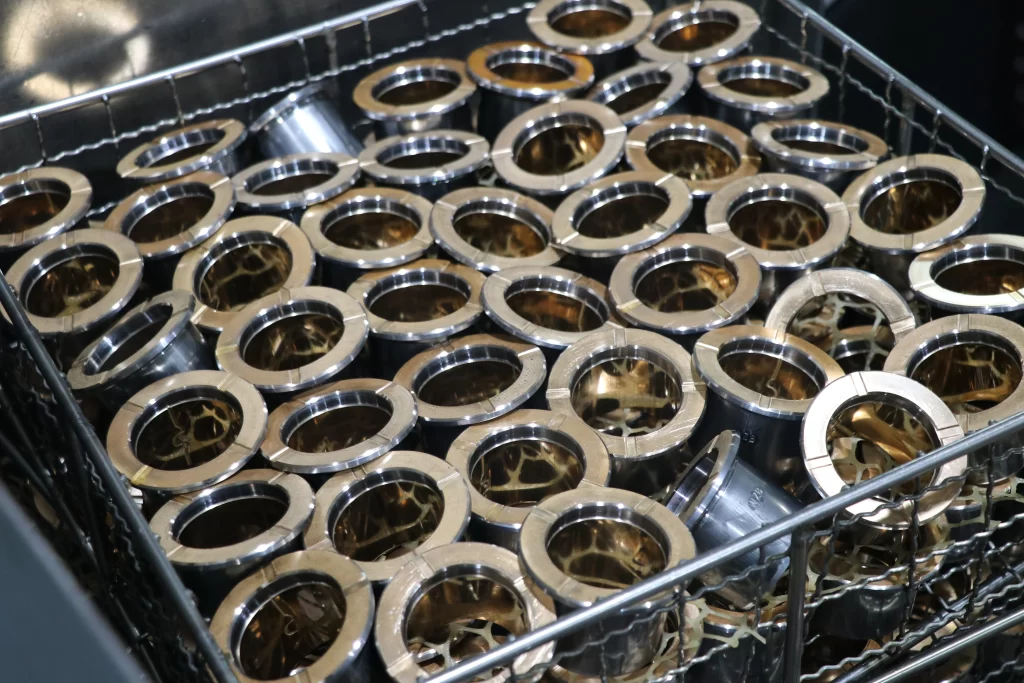
Table of Contents
1. What Are Bimetal Bushings?
A bimetal bushing, also known as a two-metal bushing or a steel-backed bronze bushing, is a type of sleeve bearing constructed from two distinct metal layers permanently bonded together. This design isn’t a simple assembly; it’s a composite material engineered for specific performance advantages.
The structure is straightforward yet brilliant:
Steel Backing (The Muscle): The outer layer is typically made from a high-quality, low-carbon steel (like SAE 1008 or 1010). This steel shell provides the structural backbone, offering exceptional strength, high load-bearing capacity, and impressive resistance to shock and impact. It ensures the bushing can withstand immense forces without deforming.
Bronze Alloy Liner (The Glide): Bonded to the inside of the steel shell is a lining of a copper-based alloy. Common materials include CuPb10Sn10 (leaded tin bronze), CuSn6Zn6Pb3, or CuPb24Sn4. This inner layer is the bearing surface. It provides excellent wear resistance, a low coefficient of friction, and often incorporates self-lubricating properties or features like indents to hold grease.
The primary methods for creating this inseparable bond are sintering and casting. The sintering process involves fusing bronze alloy powder onto the steel strip under high heat, creating a strong metallurgical bond with a slight porosity that can be beneficial for lubrication.
2. Key Materials and Properties: Choosing the Right Alloy
The choice of bronze lining material directly dictates the bushing’s performance in your application. Here’s a breakdown of common alloys and their strengths:
| Alloy (Common Standard) | Key Characteristics | Ideal For / Applications |
|---|---|---|
| CuPb10Sn10 (SAE 792, ISO Standard) | Excellent anti-seizure & embeddability, good wear & corrosion resistance. | General heavy-duty use; automotive engines, construction equipment, high-impact loads. |
| CuSn6Zn6Pb3 | A versatile, general-purpose tin bronze. | Moderate loads and speeds; commonly used in connecting rods and compressor parts. |
| CuPb24Sn4 (SAE 794) | Very high fatigue strength and load capacity. | Applications with extreme cyclic loading, though it can be prone to lead segregation. |
| AlSn20Cu | Offers a good balance of strength and corrosion resistance, used in specialized engine applications. | High-performance or specific engine environments where aluminum-based alloys are preferred. |
Performance Snapshot:
Load Capacity: Can support high dynamic loads, with static load capacities reaching 150 N/mm² or more.
Temperature Range: Operates reliably from -40°C to 250°C, with some high-temp grease or oil lubrication pushing limits higher.
Other Advantages: These bushings also offer very good damping properties for vibration, corrosion resistance (especially with plated steel backs), and can be designed for maintenance-free operation when combined with solid lubricants.
3. Bimetal vs. Solid Bronze: Which One Wins?
Choosing between a bimetal and a solid bronze bushing is a classic engineering trade-off between performance, cost, and application needs.
Solid Bronze Bushings are a single, homogeneous material throughout. They are known for:
Excellent wear resistance and durability.
Good machinability and the ability to be customized post-installation.
Superior performance in corrosive environments.
Bimetal (Steel-Backed) Bushings offer distinct advantages that make them the preferred choice for many heavy-duty applications:
Higher Strength-to-Weight Ratio: The steel backing provides immense strength without the need for thick, heavy bronze walls. This makes them lighter and more compact for the same load capacity.
Better Heat Dissipation: Steel is an excellent conductor of heat, helping to draw heat away from the critical bearing surface, which prolongs life.
Cost-Effectiveness: By using a thinner layer of more expensive bronze alloy on a steel backing, bimetal bushings often provide a more economical solution for high-load scenarios.
Superior Impact & Fatigue Resistance: The steel back is exceptionally good at handling the shock, vibration, and repeated loading common in machinery like excavators, crushers, and heavy vehicles.
4. Where Bimetal Bushings Excel: Critical Applications
The unique properties of bimetal bushings make them indispensable across industries where failure is not an option:
Heavy Machinery & Construction: This is their natural habitat. They are essential in excavators, bulldozers, cranes, and concrete pumps, handling the extreme loads and oscillating motions in pivot points, hydraulic cylinder mounts, and track rollers.
Automotive and Transportation: Found in engine components, transmission systems, suspension linkages (like kingpins and balance suspensions), steering systems, and clutches. They endure high temperatures and constant vibration.
Agricultural Equipment: Used in tractors, combines, and other farm machinery that operates under heavy loads in dirty, demanding environments.
Industrial Machinery: Common in gear pumps, compressors, lifting equipment, conveying systems, and rolling mill machinery.
5. The MYWAY Advantage in Bimetal Solutions
Understanding the theory is one thing; sourcing a reliable, high-performance component is another. This is where MYWAY Bushing transforms industry knowledge into tangible value for engineers and procurement specialists.
MYWAY specializes in the engineering and manufacture of precision bimetal bushings and bearings, offering both standard catalog items and full custom, build-to-print solutions. Our expertise ensures you get more than just a part—you get a performance-optimized component.
Our core capabilities include:
Expert Material Selection: We don’t just supply generic parts. Our engineering team helps select the optimal material—whether it’s CuPb10Sn10 for high-impact loads, CuSn6Zn6Pb3 for general duty, or advanced alloys like eco-friendly CuSn6.5P0.1—to match your specific load, speed, and environmental conditions.
Advanced Manufacturing & Customization: Beyond standard sleeves, we produce flanged bushings, thrust washers, and components with custom lubrication grooves, oil holes, and indentations (spherical or diamond) to ensure perfect lubricant distribution. We work to your precise tolerances and specifications.
Proven Quality & Direct Replacement: Our processes are designed for reliability. We offer direct replacements for major bearing brands like GGB, CSB, and ISB, ensuring a seamless upgrade or maintenance path for your existing equipment.
Engineered for Your Challenge: Whether you need a bushing for the high-impact, oscillating loads in a concrete pump truck or a custom solution for a specialized piece of industrial equipment, MYWAY provides the engineering support to develop the right answer.
FAQ: Your Bimetal Bushing Questions Answered
Q: Do bimetal bushings require lubrication?
A: Most traditional bimetal bushings are designed for use with grease or oil lubrication. The bronze lining often features indents or grooves to act as reservoirs for this lubricant. However, MYWAY and other manufacturers also offer “oilless” or self-lubricating variants, where the lining is impregnated or filled with solid lubricants like graphite or PTFE, making them ideal for maintenance-free or difficult-to-lubricate applications.
Q: Can bimetal bushings be used in high-speed applications?
A: They are generally optimized for low to medium speeds under high load. Their excellence lies in handling high specific loads and oscillating or shock movements, such as in construction equipment joints, rather than in high-speed rotational applications. For very high rotational speeds, other bearing types may be more suitable.
Q: How do I ensure a long service life for my bimetal bushing?
A: Key factors include: Proper installation using the correct tools (never hammer directly), ensuring the mating shaft is sufficiently hard and smooth, providing adequate and correct lubrication, and protecting the assembly from excessive contaminants like dirt and moisture. Selecting the right bushing material and design for the application from the start is the most critical step.
Q: Can I get bimetal bushings in non-standard sizes?
A: Absolutely. While standard metric and inch sizes are widely available (e.g., from large catalogs like those offered by MYWAY), custom manufacturing is a core service of specialists. You can get bushings tailored to unique inner/outer diameters, widths, flange dimensions, and with special features like keyways or unusual groove patterns.
Q: What certifications or standards do your bushings comply with?
A: Quality manufacturers adhere to international material and dimensional standards. Common standards for bimetal bushings include DIN 1494 / ISO 3547 for thin-walled wrapped bushes, and material standards like SAE 792 (CuPb10Sn10) and SAE 794 (CuPb24Sn4). Products are often REACH/RoHS compliant.
100000+ Types of Bushings – Contact Us for Details