
Recent Posts
Sliding Bushing Materials: Selection, Applications, and Performance Optimization
Introduction: Why Bushing Material Selection Matters
If you’ve ever dealt with machinery breakdowns or unexpected maintenance downtime, you already know the culprit often hides in plain sight—the humble bushing. These cylindrical components might look simple, but they’re doing the heavy lifting: reducing friction, absorbing shock, guiding movement, and supporting loads between moving parts .
Here’s the thing most buyers don’t realize: the bushing sliding material determines everything—how long the part lasts, how much maintenance it needs, whether it can handle dusty or wet environments, and ultimately, your total cost of ownership.
Whether you’re sourcing for construction equipment, agricultural machinery, or automotive applications, understanding bushing materials isn’t just technical trivia—it’s the difference between a machine that runs for years and one that fails every few months.
Let’s break down what you actually need to know.
Table of Contents
1. What Are Bushing Sliding Materials? (And Why They're Not All the Same)
A bushing sliding material is exactly what it sounds like: the surface material that contacts the shaft and handles the friction and wear. Unlike rolling element bearings that use balls or rollers, bushings rely on sliding contact—which means the material choice is mission-critical .
Good bushing materials share a few essential traits:
Low friction to minimize energy loss and heat
Wear resistance to survive continuous contact
Load capacity to handle pressure without deforming
Compatibility with the shaft material and operating environment
But here’s where it gets interesting: different applications demand completely different material properties. A bushing in an excavator arm experiences pounding shocks and dirt. A bushing in a packaging machine needs clean operation and minimal lubrication. A bushing in an automotive engine deals with high temperatures and constant motion.
There’s no universal “best” material—only the right material for your specific job .
2. Common Bushing Sliding Materials: A Practical Breakdown
Let’s walk through the major material categories you’ll encounter in industrial sourcing.
Bronze-Based Bushing Materials
Bronze has been a bearing workhorse for over a century—and for good reason.
Standard bronze bushings (like CuSn7Zn4Pb7 or SAE 660) offer solid anti-friction properties, good thermal conductivity, and decent load capacity . They’re what most people picture when they think of a traditional bushing.
But here’s the catch: bronze alone isn’t self-lubricating. These bushings require external lubrication—grease fittings, oil holes, or lubrication grooves machined into the surface . Without regular maintenance, they’ll wear fast and fail.
High-strength bronze alloys like CuSn12 or CuSn8 step up the game with better wear resistance and the ability to handle higher surface pressures and impact loads . These are common in heavy machinery where loads are severe and consistent.
Aluminum bronze adds corrosion resistance to the mix, making it valuable in marine or chemical environments .
The downside? Pure bronze bushings need lubrication, they’re heavier than alternatives, and manufacturing lubrication features adds cost .
Steel-Backed Composite Bushings (The Modern Standard)
If you’ve sourced bushings recently, you’ve probably encountered DU and DX type materials. These are game-changers in the industry.
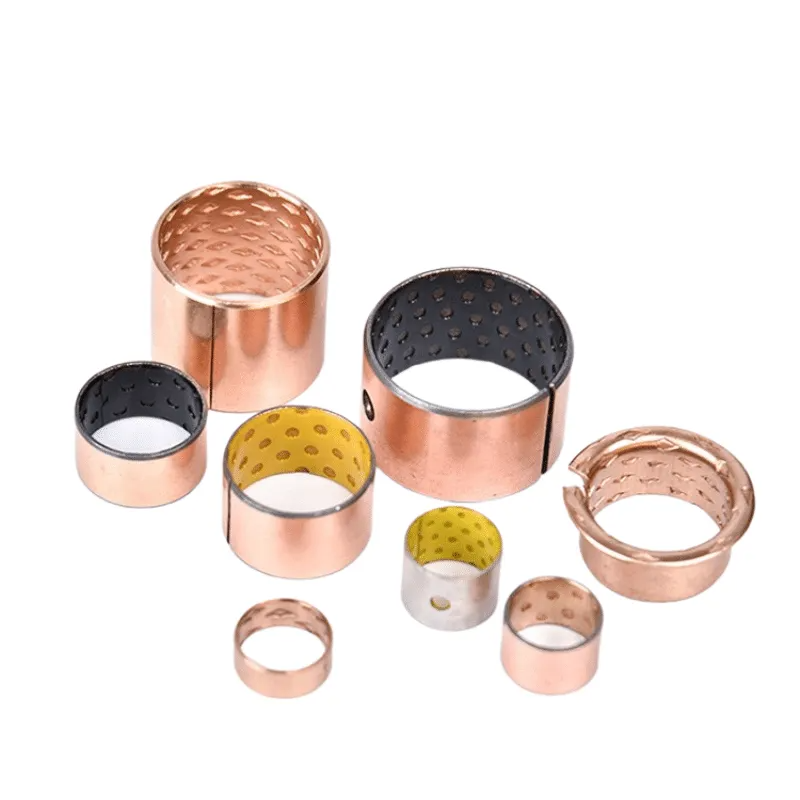
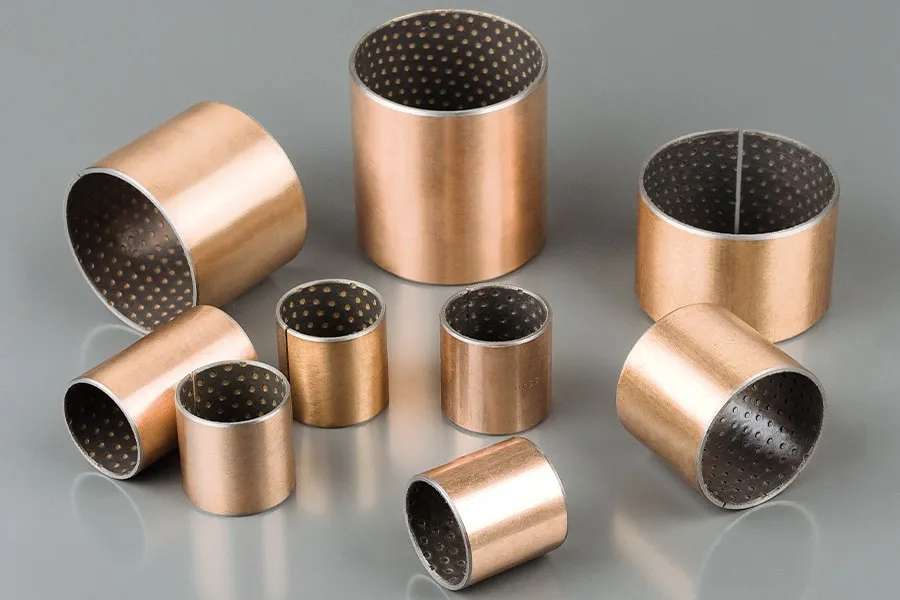
DU bushings (PTFE composite) consist of a steel backing for strength, a sintered porous bronze layer that acts as a reservoir, and a PTFE-lead or PTFE-polymer lining that provides the low-friction sliding surface .
What makes DU special? They’re self-lubricating. The PTFE transfers a thin film to the shaft during operation, creating a low-friction interface without external grease . This is huge for applications where maintenance access is difficult or contamination is a concern.
Key specs for DU materials:
Compressive strength up to 280 MPa
Temperature range -195°C to +270°C
Friction coefficient < 0.20
Suitable for dry running or minimal lubrication
DX bushings (POM composite) use a similar steel-and-bronze backing but with a modified polyacetal (POM) surface layer featuring indented grease pockets . These are designed for boundary lubrication—they work best with an initial grease charge that replenishes from the pockets during operation.
DX materials excel in:
High-load, low-speed applications
Frequent start-stop motion
Situations where occasional relubrication is possible
Oscillating movements
The beauty of composite bushings? You get the strength of steel with the sliding properties of engineered polymers, all in a thin-walled, lightweight package .
Solid Lubricant-Inlaid Bushings
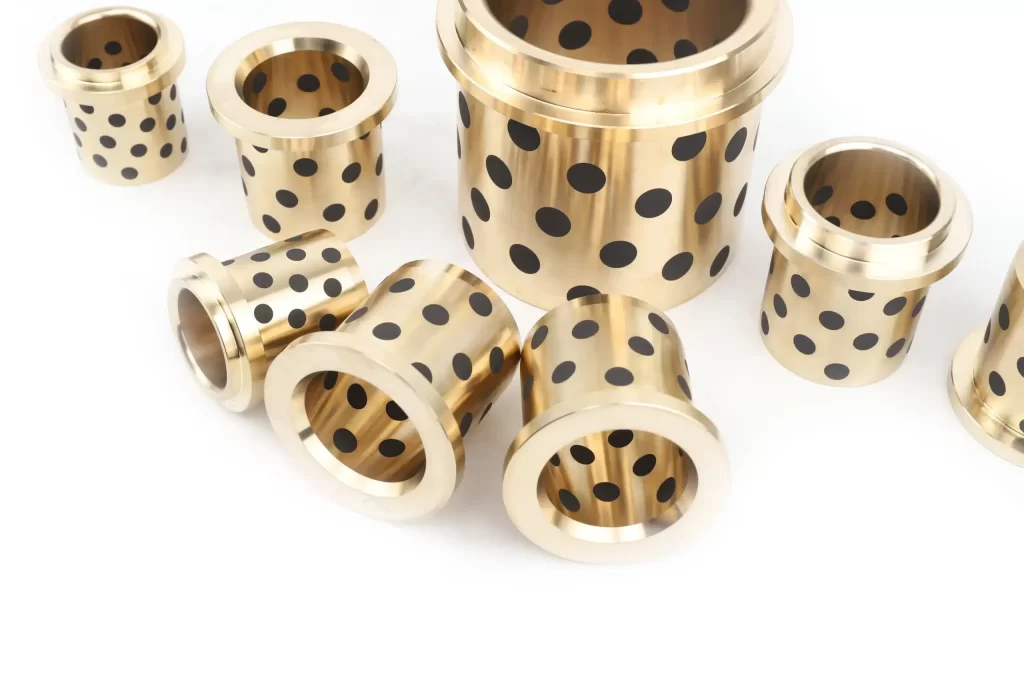
Sometimes called graphite-plugged bushings or JDB-type materials, these combine a bronze or steel backing with solid lubricant inserts (usually graphite or PTFE) pressed into holes or grooves on the bearing surface .
As the shaft rotates, graphite transfers to the contact surface, creating a lubricating film. This design handles:
Extremely high loads
Intermittent or oscillating motion
High temperatures where grease would fail
Applications where oil film formation is impossible
These are common in heavy construction equipment, dam gates, plastic molding machinery, and steel mill applications .
Plastic and Polymer Bushings
For lighter loads or specialized environments, polymer bushings offer unique advantages.
PTFE (Teflon) bushings have the lowest friction coefficient of any solid material and resist virtually all chemicals . They’re ideal for clean environments, food processing, or where lubrication is impossible.
POM (polyacetal) bushings offer good wear resistance and mechanical strength with self-lubricating properties .
High-performance plastics like PPS (polyphenylene sulfide) handle temperatures up to 200°C+ and resist chemicals and water .
The advantages? Light weight, corrosion resistance, no lubrication needed, and quiet operation. The trade-off? Lower load capacity than metal alternatives .
Bimetallic Bushings
These combine a steel backing (for strength) with a bronze or copper alloy lining (for sliding properties) . The steel provides structural support at lower cost than solid bronze, while the bearing surface delivers the necessary friction and wear characteristics.
Bimetallic bushings are common in:
Automotive engines (connecting rods, piston pins)
Truck chassis applications
Construction and agricultural machinery
High-speed, shock-load conditions
3. How to Choose the Right Bushing Sliding Material: Practical Selection Criteria
Alright, you know the materials. Now—how do you actually pick the right one? Here’s a framework that works for real-world sourcing decisions.
1. Define Your Load Conditions
Start with the load. Is it light, moderate, or heavy? Static or dynamic? Continuous or intermittent?
Light loads (agricultural implements, light machinery): Consider economical plastic bushings (PTFE/POM) or powder metallurgy options .
Heavy loads (excavators, crushers, presses): You need bronze alloys, bimetallic, or solid lubricant-inlaid bushings with higher load capacity .
Impact or shock loads: Go with tough materials like CuSn12 bronze or steel-backed composites that absorb energy without fracturing .
Check the specific bearing load ratings from manufacturers. Diagram 3 in the SKF selection guide shows permissible loads under dynamic versus static conditions—static loads can be much higher than dynamic .
2. Consider Your Speed and Motion Type
Speed changes everything.
Low speed, high load: DX POM bushings or solid lubricant types work well. The slower movement allows lubricant films to form and persist .
High speed: You need materials that handle heat dissipation. Bronze alloys with proper lubrication or PTFE composites with good thermal conductivity are options .
Motion type matters too:
Rotational: Most bushing types work
Oscillating: Look for materials with good wear under partial rotation (solid lubricant inlaid or composite types)
Linear reciprocating: Surface finish and lubrication become critical
3. Evaluate Your Lubrication Reality
Be honest: will this bushing actually get greased regularly?
If yes—traditional bronze or bimetallic bushings with grease fittings are cost-effective and proven.
If no—or if maintenance is unreliable—you need self-lubricating materials:
DU/PTFE composites for dry operation
Solid lubricant inlaid for heavy loads
Polymer bushings for lighter duty
Many machine failures trace back to “lubrication neglect”—people simply don’t grease on schedule. Self-lubricating materials eliminate that risk .
4. Assess Your Operating Environment
Dust and dirt: Construction, mining, and agricultural environments punish bushings. Self-lubricating types (SF-1, JDB) minimize maintenance and resist contamination better than greased bearings that attract abrasive particles .
Temperature extremes:
High heat (>150°C): Bronze with graphite plugs or special high-temp composites
Cryogenic: PTFE-based materials survive to -195°C
Normal range (-20°C to +100°C): Most materials work
Corrosive conditions: Stainless steel backing, bronze alloys, or engineered plastics resist chemical attack .
Water or washdown: Some polymers handle submersion; bronze resists rust better than steel .
5. Match Your Shaft Requirements
The shaft isn’t just a random piece of metal—it’s half the bearing system.
Hardness matters: Heavier loads demand harder shafts. For bronze and bimetallic bushings, shaft hardness should typically exceed HRC 35-45 depending on load . The hardness difference between bushing and shaft should ideally be at least 100 HB .
Surface finish: Too rough and you’ll wear the bushing fast. Too smooth and you might not transfer lubricant film. Target Rz = 3-6.3 µm (ground finish) for most applications . Roughness above 0.4 µm Ra can negatively affect service life .
Tolerance classes: Common shaft fits include h6 (precision), f7/e7 (general engineering), and d8/e8 (heavy machinery) . Housing bores typically use H7 .
4. Bushing vs. Sliding Bearing: Clearing Up the Confusion
Here’s a distinction that trips up many buyers:
All bushings are sliding bearings, but not all sliding bearings are bushings .
A bushing is specifically a cylindrical liner that fits between a shaft and housing—typically a simple sleeve design .
Sliding bearings (plain bearings) is the broader category that includes:
Straight bushings (cylindrical)
Flanged bushings (for axial location)
Thrust washers (flat, for axial loads)
Wear strips and plates
Custom configurations
When you’re sourcing, be specific about what configuration you need. A flanged bushing handles both radial and axial loads. A thrust washer handles only axial loads. A straight bushing handles radial loads only .
5. Technical Performance Comparison: Key Parameters
Let’s get into the numbers that matter for engineering decisions.
Load Capacity (MPa)
Different materials handle pressure differently:
DU/PTFE composite: ~280 MPa static
DX/POM composite: ~140 MPa
Bronze alloys: Varies by alloy, generally 30-100+ MPa depending on design
Polymer: Lower, typically under 30 MPa
Temperature Range
DU/PTFE: -195°C to +270°C (exceptional range)
DX/POM: -20°C to +100°C (limited by POM)
Bronze: Depends on lubricant; base metal handles high heat
Polymer: Typically -40°C to +100-200°C depending on type
Friction Coefficient
Under dry or boundary conditions:
DU/PTFE: <0.20
DX/POM: <0.20 (with grease)
Solid lubricant: 0.06-0.12 typical
Lower friction means less heat and energy loss, but you must consider the whole system—load, speed, and lubrication all affect actual friction .
PV Factor (Pressure × Velocity)
This combined parameter tells you how much work the material can handle:
DU/PTFE: 3.6 MPa·m/s limit
DX/POM: 10 MPa·m/s (with grease)
Exceed the PV limit and you’ll overheat the bearing.
6. Industry Applications: Where Different Bushing Materials Excel
Construction Machinery
Excavators, loaders, bulldozers—these machines punish bushings with:
Heavy loads and shock
Mud, sand, and grit
Limited maintenance access
Recommended: Self-lubricating bushings (SF-1, JF) for pin joints, bronze or bimetallic for high-load areas, graphite-plugged for extreme conditions .
Key applications:
Bucket hinge/lift arm: FB090 bronze, self-lubricating types
Track wheels/steering joints: JDB solid lubricant, bimetallic
Eccentric shafts/spindles: Bronze or graphite-embedded
Agricultural Machinery
Farming equipment faces:
Dusty, dirty fields
Exposure to fertilizers and chemicals
Long hours during planting/harvest seasons
Recommended: Maintenance-free options where possible. DX bushings for medium loads with occasional grease, PTFE composites for chemical resistance, modified POM for fertilizer environments .
Specific applications:
Steering shafts/connecting rods: Self-lubricating (DX, SF-1)
Seeders: PTFE composite (resists chemicals)
Balers: Thermoplastic polymer (handles peak loads to 120MPa)
Automotive and Heavy Truck
Vehicles demand:
High temperature capability
Compatibility with oils and greases
Long service intervals
Precision tolerances
Recommended: Bimetallic bushings for engines/transmissions, bronze-based for chassis, composite for suspension .
Key uses:
Engine piston pins/connecting rods: Bimetallic (steel + copper/lead)
Suspension arms: FB090 bronze, plastic/PTFE
Steering columns: Copper-based, graphite-embedded
Industrial Machinery
General manufacturing covers everything from pumps to packaging equipment.
Considerations: Speed, cleanliness, maintenance access, and duty cycle.
Options: DU for dry operation, DX for greased applications, bronze for traditional setups, polymer for clean environments .
7. Why Industry Leaders Choose MYWAY Bushings
After decades in the bushing industry, we’ve learned that material expertise matters more than catalog listings. That’s why MYWAY focuses on engineering the right solution—not just selling standard parts.
Our material capabilities include:
Bronze alloys (tin bronze, aluminum bronze, high-lead brass)
Steel-backed composites (PTFE, POM, custom formulations)
Solid lubricant-inlaid (graphite/PTFE plugs)
Bimetallic (steel-backed bronze)
Engineering plastics (PTFE, POM, high-performance polymers)
We serve demanding applications across:
Construction machinery (excavators, loaders, bulldozers)
Agricultural equipment (tractors, harvesters, sprayers)
Automotive and heavy truck (OEM and replacement)
Industrial machinery (plastic injection, die-casting, packaging)
Our quality commitments:
ISO 9001 certified
Precision tolerances (<0.2 mm variation)
Consistent batch-to-batch quality
Materials from verified suppliers
These industry leaders choose us because we deliver proven performance under extreme pressure, precision engineering for consistent quality, and customized support for unique requirements .
Contact MYWAY today to discuss your application and get a better quote on bushings engineered for your success.
FAQ: Common Bushing Material Questions
Q: What’s the difference between a DU bushing and a DX bushing?
A: DU uses a PTFE-based sliding layer for dry operation; DX uses a POM layer with grease pockets for boundary lubrication . Choose DU if you want truly maintenance-free dry running. Choose DX if you can apply initial grease and want higher load/speed capacity.
Q: Can I replace a bronze bushing with a composite bushing?
A: Often yes, but check the dimensions, load requirements, and lubrication situation. Composite bushings are thinner-walled, so you may need to adjust housing sizes. They offer maintenance-free operation but may have different load limits .
Q: Do self-lubricating bushings really need NO lubrication?
A: True self-lubricating types (like DU with PTFE) don’t need external oil or grease. The PTFE transfers to the shaft and provides lubrication inherently . Some “maintenance-free” bushings still benefit from initial grease—always check manufacturer specs.
Q: How do I know what shaft hardness I need?
A: Heavier loads require harder shafts. General guidelines: For moderate loads, HRC 35-45 is common; for heavy or contaminated conditions, go harder (HRC 50+) . The bushing material datasheet usually provides recommendations.
Q: What’s the best bushing material for high temperatures?
A: Bronze with solid graphite lubricant handles high heat well (graphite doesn’t melt). Some specialty composites also work. Avoid polymers above their rated temperature .
Q: How important is shaft surface finish?
A: Critical. Too rough wears the bushing; too smooth may not transfer lubricant film. Target 0.4 µm Ra or Rz 3-6.3 µm for most applications .
Q: Can bushings handle misalignment?
A: Standard straight bushings tolerate minimal misalignment. For significant misalignment, consider spherical bearings or specially designed sleeve bushings with clearance .
100000+ Types of Bushings – Contact Us for Details