
Recent Posts
What Are bushes? The Engineer's Guide to Sleeve bushes
If you work with machinery—whether you’re designing a massive rolling mill, fixing a car suspension, or maintaining a conveyor belt—you rely on a small but mighty component: the bushing.
You might hear them called plain bearings, sleeve bearings, or simply bushes. Whatever the name, these cylindrical liners are the unsung heroes of the mechanical world. They sit between two moving parts (usually a shaft and a housing) to reduce friction, absorb shock, and keep everything running smoothly .
But what exactly are they, and how do you choose the right one? More importantly, how do you ensure you’re getting a component that won’t let you down when the pressure is on?
Let’s break it all down.
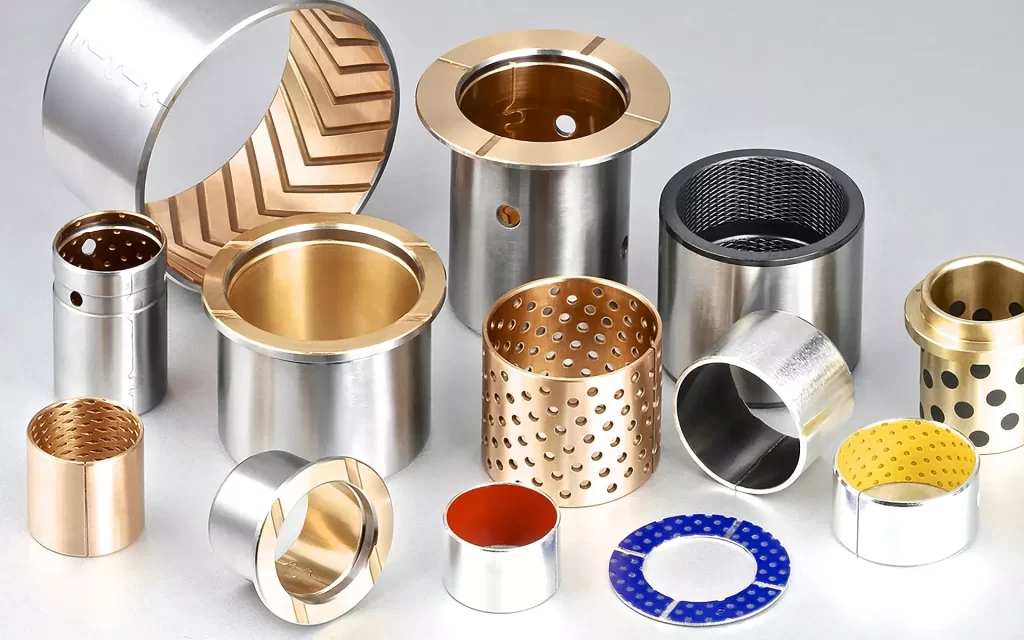
Table of Contents
1. What is a Bushing? (The Simple Breakdown)
At its core, a bushing is a thin-walled tube or sleeve that is inserted into a housing to provide a bearing surface for a rotating or sliding shaft .
Unlike complex rolling element bearings (like ball or roller bearings) that use moving parts to reduce friction, bushings are simpler. They work via a sliding action. The shaft moves across the bushing’s surface, and a film of lubricant—or the bushing material itself—prevents metal-to-metal contact .
Think of it as the sacrificial layer. It’s cheaper and easier to replace a worn-out bushing than to replace an expensive housing or a long, machined shaft .
Bushing vs. Bearing: What’s the Difference?
This is a common point of confusion. Technically, a bushing is a type of bearing (a “plain bearing”). However, the terms aren’t always interchangeable in conversation .
Bearings (ball/roller): Use rolling elements. They are great for high speeds and high precision but can be sensitive to shock loads and contamination .
Bushings (plain/sleeve): Use a sliding surface. They are quieter, better at absorbing vibration, handle shock loads like a champ, and usually take up less space .
If your application involves heavy loads, oscillating motion, or you need to dampen noise, a bushing is often the smarter choice.
2. Key Functions: What Do Bushings Actually Do?
Engineers specify bushings for four main reasons :
Friction Reduction: They provide a low-friction interface between moving parts, reducing energy loss and heat generation.
Vibration Damping: Certain bushing materials (like rubber or polymers) absorb shock and noise, protecting the rest of the machine.
Load Support: They distribute the load from the shaft across a wider surface area on the housing, preventing indentation and wear.
Alignment & Protection: They guide moving parts precisely and protect the housing bore from wear. When the clearance wears out, you just replace the bushing—not the whole assembly.
3. Types of Bushings: A Look at the Variations
Not all bushings are created equal. Depending on how they are built, they fit different roles:
1. Solid Sleeve Bushings
The simplest type: a plain cylinder. It offers the highest load capacity because it has no seams. You’ll see these in heavy machinery where the shaft rotates continuously .
2. Split Bushings
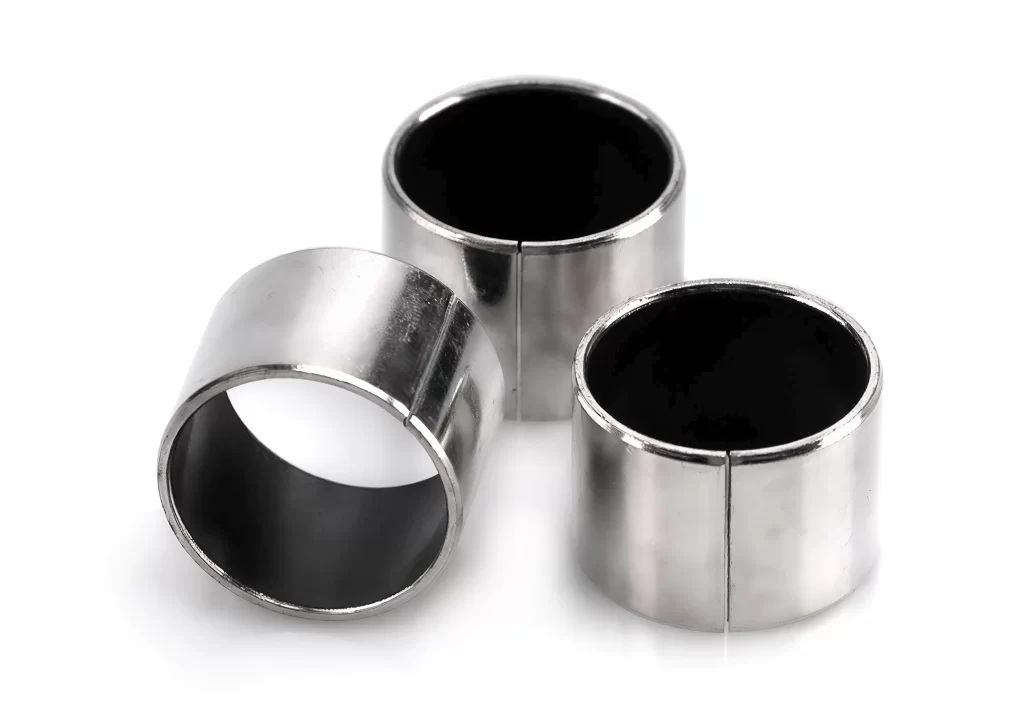
These have a cut along the length (a “butt joint” or “clenched” seam). They are easier to install because you can compress them slightly. They are common in automotive engines and transmissions where space is tight .
3. Flanged Bushings
These have a rim (flange) at one end. The flange acts as a built-in thrust washer, handling loads along the axis of the shaft while the sleeve handles radial loads .
4. Thrust Washers
While technically a flat disc, these are often grouped with bushings. They sit between rotating and stationary surfaces to handle axial loads .
4. The Best Bushing Materials
Choosing the right material is 80% of the battle. Here’s how the options stack up:
Bronze Bushings
This is the gold standard for heavy industry. Bronze bushings (often made from materials like C86300 or CuSn8) offer incredible strength and corrosion resistance .
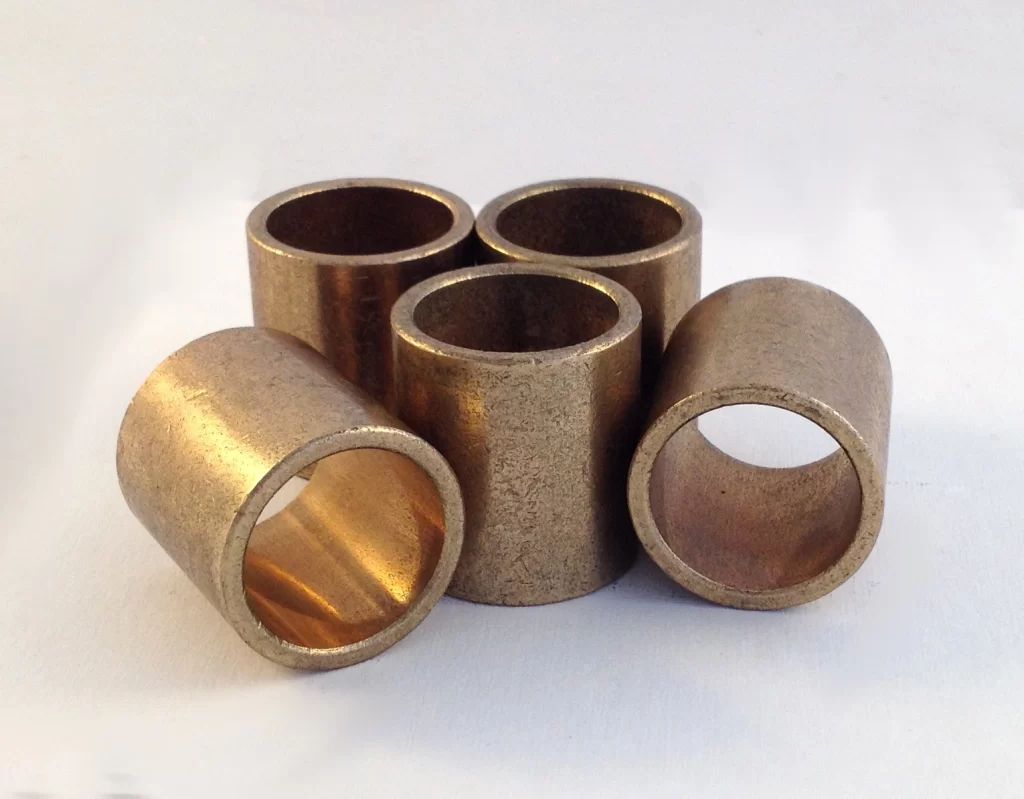
Oil-Impregnated Bronze (Oilite): These are porous. During manufacturing, they are soaked in oil. When the shaft spins, the heat draws the oil out to lubricate the surface. When it stops, the oil gets sucked back in. It’s “self-lubricating” in the truest sense .
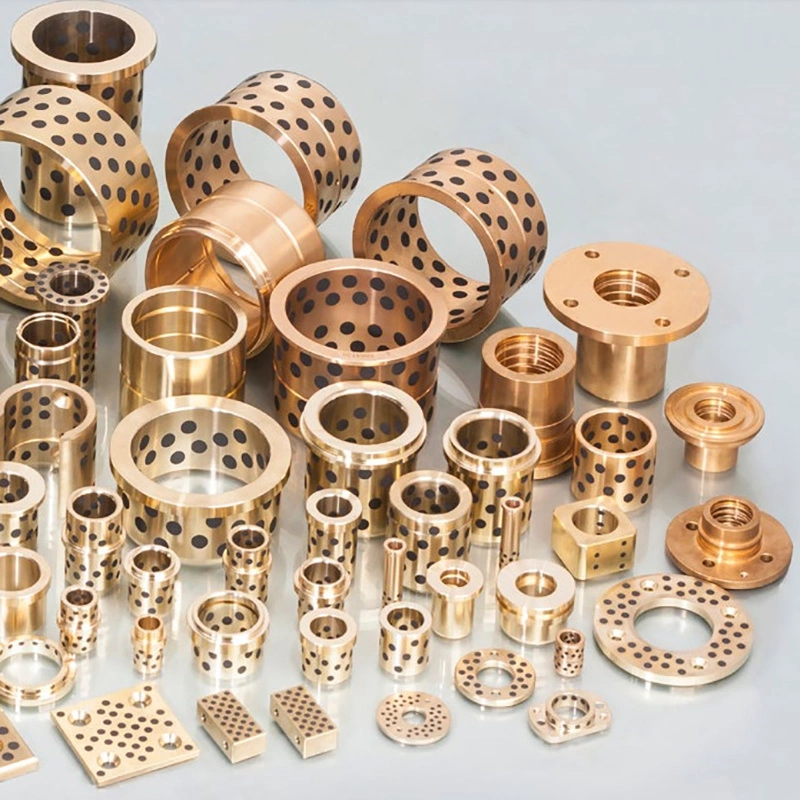
Graphite-Plugged Bronze: For applications where grease or oil will wash away (like in food processing or submerged equipment), bronze bushings with graphite plugs are the answer. The graphite acts as a solid lubricant, providing a maintenance-free solution .
Steel-Backed (Bimetallic) Bushings
These combine a steel shell for structural strength with a thin layer of a bearing material (like bronze or a polymer). They are strong and save on material costs.
Polymer / Plastic Bushings
Materials like Nylon, PTFE (Teflon), or POM. These are lightweight, run dry (no lube needed), and resist chemicals. However, they don’t handle high heat or extreme loads as well as metal .
Babbitt (Tin or Lead Based)
An older but effective material. It’s soft and “conforms” to shaft misalignments, embedding any dirt so it doesn’t score the shaft .
5. Where Are Bushings Used? (Real-World Applications)
Walk through any factory or look under any car, and you’ll find them:
Automotive: Suspension arms, shock absorbers, engine balance shafts, and transmission gears .
Industrial Machinery: Rolling mills (steel production), injection molding machines, pumps, and compressors .
Agriculture: Tractors and harvesters where dust and dirt are prevalent; bronze bushings handle the grit better than precision bearings .
Marine: Propeller shafts and rudders, where bronze’s corrosion resistance is vital .
Construction: Excavators and loaders, where high shock loads are the norm .
6. How to Choose the Right Bushing
If you are sourcing a bearing bush for a project, don’t just grab the cheapest option. Use this checklist:
Load (Pressure): How heavy is the load? Is it constant or intermittent? Bronze handles heavy loads; plastic handles light loads .
Speed (Velocity): How fast is the shaft moving? High speeds require good lubrication or specialized self-lube materials .
PV Value (Pressure x Velocity): This is the magic number. Multiply the pressure (psi) by the speed (fpm). Every material has a maximum PV. Exceed it, and the bushing will fail .
Environment: Is it wet, dusty, or hot? High-temp environments might rule out polymers. Dusty environments favor graphite-plugged bronze because grit won’t stick to dry graphite like it sticks to grease .
7. Frequently Asked Questions (FAQ)
Q: How often should bushings be replaced?
A: It depends on the operating conditions—load, speed, and lubrication quality. In heavy machinery, they are often inspected during scheduled maintenance. Unlike ball bearings that fail catastrophically, bushings usually wear gradually. You replace them when the clearance between the shaft and the bushing exceeds the design tolerance .
Q: What causes bushing failure?
A: The usual suspects are:
Poor Lubrication: The #1 killer. If the oil film breaks down, you get metal-to-metal contact and scoring .
Misalignment: If the shaft is bent or the housing is off, the bushing will wear on one side only .
Contamination: Dirt or grit getting between the shaft and the bushing acts like sandpaper.
Overloading: Exceeding the material’s load capacity.
Q: Can a bushing run without oil?
A: Yes, if it is designed to. Self-lubricating bushings made from porous bronze (impregnated with oil) or those with graphite plugs can run without external oilers. PTFE-lined bushings also provide dry lubrication .
Engineered for Extremes: Why Engineers Choose MYWAY Bushings
Understanding the theory is one thing, but sourcing a bushing that actually survives in the field is another. That’s where MYWAY Bushing comes in.
With over 20 years of experience and a 35,000-square-meter manufacturing facility in China, MYWAY isn’t just a parts supplier; they are engineering partners to some of the world’s most demanding industries .
The MYWAY Difference
When you specify a bronze bushing from MYWAY, you aren’t just getting a piece of metal. You are getting a component born from a vertically integrated process:
In-House Casting & Sintering: Unlike many brands that outsource raw materials, MYWAY controls the process from the melt. They operate horizontal continuous casting lines (20,000-ton capacity) and sintering lines, ensuring the metallurgy is perfect before machining even begins .
Precision Engineering: They hold tight tolerances. With a 400-strong workforce and over 2,000 precision molds, they produce standard bushings and highly complex custom parts for industries ranging from steel metallurgy to new energy vehicles (NEVs) .
Proven in the Trenches: MYWAY bushings aren’t tested in a lab and then forgotten. They are currently powering heavy equipment in the metallurgy industry for giants like China First Heavy Industries (CFHI). Think cold rolling mills, coke ovens, and aluminum extrusion presses. These are applications where downtime costs a fortune, and failure is simply not an option .
High-Performance Solutions for Modern Challenges
Whether you need a graphite-plugged bronze bushing for a high-temperature furnace application, a bimetallic bearing for a hydraulic pump, or a PTFE-coated component for maintenance-free operation, MYWAY has the range .
They are certified to IATF 16949 and ISO 9001, serving over 40 countries. Their automated warehouse holds a massive inventory of standard parts, ensuring that if you need a bushing fast, you don’t have to wait weeks for a production run .
Ready to Spec a Bushing That Won’t Let You Down?
Don’t let a cheap, off-the-shelf bushing be the reason your machinery grinds to a halt.
Whether you need help calculating the PV value for your application, require a custom drawing for a non-standard part, or just want to stock up on reliable standard stock bushings, the team at MYWAY is ready to help.
100000+ Types of Bushings – Contact Us for Details