
Recent Posts
Why Heavy-Duty Applications Rely on Spherical Plain Bearings: Self-Lubricating, Maintenance-Free, and Built to Last
If you work with construction machinery, mining equipment, marine systems, or even hydropower infrastructure, you already know this truth: the joints wear out first.
Cylinder clevises. Hydraulic pivots. Gate hinges. Swing linkages.
These are the spots where misalignment happens, where shock loads hit hardest, and where maintenance access is usually a nightmare.
That’s why spherical plain bearings exist. And if you’re sourcing them for demanding applications—especially in industries like mining, oil & gas, or heavy fabrication—you need to know what separates a bearing that survives from one that fails in six months.
Let’s walk through the real engineering behind these components, the material choices that actually matter, and why MYWAY bronze-based spherical plain bearings are gaining traction among maintenance professionals who are tired of premature wear and lubrication headaches.
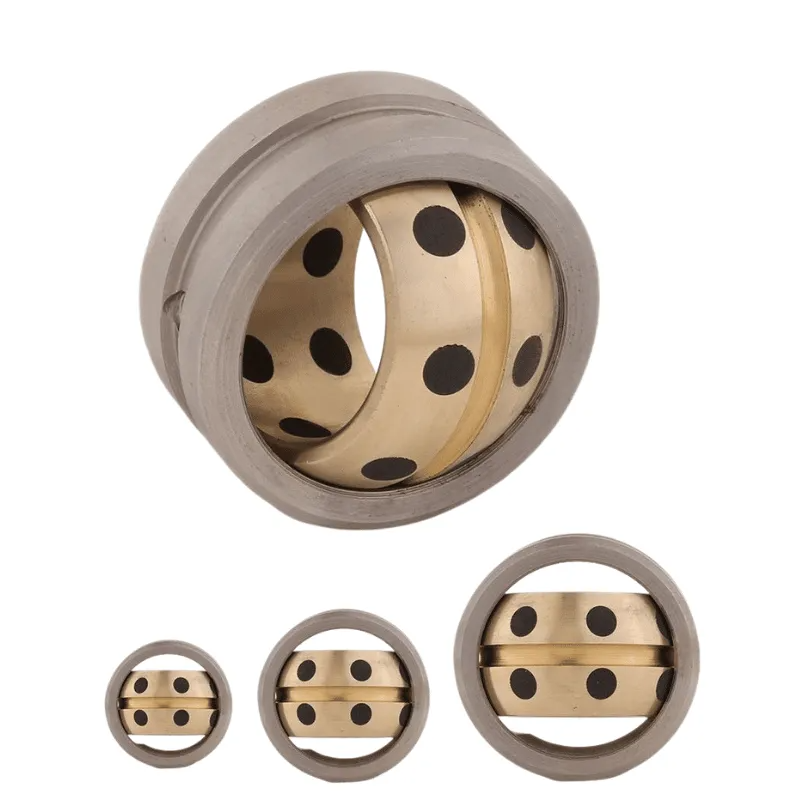
Table of Contents
1. What Exactly Is a Spherical Plain Bearing? (And Why “Plain” Doesn’t Mean “Simple”)
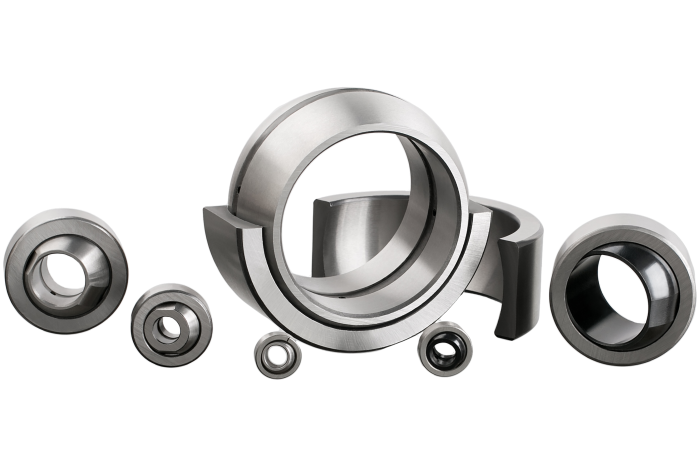
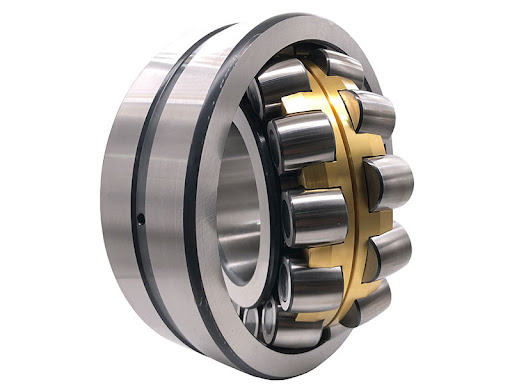
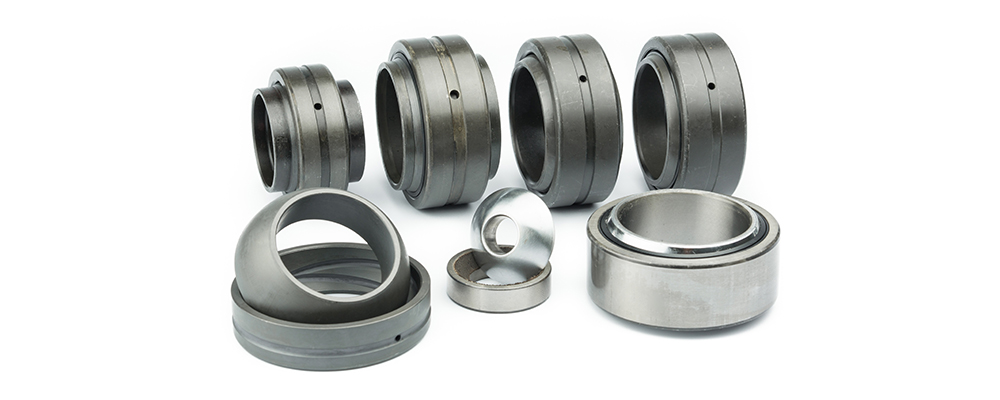
A spherical plain bearing is not a rolling element bearing. There are no balls, no rollers, no cages.
Instead, it consists of two rings:
An inner ring with a spherical convex outer surface
An outer ring with a matching spherical concave inner surface
This ball-and-socket design allows angular misalignment and oscillating movement in multiple directions. Unlike conventional bearings that require perfect alignment, spherical plain bearings self-align under load .
They are classified into three main types based on load direction :
| Type | Load Direction | Typical Use Case |
|---|---|---|
| Radial | Primarily radial loads | Cylinder pivots, linkage systems |
| Angular contact | Combined radial & axial | Suspension, gearbox mounts |
| Thrust | Primarily axial | Dam gates, press applications |
Why this matters to you: If your equipment experiences shaft deflection, housing misalignment, or multi-directional forces, spherical plain bearings are not optional—they are the only solution that won’t bind or edge-load.
2. High-Load Capacity: Not All Bearings Are Created Equal
One of the most frequent questions we hear:
“Can spherical plain bearings really handle high-load applications?”
Short answer: Yes. Absolutely. But it depends entirely on material and design.
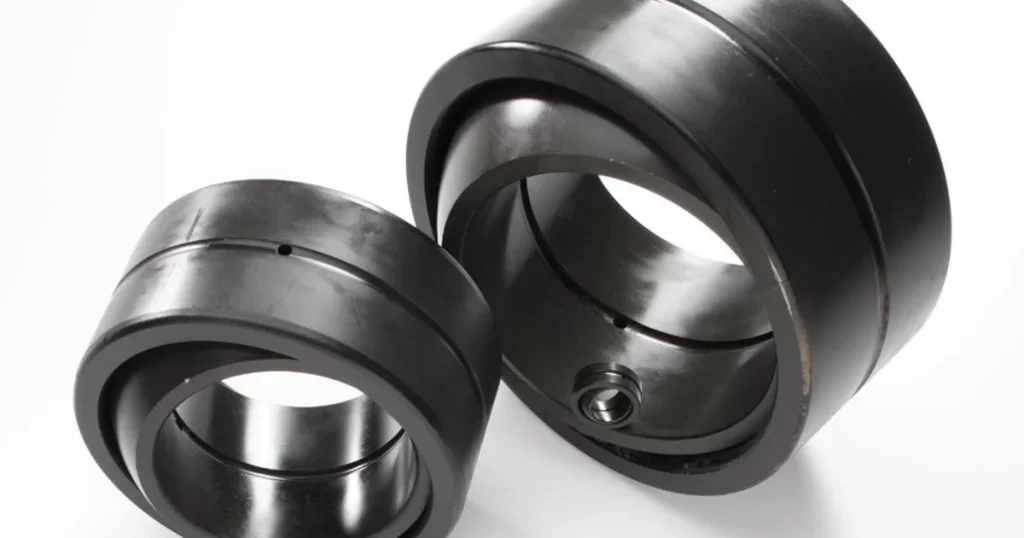
High-carbon chromium bearing steel (like GCr15 or SUJ2) is the standard for inner and outer rings in heavy-duty series. Through-hardened and precision-ground, these rings provide the compressive strength needed for static loads up to 250–350 N/mm² in some configurations .
However—and this is critical—steel-on-steel bearings require lubrication. Without it, friction coefficients spike, galling occurs, and service life collapses.
That’s why maintenance-free spherical plain bearings have become the dominant choice for modern equipment designers. Instead of relying on grease films that squeeze out under load, these bearings incorporate solid lubricants or PTFE-based sliding layers directly into the interface .
DIN ISO 12240-1, -2, -3 standardizes the dimensions and tolerance classes, but the sliding contact material is what determines real-world performance .
3. Self-Lubricating Technologies: PTFE Fabric, Bronze + Graphite, and the “Maintenance-Free” Promise
Let’s separate hype from hardware.
There are two dominant approaches to maintenance-free spherical plain bearings:
A. PTFE Fabric / Composite Liners
Used by manufacturers like Schaeffler (ELGOGLIDE®) and DURBAL (DURBAL-Glide®).
A woven PTFE fabric is bonded to the outer ring’s spherical surface. The inner ring (hard chrome plated or stainless steel) slides against this fabric.
Pros: Extremely low friction, no lubrication needed, excellent for continuous oscillation.
Cons: Limited load capacity compared to bronze-backed designs; susceptible to edge wear if misalignment exceeds design limits .
B. Bronze-Backed Solid Lubricant Inserts
This is where CuSn12 bronze + graphite plugs enter the picture.
A high-strength tin bronze (CuSn12) serves as the bearing backing. Holes or recesses are machined into the sliding surface and filled with solid lubricant plugs—typically graphite, PTFE, or a hybrid. As the bearing oscillates, the plugs transfer a microscopic lubricant film onto the shaft or inner ring surface .
Why engineers choose this route:
Higher static/dynamic load ratings (CuSn12: up to 180 MPa static)
Forgiving under shock loads and edge loading
Works in dirty environments where grease would attract abrasives
No risk of lubricant starvation—the lubricant is literally part of the structure
This is exactly the construction used in OILES#500 series, COB M055, and JDBS spherical plain bearings—and it’s the same architecture MYWAY has refined for heavy industrial applications.
4. Where Do You Actually See These Bearings in Action?
Let’s move beyond theory. Here are real applications where spherical plain bearings are mission-critical:
Construction & Mining
Excavator boom pivots, hydraulic cylinder clevises, swing gear linkages.
Load profile: High impact, low-speed oscillation, frequent contamination.
Why MYWAY bronze-graphite works: The graphite plugs constantly replenish the transfer film; dirt embeds into the softer bronze without scoring the shaft .
Marine & Offshore
Rudder carriers, hatch covers, dam gates.
Load profile: Single-direction static loads, corrosion risk, nearly impossible to relubricate.
Real-world case: The Tra Khuc River Dam in Vietnam uses maintenance-free spherical plain bearings to support 19 radial gates under high water pressure. Zero lubrication, years of service .
Hydraulic Systems & Industrial Machinery
Pump linkages, injection molding machines, continuous casters.
Load profile: Alternating loads, limited swing angles.
Why this matters: In many hydraulic systems, the bearing operates in boundary lubrication mode—exactly where solid lubricant inserts outperform grease-dependent designs .
Agriculture & Forestry
Harvester joints, tractor suspension links.
Load profile: Dirt, moisture, intermittent operation.
Cost reality: Maintenance access is expensive. A self-lubricating bearing that lasts the season is worth far more than its purchase price.
5. How Solid Lubricant Inserts Actually Work (The Tribology Bit)
If you’ve ever been told “graphite plugs just rub off onto the shaft,” that’s not quite accurate.
Here’s what actually happens at the microscopic level:
During initial run-in, the bronze surface and the shaft establish contact.
Graphite or PTFE plugs are slightly recessed (or designed to wear preferentially).
Under load and motion, the solid lubricant shears, transferring an adherent film onto the mating surface.
This film stays in the contact zone—it doesn’t squeeze out like oil. Even under extreme pressure, the lubricant is physically present .
This mechanism enables:
Stick-slip elimination
Low, stable friction coefficient (0.02–0.25 dry)
Operation in reciprocating, rotating, and oscillating modes
The catch: Not all bronze is created equal. CuSn12 offers the ideal balance of hardness (min. 90 HB) and embeddability. Softer bronzes deform under heavy load; harder materials fail to embed debris .
6. Installation Realities: What Works vs. What Causes Early Failure
We’ve seen too many spherical plain bearings fail prematurely—not because the bearing was bad, but because installation basics were ignored.
Here’s what the OEMs and experienced fitters know :
The bronze bushing should NOT spin.
It is press-fit into the outer ring. If it rotates, the interference fit has failed, and the bearing must be replaced.
The bearing should NOT rotate within the housing.
Housing fit should be tight enough to prevent creep. Use recommended tolerances (typically M7 or N7 for steel housings).
Initial alignment trick:
Mount the shaft, tighten fasteners loosely, then tap the assembly with a rubber mallet. This allows the spherical bearing to self-align before final torque .
If it’s maintenance-free, DON’T lubricate it.
Sounds obvious—but we’ve seen crews hit PTFE-lined bearings with grease guns “just to be safe.” This destroys the sliding layer’s transfer film and drastically shortens life .
For bronze-graphite bearings:
Shaft finish matters. Target Ra 0.3–0.5 µm. Too smooth and the transfer film won’t anchor; too rough and you’ll wear the bronze prematurely .
7. The Standards Landscape (And Why You Should Care)
If you’ve ever tried to cross-reference a “GE50-UK-2RS” from one manufacturer to another, you know the frustration.
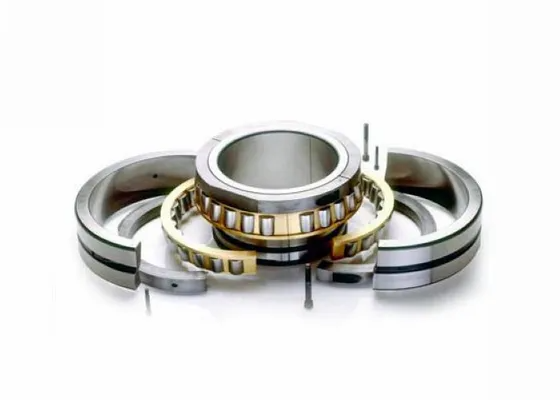
DIN ISO 12240-1 covers radial spherical plain bearings.
DIN ISO 12240-2 covers angular contact.
DIN ISO 12240-3 covers thrust .
Here’s the catch: The standard defines boundary dimensions and tolerances, but NOT load ratings or service life calculations. That’s why a “GE50” from Brand A and Brand B may fit the same housing but fail at wildly different load cycles .
What’s changing:
A new ISO standard (ISO/NP 25994) is under development, specifically for PTFE fabric liner type self-lubricating spherical plain bearings. It aims to standardize wear life evaluation and acceptance criteria. But for bronze + solid lubricant designs, there is still no unified global rating system .
Practical advice: Don’t buy on part number alone. Buy based on proven material systems and supplier traceability.
8. Why MYWAY? (Yes, This Is the Transition)
You’ve read the engineering. You’ve seen the applications. Now let’s talk about who actually delivers this consistently.
MYWAY specializes in bronze-based spherical plain bearings and bushings with solid lubricant inserts—engineered specifically for:
🔹 Heavy static/dynamic loads (CuSn12, CuAl10Ni, CuZn25Al5 available)
🔹 Maintenance-free or reduced-lubrication operation
🔹 ISO 12240-compliant dimensions or custom configurations
🔹 Harsh environments: corrosion, immersion, temperature extremes, abrasive contamination
What sets MYWAY apart:
In-house metallurgical control: We don’t buy generic bronze stock and machine it. Our CuSn12 alloy is formulated for optimal graphite bonding and mechanical strength.
Precision machining: Graphite plug placement isn’t random. Plug diameter, depth, and pattern are engineered for continuous film transfer, not just decoration.
Application engineering support: Tell us the load, angle, frequency, and environment. We’ll recommend the specific bronze alloy, lubricant type, and clearance class. No guesswork.
Frequently Asked Questions (FAQ)
Q1: What’s the difference between “maintenance-free” and “self-lubricating”?
A: They’re often used interchangeably, but technically:
Self-lubricating means the bearing contains solid lubricant (graphite, PTFE) that transfers to the shaft.
Maintenance-free means no external relubrication is required during service life.
Most bronze-graphite bearings are both .
Q2: Can I use a bronze-graphite spherical plain bearing underwater?
A: Yes—graphite is chemically stable in fresh and salt water. Unlike grease, it won’t wash out. This is a common solution for marine rudders, dam gates, and submerged excavator components .
Q3: My application has very small oscillation angles (<5°). Will the lubricant film still form?
A: Small angles are harder on self-lubricating bearings because the same surface area is repeatedly contacted. However, bronze-graphite handles this better than PTFE fabric because the graphite plugs continuously replenish the film. We recommend consulting with our engineers for low-angle, high-load cases .
Q4: How do I know if I need a radial, angular contact, or thrust type?
A:
Radial (E, G series) : Load is mostly perpendicular to the shaft.
Angular contact (SW series) : Significant axial load in addition to radial.
Thrust (AW series) : Load is along the shaft axis.
If you’re unsure, send us your housing and shaft details. We’ll model the load vector .
Q5: Do you offer stainless steel versions?
A: Yes. For corrosive environments, we offer inner rings in AISI 440C or 316L, with bronze outer rings or alloy steel with Durotect-style chrome plating. Custom options available .
Q6: What’s your typical lead time?
A: For standard sizes (JDBS-015 through JDBS-100 equivalents): 10–15 working days.
For custom dimensions or special alloys: 3–4 weeks, depending on complexity.
Q7: Can you provide material certifications?
A: Absolutely. Every batch of CuSn12 is spectrographically tested. Graphite purity is certified. Full traceability is standard.
100000+ Types of Bushings – Contact Us for Details