
Recent Posts
Flanged Sleeve Bearings: Durable, Maintenance-Free Machine Performance
In the world of machinery, where every moving part counts, a simple yet revolutionary component is redefining reliability: the flanged sleeve bearing. More than just a spacer, this clever bearing is a cornerstone for efficient design, offering unmatched durability and maintenance-free operation in the harshest conditions. This article delves into what makes flanged sleeve bearings indispensable, explores advanced materials like PTFE, and reveals how MYWAY’s engineering provides superior solutions for your toughest challenges.
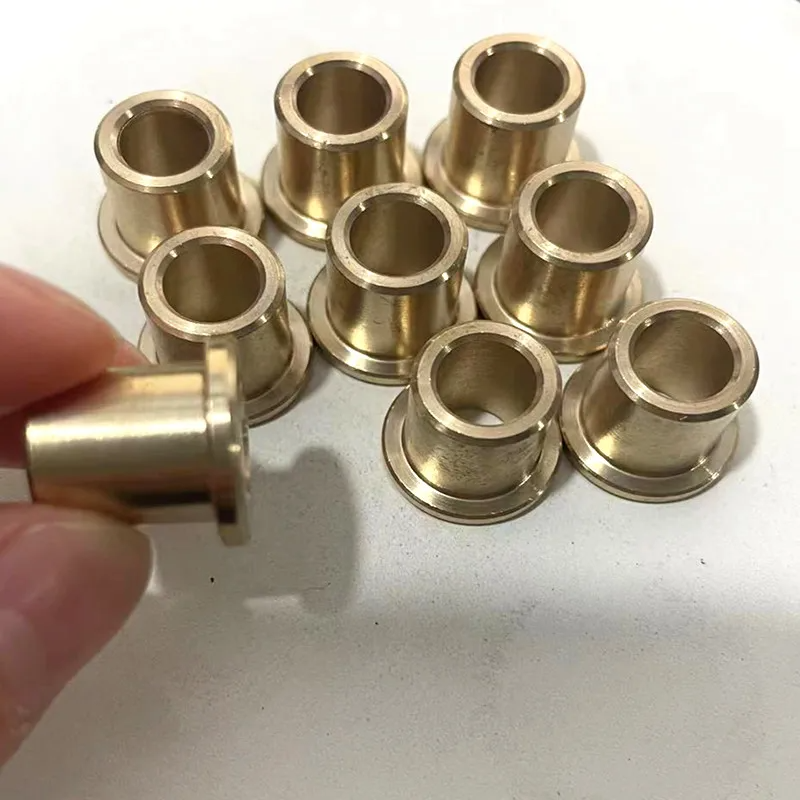
Table of Contents
1. Understanding the Flanged Sleeve Bearing: A Simple Design with a Critical Job
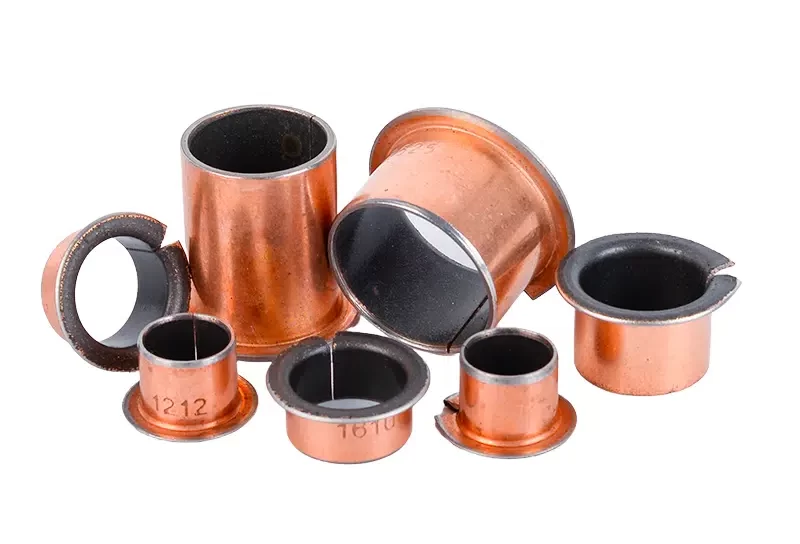
At its core, a flanged sleeve bearing—also commonly called a flanged bushing, shoulder bushing, or collared bushing—is a type of plain bearing or sliding bearing. Its defining feature is a flange (a protruding collar) at one or both ends of a cylindrical sleeve.
The brilliance of this design lies in its dual functionality:
The Sleeve (Bore): Manages radial loads, supporting the shaft and facilitating smooth rotational or oscillating movement with minimal friction.
The Flange (Collar): Handles axial (thrust) loads, preventing the shaft from moving sideways. It also acts as a positive locator during assembly, simplifying installation and ensuring precise positioning within a housing.
This combination makes it an incredibly versatile component, adept at supporting loads from all directions in a compact, single-unit design.
2. Design Types and Material Innovations: Choosing the Right Bearing for the Job
Flanged sleeve bearings come in various configurations and materials, each tailored to specific performance needs.
Common Design Types
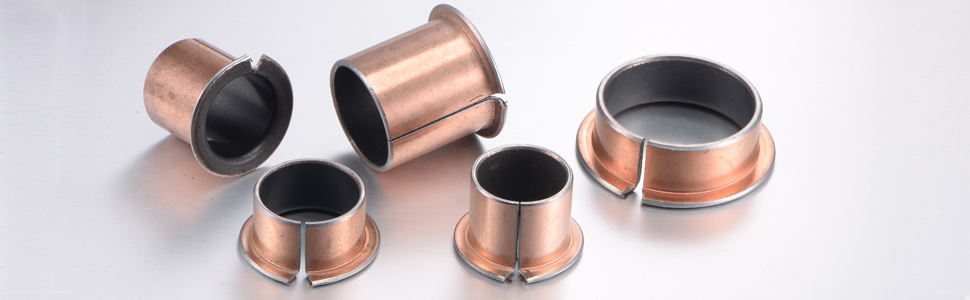
Single-Flange vs. Double-Flange: A single flange provides axial location from one side, while double-flanged bearings secure the component from both ends.
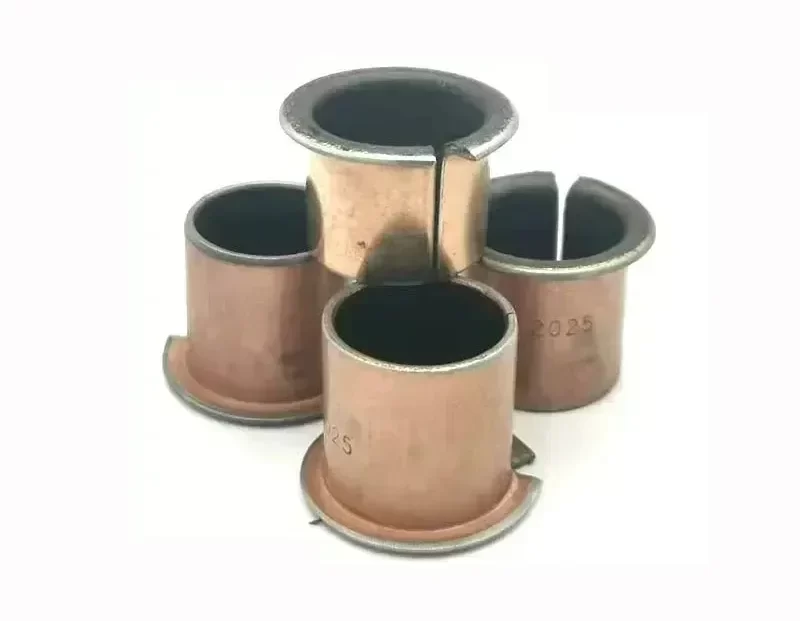
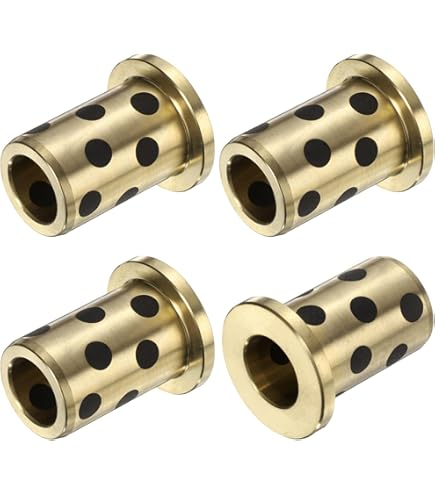
Wrapped Construction vs. Solid: Many high-performance bearings use a wrapped steel backing for strength, lined with a specialized sliding layer. Solid bearings, often made from cast bronze or polymers, are used for different load and speed requirements.
Advanced Material Technology
The quest for efficiency has driven material science forward, moving beyond traditional oiled bronze to advanced self-lubricating composites.
The PTFE Revolution: Polytetrafluoroethylene (PTFE) liners are a game-changer. This material offers one of the lowest coefficients of friction known, promoting smooth operation and wear resistance without external grease or oil. Its benefits extend to a wide operating temperature range (from as low as -65°F to over +325°F) and excellent chemical resistance.
Metal-Polymer Composites: These are the industry standard for high-performance applications. They typically feature:
A steel backing for high load-bearing capacity and structural rigidity.
A porous bronze sintered layer bonded to the steel, providing excellent heat dissipation and a secure anchor for the top layer.
A PTFE-based sliding layer impregnated with additives like lead or carbon for optimal friction performance and the formation of a protective transfer film on the shaft.
Fiber-Reinforced Polymers (FRP): For applications requiring compatibility with composite structures or where extreme corrosion resistance is needed, fiber-reinforced plastic bearings offer a lightweight, robust alternative.
3. Why Flanged Sleeve Bearings are the Superior Choice: Core Advantages
Adopting modern flanged sleeve bearings translates into direct operational benefits:
Maintenance-Free & Self-Lubricating: The integrated solid lubricants in the sliding layer ensure consistent performance, eliminating the cost, downtime, and environmental concerns of regular re-lubrication. This makes them ideal for sealed-for-life applications or hard-to-reach locations.
Exceptional Wear Resistance & Long Life: Advanced material combinations are engineered to withstand abrasive particles, dust, and dirt. This wear-resistant quality ensures extended service life, even in contaminated environments like construction or agriculture.
High Load Capacity in a Compact Design: The combination of a sturdy metal backing and an efficient sliding surface allows these bearings to sustain significant radial and axial loads, often outperforming larger, more complex bearing arrangements.
Corrosion & Contamination Resistance: Materials like PTFE and certain composite backings are inherently resistant to water, chemicals, and corrosion. Their dry-running nature also means they don’t attract grime that can degrade performance.
Cost-Effectiveness: When considering total cost of ownership—including purchase price, installation, maintenance, and downtime—the reliability and longevity of a quality flanged sleeve bearing make it an exceptionally economical choice.
4. Innovation at MYWAY: Engineering Solutions Beyond the Standard
At MYWAY, we understand that superior performance requires more than just meeting a standard spec. Our DU/SF-1 series of self-lubricating flanged bearings are engineered to address the real-world shortcomings of conventional products.
Solving Traditional Manufacturing Flaws
A key challenge in manufacturing bimetal flanged bearings (steel back with a copper alloy lining) is flange cracking during the forming process. Traditional methods, like welding a separate flange or flanging without precise control, can cause micro-fractures in the critical bearing lining, leading to premature failure.
MYWAY’s advanced manufacturing process overcomes this. By utilizing precision-controlled tooling and proprietary techniques, we ensure the integrity of the copper sintered layer and the overlying PTFE mixture is maintained throughout the flange formation. This results in a perfectly homogeneous bearing surface with no weak points, guaranteeing the promised load capacity and service life.
The MYWAY DU/SF-1 Material Advantage
Our flagship material is a testament to precision engineering:
Top Layer (0.01-0.03mm): A modified PTFE and Pb (lead) mixture that creates a low-friction transfer film on the shaft for smooth, protective operation.
Intermediate Layer (0.20-0.30mm): A copper powder sinter that provides exceptional bonding strength, high thermal conductivity to dissipate heat, and enhanced load-carrying capacity.
Backing Layer (0.70-2.30mm): A high-strength copper substrate (or steel, based on application) that offers robust structural support, excellent corrosion resistance, and further thermal management.
This tri-layer structure is manufactured using tungsten steel precision molds and automated sintering furnaces, ensuring dimensional accuracy and consistent, high-quality output for every single bushing, whether for a standard metric size or a custom imperial dimension.
5. Industry Applications: Where Reliability Cannot Be Compromised
The robustness of MYWAY’s flanged sleeve bearings makes them the go-to choice for demanding sectors:
Construction & Heavy Machinery: Excavators, loaders, and cranes rely on them for pivot points, boom connections, and cylinder joints where high shock loads and contamination are constant.
Automotive & Transportation: Used in suspension linkages, brake systems, and gear assemblies, benefiting from their maintenance-free life and vibration damping.
Agricultural Equipment: Plows, harvesters, and tractors operate in dusty, high-moisture environments where our bearings’ dirt and corrosion resistance ensures uptime.
General Industrial Machinery: Conveyors, printing presses, and hydraulic systems leverage their long service life and ability to run without lubrication.
Frequently Asked Questions (FAQ)
| Question | Answer |
|---|---|
| What’s the difference between a flanged sleeve bearing and a plain bushing? | The key difference is the integral flange. A plain bushing only handles radial loads. The flange on a sleeve bearing allows it to also manage axial (thrust) loads and provides positive location during assembly. |
| Are these bearings truly maintenance-free? | Yes, high-quality self-lubricating bearings like MYWAY’s DU/SF-1 series are designed for maintenance-free operation. The PTFE-based sliding layer provides lubrication for the entire service life, eliminating the need for re-greasing. |
| Can they handle both high loads and high speeds? | They excel in high-load, low-to-moderate speed applications. For very high-speed shafts, dynamic lubrication (oil or grease) might be more suitable. Consult our engineers for your specific speed and load parameters. |
| How do I select the right size and material? | Selection depends on shaft diameter, housing bore, load type (radial/axial), speed, temperature, and operating environment. We offer both standard metric and imperial sizes, as well as full custom manufacturing to your drawings. |
| Why choose MYWAY over other suppliers? | MYWAY combines advanced material technology (like our proprietary DU/SF-1 composite) with precision manufacturing processes that prevent common flaws like flange cracking. We offer not just a part, but a reliable, engineered solution backed by technical support and custom capabilities. |
100000+ Types of Bushings – Contact Us for Details