
Recent Posts
Bronze Bushings for High-Load Industrial Joints: Materials, Design Logic, and Selection That Actually Holds Up
Introduction
High-load industrial joints — the pivot points on excavators, the slew rings on cranes, the articulation hinges on motor graders — live and die by their bushings. When a bronze bushing fails, the whole machine goes down, and the repair bill rarely stops at the bushing itself. This article cuts through the marketing noise and walks through what actually matters: which bronze alloy fits which load profile, how the PV factor drives real-world performance limits, why self-lubricating graphite-plugged designs outperform conventional lubricated bushings in oscillating joints, and what to check before you place a bulk order. Whether you’re an OEM engineer specifying a new joint or a maintenance manager tired of premature bushing failures, the material here is drawn from industry data, supplier specifications, and field experience.
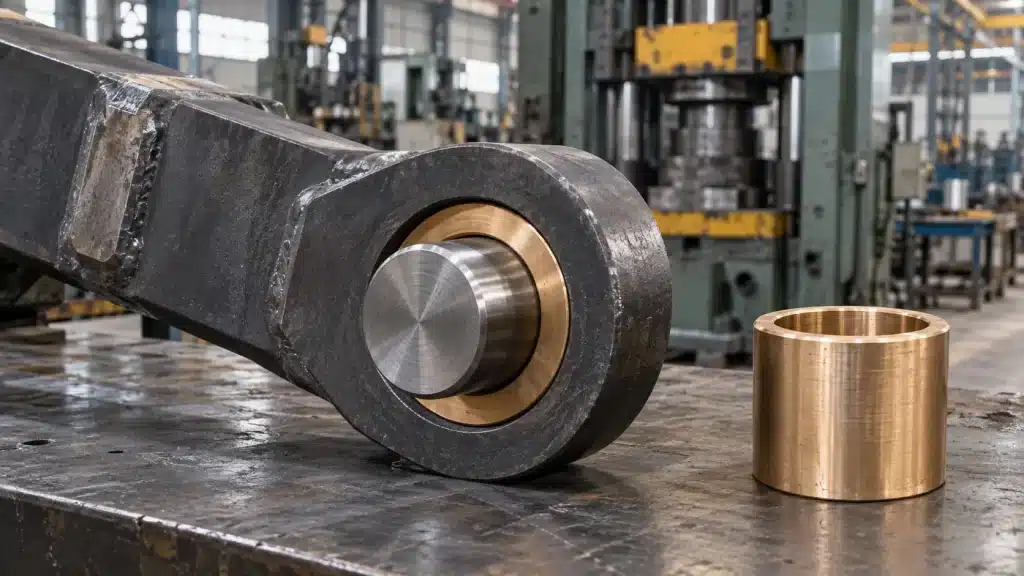
Table of Contents
1. Why Bronze Still Dominates High-Load Joints
Walk through any heavy equipment yard and you’ll find bronze bushings in the same places they’ve been for decades: boom pivots, bucket pins, steering knuckles, slew ring seats. There’s a reason nobody replaced them with steel or polymer in most of these positions.
Bronze sits in a sweet spot. It’s softer than the hardened steel shaft it protects, so it wears first — by design. A $30 bronze bushing sacrificing itself to save a $3,000 machined shaft is one of the better deals in industrial maintenance. But that’s only half the story. Bronze also has natural anti-friction properties that steel lacks, which matters enormously when you’re dealing with oscillating motion that never quite builds a full hydrodynamic oil film.
Steel bushings, by contrast, tend to seize or generate abnormal noise in construction machine joints under the same conditions. When you’re looking at a crane boom pivot that rocks back and forth under load all day, seizure isn’t just inconvenient — it’s a safety issue–.
The catch is that “bronze” covers a wide family of alloys, and picking the wrong grade is the most common reason bushings fail early. More on that in the next section.
2. Bronze Alloy Selection: The Four Grades That Matter Most
2.1 C93200 (SAE 660) — The Workhorse
If you had to pick one bearing bronze and stick with it for everything, C93200 would be the reasonable choice. It’s a leaded tin bronze with a composition of roughly 83% copper, 7% tin, 7% lead, and 3% zinc. The lead content gives it that slippery, self-lubricating quality that makes it forgiving in start-stop and oscillating applications where oil films struggle to form.
Mechanically, C93200 delivers a tensile strength around 35,000 psi (240–310 MPa), yield strength of about 20,000 psi, and a Brinell hardness in the 60–90 HB range. Its maximum PV factor sits around 75,000 (with periodic oil lubrication), and it handles continuous operating temperatures from -450°F to +450°F.
Where C93200 shines: general industrial bushings, pump components, moderate-to-heavy load pivots, and anything where machinability and cost matter. Where it doesn’t: severe shock loading, high-impact applications, or extreme abrasive environments where the lead phase can wear preferentially.
2.2 C95400 — Aluminum Bronze for Heavier Duty
When loads climb and shock enters the picture, aluminum bronze takes over. C95400 (CuAl11Fe4) brings tensile strength up to roughly 85,000 psi — more than double C93200 — with significantly better fatigue resistance and wear performance under high-load, low-speed conditions.
The trade-off is real. C95400 is harder to machine (it work-hardens), requires a harder mating shaft (typically 300+ HB), and costs more per kilogram. But in excavator boom cylinder base-end bushings, crane sheave bushings, and similar high-stress pivot points, the service life advantage typically justifies the premium. Industry data shows aluminum bronze bushings handling dynamic loads up to 100 N/mm² in grease-lubricated oscillating joints–.
C95400 also offers excellent corrosion resistance in marine and chemical environments, which makes it a go-to for offshore and port equipment. For applications requiring even more strength, C95500 (nickel aluminum bronze) pushes tensile strength past 90 ksi with additional corrosion protection from the nickel content.
2.3 C86300 — Manganese Bronze for Extreme Loads
This is the heavyweight. C86300 manganese bronze hits tensile strengths in the 110,000 psi range, with Brinell hardness around 210 HB and yield strength exceeding 414 N/mm². It’s specified for applications where nothing else survives: bridge structural pivots, massive crane slewing rings, and high-shock mining equipment joints.
Self-lubricating C86300 bushings with graphite plugs are rated for static loads up to 400 N/mm² and dynamic loads up to 250 N/mm², albeit at limited sliding speeds (0.5 m/s max). The extreme hardness comes with machining challenges and a requirement for correspondingly hard shafts, but when you’re dealing with 8,000 psi bearing pressure, C86300 is often the only bronze that won’t deform.
2.4 C54400 — Phosphor Bronze for Fatigue Resistance
Phosphor bronze (C54400) occupies a niche where fatigue resistance and dimensional stability matter more than raw load capacity. With roughly 40,000 psi tensile strength and a maximum recommended load around 3,500 psi, it’s not the choice for brutal impact service. But in precision machinery, hydraulic cylinder bushings, and applications involving continuous reciprocating motion, phosphor bronze’s resistance to fatigue cracking and its excellent wear characteristics make it a solid performer.
3. The PV Factor: How to Know If Your Bushing Will Survive
3.1 The Basic Calculation
The single most useful design check for any bronze bushing is the PV factor — Pressure times Velocity. Get this number right and you avoid 80% of premature failures. Get it wrong and no alloy upgrade will save you.
Pressure (P) = Load (lbs or N) ÷ (Bushing ID × Bushing Length) — expressed in psi or N/mm².
Velocity (V) = π × Shaft Diameter × RPM ÷ 12 — expressed in surface feet per minute (SFM) or m/s.
PV = P × V. This product represents the heat generation rate per unit of projected bearing area.
3.2 What the Numbers Mean in Practice
For C93200 with grease lubrication, keep the operating PV below 50,000 (imperial units). With periodic oil lubrication, you can push toward 75,000. Exceed the limit and friction heat builds faster than the bushing can dissipate it, leading to lubricant breakdown, metal-to-metal contact, and seizure.
For self-lubricating C86300 with graphite inserts, the maximum PV drops to around 1.5 MPa·m/s because the graphite plugs can only transfer so much solid lubricant to the shaft surface at any given speed. But the permissible static load is enormous — up to 400 N/mm² — because static load doesn’t generate friction heat.
This is why graphite-plugged bronze bushings dominate high-load, low-speed, oscillating applications. The load is high but the velocity is low, so PV stays manageable while the graphite plugs eliminate the need for regular greasing.
3.3 When PV Isn’t the Whole Story
PV calculations assume uniform load distribution across the bushing face. In reality, misaligned joints concentrate load at the bushing edges, creating local pressures 2–3× higher than the calculated average. This is why edge wear is one of the most common failure modes in heavy equipment bushings — the material spec was fine, but the alignment wasn’t.
Shock loads are another blind spot. A hydraulic excavator bucket hitting rock generates instantaneous pressure spikes that can be 5–10× the steady-state load. C93200 might handle the steady-state condition comfortably but crack under the shock. This is where C95400 or C86300 earns its keep.
4. Self-Lubricating Bronze Bushings: When Maintenance Isn't an Option
4.1 Graphite-Plugged Design
The graphite-plugged bronze bushing is one of those engineering solutions that’s almost too elegant. Take a high-strength bronze body — typically aluminum bronze or manganese bronze — machine holes or grooves into the sliding surface, and press-fit solid graphite plugs into them. The graphite acts as a continuous solid lubricant, transferring a thin film to the mating shaft with every movement.
What makes this work so well in high-load joints is that the lubrication mechanism doesn’t depend on speed. Conventional oil or grease lubrication needs relative motion to distribute the lubricant; in oscillating joints that barely move a few degrees per cycle, the oil film never establishes properly. Graphite transfers through direct contact pressure, so even a 2° oscillation feeds lubricant to the contact zone–.
4.2 Where Self-Lubricating Bushings Win
The application sweet spot is narrow but deep: high load, low speed, oscillating or reciprocating motion, and difficult maintenance access. Think excavator bucket pins that can’t be greased daily because the machine runs 20-hour shifts in remote locations. Think crane boom pivots that are 15 meters in the air. Think offshore platform joints where sending a technician with a grease gun costs more than the bushing itself.
GGB’s graphite-insert bronze bushings, for example, are rated for maintenance-free operation with static load capacity up to 400 N/mm² and dynamic capacity up to 250 N/mm² in these exact conditions. Operating temperatures range from cryogenic to +300°C depending on the solid lubricant formulation, and the bushings perform in water, oil, or grease environments without modification.
4.3 The Limitations You Should Know
Self-lubricating bushings aren’t magic. The graphite transfer film is thin, so shaft surface finish matters more than in lubricated applications — typically Ra ≤ 0.8 μm is recommended. Contamination with fine abrasives (sand, grinding dust) can disrupt the graphite film and accelerate wear. And continuous rotation at high speed will exhaust the graphite supply faster than the design intends.
For full-rotation applications above 1 m/s surface speed, conventional lubricated bronze bushings typically outperform graphite-plugged designs on both life and cost.
5. Matching Bronze Bushings to Real Industrial Joints
5.1 Construction Equipment
Motor grader articulation joints are a textbook case. The articulation hinge carries both radial load and tilting moment as the machine steers, and it oscillates through a limited angle rather than rotating continuously. XCMG’s OEM bushings for these positions (part numbers like 273100563) are machined from continuous-cast phosphor bronze with spiral lubrication grooves, rated for dynamic loads up to 80 N/mm² and operating temperatures from -40°C to +150°C.
Excavator boom and bucket cylinder bushings follow a similar pattern. Caterpillar’s 7Y-3553 sleeve bearing, used in medium-load pivot points, is specified as C93200 / SAE 660 bronze — the workhorse grade — while higher-load positions on larger machines often step up to aluminum bronze–.
5.2 Cranes and Lifting Equipment
Crane slew rings and boom pivots are among the most demanding bronze bushing applications because they combine high static loads with slow, intermittent motion and limited lubrication access. Industry recommendation tables show C95400 aluminum bronze for crane slewing rings handling 28 MPa static load and 12 MPa dynamic load, while C93200 leaded bronze is preferred for conveyor rollers at lower pressure–.
For offshore cranes and port equipment, nickel aluminum bronze (C95500) is often specified because the seawater corrosion resistance eliminates the need for additional protective coatings that would interfere with the bearing surface.
5.3 Mining and Aggregate Processing
Mining equipment bushings face a triple threat: high load, heavy contamination, and shock loading. Wear data from mining operations shows that bronze bushings in hinge joints with proper lubrication achieve wear rates less than 10% of steel bushings with bronze coating under identical conditions–. Manganese bronze load roller bushings in mining equipment have documented service lives exceeding 30,000 hours before replacement is needed–.
The contamination factor is critical. In dusty mining environments, grease lubrication actually makes things worse by attracting and holding abrasive particles against the bearing surface. Graphite-plugged self-lubricating bushings, by contrast, don’t have grease to trap contaminants — the graphite film is dry and the bushing tolerates dirty environments far better.
5.4 Offshore and Marine
Seawater is bronze’s natural environment — naval architecture used bronze bearings before the internal combustion engine existed. Modern offshore applications benefit from aluminum bronze and nickel aluminum bronze alloys that resist both corrosion and biofouling while maintaining structural strength.
GGB’s cast bronze bushings with solid lubricant inserts are specifically marketed for offshore industry and underwater equipment, rated for maintenance-free operation under high loads and intermittent duty–. The solid lubricant formulation can be adjusted for seawater compatibility, and the bronze body itself provides decades of corrosion resistance without coatings.
6. Installation, Clearance, and the Mistakes That Kill Bushings
6.1 The Tolerance Stack Nobody Talks About
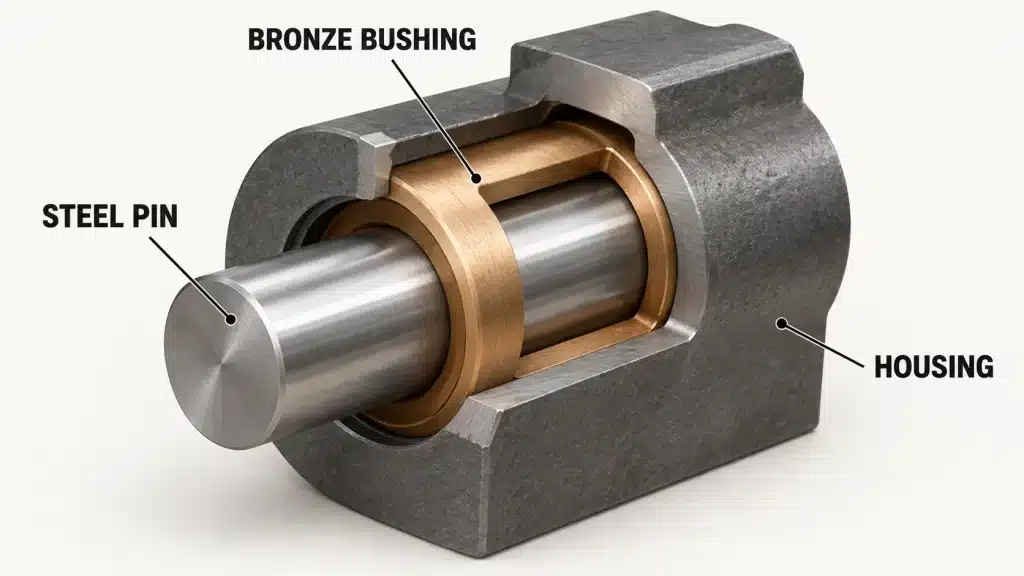
Bronze bushings are typically installed with an interference fit in the housing — the outer diameter is slightly larger than the housing bore so the bushing stays put. The problem is that press-fitting compresses the bushing, shrinking the inner diameter. If you machine the bushing ID to the “correct” final dimension before pressing it in, it’ll be too tight afterward and the shaft won’t fit — or worse, it’ll seize.
The industry rule of thumb: expect ID closure of 80–100% of the interference amount. A bushing with 0.05 mm interference will typically close up by 0.04–0.05 mm after installation. Machinists who don’t account for this produce bushings that either won’t accept the shaft or have excessive clearance that causes impact loading and rapid wear.
6.2 Clearance for High-Load Joints
Running clearance between the bushing ID and the shaft determines whether the joint operates smoothly or pounds itself to death. Too little clearance causes overheating and seizure; too much causes impact loading every time the load reverses direction.
For heavy-load industrial joints, a typical clearance range is 0.05–0.15 mm for bore diameters in the 30–50 mm range–. Larger bores need proportionally more clearance. The shaft tolerance should generally be d8 or e7 for high-load applications, while the housing bore should be H7–.
6.3 Shaft Hardness and Surface Finish
This is where a lot of well-intentioned specifications fall apart. Bronze bushings work by being softer than the shaft. But “softer” doesn’t mean “any hardness.” For C93200 bushings, the shaft should be at least 100 HB harder than the bushing material, and ideally hardened and ground to Ra ≤ 0.8 μm.
Run a C93200 bushing against a soft, rough shaft and you’ll get rapid wear on both surfaces — the bronze can’t form a proper transfer film on a rough surface, and the rough peaks act as cutting tools that abrade the bushing. For aluminum bronze bushings, the shaft hardness requirement goes up further, often to 300+ HB, because the bushing is harder and less forgiving.
6.4 Lubrication Groove Design
Custom oil grooves aren’t cosmetic. The groove pattern determines how lubricant distributes across the bearing surface and whether it reaches the load zone. A few common patterns and their best-fit applications:
Figure-8 / single-loop grooves work best for grease-lubricated oscillating joints. The crossing pattern ensures grease reaches the load zone regardless of oscillation angle.
Straight axial grooves suit full-rotation applications where oil needs to travel along the bushing length.
Spiral grooves — like those on XCMG’s motor grader bushings — are a compromise design that distributes grease along the full pin length while maintaining structural integrity of the bearing surface.
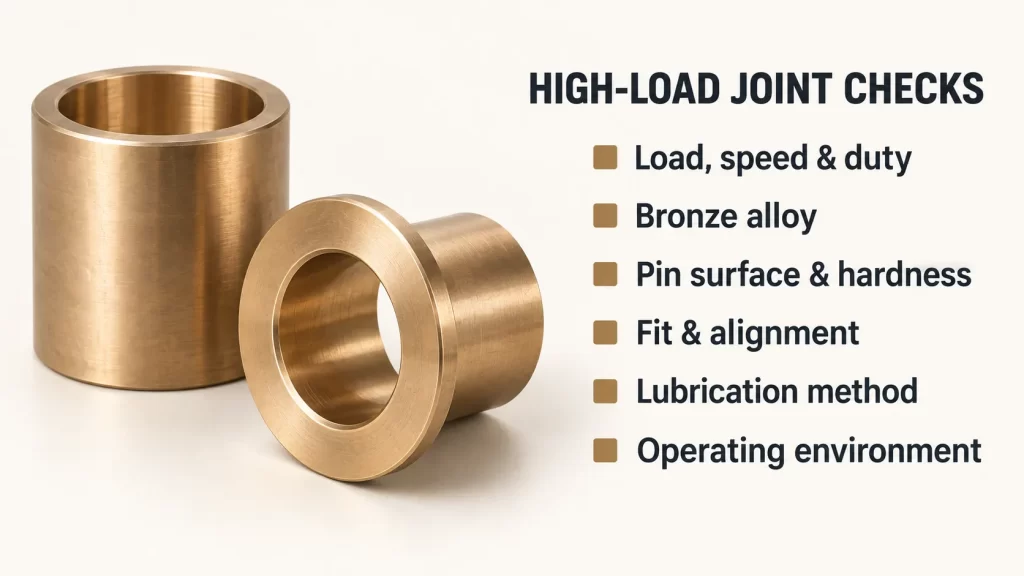
7. What to Check Before You Order
7.1 Material Certification and Traceability
Any serious bronze bushing supplier should provide Mill Test Reports (MTRs) for every heat lot, verifying chemical composition against the specified alloy grade. If a supplier can’t produce MTRs, they’re either buying from a distributor they can’t trace or they’re not testing their incoming material. Either way, you’re taking a risk.
The relevant standards to look for: ASTM B505 for continuous cast bronze, ASTM B271 for centrifugal cast bronze, and the appropriate UNS designation (C93200, C95400, C86300, etc.) on the certification–.
7.2 Dimensional Inspection Protocol
For high-load joints, dimensional accuracy isn’t optional. Critical bore tolerances for bronze bushings typically run ±0.0002 inches (±0.005 mm) for precision applications. Air gauging is the standard inspection method for this level of accuracy, and any supplier producing bushings for heavy equipment should have it.
Also ask about roundness and taper inspection. A bushing that’s within diameter tolerance but oval by 0.03 mm will concentrate load on two points instead of distributing it around the circumference — and it’ll fail prematurely for reasons that won’t show up in a simple diameter check.
7.3 Supplier Evaluation Criteria
When sourcing bronze bushings for high-load applications, look for suppliers with at least five years of production history in the specific alloy family you need. ISO 9001 certification is the baseline; IATF 16949 adds automotive-grade process control if your application demands it.
Request sample parts and test them in your actual operating conditions before committing to a production order. A supplier that hesitates to provide samples, or whose samples don’t meet dimensional specs, is telling you something about their production consistency.
China’s Zhejiang, Anhui, and Guangdong provinces host concentrated clusters of bearing and bushing manufacturers with vertically integrated supply chains, often offering 15–30% cost savings compared to Western equivalents without sacrificing technical performance for standard bronze grades. The key is verifying process control and material traceability rather than assuming cost savings come at the expense of quality.
8. FAQ
Q: Can I replace a C93200 bushing with C95400 without changing anything else?
A: You can physically swap them if the dimensions match, but you shouldn’t assume the joint will perform better. C95400 requires a harder shaft (300+ HB vs. the ~200 HB typical for C93200 applications), generates more friction heat at the same PV, and is less forgiving of misalignment. If your existing joint has alignment issues or a soft shaft, upgrading to C95400 will actually accelerate wear rather than reduce it.
Q: How do I know if my bushing failed because of the wrong material or the wrong installation?
A: Look at the failure pattern. Uniform wear around the bore points to material limitation — the alloy couldn’t handle the load or speed. Edge wear on one side indicates misalignment. Scoring and galling suggest insufficient clearance or lubrication failure. Cracking under load points to a shock-loading issue where a tougher alloy is needed. Oval deformation means the material’s yield strength was exceeded, and you need a higher-strength grade.
Q: Are graphite-plugged bronze bushings truly maintenance-free?
A: In the right application, yes. “Right application” means high load, low speed (typically under 1 m/s), oscillating or intermittent motion, and a properly finished shaft (Ra ≤ 0.8 μm). In continuous high-speed rotation or in environments where fine abrasives can pack into the graphite plug recesses, they still need periodic inspection. The graphite supply is finite — eventually the plugs wear flush and the self-lubricating effect diminishes.
Q: What’s the maximum operating temperature for bronze bushings?
A: It depends on the alloy and lubrication method. C93200 with grease lubrication operates comfortably up to about 150°C. Graphite-plugged bushings extend this to 300°C or even 400°C depending on the solid lubricant formulation. Aluminum bronze and manganese bronze alloys have higher inherent temperature tolerance than leaded tin bronze, but the limiting factor is usually the lubricant, not the bronze itself.
Q: Can bronze bushings be used in seawater without additional protection?
A: Yes, and this is one of bronze’s oldest and most reliable applications. Aluminum bronze and nickel aluminum bronze alloys are particularly well-suited to seawater because they form a protective oxide layer that resists chloride attack. The nickel content in C95500 specifically enhances this passivation behavior. Avoid leaded tin bronzes (like C93200) in continuous seawater immersion — the lead phase can be selectively leached over time.
Q: How much interference fit is right for a heavy-load bronze bushing?
A: For bore diameters under 100 mm, a rule of thumb is 0.001 inch interference per inch of diameter. For larger bushings or high-vibration applications, increase slightly. But always calculate the resulting ID closure and adjust your pre-installation ID machining accordingly. And use a lead-in chamfer (15–30 degrees) on the bushing OD to avoid shearing material during press-fitting.
Q: What’s the lead time for custom bronze bushings in high-load grades?
A: Standard sizes in C93200 are often available from stock. Custom sizes in any alloy typically run 2–4 weeks for centrifugal or continuous cast material plus machining. C86300 and other high-hardness alloys may add 1–2 weeks due to more demanding machining processes. Always confirm whether the lead time covers material casting, machining, and inspection — some suppliers quote only machining time and assume you’ll supply the raw cast bar.
100000+ Types of Bushings – Contact Us for Details