
Recent Posts
SF-1 vs SF-2: Which Self-Lubricating Bushing Is Right for Your Machine?
Introduction
SF-1 and SF-2 bushings look almost identical on the outside. Both are three-layer steel-backed composite bearings. But their surface materials — PTFE versus POM — create two fundamentally different wear mechanisms, load profiles, and application windows. This article breaks down the material architecture, performance data, and real-world selection logic behind both types. It also shows how MYWAY’s SF-1 and SF-2 product lines are engineered for different operating conditions, and why getting the choice right saves you money on maintenance and downtime.
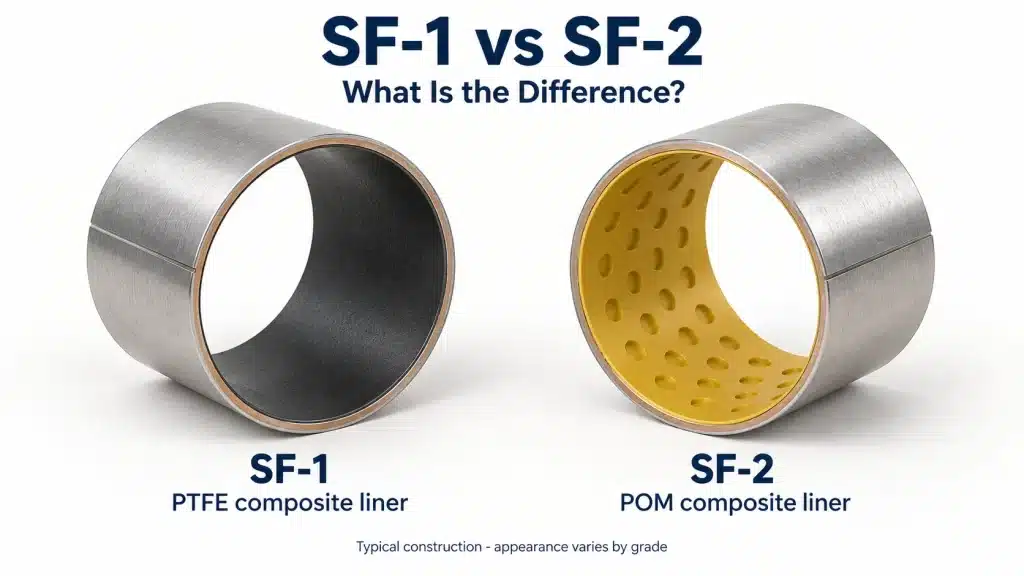
Table of Contents
1. Why Engineers Keep Asking About SF-1 vs SF-2
If you’ve spent any time sourcing self-lubricating bushings — also called oilless bearings, DU bushings, or dry plain bearings — you’ve run into the SF-1 and SF-2 naming convention. These two product families dominate the market for steel-backed composite sliding bearings. Yet the difference between them isn’t always explained clearly.
Some suppliers treat them as interchangeable. They are not. Choosing the wrong one for your application can lead to accelerated wear, shaft damage, or premature seizure. Understanding the material-level distinction between SF-1 and SF-2 is the first step toward specifying the right bushing for your machine.
MYWAY has manufactured both SF-1 and SF-2 bushing lines for years, and the most common technical questions we get from buyers come down to one thing: “Which one should I use?” This article answers that question with material data, performance comparisons, and selection criteria you can apply directly to your design or maintenance schedule.
2. SF-1 Bushing: The PTFE-Based Self-Lubricating Workhorse
2.1 Material Architecture
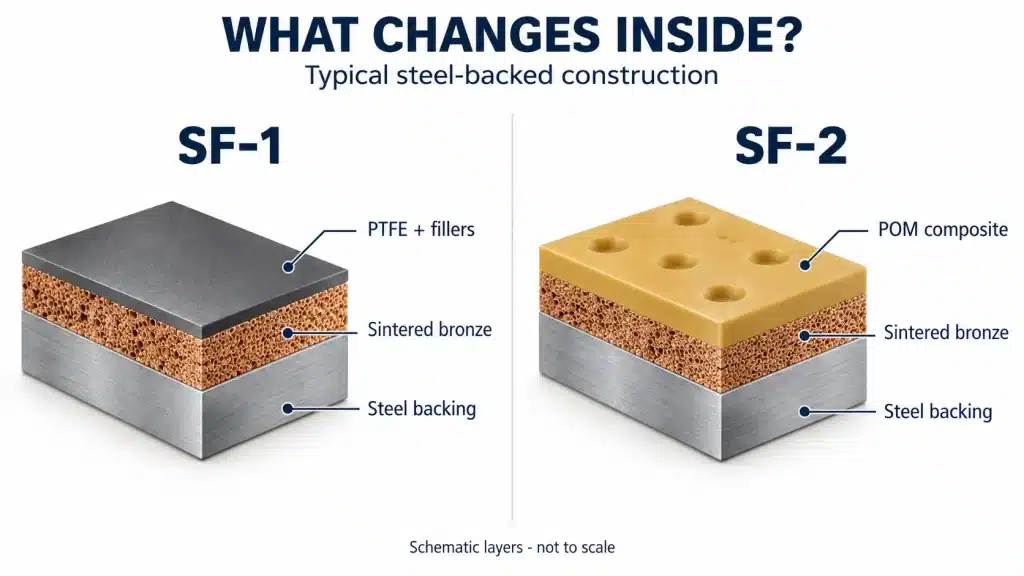
An SF-1 bushing is built on a three-layer composite structure. The base is a high-quality low-carbon steel plate, typically 0.4–2.2mm thick. On top of that steel backing, a porous layer of tin bronze powder is sintered at high temperature. The surface layer is a rolled composite of PTFE (polytetrafluoroethylene) and other fillers pressed into the bronze pores and coated over the surface.
That PTFE surface is what makes SF-1 a true self-lubricating bearing. PTFE has one of the lowest friction coefficients of any solid material. As the shaft rotates or oscillates, a thin PTFE film transfers onto the mating surface, creating a boundary lubrication layer that requires no external grease or oil.
Some SF-1 variants contain lead in the PTFE mixture. Leaded SF-1 offers excellent tribological performance, but RoHS and ELV restrictions have pushed many manufacturers — MYWAY included — toward lead-free PTFE formulations that still deliver low friction and long wear life.
2.2 Key Performance Parameters
The numbers tell a clear story. SF-1 bushings operate across a temperature range of approximately −195°C to +270°C, making them suitable for applications from cryogenic environments to hot engine compartments. The maximum dynamic load capacity is typically rated at 140 N/mm², and static loads can reach higher values depending on the wall thickness and housing support. The friction coefficient under dry running conditions sits below 0.20, with lead-free variants achieving even lower values with proper shaft surface preparation.
The PV limit (pressure × velocity) is the metric engineers should focus on. MYWAY’s DU/SF-1 bushings are rated for continuous operation at 1.8 N/mm²·m/s and can handle short peaks up to 3.6 N/mm²·m/s.In practical terms, this means SF-1 works best in moderate-load, moderate-speed applications where dry running or minimal lubrication is required.
2.3 Where SF-1 Excels
SF-1 bushings shine in applications where contamination is a concern and maintenance access is limited. Common use cases include hydraulic cylinders, shock absorbers, automotive pedal assemblies, textile machinery, printing equipment, and agricultural implements. The PTFE surface tolerates intermittent dry running without galling or seizing, which makes SF-1 a reliable choice for oscillating motion — door hinges, linkage pivots, and seat adjustment mechanisms, for example.
The chemical resistance of PTFE also gives SF-1 an edge in food processing equipment, marine environments, and any application where grease contamination is unacceptable
3. SF-2 Bushing: The POM-Based Boundary Lubrication Specialist
3.1 Material Architecture
SF-2 shares the same steel backing and sintered bronze interlayer as SF-1. The difference lies in the surface layer: instead of PTFE, SF-2 uses a modified polyoxymethylene (POM) resin. This POM layer is typically about 0.5mm thick and is anchored into the bronze pores during a rolling process.
What sets the SF-2 surface apart is its pattern of oil reservoir pits — small pockets machined or formed into the POM surface. These pits hold lubricating grease and release it gradually during operation. SF-2 is therefore a boundary lubrication bearing, not a fully dry-running bearing. It needs a small amount of grease to perform at its best, but it can operate under intermittent or low-oil conditions without failing.
3.2 Key Performance Parameters
SF-2 bushings have a narrower temperature window than SF-1: roughly −20°C to +100°C. The compressive strength of the POM surface layer is lower, around 140 MPa, compared to SF-1’s 280 MPa. However, SF-2 compensates with higher load capacity in low-speed, heavy-load conditions. The static load rating can reach 250 N/mm², and dynamic loads typically fall in the 70–150 N/mm² range depending on the motion type
The friction coefficient for SF-2 depends heavily on lubrication state. With grease present, it stays below 0.20; without adequate lubrication, friction rises quickly, and wear accelerates. This is the critical operational constraint: SF-2 is not designed for dry running. It is designed for applications where grease can be applied periodically, or where the motion pattern naturally retains lubricant.
3.3 Where SF-2 Excels
SF-2 bushings are the go-to choice for high-load, low-speed applications. Metallurgical machinery, mining equipment, steel rolling mills, construction machinery, and forging presses all rely on SF-2 for its combination of load capacity and wear resistance under boundary lubrication conditions. Automotive chassis components, steering knuckles, and suspension linkages also commonly use SF-2 where grease fittings are already part of the maintenance schedule.
The POM surface also offers excellent dimensional stability and low moisture absorption, which keeps clearances predictable in humid or wet environments. This makes SF-2 suitable for hydraulic turbine guide bushings, marine deck equipment, and water conservancy machinery.
4. Head-to-Head: The Numbers That Matter
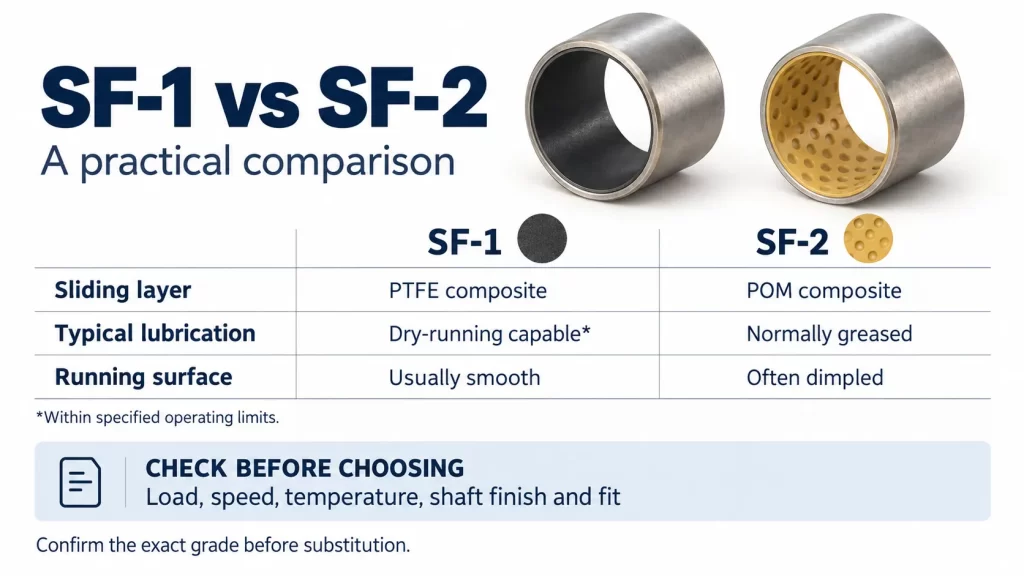
| Performance Metric | SF-1 (PTFE) | SF-2 (POM) |
|---|---|---|
| Surface material | PTFE composite | Modified POM |
| Temperature range | −195°C to +270°C | −20°C to +100°C |
| Max dynamic load | ~140 N/mm² | 70–150 N/mm² (grease) |
| Max static load | ~250 N/mm² | ~250 N/mm² |
| Friction coefficient (dry) | <0.20 | Not recommended dry |
| Friction coefficient (greased) | N/A (self-lubricating) | <0.20 |
| Lubrication requirement | None (dry running OK) | Light grease preferred |
| Best speed range | Moderate to high | Low |
| Best load range | Light to moderate | Moderate to heavy |
| Chemical resistance | Excellent (PTFE) | Good (POM) |
| RoHS / lead-free options | Yes | Yes |
The table makes the selection logic obvious. SF-1 wins when you need dry running, wide temperature tolerance, or chemical resistance. SF-2 wins when you need high load capacity at low speed with occasional grease.
There is one more practical consideration: housing fit and shaft hardness. Both SF-1 and SF-2 perform best with a shaft surface hardness of at least HRC 45 and a surface roughness of Ra 0.2–0.8μm. A soft or rough shaft will wear the bushing surface prematurely, regardless of whether it’s PTFE or POM.
5. How MYWAY Engineers Both Bushing Lines
MYWAY produces SF-1 and SF-2 bushings at its Zhejiang manufacturing facilities, with IATF 16949 and ISO 9001 certifications. The production process starts with high-precision steel strip, followed by controlled-atmosphere bronze sintering, and then surface coating or POM inlay depending on the product line.
For SF-1, MYWAY offers lead-free PTFE formulations that meet RoHS and ELV requirements without sacrificing friction performance. The company’s DU/SF-1 bushings are available in cylindrical, flanged, and thrust washer configurations, covering bore diameters from small precision sizes up to large industrial dimensions.
For SF-2, MYWAY’s POM surface layer is engineered with optimized oil pocket geometry. The number and depth of the pockets are adjusted based on the intended motion pattern — oscillating applications get a different pocket pattern than rotating ones. This level of customization is what separates a commodity bushing from a properly engineered one.
6. Selection Checklist: Six Questions to Ask Before You Specify
1. Can the application run dry? If yes, lean toward SF-1. If no, SF-2 with a defined grease interval.
2. What is the operating temperature? Above +100°C or below −20°C, SF-1 is the only safe option.
3. What is the load and speed combination? High load + low speed → SF-2. Moderate load + moderate speed → SF-1.
4. Is grease contamination a problem? Food, pharmaceutical, and clean-room applications almost always require SF-1.
5. How frequent is maintenance access? Hard-to-reach locations favor SF-1’s maintenance-free operation.
6. What is the shaft material and hardness? Both types need a hard, smooth shaft. If the shaft is soft, consider a bronze or bimetallic bushing instead.
Running through these six questions takes five minutes and prevents the most common bushing selection mistake: using SF-2 in a dry-running application because it was cheaper or already in stock.
7. Common Misconceptions About SF-1 and SF-2
“SF-2 is just a cheaper SF-1.” No. SF-2 has a different surface chemistry and a different operating principle. It is not a downgrade; it is a different tool for a different job.
“SF-1 can handle any load because it has a steel backing.” The steel backing provides structural support, but the PTFE surface layer determines the tribological limits. Exceeding the PV rating will destroy the PTFE film and expose the bronze interlayer.
“Both types are interchangeable in a grease-lubricated application.” They are not. SF-1 can run with or without grease. SF-2 requires grease to function as designed. Putting SF-2 in a dry application is a specification error, not a cost-saving measure.
“POM is just plastic, so SF-2 must be weak.” Modified POM is a high-performance engineering polymer with excellent fatigue resistance and load-bearing capability. In the right application — low speed, high load, greased — SF-2 can outlast bronze bushings by a significant margin.
8. FAQ
Q1: Can I replace an SF-1 bushing with an SF-2 bushing without changing anything else?
Not safely. SF-2 requires lubrication to function properly. If your original application used SF-1 because it runs dry, switching to SF-2 will cause rapid wear unless you add a grease supply. The housing bore and shaft dimensions are the same, but the lubrication requirement is different.
Q2: Which bushing is better for outdoor equipment exposed to rain and dust?
SF-1 is generally the better choice for exposed environments. PTFE resists water, dust, and most chemicals without degradation. SF-2 can work outdoors if grease is maintained, but the POM surface is more sensitive to abrasive contamination.
Q3: Do MYWAY SF-1 bushings contain lead?
MYWAY offers both leaded and lead-free SF-1 formulations. The lead-free versions use alternative solid lubricants in the PTFE matrix and are compliant with RoHS and ELV directives. For automotive and consumer product applications, specify the lead-free option.
Q4: What is the maximum PV value for MYWAY SF-1 bushings?
MYWAY’s DU/SF-1 bushings are rated for continuous PV of 1.8 N/mm²·m/s and short-term peaks of 3.6 N/mm²·m/s. Exceeding these values will generate excessive heat and accelerate wear.
Q5: Can SF-2 bushings operate without any grease at all?
Technically they can start moving, but they will not last. The POM surface is designed to work with a grease film. Dry running SF-2 leads to rapid friction increase and surface melting in extreme cases.
Q6: How do I know which size bushing I need?
You need three measurements: shaft diameter, housing bore diameter, and bushing length. MYWAY’s online catalog lists standard sizes in metric and inch dimensions. For custom sizes, contact the sales team with your drawing.
Q7: What is the delivery time for MYWAY SF-1 and SF-2 bushings?
Standard sizes ship within 2 weeks. Custom or non-stock sizes typically require 30–50 days depending on quantity and material specifications
9. Final Thoughts: Match the Bushing to the Job
SF-1 and SF-2 are not competing products. They are complementary solutions for different operating conditions. The PTFE-based SF-1 handles dry running, extreme temperatures, and chemical exposure. The POM-based SF-2 handles high loads at low speeds with periodic grease lubrication.
The most expensive bushing is the one that fails early because it was specified for the wrong job. Whether you’re designing a new assembly or replacing worn components on existing equipment, start with the six-question checklist in Section 6. If you’re still unsure, send your operating parameters to MYWAY’s engineering team — load, speed, temperature, lubrication access, and shaft material — and they’ll recommend the right bushing from the SF-1 or SF-2 line.
For quotes, technical datasheets, or custom sizing, visit mybushing.com or contact the MYWAY sales team directly.
100000+ Types of Bushings – Contact Us for Details