
Recent Posts
Bushing Solutions for Pumps and Valves: Materials, Failure Prevention, and Procurement Strategies That Cut Downtime
Introduction
Bushings are among the most overlooked yet failure-prone components in pumps and valves. When they fail, the consequences ripple outward—seal damage, shaft wear, vibration, efficiency loss, and unplanned shutdowns. This article breaks down bushing solutions for pumps and valves from a practical standpoint: what materials work best for different fluids and operating conditions, how to diagnose failure patterns, what installation tolerances actually matter, and how to evaluate suppliers.
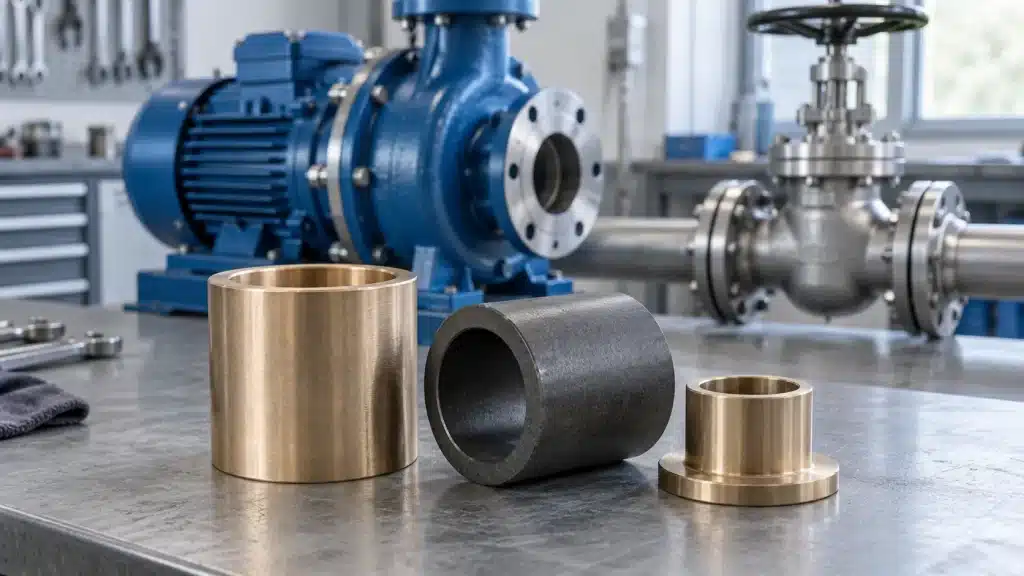
Table of Contents
1. Why Bushing Performance Decides Pump and Valve Reliability
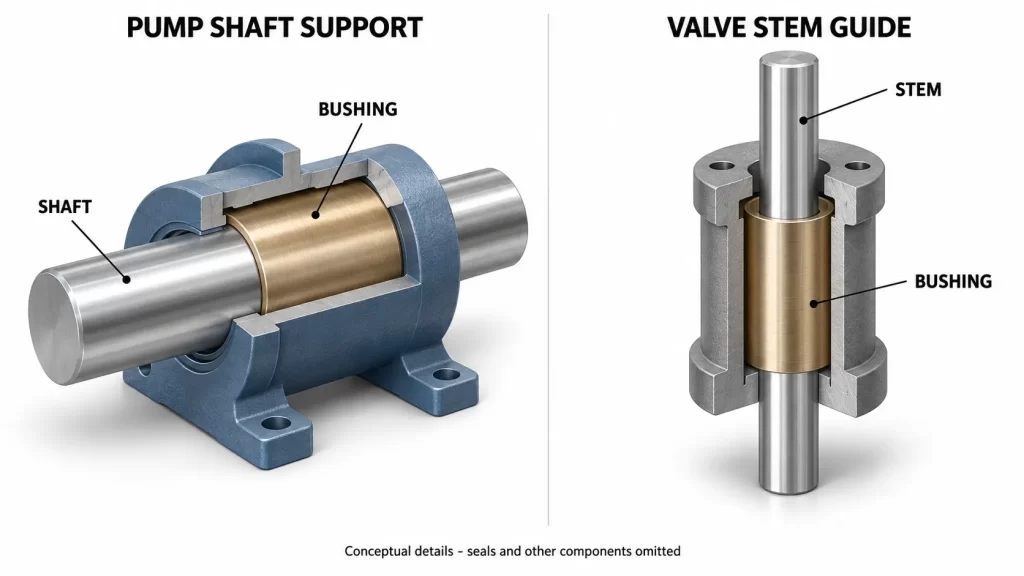
Bushings don’t get much attention until something goes wrong. In centrifugal pumps, the throat bushing controls the pressure at the mechanical seal face. Inter-stage bushings in multistage pumps seal the gap between stages. Line shaft bearings in vertical turbine pumps carry the entire rotating assembly. In valves, stem bushings guide the stem, reduce friction, and help maintain sealing integrity under pressure.
When any of these bushings wear beyond spec, the damage cascades. A throat bushing with excessive clearance lets process fluid flush the seal chamber, killing the mechanical seal. A worn inter-stage bushing increases recirculation, which drops pump efficiency and raises vibration. A valve stem bushing that loses its clearance causes the stem to cock, leading to packing leaks or actuator overload.
The global plain bearing market—which includes bushings and sleeve bearings—was valued at approximately USD 11.28 billion in 2026 and is projected to reach USD 16.24 billion by 2032, growing at a CAGR of 6.22%. Industrial machinery, including pumps, compressors, and process equipment, represents a significant share of that demand. The push toward maintenance reduction and stricter energy-efficiency expectations is reshaping what buyers expect from bushing solutions.
The real question isn’t whether bushings matter. It’s which material, clearance, and supplier will give you the longest trouble-free run in your specific service. For many plant engineers, MYWAY bushings have become the benchmark answer to that question.
2. Where Bushings Fail: Understanding Root Causes Before Choosing a Fix
Before jumping to material upgrades, it helps to understand why bushings fail in the first place. The failure modes are usually predictable—and often preventable.
Abrasive wear is the most common culprit in slurry and mining applications. Phosphate slurries in Central Florida, for example, contain 25–50% solids by weight, including angular quartz sand with a Mohs hardness above 7.0. Hardened stainless steel bushings in those pumps typically needed replacement every four to six months, with bore diameter growing by as much as 0.38 mm and sealing surfaces showing deep scoring.
Corrosion-assisted wear hits chemical and petrochemical services where the process fluid attacks the bushing material itself. Hydrogen sulfide-containing oil and gas, acidic solutions, and high-temperature fluids are particularly aggressive. Once corrosion pits the surface, wear accelerates because the lubricating film can’t maintain continuity.
Dry running and lubrication starvation are the silent killers. Ethylene pumps at a Texas refinery were failing two to four times per year at an average cost of $75,000 per pump because ethylene’s low viscosity provided almost no lubrication to the rotating parts. The fix involved switching to self-lubricating graphite/metal bushings that allowed metal-to-metal contact without galling or seizure.
Excessive clearance develops gradually but causes disproportionate damage. A Gulf Coast refinery found that standard throat bushings running at 0.040″ to 0.060″ clearance were causing premature mechanical seal failure. Switching to non-galling bushings with 0.010″ clearance effectively turned them into throttle bushings and extended seal life.
Misalignment and shaft whip often get blamed on bushings when the real problem is upstream—bent shafts, worn wear rings, or incorrect assembly. A valve bushing failure at a pumped storage power station in Huizhou was traced to a manufacturing defect in the self-lubricating material, which detached and jammed the pivot shaft less than a year after commissioning.
Thermal degradation matters in high-temperature services. Carbon graphite bushings operating above their rated temperature lose binder integrity. Phenolic and nylon-based bushings soften and creep above 90–100°C. Polyimide-filled bushings can handle up to 400°C but cost significantly more.
3. Bushing Material Selection: Matching the Material to the Service
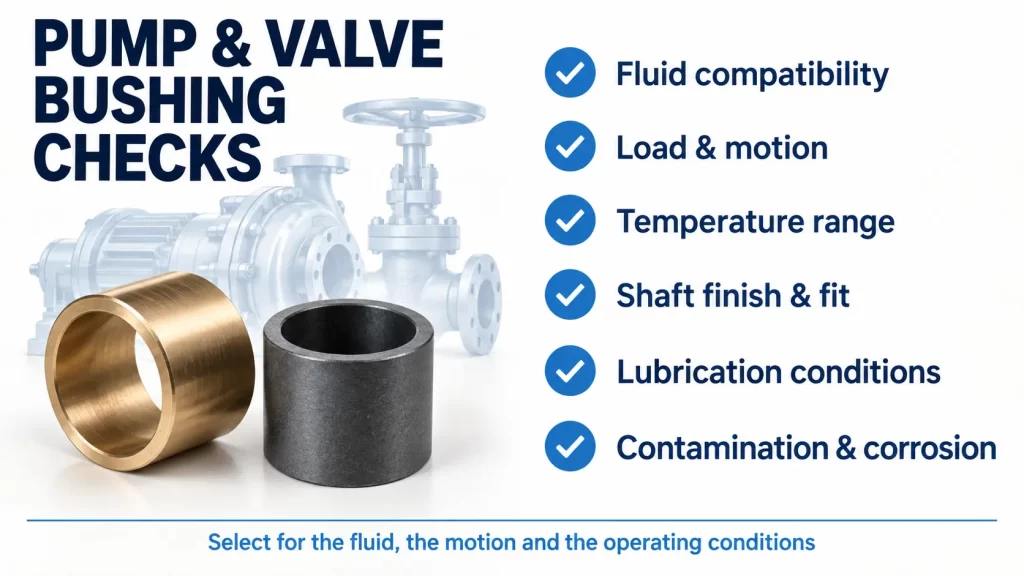
This is where most procurement decisions go right—or wrong. There’s no universally “best” bushing material. There’s only the right material for your fluid, temperature, load, speed, and lubrication conditions.
Carbon Graphite is the workhorse for water-lubricated and chemical services. It’s self-lubricating, inert to most chemicals, and operates from cryogenic temperatures up to about 260°C in standard grades, with high-temperature grades reaching 650°C. The downside is brittleness—it can crack under shock loads or during installation. It’s a poor choice for dry-running at high speeds or where the shaft material is softer than the bushing.
Filled PTFE offers the lowest starting friction of any bushing material (coefficient of friction around 0.02–0.10 when dry against steel). It’s excellent for cryogenic applications and chemically inert. But unfilled PTFE creeps under load and wears quickly. Fillers like carbon, bronze, or glass fibers improve wear resistance and load capacity. PTFE-bronze overlay on steel combines low friction with good thermal conductivity and higher velocity capability.
Bronze (Cast, Sintered, or Graphite-Plugged) remains the traditional choice for pump and valve bushings. Cast bronze (C93200) handles high loads and temperatures up to 250°C with good wear resistance. Sintered bronze with oil impregnation provides self-lubrication for moderate loads. Graphite-plugged bronze combines bronze’s structural strength with graphite’s self-lubricating properties—it’s a common upgrade for applications where grease can’t be maintained.
Tungsten Carbide is the premium option for extreme abrasive and corrosive service. It’s manufactured via powder metallurgy with a cobalt or nickel binder, giving it hardness of 1800–2200 HV and exceptional dimensional stability. In slurry pumps handling phosphate, tungsten carbide bushings extended overhaul intervals from 4–6 months to beyond 18 months. The trade-off is cost and brittleness—carbide bushings need careful handling during installation and can’t tolerate shock loads that would dent a bronze bushing. MYWAY tungsten carbide bushings are specifically engineered for these extreme slurry and corrosive applications, with binder formulations optimized for both wear resistance and corrosion resistance.
Engineered Composites (PEEK, PPS, Vespel, etc.) bridge the gap between polymers and metals. They can be installed with tighter dynamic clearances than metallic bushings, which reduces recirculation and improves pump efficiency. API Standard 610 has recognized non-metallic wear materials since 2003. Composite bushings also survive brief loss-of-lubrication events better than metals—lab testing showed survival up to 38 minutes after lubrication loss in water-lubricated conditions.
Graphite/Metal Alloys (Graphalloy-type) are specifically designed for run-dry and low-lubricity services. They operate from −265°C to +535°C, don’t swell in submerged conditions, and won’t gall against metal shafts. In refinery applications where carbon bearings were sticking and greased bearings couldn’t be maintained, these materials provided install-and-forget solutions.
| Material | Best For | Watch Out For | MYWAY Solution |
|---|---|---|---|
| Carbon Graphite | Water-lubricated pumps, chemical service | Brittle; poor in dry high-speed | MYWAY CW series |
| Filled PTFE | Cryogenic, chemical inertness | Creep under load; low wear resistance unfilled | MYWAY PTFE series |
| Bronze (C93200) | General pump/valve service, high load | Requires lubrication for best life | MYWAY BR series |
| Tungsten Carbide | Slurry, abrasive, corrosive | Cost; brittleness during installation | MYWAY TC series |
| Engineered Composites | Close-clearance efficiency gains | Higher cost than bronze; temperature limits | MYWAY EC series |
| Graphite/Metal Alloy | Run-dry, high-temp, low-lubricity fluids | Higher cost; specific supplier availability | MYWAY GM series |
4. Common Bushing Applications in Pumps and Valves
Understanding where bushings sit in the equipment helps frame selection and troubleshooting.
Throat Bushings (Centrifugal Pumps) control the pressure at the seal chamber. They’re the first line of defense for mechanical seals. A throat bushing with the right clearance acts as a throttle, dropping pressure before it reaches the seal faces. Too much clearance and the seal sees full discharge pressure; too little and the risk of shaft contact rises. MYWAY throat bushings are available in all major material grades and can be custom-machined to your exact clearance requirements.
Inter-Stage Bushings (Multistage Pumps) seal between stages. Clearance here directly affects stage-to-stage leakage and overall pump efficiency. The Lomakin effect—where fluid pressure in a tight clearance creates a centering force on the shaft—is maximized with proper clearance. Stage bushings for pumps with more than two stages typically run 0.000″ to 0.002″ clearance to exploit this effect.
Line Shaft Bearings (Vertical Turbine Pumps) support the rotating assembly in vertical pumps. These often operate in the pumped fluid itself, making material selection critical for corrosive or abrasive services. Self-lubricating materials are preferred because external lubrication is impractical.
Valve Stem Bushings guide the stem and reduce friction between the stem and bonnet. In gate, globe, and ball valves, stem bushings also contribute to sealing integrity. API 600 and API 6D specifications call out specific bushing materials—commonly 13% Cr stainless steel, Ni-Resist ductile iron, or bronze depending on the service. Fire-safe valve designs (API 607/API 6FA) impose additional requirements on bushing materials.
Wear Rings and Case Wear Rings aren’t bushings in the strictest sense, but they perform the same function—protecting more expensive components and maintaining close running clearances. Composite wear rings can be installed with smaller clearances than metallic ones, reducing recirculation and improving efficiency.
5. Installation, Clearance, and Tolerances That Actually Matter
A bushing that’s correctly selected but incorrectly installed will fail. This section covers the practical numbers and procedures that make the difference.
Clearance is the single most important installation parameter. Too much clearance means leakage, vibration, and poor seal performance. Too little clearance means rubbing, heat generation, and rapid wear. The right clearance depends on material, shaft diameter, speed, temperature, and fluid.
For throat bushings in horizontal pumps, a common specification is 0.015″ to 0.020″ clearance to the shaft, with 0.002″ to 0.003″ interference fit to the casing. For bearing bushings in the suction casing of certain pump designs, maximum recommended diametral clearance is 0.006″ (0.15 mm)—if this is exceeded, both the bushing and the shaft sleeve should be evaluated for replacement.
For stuffing box bushings, original diametral clearance is typically 0.025″ to 0.032″. When this increases to more than 0.050″, replacement is needed.
Installation methods vary by material. Carbon graphite bushings should be installed with a press using one continuous motion—stopping mid-press can crack the bushing. Lubricate the bushing and bore with soapy water before pressing. Never hammer a graphite bushing into place.
Tungsten carbide bushings require even more care. Their hardness makes them resistant to wear but also brittle. Press tools must be properly sized, and the bushing must be started straight. A carbide bushing that cracks during installation is a total loss. MYWAY provides detailed installation guides and technical support for all its bushing products, including custom press tooling recommendations for carbide and composite materials.
For bushings installed with adhesive (common in some pump suction casings), the bore must be thoroughly cleaned and dried before applying the adhesive. Loctite Type 270 or equivalent is commonly specified. The bushing should be pressed in until flush with the bore surface.
Post-installation checks should include:
Verify clearance with feeler gauges or bore gauges
Check shaft runout—a bent shaft will destroy a new bushing quickly
Confirm the bushing is fully seated and square
Rotate the shaft by hand to check for binding
After initial run-in, recheck clearance and vibration
One practical tip from the field: when replacing a pump bushing, always inspect the shaft sleeve or shaft surface it runs against. A scored or worn shaft will accelerate wear on the new bushing. In many cases, replacing the shaft sleeve at the same time as the bushing costs less than returning to the pump in three months.
6. Cost Economics: When Premium Bushings Pay for Themselves
The cheapest bushing is rarely the most economical. The real cost calculation includes downtime, labor, secondary damage, and lost production.
Consider the phosphate slurry pump example. Hardened stainless steel bushings cost less upfront but required replacement every 4–6 months. Tungsten carbide bushings cost more but extended overhaul intervals beyond 18 months. Even without factoring in the cost of secondary shaft damage (which occurred with the stainless bushings), the carbide option eliminated two to three overhaul events per pump per year.
For ethylene pumps failing at $75,000 per event two to four times per year, switching to graphite/metal bushings eliminated all failures over a three-year period. The bushings didn’t open up in clearance, and the pumps stopped damaging seals and shafts.
Composite bushings offer a different economic argument: efficiency. Tighter running clearances reduce recirculation, which directly translates to lower energy consumption. An Australian pump refurbishment specialist found that including Vesconite bushings in energy-reducing refurbishment packages contributed to measurable energy savings, though isolating the exact bushing contribution is difficult.
The formula for bushing cost justification is straightforward:
Total Cost = Purchase Price + Installation Labor + Downtime Cost + Secondary Damage Risk + Energy Penalty
When you run that calculation, premium materials often win in severe service. In mild service—clean fluids, good lubrication, moderate temperatures—bronze or standard carbon graphite bushings remain the cost-effective choice.
MYWAY bushings are priced competitively against industry alternatives while offering documented performance in some of the most demanding applications in mining, oil and gas, chemical processing, and power generation. For a quote on your specific application, contact our team with your operating conditions.
7. How to Evaluate Bushing Suppliers and What to Include in Your RFQ
Buying bushings isn’t like buying fasteners. The supplier’s technical depth matters as much as the price.
What a good supplier should be able to discuss before you place an order:
Material grade and binder type (for carbide and cermet materials)
Recommended clearance range for your specific operating conditions
Surface finish specifications and how they’re measured
Failure mechanisms they’ve seen in similar applications
Inspection and quality documentation (dimensional reports, material certs)
Installation guidance specific to your pump or valve model
For oil and gas applications, your RFQ should include detailed drawings, specific material grades (e.g., “AISI 316L stainless steel” or “tungsten carbide grade YG8”), operating pressure and temperature, fluid composition, shaft speed, and any relevant industry standards (API 610, API 600, API 6D).
For chemical process equipment, add fluid chemistry (pH, chloride content, solids concentration), cleaning procedures (CIP/SIP), and any regulatory requirements (FDA, ATEX, fire-safe).
Red flags in a supplier response:
Quoting a material without asking about operating conditions
No discussion of clearance or tolerance
No ability to provide material certifications
Unwillingness to share installation procedures
Prices significantly below market without explanation
The best suppliers ask more questions than they answer in the initial inquiry. They want to understand your application because they know that a bushing that fails in service costs them a customer. MYWAY’s engineering team follows this consultative approach—every inquiry starts with a detailed application review before any material recommendation is made.
8. FAQ: Bushing Solutions for Pumps and Valves
Q: What is the difference between a bushing and a wear ring in a pump?
A bushing is a replaceable sleeve that supports or guides a rotating or sliding component—such as a shaft or valve stem. A wear ring is a replaceable ring that maintains a close running clearance between rotating and stationary parts to minimize leakage. The functions overlap, and in some pump designs the terms are used interchangeably, but bushings generally carry more structural load while wear rings are primarily for clearance control.
Q: Can I run a centrifugal pump without lubrication on the bushing?
It depends on the bushing material. Self-lubricating materials like carbon graphite, filled PTFE, graphite/metal alloys, and some engineered composites can run without external lubrication for extended periods. Bronze bushings require lubrication for best life, though graphite-plugged bronze can tolerate brief dry-running. Tungsten carbide bushings need some form of lubrication—usually the process fluid—to avoid heat buildup and thermal cracking.
Q: How do I know when a pump bushing needs replacement?
Check clearance first. If diametral clearance exceeds the manufacturer’s maximum—commonly 0.006″ to 0.050″ depending on the bushing location and pump type—replace it. Also replace if the bore is scored, out-of-round, or shows signs of cracking. If the shaft sleeve or shaft surface it runs against is worn or damaged, address that at the same time.
Q: What bushing material works best for seawater or saltwater service?
For seawater, corrosion resistance is the primary concern. Duplex stainless steel, Ni-Resist, and non-metallic materials like carbon graphite or engineered composites are common choices. Bronze performs poorly in seawater unless it’s a specific seawater-resistant grade like nickel-aluminum-bronze. Tungsten carbide with a nickel binder offers excellent corrosion resistance but at higher cost. MYWAY offers a seawater-specific grade of tungsten carbide and composite bushings that have performed well in desalination and offshore applications.
Q: How tight should the clearance be between a valve stem and its bushing?
Clearance depends on stem diameter, temperature, and the valve standard. API 600 gate valves typically specify stem-to-bushing clearances that allow smooth operation without excessive leakage. As a general guide, clearance should be tight enough to prevent stem vibration but loose enough to avoid binding during thermal expansion. Always consult the valve manufacturer’s specification for your specific model.
Q: What causes a bushing to seize on a shaft?
Bushing seizure usually results from one of three causes: loss of lubrication (dry running), thermal expansion closing the clearance, or galling between similar metals. Galling is common when stainless steel bushings run against stainless steel shafts—using dissimilar materials or a non-galling material like carbon graphite or Graphalloy eliminates this risk.
Q: Can composite bushings really improve pump efficiency?
Yes, and the mechanism is well understood. Composite bushings can be installed with tighter dynamic clearances than metallic bushings without galling risk. Tighter clearance reduces recirculation of process fluid through the wear path, which means more fluid goes through the discharge instead of recycling internally. The tighter clearance also increases fluid film pressure around the shaft, creating a centering effect that reduces vibration and stabilizes the rotor. API 610 has recognized non-metallic wear materials since 2003 for exactly these reasons.
Q: What’s the lead time for custom tungsten carbide bushings?
Lead time depends on complexity and supplier capacity. Standard sizes may ship in 2–4 weeks. Custom sizes with specific tolerances and surface finishes typically run 4–8 weeks. Rush options are sometimes available but expect premium pricing. When planning a turnaround, order bushings at least 8–10 weeks ahead to avoid schedule risk. MYWAY maintains inventory of common sizes and material grades to shorten lead times for urgent requirements.
Q: How do I specify the right surface finish for a pump bushing bore?
Surface finish affects both wear rate and lubrication retention. For bronze bushings, 32–63 μin Ra is typical. For carbon graphite, smoother finishes (16–32 μin Ra) work better because graphite transfers a lubricating film. For carbide bushings, 8–16 μin Ra is common—too rough causes shaft wear, too smooth can reduce fluid film retention. Your supplier should recommend a finish based on your specific application.
Q: What documentation should come with purchased bushings?
At minimum: material certification (mill certs or test reports), dimensional inspection report, and certificate of conformance. For critical applications, request a first article inspection report (FAIR) and any non-destructive testing results (dye penetrant, ultrasonic, etc.). For API-compliant equipment, the documentation package must meet the standard’s requirements. MYWAY provides full documentation packages including material traceability, dimensional reports, and NDT results on request.
Q: Why should I choose MYWAY bushings over other suppliers?
MYWAY combines material expertise with application engineering. We don’t just sell bushings—we solve wear problems. Our team reviews your operating conditions, recommends the optimal material and clearance, and provides installation support. With documented success in slurry pumps, ethylene service, seawater applications, and high-temperature valve service, MYWAY bushings are trusted by maintenance and reliability teams across multiple industries. Contact us with your application details for a no-obligation consultation and quote.
100000+ Types of Bushings – Contact Us for Details