
Recent Posts
What “Self-Lubricating” Actually Means (And Why Half the Industry Uses the Term Wrong)
Introduction
Let me be blunt: “self-lubricating” is one of those phrases that sounds great in a brochure and causes headaches on the factory floor. It does not mean the bushing never wears. It does not mean you can ignore load, speed, or shaft finish. What it really means is that the lubricant is already inside the material — PTFE, graphite, oil trapped in pores — and it gets released while the thing runs. This article breaks down what that looks like in real life, where self-lubricating bushings win, where they fail, and how MYWAY’s eight core bushing lines solve specific problems. If you spec bushings for a living, this is the no-BS version.
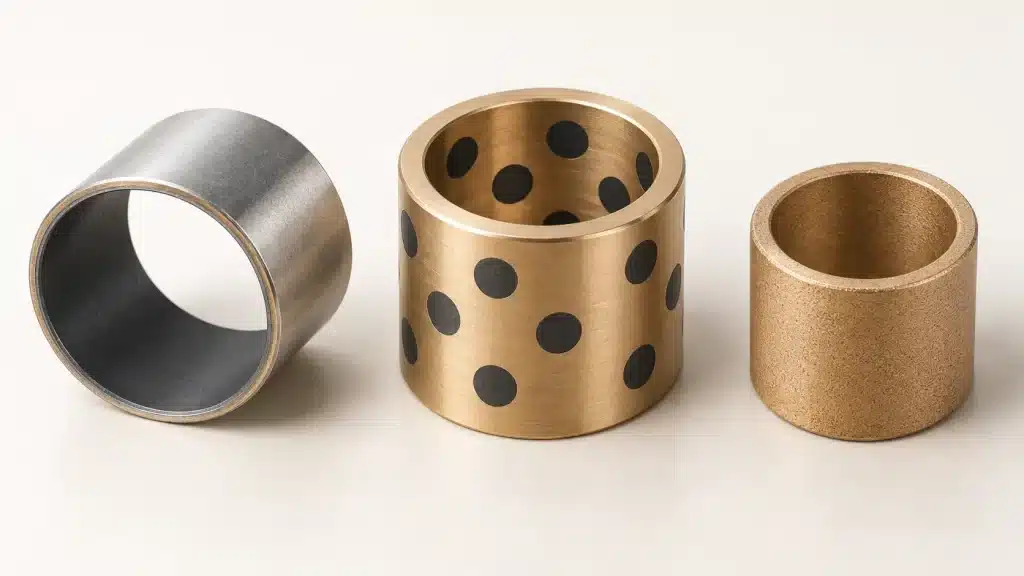
Table of Contents
1. The Real Meaning: It’s Not Magic, It’s Just Stored Lubrication
I’ve heard guys say, “Oh, it’s self-lubricating, so we don’t need to touch it ever.” That’s not true. Every bushing wears. Every bushing has a limited life. The difference is how the lubricant gets to the sliding surface.
A conventional bronze bushing needs grease. You pump it in through a fitting. You do it every week, every month, whatever the manual says. A self-lubricating bushing carries its own lubricant. Sometimes that’s a thin layer of PTFE on the surface. Sometimes it’s oil soaked into a porous bronze structure. Sometimes it’s graphite plugs pressed into holes.
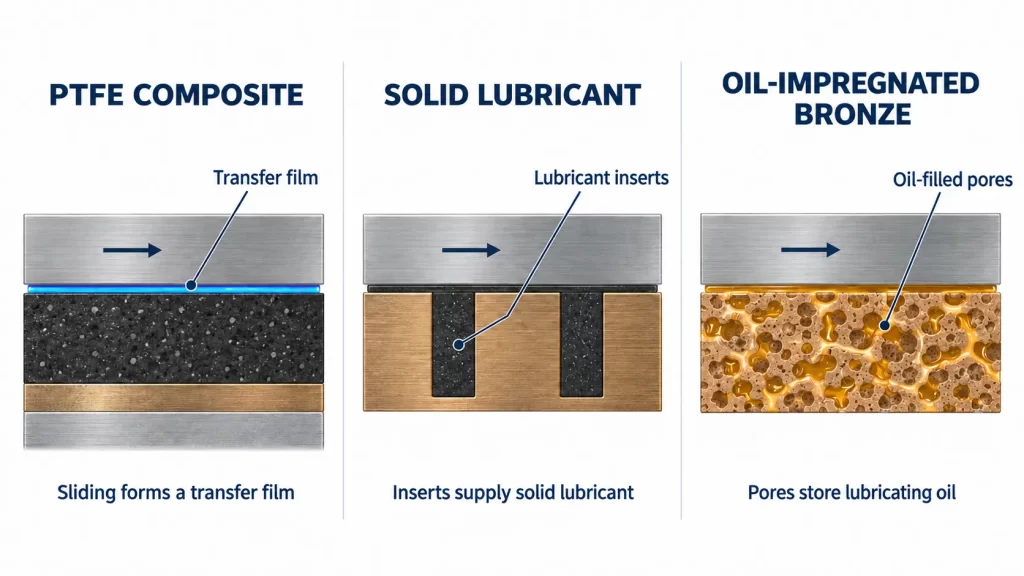
The key point: the lubricant is part of the material. It doesn’t come from outside. That’s it. That’s what “self-lubricating” really means. No magic, no infinite life. Just a different way of getting lubricant to the contact zone.
2. Three Main Types — And They Are Not Interchangeable
You can’t just say “self-lubricating” and be done. There are three main families, and picking the wrong one is how you end up with a seized shaft at 3 a.m.
2.1 PTFE-lined composite bushings (DU type)
This is the one most people mean when they say “self-lubricating.” A steel backing, a sintered bronze layer, and a PTFE-based sliding surface. During the first few minutes of running, PTFE transfers onto the shaft and forms a thin film. After that, the shaft basically slides on a PTFE film. Friction coefficient can drop to 0.08 dry. They handle loads up to 140 N/mm² and temperatures from -200°C to +280°C. Great for food equipment, high-temp spots, and anywhere you can’t have oil.
2.2 Oil-impregnated sintered bronze bushings
Powder metal is pressed and sintered, leaving 10–40% porosity. Then it’s vacuum-impregnated with oil. When it heats up, oil seeps out. When it cools, oil gets sucked back in. Simple, cheap, works great in electric motors, fans, conveyors. But limit is around 120°C — above that the oil breaks down. And don’t use them in a vacuum; the oil evaporates.
2.3 Graphite-plugged bronze bushings
For the nasty stuff — steel mills, mining, foundries. Graphite plugs are mechanically inserted into the bronze. As the shaft moves, graphite rubs off and coats the surface. No oil, no grease, no drip. Handles 300°C+ and loads that would destroy a polymer bushing. If you’ve got a furnace or a continuous caster, this is your baby.
Quick comparison:
| Type | Lubricant | Temp range | Maintenance | Best for |
|---|---|---|---|---|
| PTFE-lined | Solid PTFE | -200 to +280°C | None | Food, high-temp, inaccessible |
| Oil-impregnated | Oil in pores | -20 to +120°C | None (for life) | Motors, appliances, moderate loads |
| Graphite-plugged | Solid graphite | up to 300°C+ | None | Steel, mining, extreme heat |
3. Where Self-Lubricating Bushings Actually Make Sense
Not every application needs them. Sometimes a greased bronze bushing is cheaper and perfectly fine. But here’s where self-lubricating wins big:
Food and pharma: One drop of grease = recall. Self-lubricating eliminates that risk.
Wind turbines: You can’t send a guy up a tower every month. Self-lubricating pitch and yaw bushings cut O&M costs.
Construction equipment: Excavator pins, loader arms — grease gets washed out by mud and water. Graphite-plugged or DU bushings keep working.
Automotive: Pedal assemblies, seat tracks, steering columns. EVs especially want no grease near battery systems.
Industrial automation: 24/7 lines can’t stop for greasing. Self-lubricating bushings run unmanned.
Where they don’t make sense: extremely high speed (above 5 m/s for sintered bronze), or very dirty environments where abrasive particles get into the PTFE film. In those cases, you might need a different solution.
4. The Money Talk: Cheap Upfront, Expensive Later
I’ve seen plant managers buy the cheapest bronze bushing they can find, then wonder why they’re replacing them every six months. Let’s do the math on a conveyor with 20 grease-lubricated bushings.
Greasing labor: 2 hours/month at $50/hr = $1,200/year
Downtime for replacement: 4 hours/year = $8,000–$20,000 lost production
Grease and disposal: $500/year
Total annual cost: $9,700–$21,700
Now swap in self-lubricating bushings at $15 each instead of $10.
Extra upfront: $100
Annual maintenance after that: $0
Break-even: less than 2 months
And if the bearing is in a wind turbine nacelle or under a mining truck, the labor savings alone are massive. So yeah, the upfront cost is higher. But the lifecycle cost is almost always lower.
5. MYWAY’s Eight Core Bushing Lines — Numbered for Your Sanity
We’ve been making bushings since 2005. Three factories in Zhejiang, IATF 16949 and ISO 9001. We don’t just sell catalog parts; we solve problems. Here are the eight lines that cover 90% of what customers ask for.
1. MYWAY DU Bushing (SF-1 Series)
Steel backing + sintered bronze + PTFE sliding layer. The workhorse. Dry running up to 2.5 m/s, loads to 140 N/mm², temp -200 to +280°C. Available in cylindrical, flanged, and split. If you need a maintenance-free bushing for food equipment or high-temp applications, start here.
2. MYWAY Sintered Bronze Bushing
Powder metallurgy, controlled porosity 10–40%, vacuum oil impregnated. Materials: CuSn10, SAE841, SINT A51. Perfect for electric motors, small appliances, conveyor rollers. Cheap, reliable, maintenance-free for life.
3. MYWAY Graphite-Plugged Bronze Bushing (JDB Series)
Aluminum bronze or tin bronze with graphite plugs. No oil at all. Runs at 300°C+. Used in steel mills, injection molding machines, mining conveyors. If grease would burn or contaminate, this is the answer.
4. MYWAY Stainless Steel Bushing
304 or 316 stainless. For chemical plants, marine, food processing where corrosion is the enemy. Sintered bronze or PTFE-lined versions available. Won’t rust, won’t contaminate.
5. MYWAY Flanged Bushing
Same materials as above, but with a flange. Handles axial loads and simplifies assembly. You don’t need a separate thrust washer. Common in automotive and appliance applications.
6. MYWAY Split Bushing
Two halves that wrap around the shaft. Used when you can’t slide the bushing over the shaft end. Repair and retrofit jobs love these. Available in DU and bronze.
7. MYWAY Custom Machined Bushing
Need a weird diameter? 1,200 mm? Special groove? We machine it. Send a drawing, we’ll quote. Full material certs and dimensional reports.
8. MYWAY High-Temp PTFE Bushing
For continuous operation above 250°C. Special PTFE compound with fillers. Outperforms standard DU in furnaces, ovens, and exhaust systems.
6. Real Applications That Actually Benefit
Let me give you a few concrete examples from our order history.
A packaging plant in Germany was greasing 40 bushings every two weeks. They switched to MYWAY DU bushings. Maintenance went to zero. Downtime dropped by 6 hours per month. Payback was five weeks.
A steel mill in Hebei had a furnace conveyor running at 280°C. Grease was carbonizing and seizing the bearings every 3 weeks. We supplied graphite-plugged JDB bushings. They’ve been running 14 months without a single replacement.
An EV startup needed bushings for seat tracks. No grease allowed because of sensitive electronics. We made custom PTFE-lined flanged bushings. Passed all their durability tests.
These aren’t rare cases. This is what self-lubricating bushings do when you match them correctly.
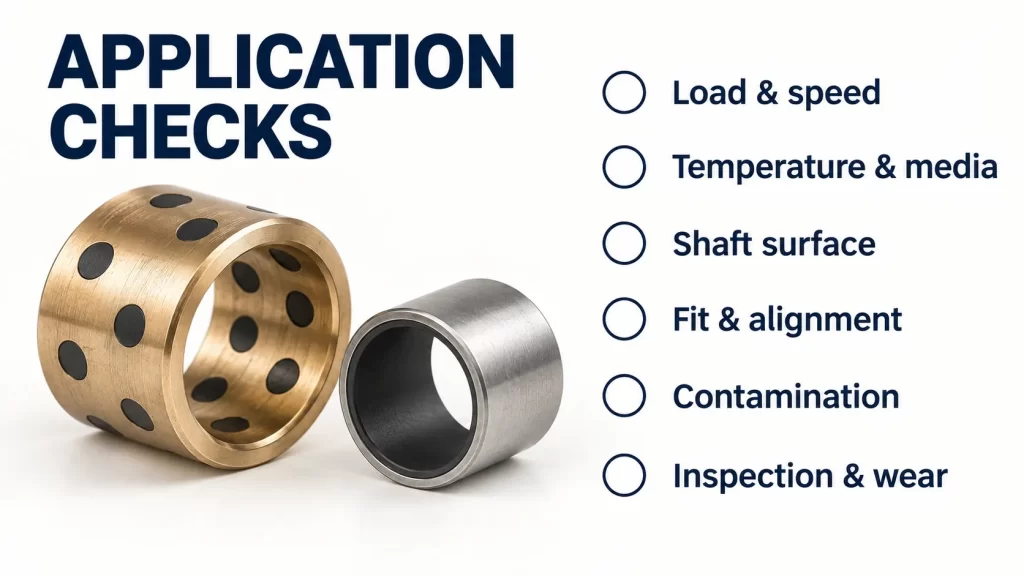
7. Mistakes I See Every Single Week
Mistake 1: Ignoring shaft hardness.
PTFE transfer film needs a hard shaft. 45 HRC minimum. If your shaft is soft, the film won’t form properly and wear goes through the roof.
Mistake 2: Too rough a shaft finish.
Ra should be 0.2–0.6 µm. A rough shaft acts like sandpaper on the PTFE. You’ll kill the bushing in weeks.
Mistake 3: Using oil-impregnated bronze in a vacuum.
The oil evaporates. Then you have a dry bronze bushing with no lubricant. Use graphite or PTFE instead.
Mistake 4: Skipping the run-in.
Self-lubricating bushings get better after a few hours. Don’t hit them with full load on day one. Let the transfer film form.
Mistake 5: Assuming all “self-lubricating” bushings are the same.
They’re not. A $2 sintered bronze bushing and a $15 DU bushing are completely different animals. Match the material to the job.
8. FAQ — Straight Answers, No Fluff
Q: Do self-lubricating bushings really need zero maintenance?
A: For their designed life, yes. But they do wear out eventually. You still need to replace them when they hit the wear limit.
Q: Can I use them in food processing?
A: Absolutely. That’s one of the best applications. No grease means no contamination. Stainless steel and PTFE-lined versions are common.
Q: What’s the maximum load?
A: MYWAY DU bushings handle 140 N/mm² dynamic. Graphite-plugged bronze can go higher static. But watch the PV value — pressure times velocity — that’s the real limit.
Q: How long do they last?
A: Depends on load, speed, temp, and shaft. In a well-matched application, 10,000+ hours is normal for DU bushings. Sintered bronze in motors often lasts the motor’s life.
Q: Are they more expensive than greased bushings?
A: Upfront, yes. 30–50% more. But over the life of the machine, they’re almost always cheaper because you cut labor and downtime.
Q: Can I get custom sizes?
A: Yes. MYWAY machines custom bushings up to 1,200 mm diameter. Send a drawing.
Q: What if I’m not sure which type to use?
A: Talk to us. We’ll ask about load, speed, temperature, environment, and shaft. Then we’ll recommend the right one. No obligation.
100000+ Types of Bushings – Contact Us for Details