
Recent Posts
Steel Backed Bushings for Reliable Motion and Easier Maintenance
Introduction
A steel-backed bushing can be a good choice for a joint that’s awkward to grease, but the words ‘steel backed’ don’t tell you whether it can run dry. You need to know what’s on the inside. PTFE composites, POM linings, and bronze bearing layers serve different purposes. This guide looks at those differences through the questions buyers actually need answered: Will the material suit the movement? What does the shaft need? How should the sleeve be fitted? It also explains what to send MYWAY when requesting a material recommendation and price, so a drawing turns into a workable specification rather than another round of emails.
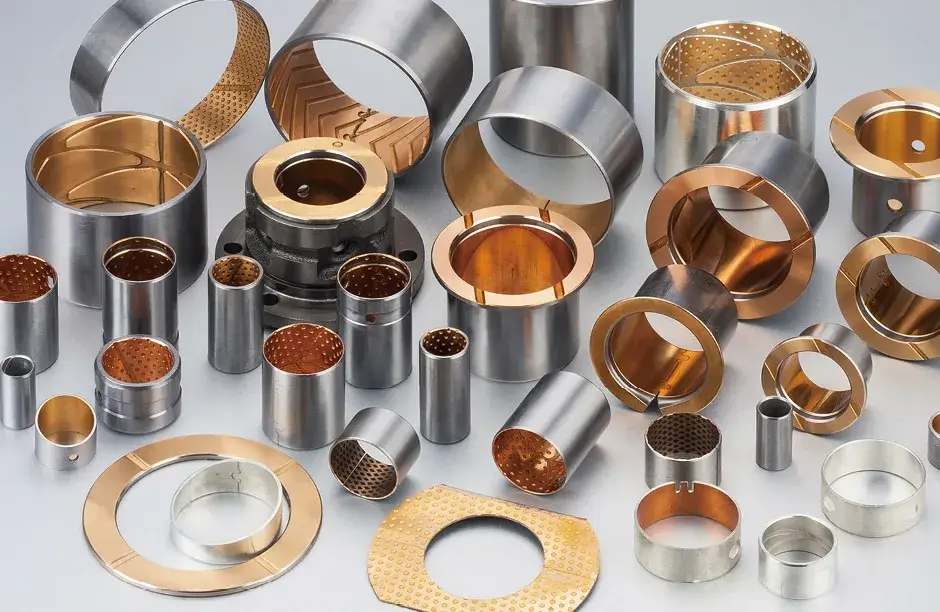
Table of Contents
1. What steel backed bushings actually do
A pin joint starts to develop play. A guide becomes harder to move. A grease point sits behind a guard that takes half an hour to remove. These are practical reasons to review a bushing, even when the original part is inexpensive.
A steel-backed bushing is a plain bearing with a steel outer support and a different material at the sliding surface. The steel supports the bearing layer within the housing. The lining is selected for friction, wear, lubrication, and compatibility with the shaft. Common metal-polymer constructions also include a porous bronze intermediate layer that anchors the sliding material.
Here’s the catch when buying by appearance: a PTFE-lined sleeve and a bronze-lined sleeve can have similar outer surfaces. Their lubrication needs may be quite different. Even the copper color can be misleading. It might be a coating on steel, so don’t use it to identify a solid bronze bearing.
You may see these components listed as steel backed bushes, sleeve bearings, composite bushings, or metal-polymer plain bearings. Those terms help you find suppliers, but a purchase specification needs more detail. Start with the backing and lining materials, dimensions, and intended lubrication condition.
There is also a useful distinction between a steel-backed bearing and a solid steel sleeve. A solid steel sleeve does not automatically provide the sliding behavior of a polymer-lined bearing. When comparing quotations, ask what actually contacts the shaft. That single question can prevent a poor substitution.
2. When a PTFE composite bushing makes sense
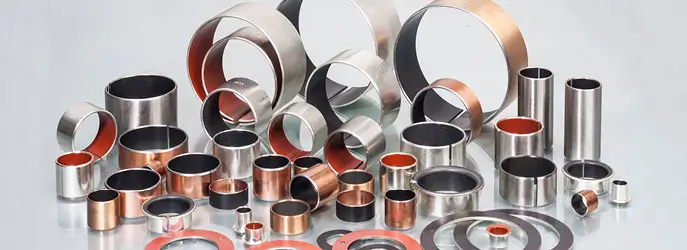
A dry-running PTFE composite bushing is worth considering when regular greasing is difficult or unwanted. The PTFE-based surface provides solid lubrication, and material transferred to the mating surface contributes to the running interface. The details depend on the formulation and operating conditions.
Suppose a linkage sits behind a guard and moves only when the machine changes position. Getting a grease gun to it is difficult. A suitable dry bearing could remove that awkward maintenance job. Before making the change, though, check the load and the actual movement. A convenient maintenance arrangement is only useful if the bearing survives the duty.
‘Maintenance free’ can sound more reassuring than it should. The sleeve still wears. Leave a rough shaft in place or allow dirt into the joint, and a new liner may have a short life. Misalignment deserves a look as well, especially when the old part is worn heavily at one end.
MYWAY self-lubricating bushings include PTFE composite options and several component forms, including straight sleeves, flanged bushings, thrust washers, and sliding plates. The relevant starting point is the duty you need to solve, rather than the color of the liner.
Perhaps the real complaint is that the mechanism sticks after sitting overnight. Say that in the inquiry. ‘Low friction’ doesn’t explain when the problem occurs. Give the stroke or swing angle for repeated short movements, and mention any restriction on added oil. That is the information needed to discuss the contact in your machine.
Do not add grease to a dry-running design merely because a joint feels tight after installation. Check the installed bore, shaft size, and alignment first. Lubrication changes should follow the guidance for the selected bearing material.
3. Choosing between POM and bimetal bushings
If grease already reaches the joint reliably, there may be no reason to remove it. Look at materials intended to work with that lubrication arrangement before switching to a dry-running design.
A POM composite bushing commonly has a steel support, a sintered bronze interlayer, and a polymer surface with lubricant pockets. SKF’s composite bearing guide distinguishes this construction from its PTFE composite material. The pockets support grease retention; they are not evidence that the bearing can run indefinitely without lubrication.
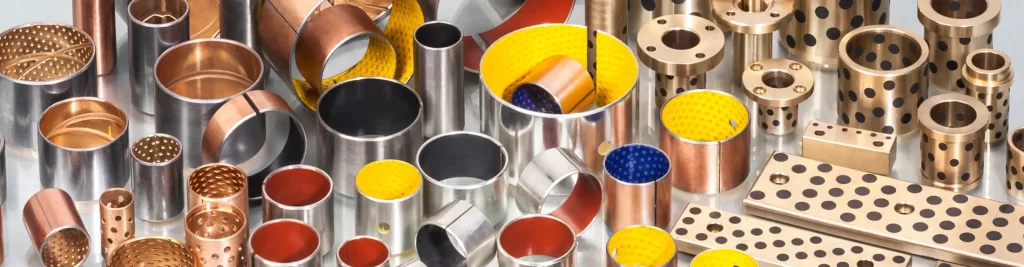
MYWAY POM boundary lubrication bushings provide a product route for applications where initial lubrication and, where required, later replenishment can be arranged. Ask about lubricant compatibility and the maintenance interval for your operating cycle. An interval copied from another machine is only a guess.
A conventional bimetal bushing uses steel with a metallic bearing layer, often a bronze alloy. MYWAY’s range includes several steel-and-alloy combinations. MYWAY bimetal bushings are therefore another option to discuss when the assembly has an appropriate grease or oil supply. Specify the alloy and lubrication arrangement, since the family also includes specialized constructions.
Here is a practical way to narrow the discussion. For a joint that must run dry, begin with a grade explicitly intended for dry service. For a greased pivot, compare a suitable POM composite with a suitable metallic bearing. For an oil-fed mechanism, provide the oil specification, operating temperature, and supply details before choosing the lining.
The question ‘Which is strongest?’ won’t settle this choice. Holding a heavy load while stationary is a different job from carrying it through repeated movement. Ask how the proposed material fits the whole operating cycle, including stops and restarts. A large load figure on its own leaves too much out.
4. Match the bushing to the way the machine moves
‘For agricultural machinery’ is a useful starting point. It still leaves the supplier guessing about the joint. One linkage may move a few times a day; another works throughout a shift in abrasive dust. Even with the same shaft diameter, you’d want to discuss them separately.
For an oscillating pivot, record the angle of movement, cycles per minute, and whether the load changes direction. Include long holding periods and occasional impacts. A joint that rocks through a small angle needs to be assessed using that motion, rather than described as a slow rotating shaft.
In a packaging mechanism or assembly fixture, friction consistency may matter as much as wear. An actuator may have enough force to move the joint once it is running but less margin at startup. If smooth positioning is the priority, ask for validation of starting behavior as well as operating clearance.
For hydraulic equipment, distinguish a cylinder mounting pivot from a guide operating inside an oil-filled assembly. The first may need environmental protection and a separate lubrication plan. The second requires compatibility with the working fluid and the actual temperature cycle. Calling both “hydraulic bushings” leaves too much unanswered.
Outdoor machinery adds another set of questions. Can water sit around the sleeve? Does the equipment face salt spray, washdown chemicals, or abrasive dust? State the exposure instead of simply requesting a corrosion-resistant bushing. Backing material, protective finish, shaft condition, and sealing all deserve review.
Treat these as examples of what to discuss, rather than approvals for a particular MYWAY grade. There is no need to write a long application report. A drawing, a description of the movement, and the operating conditions usually make a much better starting point than an industry name alone. Use those details to agree on the material and sample test.
5. Read the load and speed data together
It’s tempting to read down a data sheet and tick off load, speed, and temperature separately. Be careful: the maximum in each row isn’t necessarily available at the same time. Check the combination your machine will actually reach, under the stated lubrication condition.
For an initial check of a cylindrical sleeve under radial load, average projected bearing pressure is calculated by dividing radial force by the product of shaft diameter and effective bearing length. The units must agree. With force in newtons and dimensions in millimeters, the result is N/mm², equivalent to MPa.
Consider a hypothetical 20 mm shaft, a 25 mm effective bearing length, and a radial load of 5,000 N. The projected area is 500 mm², giving an average pressure of 10 MPa. This is a worked example, not a MYWAY rating.
At 60 rpm, that shaft’s circumferential speed is approximately 0.063 m/s. Multiplying pressure by sliding speed gives a PV value of approximately 0.63 MPa·m/s. PV is a useful screening measure related to the severity of the sliding duty. It does not predict service life by itself or account for every local contact condition.
If the load is carried near one edge because the shaft bends, the average calculation can hide a much higher local pressure. A longer sleeve may reduce the calculated average pressure, yet still leave an alignment problem unresolved. This is why a section drawing and information about the surrounding supports can matter.
The running surface also needs attention. Specify shaft material, hardness, roughness, and any coating. Confirm the roughness parameter being quoted: Ra and Rz are different measurements. Schaeffler’s metal-polymer bearing guidance treats the mating surface and installation geometry as design inputs. Its recommendations are material-specific, so they should not be copied across unrelated grades.
Ask MYWAY to review the complete operating point against the proposed grade. Include peak loads, duty cycle, temperature, and the proposed lubricant. For a critical assembly, agree on a test that represents actual use, with defined limits for wear, clearance, and operating resistance.
6. Installation details that deserve a place on the drawing
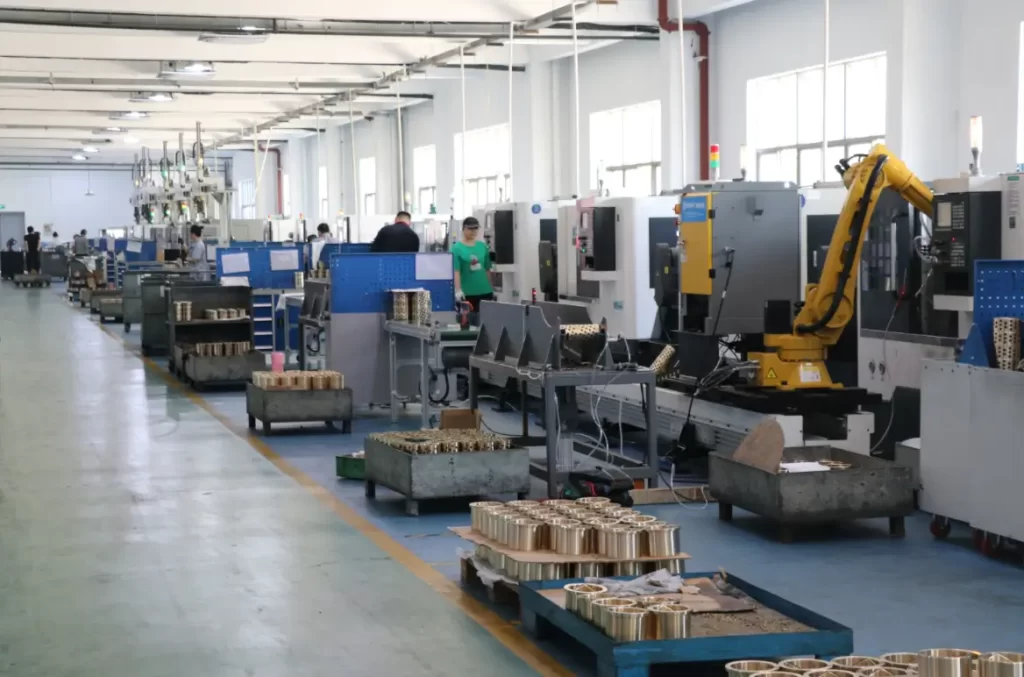
Don’t leave fitting instructions until the sleeves arrive. A correct material choice won’t help much if the lining is damaged during assembly. Put the installation requirements on the drawing or in the assembly instructions, alongside the dimensions the inspector will check.
Begin with a clean, burr-free housing bore and the specified entry geometry. Check the housing dimensions and support the part during pressing. Use tooling that keeps the bushing aligned and applies force appropriately to the end face. Hammering directly on a thin sleeve can distort it or damage the lining.
The installed bore is the dimension the shaft will actually run in. A wrapped bushing’s free-state shape and dimensions do not tell the whole story after it is pressed into a housing. Agree on the installed-bore inspection method, housing tolerance, and shaft tolerance before production. A universal interference value cannot replace those details.
When lubricant holes are required, check their position against the housing supply. Confirm any required seam orientation with the supplier. Neither feature should be left to the assembler to interpret from a photograph.
Be particularly careful about machining a polymer-lined bore. Some bearing materials are supplied ready for use and cannot tolerate routine reaming of the sliding layer. Other products are specifically designed for controlled machining.
For the first assembly, record the dimensions and check movement through the intended travel. If resistance is unexpectedly high, stop and inspect the fit. Forcing the shaft through may conceal the original problem while creating a new one. Keep the sample inspection record with the drawing revision so the approved arrangement can be repeated.
7. Getting a useful steel backed bushing quote from MYWAY
An email saying ’20 mm bore, please quote’ is quick to send. It may take several more emails to establish what you need. Even a complete set of dimensions leaves the material and operating conditions open. Give suppliers the same information at the start, and their quotations will be easier to compare.
MYWAY lists both standard and custom bushings. Its published range gives buyers several material families to discuss without treating one lining as the answer to every problem. For a new design, request a proposed material specification together with the quotation. For a replacement, include the existing part number and explain what you want to improve.
A useful RFQ includes:
- A drawing showing inside diameter, outside diameter, length, flange details, and tolerances.
- Shaft and housing materials, surface condition, and available inspection data.
- Normal and peak loads, movement type, speed or stroke, and operating hours.
- Temperature range, contamination, moisture, chemicals, and lubrication arrangements.
- Sample quantity, expected production demand, delivery destination, and required documents.
If the current bushing fails early, include photographs and a short description of the failure. Say whether wear is even, concentrated at one end, or accompanied by scoring. Note how long the machine ran and whether the operating conditions changed. A damaged part can be useful evidence, but it should be assessed with the surrounding assembly.
Before accepting the price, check what it covers. Which grade is being supplied? What dimensions will be inspected, and what records will come with the parts? Clarify packaging and any sample or tooling charges. If your purchasing file needs a material declaration or a particular compliance document, request it for the proposed product while the quotation is being prepared.
To start, send MYWAY your bushing drawing and application details. If the drawing is incomplete, send the dimensions you have and identify what still needs confirmation. Ask for a material recommendation, sample proposal, and quotation based on the same stated conditions. That gives both sides something concrete to review.
8. FAQ about steel backed bushings
Are all steel backed bushings self lubricating
No. The backing supplies support; the sliding material and design determine lubrication needs. A PTFE composite intended for dry service differs from a POM boundary lubrication bearing or a conventional lubricated bimetal sleeve. Ask for the lubrication condition to be written into the specification.
Is a steel backed bushing better than a solid bronze bushing
It depends on the joint. A thin composite sleeve may suit limited radial space and a need to reduce greasing. A suitable bronze bearing may suit an existing lubricated design. Compare installed dimensions, permissible duty, shaft requirements, maintenance, and replacement cost rather than relying on a material name.
Can I replace a DU or SF1 bushing by matching dimensions
Dimensions are only part of the check. Compare the actual lining, lubrication requirements, tolerances, and operating limits. DU is a GGB trademark, while SF-1 is commonly used in supplier descriptions; neither a familiar label nor a matching size proves interchangeability between products. Confirm the proposed replacement grade.
Can a steel backed PTFE bushing run at high speed
There is no universal rpm limit for the whole family. Shaft diameter affects sliding speed, and load, heat removal, lubrication, and duty cycle affect suitability. Send both the rotational speed and shaft diameter. For oscillation or linear movement, provide the actual motion profile.
Does maintenance free mean it will last forever
No. It refers to the intended maintenance arrangement, commonly the absence of routine relubrication within specified conditions. The bearing still has a finite wear life. Define an acceptable clearance or wear limit and an inspection plan appropriate to the machine.
Can steel backed bushings be used outdoors or around water
Possibly, after checking the full material combination and exposure. A polymer lining does not protect every exposed steel surface. Describe immersion, spray, salt, cleaning chemicals, and periods of inactivity so the backing, finish, mating parts, and sealing can be reviewed together.
Can I ream the bore after installation
Only when the selected material and manufacturer instructions allow it. Removing a thin sliding layer can change the bearing’s function. If you need a tightly controlled finished bore, raise that requirement before ordering so the material and manufacturing route can be chosen accordingly.
What should I send to MYWAY for a recommendation
Send the drawing, load, movement, temperature, lubrication condition, shaft details, and quantity. For a replacement, add photographs and the reason for changing it. If some values are estimates, mark them clearly. An honest estimate is more useful than an unexplained performance target.
100000+ Types of Bushings – Contact Us for Details