
Recent Posts
Bearing Bush Guide to Types Materials Applications and Selection
Introduction
A bearing bush is a plain bearing that supports a moving shaft or pin on a sliding surface. The right bush has to fit the housing, provide the required running clearance and work with the lubrication available in the machine. Size is the starting point. Material and operating conditions decide whether that size will work.
For a buyer, the difficulty is that several very different products can look like the same short metal tube. A solid bronze sleeve, an oil-impregnated bush and a graphite-plugged bush may share the same nominal dimensions. They do not necessarily share the same installation procedure, maintenance needs or working limits.
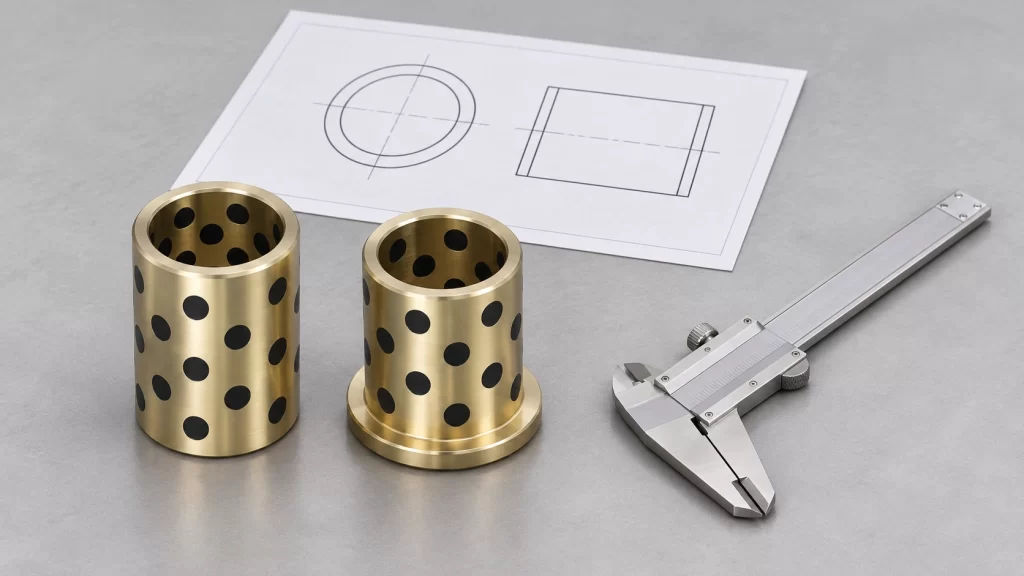
Table of Contents
1.What is a bearing bush
Picture the contact inside a plain bush: a pin moving against the bore, without balls or rollers between the two. Rotation is only one possible movement: a pin might swing through an arc, or a shaft might slide lengthways.
Catalogs are not consistent about names: bearing bushing, sleeve bearing and plain bush can all refer to this general component. “Bearing” is the wider category, so a bush is a type of bearing rather than its opposite.
There’s another naming trap in a purchasing list. Is the sleeve in that photograph a bearing, or just a spacer holding two parts apart? You can’t always tell from the picture. An assembly drawing answers much more. Even a sentence explaining which component moves would help a supplier who has never seen your machine.
2. Material Options and Performance Characteristics
Straight sleeves flanged bushes and thrust washers
A straight sleeve has its working surface around the bore and provides radial support. It is a straightforward form where the housing already provides the required location and axial movement is handled elsewhere. Its length, wall thickness and end details still need to suit the assembly; a plain shape does not make those dimensions unimportant.
A flanged bush adds an annular face at one end. The flange can locate the sleeve and, when designed for the duty, provide a surface for axial contact. A separate thrust washer is another way of providing that contact surface. Neither a flange nor a washer should be assigned a thrust capacity simply because it fits the available space.
Think about a pin shoulder pressing toward the housing. The bore contact and the shoulder contact are different working surfaces. Show both in the assembly sketch. This also helps identify a corner radius that needs clearance, a flange that would interfere with another part, or a washer whose position needs to be controlled.
Solid bronze bushes
Solid bronze is a familiar option for machined sleeves and drawing-based replacement parts. C93200, often associated with SAE 660, is one bearing bronze from the leaded tin bronze family. Other bronze grades have different properties. A drawing that says only “bronze” still leaves a significant material decision open.
For a conventional solid sleeve, trace the oil or grease route from its supply to the moving contact. Is that route actually shown? A groove without a suitable supply arrangement does not settle the lubrication question. Material choice, shaft condition and the way lubricant reaches the bearing all belong in the same review.
MYWAY’s bronze bushing range provides a starting point for discussing sleeves and related forms. If the drawing fixes the alloy, include that designation in the inquiry. If material selection is still open, describe the duty and ask for the proposed grade to be identified in the quotation.
Oil impregnated bronze bushes
With sintered bronze, oil has somewhere to reside inside the material: its pore structure. Wiping oil onto a dense machined sleeve does not give it the same construction. This distinction matters when somebody suggests adjusting the bore after delivery or treats two bronze-looking parts as interchangeable replacements.
Machining can affect the pores at the working surface. A dull tool may smear them, reducing the intended self-lubricating effect. So “we can open it up in our workshop” needs a follow-up question: by what process? Obtain the instructions for the actual material before agreeing to bore rework, even when the amount to remove sounds small.
Graphite plugged bronze bushes
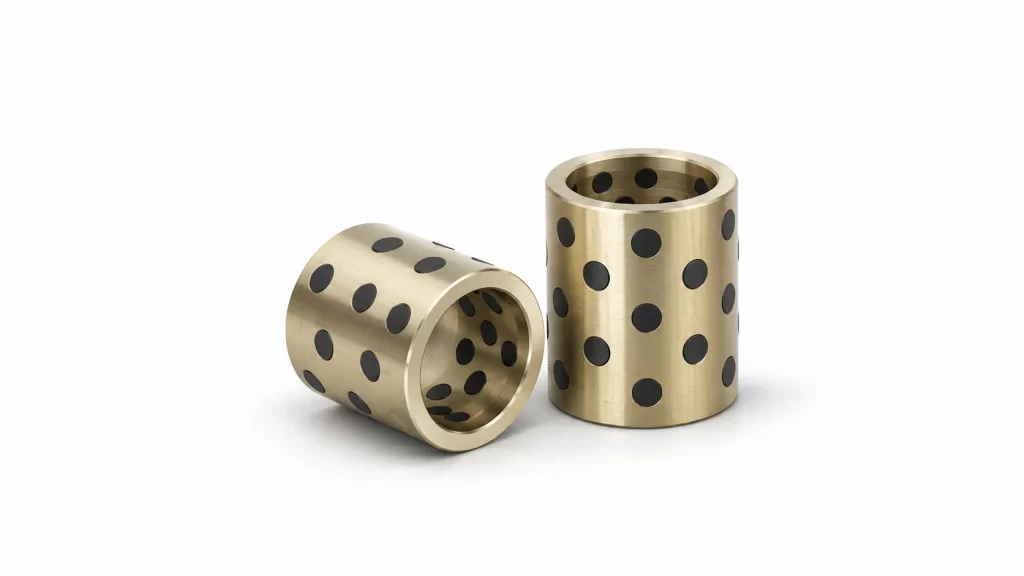
The dark circles in a graphite-plugged bush are solid lubricant inserts. They are not empty grease holes. The bronze body and the lubricant inserts perform different jobs at the bearing interface, and the chosen construction must be appropriate for the load, motion and surrounding conditions.
Consider a pivot whose grease point would be difficult to reach after assembly. That is a reason to discuss a MYWAY solid-lubricating bushing. It is not enough information to approve the part. Include the pin specification and motion details, and establish any preparation or initial lubrication required before the first movement.
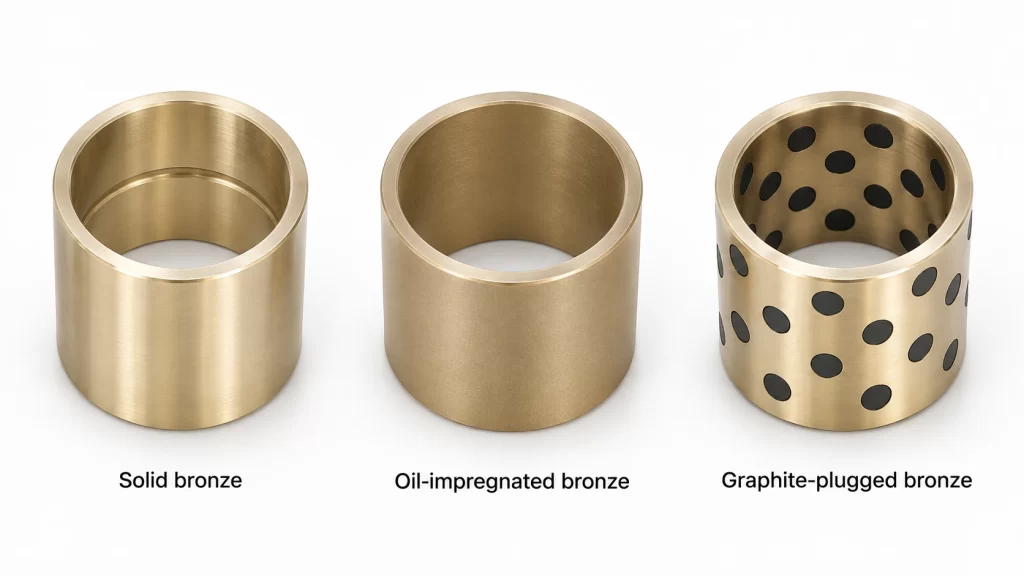
Solid bronze, oil-impregnated bronze and graphite-plugged bronze use different lubrication arrangements. Generated comparison; operating limits must be checked for each product.
Bimetal and metal polymer alternatives
Some bushes combine a metal backing with a different bearing surface. In a bimetal construction, the backing and metallic sliding layer have separate functions. Other composite bushes use a polymer-based working layer. These arrangements can be useful where available wall thickness influences the design, but the labels describe families of products rather than one universal specification.
Do not transfer the lubrication rule from one family to another. Some products are intended for dry running under stated conditions; others require oil or grease. The same caution applies to machining. A thin working layer is not an allowance for workshop adjustment unless the product instructions expressly permit that operation.
3. Where bearing bushes are used
Pivots and linkages
A pivot does not make full revolutions in the same way as a drive shaft. It moves through an angle, may pause under load and may reverse frequently. For a loader linkage, agricultural attachment or other pin joint, an inquiry should describe that movement along with the force on the pin. These are application examples, not approvals for a particular bushing.
The load on one joint may also change during the machine cycle. “The attachment weighs this much” may not describe the force at the bearing. Where the load is uncertain, provide the linkage arrangement and identify the missing calculation. An assumed value should not quietly become a confirmed design load in a purchase order.
Guides and moving mechanisms
Packaging equipment, handling mechanisms and general machinery may use bushes to guide sliding or oscillating members. Here the travel, reversals and alignment matter as well as nominal diameter. A guide that moves a short distance many times per minute deserves a different description from one that is adjusted occasionally and then remains stationary.
For a rotating shaft, specify speed and the actual running schedule. Continuous operation, frequent starts and long idle periods are different duties. A bush selected for a slow pivot should not be moved into a continuously rotating assembly merely because both shafts have the same diameter.
Equipment with difficult maintenance access
Access can be a decisive practical issue. A grease point behind a guard or deep inside an assembly may be easy to overlook when reviewing an isolated part drawing. Describe how maintenance will be carried out before deciding on the lubrication arrangement. A self-lubricating construction may be worth evaluating, subject to its operating limits.
Dust, water, cleaning chemicals and temperature also belong in the application description. “Indoor use” is not a complete environment specification if the machine is washed down regularly. These details need not become a long report. A clear note beside the assembly sketch can prevent an offer being based on conditions that do not exist at the installation.
4. How to select a bearing bush
Begin with motion and load
Write down the motion first: rotation, oscillation or linear sliding. Add speed, stroke or angle of travel as appropriate, together with the cycle frequency. Then describe the load and whether it changes direction, includes shocks or remains on the bearing while the machine is stopped. That gives the supplier a duty to assess rather than a general description such as “heavy use.”
For an initial cylindrical-bush pressure calculation, use projected area: shaft diameter multiplied by bearing length. Divide radial load by that result. This is a nominal bearing-pressure calculation, not one based on the entire curved surface area of the bore. Keep the units consistent so the number can be compared with the relevant product data.
For example, assume a 20 mm diameter, 25 mm bearing length and 2,000 N radial load. The calculation is 2,000 / (20 × 25) = 4 N/mm², equivalent to 4 MPa. Those are illustrative inputs. The result does not select an alloy or account for local pressure where a bent or misaligned shaft loads one end.
Check sliding speed and the operating cycle
Shaft rpm alone is not sliding speed. Diameter matters because a larger surface travels farther in each revolution. For an oscillating pin, provide the angular movement and the number of cycles; do not substitute a guessed rpm figure. Also identify pauses and whether the load remains applied during them.
You may see a PV value on a bearing data sheet. It combines nominal pressure and sliding velocity and is used as one screening measure related to frictional heating. A satisfactory PV calculation does not override a separate pressure limit, speed limit or temperature restriction. Compare the actual operating cycle with the conditions behind the published rating.
Longer is not automatically better, either. More nominal area can reduce calculated pressure, but length also has to work with shaft stiffness and alignment. If the assembly is loading one edge, increasing sleeve length is not a substitute for understanding the contact. Keep the calculation and the mechanical arrangement together during selection.
Set the lubrication and maintenance requirements
Start with what the machine can provide. Is there an oil supply, a grease point, or no convenient route for regular relubrication? Who will service it, and can that person reach the bearing once the guards and neighboring parts are fitted? A material recommendation made without this information may be impractical even if the dimensions are correct.
Agree on the intended lubricant where the design requires one, along with any initial preparation. For a self-lubricating bush, establish what that term means for the specific construction. It may remove scheduled relubrication under its stated conditions. It does not remove the need to investigate wear, contamination, loose parts or a damaged mating shaft.
Specify the housing shaft and installed clearance
An outside fit that retains the sleeve and an inside fit that permits movement are doing different jobs. A press-fit drawing has to address both requirements. Measuring a loose bush on the bench will not necessarily establish the clearance after it has been fitted, because installation can affect the bore.
A note such as “20 mm ID” is incomplete without limits and a measurement condition. Is it the free bush, the installed bore or a dimension after an agreed finishing operation? The quotation should say which condition the supplier is responsible for. Avoid copying a housing tolerance from an unrelated bearing construction just because the nominal diameter matches.
The shaft needs a specification too. Have its material, hardness, finish and size available for review. On a replacement job, add its present condition. Copying the bush dimensions will not tell a supplier about a scored pin, and an accurately made sleeve cannot restore material already worn away from another part.
Compare complete specifications before comparing prices
A quote for ten grooved sleeves with closely controlled bores is a different request from a large batch of unfinished blanks. Put the drawing revision, alloy, inspection scope and quantity beside each offer. Where workshop finishing is required, include that work in the comparison rather than treating the delivered sleeve as ready to install.
Custom dimensions may be justified when an existing assembly cannot accept a catalog size. On a new design, first establish which dimensions are genuinely fixed and which can change. This gives a supplier room to discuss a suitable construction without accidentally proposing changes to a shaft or housing that has already been released for manufacture.
Agree on inspection documents before the order, especially where a customer drawing calls for a material certificate or recorded dimensions. Ask what will be supplied and how it identifies the ordered parts. A general product brochure is not the same thing as documentation tied to a particular order. The requirement should be visible in the quotation rather than introduced after the bushes have shipped.
For a first order, decide how the initial parts will be accepted. Will the workshop check the loose dimensions, install a sample in the specified housing, or perform an agreed application trial? Define the acceptance condition before comparing results. A sample that turns freely on a loose pin has not demonstrated that the production assembly will have the required fit.
5. Installation and troubleshooting
Prepare the parts before applying force
Look at the housing before the press comes down. Is its lead-in free of burrs? Has the bore been cleaned and checked? Prepare a tool that supports the intended end face, starts the sleeve squarely and avoids damaging the working surface. Use the installation method specified for the construction being fitted.
A direct hammer blow on the end is not a substitute for a controlled press fit. If the drawing includes an oil hole, joint position or orientation requirement, establish that position before seating the bush. Correcting it later may require removal, and a removed part should not automatically be assumed suitable for reuse.
Don’t make the first movement check under working load. Measure the installed parts and try the specified motion. Suppose the shaft stops at one point. Note that position and the actual sizes before doing any rework. A reamer may remove evidence of the original problem, quite apart from what it might do to a porous bearing or thin lining.
Bronze bushes, a drawing and measuring tools before assembly. Generated illustration; no actual inspection result is shown.
Investigate a tight shaft or early wear
A shaft that bound during assembly has a different history from one that tightened only when warm. Try to reconstruct the sequence before blaming the alloy. Check the housing and installed bore against their specified limits, and look for damage or misalignment. Symptoms guide the investigation; they are not a diagnosis on their own.
For an early wear problem, note whether the wear is concentrated at an end or distributed along the bore. Was play present from the start, or did it develop during service? Record changes in lubrication, loading or operating hours if they are known. A brief maintenance history is more useful than a request for “a stronger bronze” with no explanation.
Before discarding the old sleeve, photograph the bore, outside surface and matching pin. Mark the orientation while you still know it. An original drawing is preferable to “make it like this worn sample,” because wear has changed the dimensions you are trying to recover. If no drawing exists, separate measured worn dimensions from proposed replacement dimensions.
6. Bearing bush FAQ
What is the difference between a bush and a sleeve bearing
In many industrial catalogs the terms describe the same general kind of plain bearing. Usage varies, however, and a part called a bushing may have another purpose. Include the drawing or part number in an inquiry rather than asking the supplier to resolve the application from the name alone.
Is a bronze bush better than a ball bearing
There is no useful winner without a duty to compare. A slow pivot and a continuously rotating drive have different requirements. A sleeve that fits where a rolling bearing used to sit has only passed a dimensional check. Friction, load capacity, heat, available space and maintenance still need an engineering assessment.
Can a bearing bush carry axial load
A straight sleeve primarily provides radial support through its bore. Axial contact may be handled by a suitably designed flange or separate thrust washer. Show the contact faces and required load in the drawing. The presence of a flange does not establish its capacity or confirm that its opposite face is suitable for the duty.
Do graphite plugged bushes need grease
Use the instructions for the particular bearing and application. A solid-lubricating construction may operate without routine greasing in its specified duty, but that does not establish one rule for every product with black inserts. Confirm preparation, start-up requirements, mating surface and environmental restrictions when selecting the part.
Can I ream a bearing bush after installation
Sometimes, when its construction and drawing allow that operation. Dense machined bronze, porous oil-impregnated material and thin bearing layers require different treatment. Get advice for the actual construction, then specify the permitted finishing process and inspection condition. Do not use a reamer as the first response to an unexplained tight fit.
How long should a bronze bearing bush last
There is no reliable universal service-life figure. Load, motion, lubrication, contamination, alignment and the mating shaft all affect the duty. An existing machine’s history can help define a replacement requirement, but it is not a guarantee for another installation. Request an application review rather than relying on an unsupported number of operating hours.
What information is needed for a custom bearing bush
Begin with the drawing revision, dimensions, tolerances, quantity and required delivery date. Add the material if fixed, plus the shaft, housing, motion and lubrication details. Mark unknowns clearly. If the inquiry only contains a sample photograph, the supplier still has to establish the dimensions and operating requirements before proposing an equivalent part.
7.Discuss your bearing bush requirements with MYWAY
MYWAY offers bronze and solid-lubricating bushing product ranges for buyers evaluating a replacement or a drawing-based component. An inquiry is most useful when it distinguishes an exact part to be quoted from a design that is still open for review. State which dimensions and materials cannot change, and identify where you want a proposal.
Send the drawing with its revision and your intended order quantity. Add an assembly sketch if the load path or surrounding contact faces are not obvious. For a replacement, include the service history and the condition of the shaft and housing. For a new machine, explain the expected movement and how lubrication or inspection will be handled.
Information to include | Useful details | Purpose |
Part specification | Drawing revision, dimensions, alloy, quantity | Defines the requested component |
Operating duty | Load, motion, speed, temperature, lubrication | Supports a suitability discussion |
Mating components | Shaft finish, hardness, housing and fits | Clarifies the bearing arrangement |
Order scope | Timing, inspection and documentation | Makes the quotation reviewable |
An unknown is better identified than disguised as a fact. “Shaft finish to be confirmed” leaves a visible question to resolve before material approval or production release. When the offer arrives, check the construction and inspection scope alongside the price, and retain those details with the purchase order for the workshop.
Ready to discuss your application? Contact MYWAY for a bearing bush quotation with your drawing, quantity and operating notes. Ask for confirmation of the proposed material and supply condition so the next step is based on an agreed part specification, whether you need a plain bronze sleeve, a flanged bush or a solid-lubricating option.
100000+ Types of Bushings – Contact Us for Details