
Recent Posts
Applications of Bronze From Marine Hardware to Machine Bushings
Introduction
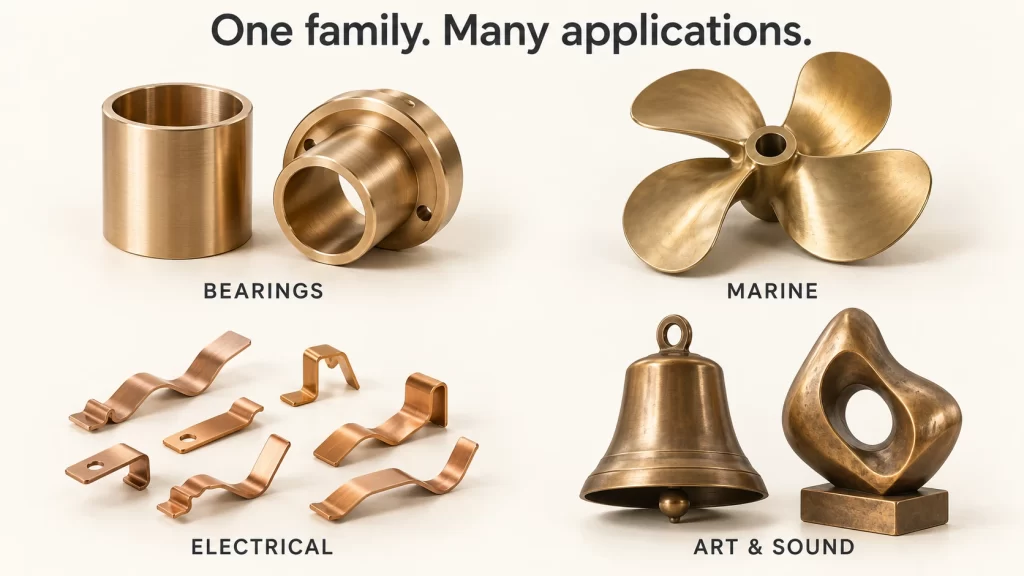
A boat propeller and a small electrical contact might not seem to have much in common. Neither looks much like a bronze statue. Yet bronze alloys have a place in all three, as they do in gears, cymbals and the plain bearings hidden inside machinery. The word covers rather more than that familiar brown metal finish suggests.
The confusion starts when that broad list becomes a purchasing specification. “Bronze sleeve, same as the old one” sounds clear enough until someone asks which bronze, what bore tolerance, or why the old sleeve wore out. Those are reasonable questions, and they rarely get answered by a catalog photograph.
For a buyer, it helps to separate two things: the jobs bronze is commonly used for, and the information needed to order a particular component. We’ll look at both here. Bushings deserve some extra attention because a small, apparently simple part can raise quite a few questions once you get beyond its outside dimensions.
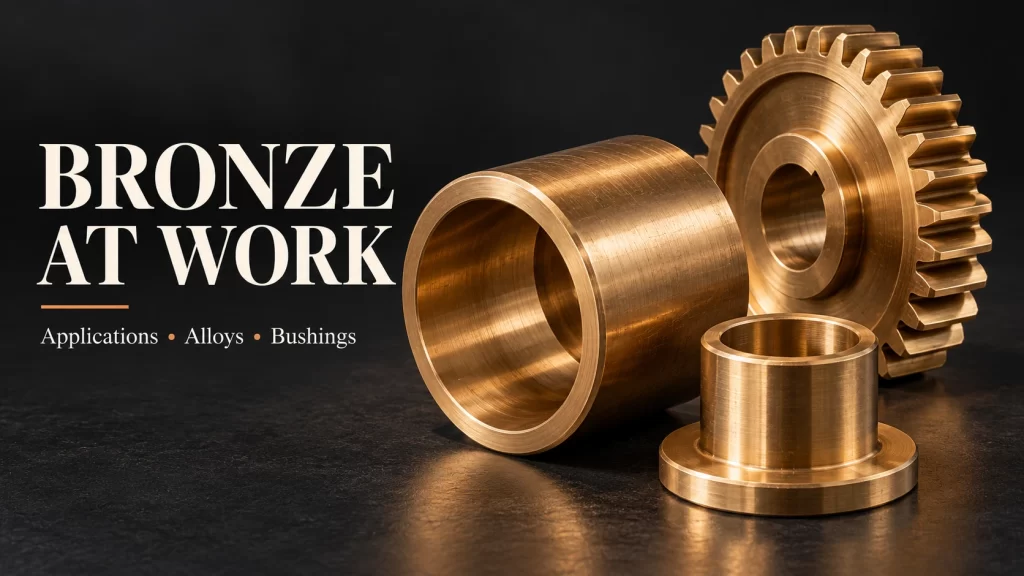
Table of Contents
1. What bronze means on a drawing
The familiar definition is copper plus tin. Open an engineering catalog, though, and you will also find aluminum bronze, silicon bronze and several other names. There is a historical wrinkle here: some manganese bronzes are brasses by composition, despite the name on the stock list. The Copper Information Center explains this in its overview of bronze alloy families.
For ordering purposes, write down the grade. Add the material standard and the condition or temper if the specification requires one. Imagine receiving three quotations with three different trade names against the same drawing. An agreed material callout gives you something to compare before anyone starts discussing price or delivery.
The photo question comes up here too. A newly polished sleeve may look quite unlike the tarnished one beside it, and warm lighting adds another variable. Keep photographs in the inquiry, by all means. Just attach the known grade rather than leaving someone to infer it from a golden or reddish surface.
2. Common bronze uses at a glance
Application | Typical starting point | Main selection question |
Bushings and sleeve bearings | Bearing bronze such as C93200 | How will the sliding surface be lubricated? |
Gears and worm wheels | C90700 tin bronze is one example | State the load and the operating cycle |
Marine hardware | Selected aluminum bronze grades | Describe water exposure and project requirements |
Electrical spring contacts | Phosphor bronze such as C51000 | What contact force and electrical performance are needed? |
Sculpture and decorative castings | Tin bronze and silicon bronze | Foundry process and the requested surface finish |
Musical instruments | The maker specifies a copper-tin formula | Required sound and how the instrument is made |
There is a range of choices behind each row. A grade appearing here does not make it a substitute for the material specified on your drawing.
3.Bronze bushings and bearings in machinery
The simplest bush is a tube with an accurately made bore. Put it between a shaft and its housing and you have a replaceable sliding surface. A pin joint can use much the same basic shape, although the pin may only move through a small angle. That is the plain-bearing arrangement we are discussing here, rather than a bearing with balls or rollers.
Try looking up C93200 in a stock catalog; SAE 660 is another name you may find beside it. The uses on Concast’s page range from machine-tool bearings to thrust washers and pump components. Being readily machinable helps when the bush needs a shoulder or a particular lubrication feature. The manufacturer’s C93200 bearing bronze data gives the material details.
Now think about the next repair. Can the sleeve come out on its own, or will removing it mean dealing with the surrounding assembly? Access matters here. A cheap part buried deep inside a machine can still be expensive to change.
MYWAY’s bronze bushing range gives you a place to compare shapes and material options. Keep your machine details beside the catalog. Finding the right diameter is useful, but it is only one part of finding a suitable replacement.
4. Gears and worm wheels
Another place to find bronze is in a speed reducer. Concast lists C90700 tin bronze for gears and worm wheels, as well as bearings working at relatively low speeds under heavy loads. Aluminum bronze enters the discussion too: heavily loaded worm gears appear among its listed C95400 uses. C90700 applications and C95400 applications provide specific examples.
Consider two orders for a bronze wheel. One is for a reducer that runs throughout a shift. The other is for an adjustment mechanism used a few times each day. Writing “industrial gear” on both inquiries hides a difference that the supplier needs to know.
An existing drawing makes this conversation easier. If the quotation proposes another grade, you can point to the original callout and ask for the reason. The mating component and lubricant do not disappear from the problem just because the replacement metal has a higher strength figure.
5. Marine hardware and seawater equipment
Propellers are probably the most recognizable marine example. Aluminum bronze and nickel aluminum bronze also find work in pumps, valves, fasteners and bearings. Corrosion resistance is part of their appeal, alongside their mechanical properties. The protective surface film on aluminum bronze is discussed in the Copper Information Center’s marine alloy overview.
On a quotation, “marine bronze” still needs a grade beside it. Where will the component sit? A fitting above the waterline and a submerged bearing have very different surroundings. Even on the same vessel, a broad description can conceal quite different service requirements.
Mention whether water exposure is constant or occasional and identify the surrounding materials. Include the project drawing rather than asking the supplier to guess which requirements apply. For repair work, photographs of the old component help explain where damage occurred. Send the material specification with them if it is available.
6. Bronze parts inside pumps and valves
Open a pump parts list and look at the component names: impeller, body, guide, bearing. Bronze alloys are used for several such parts, but their jobs differ. The body contains fluid. The guide controls movement. Calling both “bronze pump parts” tells a buyer very little about what each has to do.
C95400 is one of the grades Concast lists for pump and valve components. Its product data is a useful starting reference when that grade is being considered for a design.
The fluid description belongs in the inquiry too, along with temperature and any solids it carries. Suppose a bushing started wearing faster after a process change. That is useful information, even if nobody has established the cause yet. Without it, the manufacturer receives a familiar drawing and has no reason to know that the duty changed.
7. Electrical contacts and springs
Small electrical parts explain another use for bronze. A contact has to carry current, but it also has to keep pressing against its mating surface. That second job is easy to overlook if you only compare conductivity figures.
Concast’s C51000 phosphor bronze uses include contact blades, fuse clips and spring components. Wieland’s CuSn5 strip data describes the combination of formability, strength, conductivity and spring properties behind this type of application. C51000 uses and Wieland B15 material data.
For this application of bronze, pay attention to the form and temper being supplied. A strip that will be bent into a contact is a different purchasing item from bar stock destined for a machined bush. Put those details on the order while the designer and supplier can still resolve any ambiguity.
8. Sculpture architecture and musical instruments
Then there is the bronze you can see without opening a machine. Sculptors cast it into shapes that would be difficult to carve directly from solid metal. Tin bronze and silicon bronze both appear in sculpture references from the Copper Information Center and the Museum of Fine Arts Boston. Copper alloys in sculpture and silicon bronze.
For decorative work, the finish may be the first thing a client notices. Discuss that separately from the metal grade. A requested brown surface, for instance, is a description of appearance. It leaves the foundry with an unanswered question about what to pour into the mold and how the finished casting should be treated.
For a familiar musical example, look at Zildjian’s cymbal alloy FAQ. The company describes its cast bronze formula as 80% copper and 20% tin, with traces of silver. That detail belongs to those cymbals; it would be a mistake to turn it into a recipe for every bronze musical instrument.
A cymbal is a useful reminder to the industrial buyer. Recognizing the word bronze is easy. Finding the formulation and product form that belong in your assembly takes a little more work.
9.Choosing a bronze bushing for the actual job
Begin with the movement and the wear history
Try writing one sentence about the duty before filling in a specification sheet. “The pin rocks back and forth, then stays parked overnight” already tells someone more than “moving part.” Follow it with the measured or design values for load, speed and temperature. The Copper Development Association discusses these service conditions in Selecting bronze bearing materials.
If you are replacing a failed bush, describe what happened before asking for a different grade. Gradually increasing clearance is a different observation from seizure after a stoppage. Include where the wear occurred and how the removed bush was oriented. A photograph with the loaded end identified is more useful than an unexplained picture of a damaged sleeve.
Work out where the lubricant comes from
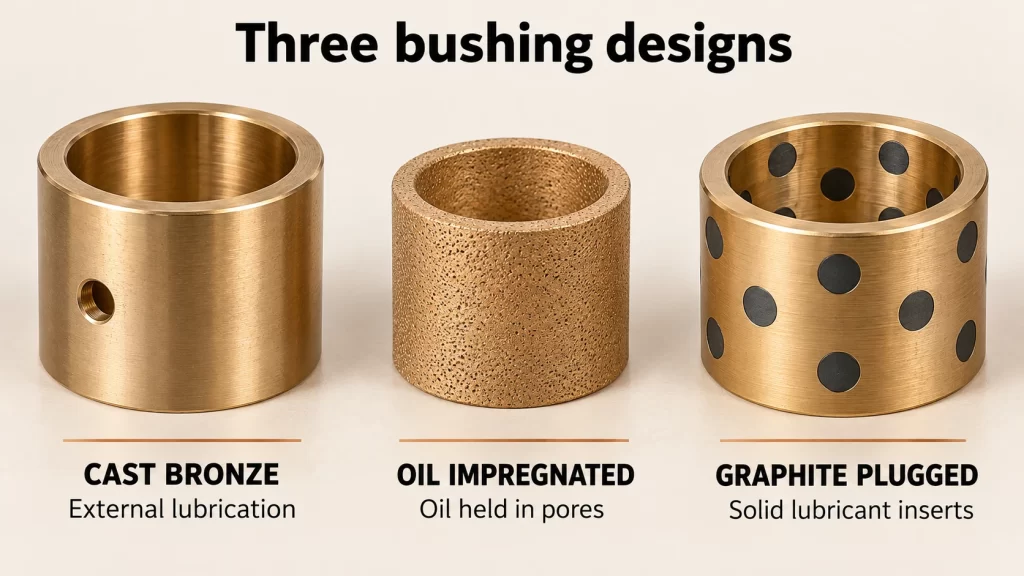
GGB describes the oil or grease requirement for conventional bronze bushes in its lubrication guidance. Load, speed and temperature enter into that choice. In the inquiry, explain the feed arrangement already on the machine, or say that it still has to be designed.
The word “impregnated” points to another construction. In a sintered bronze bearing, oil is held in pores and can reach the contact surface during operation. Bowman explains this in its sintered bronze bearing information. This construction is what makes the oil reservoir possible.
There is a third route: solid lubricant inserts in the metal body. MYWAY offers solid lubricating bushings with embedded graphite. They are worth discussing when reaching a grease point would be difficult. Have the supplier review the motion and environment before choosing one, and get the installation and service instructions for the selected product.
Specify the fitted assembly
Send the shaft and housing details with the bush drawing. A note saying only “50 mm bore,” for example, leaves the tolerance unanswered. Is that the dimension before pressing the bush into its housing? Spell that out. The drawing package also needs the shaft specification and any oil-hole or groove details.
Take an order based on an old sample. Its outline may be easy to copy, but what should the new bore measure? Wear has already removed some material. Check against a drawing or the assembly requirement, and mark any reconstructed dimensions for review.
FAQ about bronze applications
What is bronze used for today
The examples in this article run from C93200 bearing sleeves to phosphor bronze electrical contacts and cast cymbals. Marine components and gear wheels are other familiar uses. If you are looking for a material for one of those jobs, take the alloy designation from the drawing as your starting point.
Should I replace a brass bushing with bronze
What prompted the change? If the existing part has worn prematurely, send the wear history with the drawing. If it works well, explain what improvement you expect. Either way, the comparison has to involve named alloys and the actual duty; “brass versus bronze” is too broad to approve a replacement.
Is all bronze self lubricating
No. For a plain machined sleeve, the oil or grease supply may be something you have to arrange. With an impregnated or graphite-plugged product, lubricant is built into the construction. Get the instructions for the exact item you are buying rather than transferring the routine from a different bearing.
Can I choose a bronze grade from the load alone
The load figure is useful, but it leaves out what happens during movement. C90700 and C95400 both appear in Concast’s heavy-duty application lists. Ask about them with your operating cycle and lubrication details attached, rather than treating either name as an automatic answer.
Can a supplier make a bushing from a sample
A sample can help define the component, but flag worn or damaged surfaces. Supply a drawing if possible, identify the required alloy and confirm critical dimensions against the mating assembly. Do not let accidental wear become the new manufacturing dimension.
What should a bronze bushing inquiry include
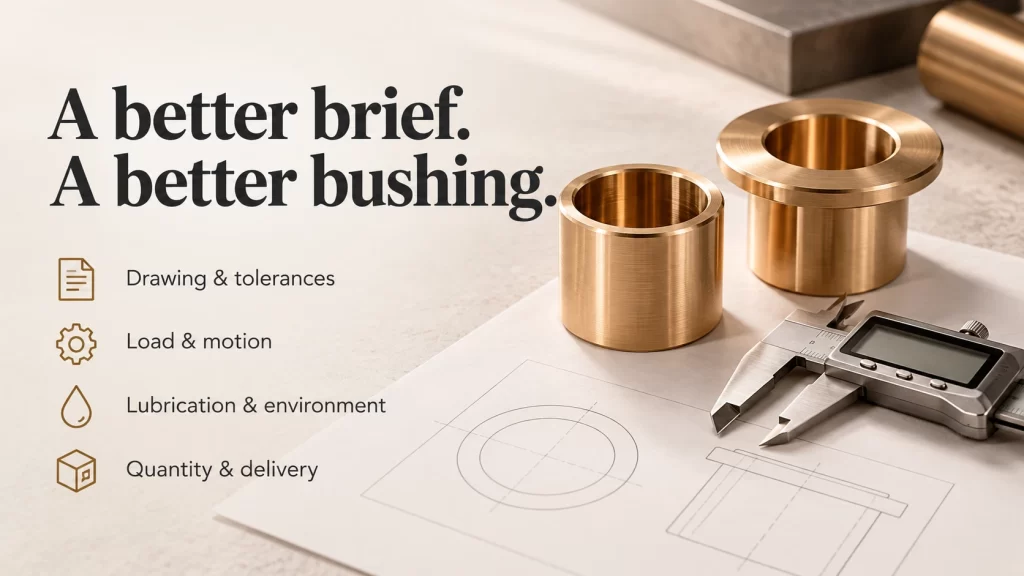
Start with the drawing and quantity. Then explain the job in a few lines: what moves, how often, under what load, and with what lubrication. Mark any unknown dimensions for review. The requested delivery date helps the supplier prepare a useful commercial response too.
Discuss your bronze bushing project with
Perhaps you already have a drawing on your desk. Or you have a worn sleeve and a machine that needs to get back to work. MYWAY lists plain and flanged bronze bushings, thrust washers and graphite-embedded designs among its options.
Have an approved material? Include it. Still choosing? Say so, and send the details you do have. That lets MYWAY see whether the inquiry is ready for quotation or needs a few technical questions answered first.
Include the old specification if this is a replacement. For new equipment, describe the intended duty even if there is no previous part to show. A quantity and a required date will also help keep the response relevant to your project.
Send MYWAY your drawing and request a bronze bushing quotation. Use the reply to check the proposed specification, price and delivery information. If a dimension or material choice remains open, get it agreed before placing the order.
100000+ Types of Bushings – Contact Us for Details