
Recent Posts
Bronze Copper and Brass Compared for Industrial Parts and Bushings
Introduction
An old drawing says “copper bush.” The part in your hand looks yellow. A supplier offers bronze, while another quotes brass. Before comparing the prices, you have a more basic problem to sort out: are these offers even for the same material?
A search for bronze, copper and brass will turn up plenty of color charts. They help with the names, but they won’t settle that drawing. For that, you need to know the alloy and what the part is expected to do. An electrical bar and a bearing sleeve may both contain mostly copper, without having much else in common as engineering choices.
Here we will work through the questions behind the comparison, from color and conductivity to machining and bushing selection. The aim is to help you ask for a part that fits the job, with enough detail for a supplier to quote it properly.
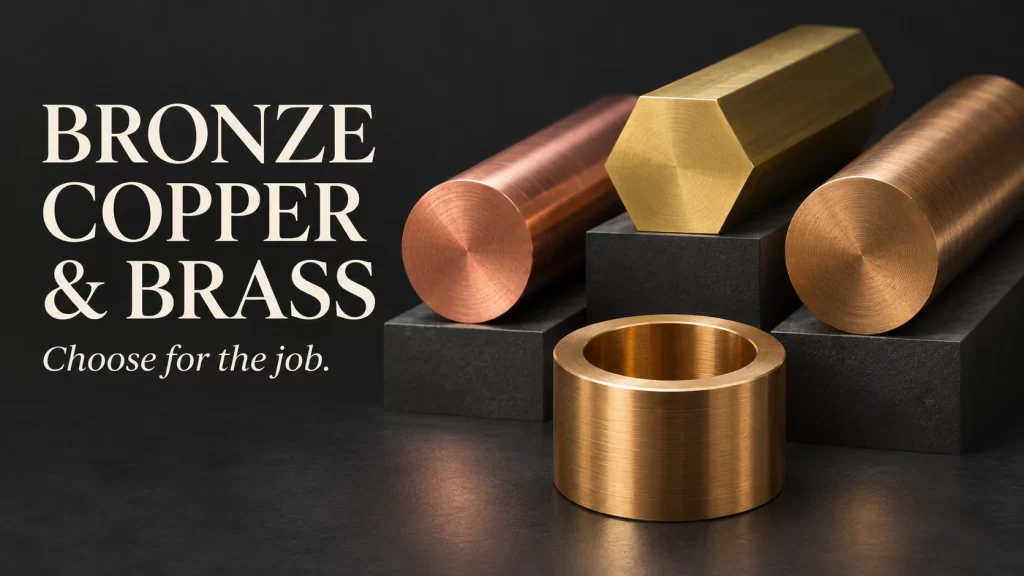
Table of Contents
1. What the three names actually mean
Copper sits in the periodic table; brass and bronze don’t. Both are alloys made with copper. That distinction is straightforward enough until a workshop uses “copper” as shorthand for almost any reddish or yellow copper-based part. For purchasing, it pays to be more exact. The International Copper Association sets out the main alloy families, with zinc as the defining addition in brass and tin in traditional bronze.
Modern bronze names reach beyond that copper-and-tin definition. Open the Copper Information Center bronze guide and you will find aluminum bronze and silicon bronze as well as phosphor bronze. They are separate material choices. Ordering one under the general name of another would leave the important part of the specification unresolved.
There is a catch in the names. C86300 is sold as manganese bronze, yet its composition includes substantial zinc, along with aluminum, manganese and iron. You can see that in Concast’s C86300 composition table. A familiar trade name does not tell you everything in the melt.
For an order, write down the alloy designation and the applicable product specification. Add the material condition where it matters. A request for “bronze tube” leaves much more open to interpretation than a drawing that states the grade, dimensions and acceptance requirements.
2. The color difference is real but limited
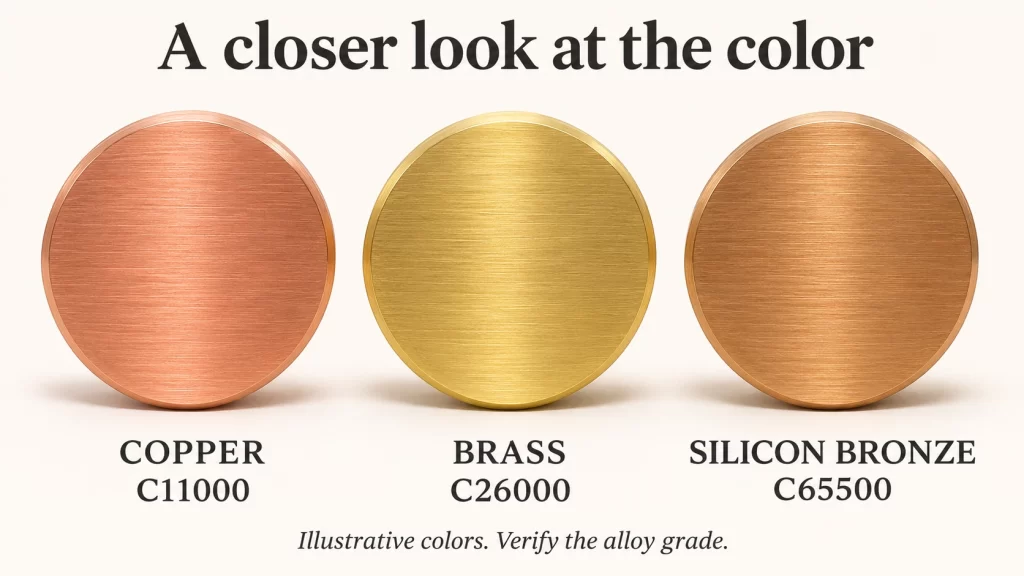
Think of the red-orange surface on a clean copper wire, then the yellow of a brass fitting. Those are useful starting points. With bronze, the mental picture is less reliable. Someone thinking of an outdoor statue may expect brown; someone buying machined sleeves may expect gold. Both have seen bronze, just in different forms and surface conditions.
There is a good explanation in the Canadian Conservation Institute’s visual guide. Its examples distinguish polished metal from tarnished or patinated surfaces. Even brass isn’t always yellow. A brown surface on an old component may tell you more about its history than about the material beneath it.
For the illustration below, the starting descriptions come from the Copper Development Association architectural handbook: salmon red for C11000, yellow for C26000, and reddish old gold for C65500. Notice the grade numbers. The third sample represents silicon bronze; it doesn’t stand in for every bronze bushing alloy.
You can use a photo to discuss the finish you want. For alloy identity, use the material record. Two sleeves could look much the same on a phone screen and still be different grades; another pair could be the same grade photographed under different lights.
3. Copper wins many electrical jobs
Electrical conductivity is one area where a comparison can be quite clear, provided the grades and test conditions are named. The figures below are reference values for annealed material at 20°C from thyssenkrupp Materials North America.
Material | Example grade | Electrical conductivity |
Copper | C11000 | 101% IACS |
Cartridge brass | C26000 | 28% IACS |
Phosphor bronze | C51000 | 15% IACS |
The percentage needs a little explanation. IACS stands for International Annealed Copper Standard, a reference for conductivity. The 101 in the first row is therefore quite possible; it isn’t a claim about purity. Read these as reference figures for the listed materials and conditions, not design limits for an unnamed alloy.
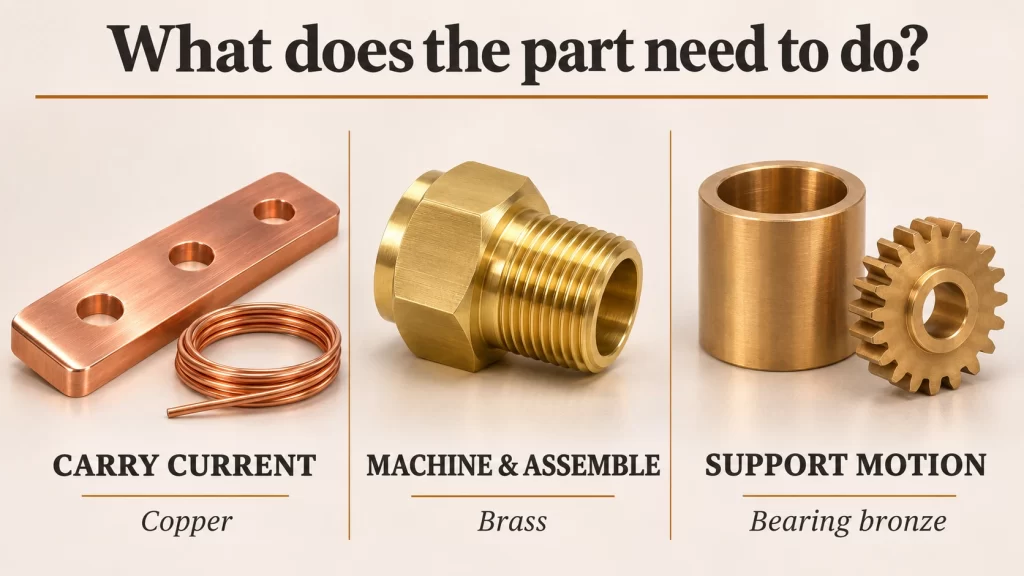
Suppose a brass bar would fit in the space occupied by a copper busbar. Physical fit settles only one question. The designer still has to account for the changed conductivity, along with current, cross section, joints and temperature rise. Buying the same outline in a different metal doesn’t preserve the electrical design.
Now consider a small contact that has to flex. Holding contact pressure becomes part of the job, too. Springs and electrical connectors appear among the applications for C51000 phosphor bronze. The modest conductivity figure in the table hasn’t ruled it out; a contact designer has more than one requirement to satisfy.
4. Strength depends on the grade and condition
Is bronze stronger than copper or brass? Sometimes that is an easy answer for two named products. As a rule covering all three families, it is too vague to use on a purchase order.
Even one copper grade changes with condition. In Wieland’s C11000 data sheet, R220 material has a tensile strength range of 220–260 MPa, while R360 has a minimum of 360 MPa. Those figures belong to that supplier’s listed product conditions. They show why comparing one soft specimen with one hardened specimen can produce a misleading headline.
Ask what “strong enough” means for the part. Does it need to resist permanent bending? Hold a thread under load? Survive repeated flexing? Support a pin that moves back and forth? Tensile strength alone cannot answer all four questions.
For a bushing, the contact conditions matter as well. A high number on a material sheet does not tell you the wear rate of the finished assembly. Before approving a substitution, have the proposed grade checked against the actual duty and the mating shaft.
5. Making the part can change the buying decision
For a batch of turned fittings, the machine shop will want to know which brass you mean. Mueller’s C36000 page describes a grade intended for free cutting and volume machining. That is a more useful basis for a production discussion than a generic promise that brass is easy to work with.
But “brass machines well” is still too broad. A deep-drawn part and a turned hex fitting call for different properties. C26000 cartridge brass, for example, has excellent cold-working capacity. Do not assume that a grade selected for easy cutting is also the right answer for severe forming.
Consider two quotes for a small threaded part. One offers a lower price for the raw bar; the other offers a lower price for the completed part. There needn’t be a contradiction. The second shop may take less time to cut each piece or need less stock to reach the finished dimensions. Inspection is part of the bill as well.
With custom bushings, put the two offers beside the drawing. Check the revision first, then the material and tolerances. A price based on a wider bore tolerance isn’t directly comparable with one based on the fit you requested. Include any certificate requirement in the inquiry so it isn’t added as a surprise later.
6.Corrosion resistance needs an environment
“Corrosion resistant” is an incomplete specification. A part exposed to indoor air, one carrying water and one working in seawater face different conditions. Give the supplier the fluid or exposure, temperature and any known contamination. For an existing part, photographs of the affected area can help explain where the problem starts.
Brass used in water sometimes raises the question of dezincification. In a susceptible alloy under the relevant conditions, zinc can be lost and a weak, copper-rich structure left behind. AMPP explains this form of corrosion, including the role of resistant alloys. The practical question for a buyer is whether the proposed grade suits this water service, not whether all brass is good or bad.
An aluminum bronze might come up in the same review. The applications on Concast’s C95400 page include bushings, gears, and parts for pumps or valves. Those examples help narrow the conversation. They don’t establish that a particular pump fluid is compatible, or that another alloy sold as bronze would behave in the same way.
There is a separate point to raise before requesting a quote: restrictions on composition. Both C36000 and C93200 contain lead. Tell the supplier if lead content is restricted in your application and identify the certification you require. Don’t leave this to an assumption based on a product photograph or the broad label “copper alloy.”
7.Why bronze comes up so often for bushings
Imagine two sleeves with the same bore and outside diameter. One is a trim piece. The other sits around a pin that moves under load all day. They may look identical in a catalog, but only the second has to be assessed as a sliding bearing. That is where bearing bronze enters the discussion.
C93200 bearing bronze, commonly associated with SAE 660, is one familiar candidate. Concast identifies it as a leaded tin bronze with good machinability and bearing properties. It is worth discussing for conventional bearing duties, while keeping the actual load and lubrication requirements in view.
It is still a candidate, rather than an answer you can apply to every sleeve. Picture a slow pivot that is easy to reach with a grease gun, then a rotating shaft inside a closed housing. Before choosing between grades, the supplier needs to understand which sort of duty you have.
The CDA bearing-material selection guide is helpful here because it connects the material decision with the way the bearing runs. Load and speed belong in that discussion, along with lubrication, temperature and the shaft. A request for “harder bronze” leaves too much of the bearing assembly out of the picture.
You can start with the forms shown in the MYWAY bronze bushing range. Take the drawing along when discussing a straight sleeve, flanged bushing or thrust washer. Where the load acts in your assembly will help determine which form belongs there.
Bronze does not automatically mean self lubricating
Does the sleeve need grease? The word bronze on its own won’t answer that. GGB’s guidance discusses oil or grease for conventional bronze bushings. Check what the chosen bearing construction requires rather than treating every bronze part as ready to run dry.
You may also see black plugs in a metal sleeve. In a graphite-plugged bearing, these provide solid lubricant at the working surface. Examples appear on MYWAY’s solid-lubricating bushing page. If you want to replace a greased sleeve with this construction, ask for a review of that change. The motion and mating surface still have to suit the proposed bearing.
FAQ: Questions buyers ask about copper brass and bronze
Can I tell brass from bronze by looking at it
You may be able to make a rough guess from a clean surface, especially when you know the likely grades. You cannot confirm the alloy that way. Use the drawing, traceable material documentation and, where required, suitable material testing. Surface coatings and age make visual guesses even less useful.
Is pure copper a good replacement for a bronze bushing
Do not approve that change from dimensions alone. Copper’s ability to conduct heat or electricity does not establish its suitability for a loaded sliding bearing. Ask the designer or supplier to check the proposed grade, shaft, clearance and lubrication against the duty before ordering a substitute.
Can brass be used for a bushing
Yes, a brass bushing can be appropriate in a design developed for that material and duty. The problem is treating “brass” as a complete specification or as an automatic replacement for bearing bronze. For a replacement order, start with the original grade and investigate why a change is being proposed.
Is bronze always more expensive than brass
There is no useful fixed price rule for a finished part. Grade, stock form, order size, machining and documentation can change the quotation. Request comparable offers on the same date and drawing. A cheap blank may still make an expensive component if it needs much more work.
Does a darker bronze part have better wear resistance
No wear rating follows from darkness. Surface appearance may reflect the alloy, oxidation, a coating or the lighting in a photograph. Ask for the material and bearing design information. Choosing from a dark-brown image rather than a gold image is not a sound way to specify wear performance.
What should I send with a bushing inquiry
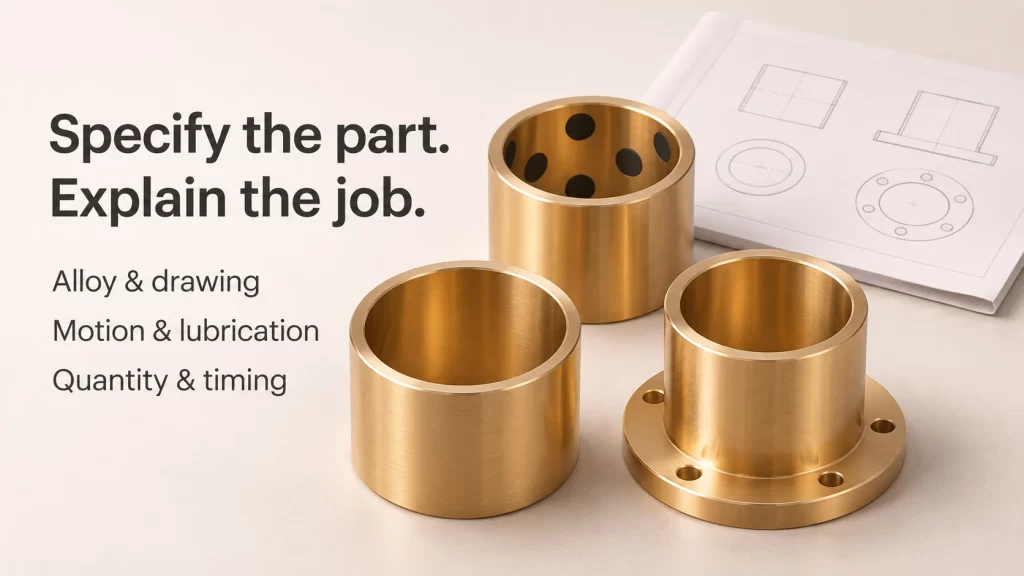
Send the drawing revision, dimensions, tolerances and requested quantity. Add the existing alloy if known. Describe the load, movement, speed, temperature, lubricant and shaft material. If you are replacing a failed part, explain what happened and how long it ran; that context is often more useful than a request for “better bronze.”
Turn the material comparison into a useful quotation
Bring that information to MYWAY. For a new project, send the drawing and intended service conditions. For a replacement, add the original specification and details of the wear or fit problem. If the grade is undecided, say so instead of copying a material name from a similar-looking online part.
Use the MYWAY contact page to request a bushing quotation, with your quantity and required timing. Ask the team to confirm the proposed material, dimensions, documentation and any assumptions in the offer. That gives you something concrete to review before you place the order—and a much better conversation than asking which yellow metal is best.
100000+ Types of Bushings – Contact Us for Details