
Recent Posts
Beyond Bronze: The Complete Guide to Composite Bearings and Why Your Machinery Needs Them
Introduction: The Quiet Revolution in Motion Control
Let’s face it—when most people think about bearings, they picture shiny metal cylinders or rows of steel balls. And for decades, that’s been the standard. Bronze bushings, roller bearings, all-metal assemblies—they’ve kept the industrial world spinning.
But here’s the thing: the industrial world isn’t what it used to be. Equipment runs faster, hotter, and longer. Maintenance crews are stretched thin. Sustainability goals demand less lubrication and longer life. And somewhere along the way, engineers started asking a simple question: “Isn’t there something better than bronze?”
Turns out, there is. And it’s called composite bearings.
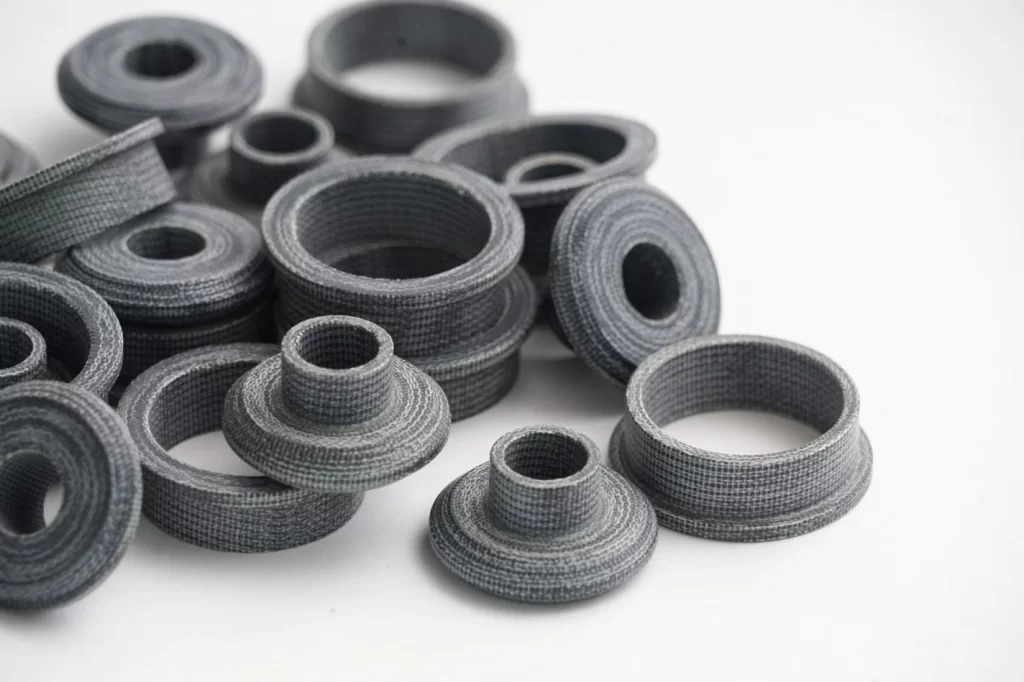
These aren’t your grandfather’s bearings. Composite bearings combine the structural strength of metal with the self-lubricating magic of advanced polymers. They’re lighter, tougher, and often outlast traditional bronze by factors of five or more . They don’t squeak, they don’t corrode, and they certainly don’t need greasing every Tuesday.
In this guide, we’re going deep into the world of composite bearings. What they are, how they work, where they shine, and—if you’re smart—why your next project should spec MYWAY bushings instead of that same old bronze.
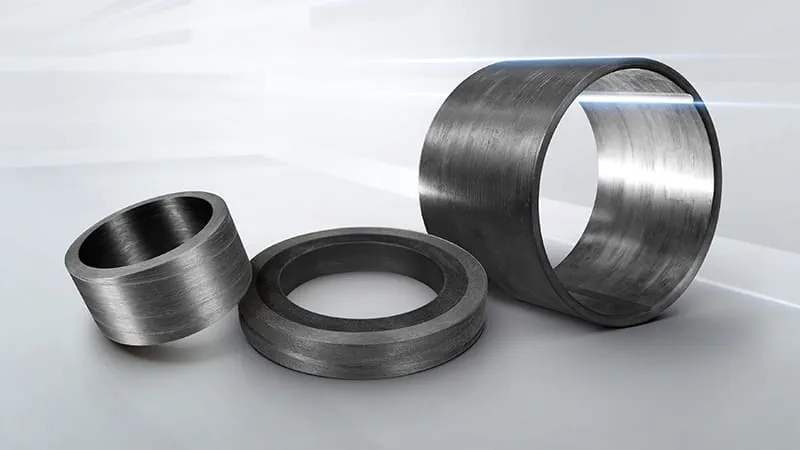
Table of Contents
1. What Exactly Is a Composite Bearing?
Let’s start with a definition that actually makes sense.
A composite bearing is a plain bearing made from—you guessed it—multiple materials working together. Unlike a solid bronze bushing that’s one material all the way through, composite bearings are engineered sandwiches. They combine a strong structural backing with a low-friction sliding layer .
Think of it like this: if a traditional bearing is a brick wall, a composite bearing is a carbon-fiber racing bike. Both are strong. But one is smarter, lighter, and performs better under stress.
The Three-Layer Construction That Changes Everything
Most high-performance composite bearings share a common architecture :
| Layer | Material | Job Description |
|---|---|---|
| Backing | Steel or bronze strip | Provides mechanical strength, stiffness, and press-fit integrity |
| Intermediate | Sintered porous bronze | Bonds the layers, dissipates heat, acts as a reservoir for lubricant |
| Lining | PTFE, POM, or other polymer | Delivers the low-friction, self-lubricating magic |
The steel backing is what gives the bearing its guts. It handles the heavy lifting—static and dynamic loads that would crush a pure plastic bearing .
The porous bronze layer is the unsung hero. It’s not just there for show. This sintered matrix creates a mechanical bond between the steel and the polymer, while also wicking away heat and holding a microscopic reserve of lubricant .
The polymer lining is where the action happens. Depending on the formulation, this layer delivers coefficients of friction as low as 0.05—dry. No oil. No grease. Just smooth, consistent motion .
Wait, Isn’t That Just a PTFE Bearing?
Good question. And no—there’s a difference.
A true composite bearing integrates the PTFE or POM into a structural matrix. It’s not just a coating or a liner slapped onto metal. The polymer is mechanically locked into the bronze pores, creating a surface that wears evenly and lasts . This is why composite bearings don’t delaminate the way cheap “lined” bushings do.
2. The Two Titans of Composite Bearing Technology
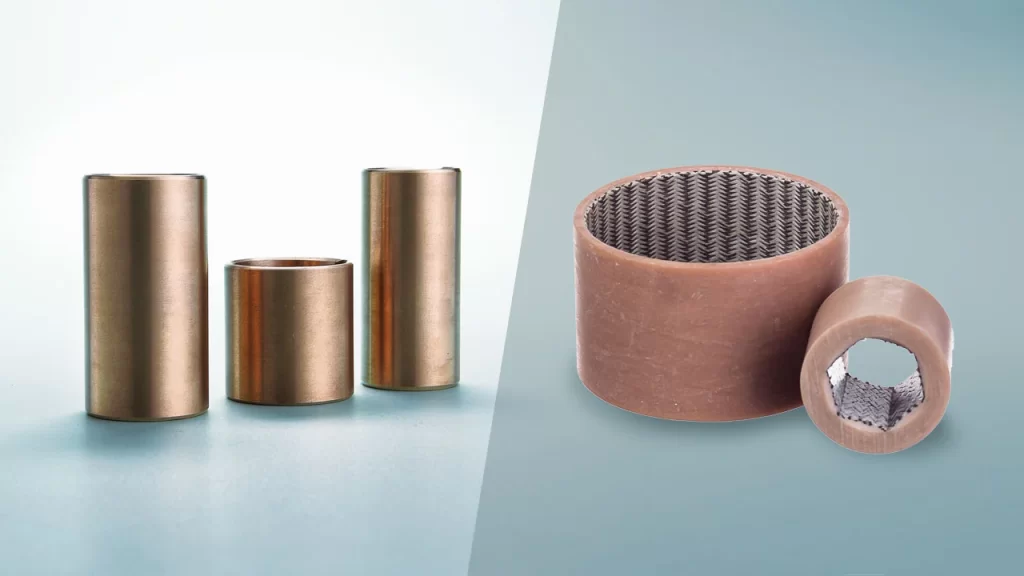
Not all composite bearings are created equal. In fact, the industry has largely settled on two major families: PTFE-based and POM-based composites. Each has its strengths, and choosing between them depends on what you’re trying to accomplish.
PTFE Composite Bearings: The Dry-Running Champions
PTFE (polytetrafluoroethylene)—yes, the same stuff on non-stick frying pans—is a bearing superstar. Its molecular structure gives it the lowest coefficient of friction of any solid material .
In a PTFE composite bearing, the polymer layer is a carefully formulated blend of PTFE and other additives (like MoS₂ or glass fibers) that’s rolled into the porous bronze matrix .
What makes them special:
True self-lubrication: These bearings run completely dry. No oil, no grease, no maintenance .
Extremely low friction: We’re talking coefficients in the 0.05–0.10 range .
Chemical resistance: PTFE laughs at solvents, fuels, and most industrial chemicals.
Wide temperature range: Many formulations handle -200°C to +260°C.
Smooth as silk: No stick-slip, even at low speeds.
Perfect for: Applications where lubrication is impossible, undesirable, or would attract contamination. Food processing equipment, cleanroom machinery, oxygen-rich environments, and aerospace systems all love PTFE composites .
POM Composite Bearings: The Low-Maintenance Workhorses
POM (polyoxymethylene), also known as acetal, takes a different approach. These bearings feature a thicker polymer layer—often around 0.3mm—with a clever addition: grease pockets .
These small indentations in the surface act as reservoirs, holding grease right where it’s needed most. The result is a bearing that can go years between re-lubrication, rather than weeks.
What makes them special:
Extended maintenance intervals: Those grease pockets mean you lubricate less often.
Excellent damping: POM absorbs vibration and shock better than PTFE .
Forgiving of misalignment: The thicker polymer layer conforms better to shaft deflection.
Good wear resistance: Especially under boundary lubrication conditions.
Cost-effective: Often less expensive than PTFE equivalents.
Perfect for: Automotive applications, construction equipment, agricultural machinery—anywhere you can lubricate but would rather not do it constantly .
Side-by-Side: PTFE vs. POM Composite Bearings
| Factor | PTFE Composite | POM Composite |
|---|---|---|
| Lubrication regime | Dry-running, self-lubricating | Low-maintenance, benefits from grease |
| Friction coefficient | 0.05–0.10 (dry) | 0.10–0.20 (greased) |
| Best motion type | Rotary, oscillating, short-stroke linear | Rotary, oscillating, long-stroke linear |
| Temperature range | -200°C to +260°C | -40°C to +130°C |
| Chemical resistance | Excellent | Good |
| Cost | Higher | Moderate |
3. Why Composite Bearings Are Leaving Bronze in the Dust
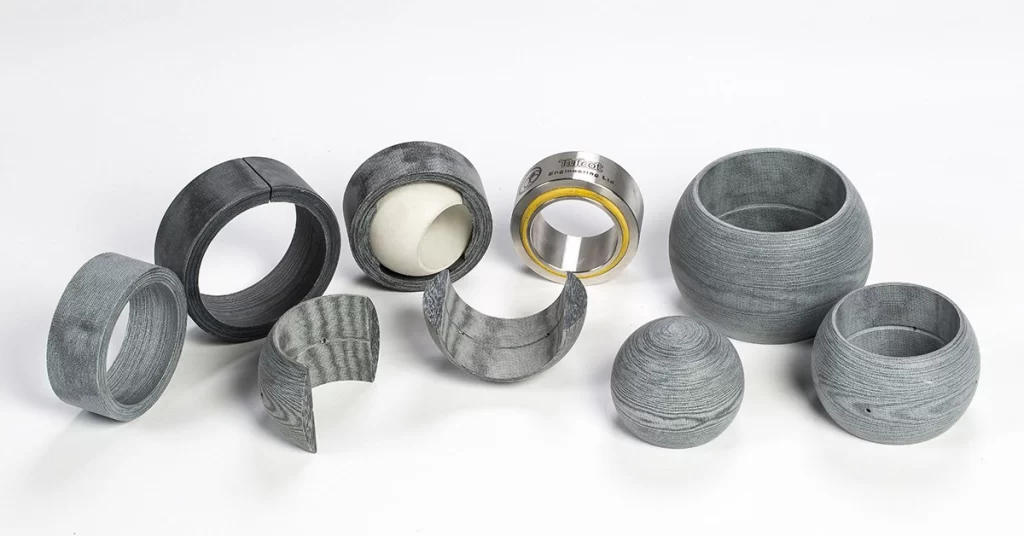
Here’s where things get interesting. Bronze bushings have been the default choice for decades. They’re familiar. They’re available. They… well, they’re what everyone uses.
But familiarity isn’t the same as superiority. And when you put bronze and composites head-to-head, the results are eye-opening.
The Test That Changed Everything
Trelleborg, a major player in sealing and bearing technology, ran a comparison test that tells the story .
They put a standard RG12 bronze bearing against their Orkot® composite bearing in a rudder application simulation. Both ran in water, with continuous shaft motion, under a surface pressure of 10 N/mm².
The results?
| Metric | RG12 Bronze | Orkot® Composite |
|---|---|---|
| Time to failure | 20.4 hours | 100+ hours (test ended) |
| Avg coefficient of friction | 0.343 | 0.151 |
| Peak coefficient | 0.621 | 0.299 |
| Bearing temperature | 24.3°C | 20.4°C |
| Wear | Completely worn away | Minimal, measurable wear |
Let that sink in. The bronze bearing was completely destroyed after 20 hours. The composite bearing was still going strong at 100 hours .
Why Composites Win: The Load Distribution Advantage
Here’s something most engineers don’t think about. When a rigid bronze bushing encounters side loading—say, from shaft deflection or misalignment—the stress concentrates at the edges .
FEA analysis shows this clearly. In a rigid bushing, the peak stress at the leading edge can be several times higher than the average stress across the bearing surface. That’s why bronze bushings often fail from edge loading—the corners wear first, then the damage spreads .
Composite bearings, on the other hand, have just enough elastic compliance to conform to the shaft. They distribute the load more evenly across the entire bearing surface. The peak stress is lower, so the wear is slower and more uniform .
Bottom line: A composite bearing under 10,000 psi load might actually experience lower peak stress than a bronze bearing under the same load. That’s not magic—that’s material science.
The Weight Factor
In aerospace and automotive, weight is everything. Composite bearings can be one-tenth the weight of traditional rolling element bearings . That’s not a typo. When you’re counting grams on an aircraft control surface or kilograms on a race car, composites are the obvious choice.
4. Where Composite Bearings Are Used (And Why)
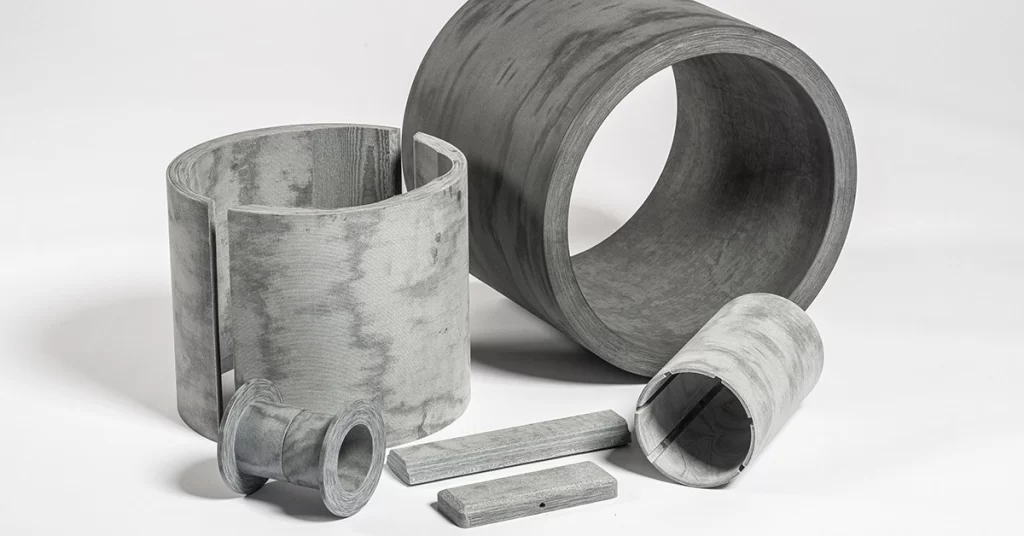
The beauty of composite bearings is their versatility. They’re not niche products for exotic applications—they’re everyday solutions for real-world problems.
Automotive: Under the Hood and Beyond
Modern cars are packed with composite bearings .
Suspension systems: Control arms, stabilizer bars, and strut mounts all benefit from composite’s ability to handle oscillation without squeaking.
Steering components: The steering yoke bearing determines how much road feel reaches the driver. Composite bearings reduce friction and eliminate that notchy feeling .
Seat mechanisms: Every time you adjust your seat, composite bearings are probably helping it slide smoothly.
Door hinges: Bearings here need to handle high loads, resist corrosion, and—crucially—allow for electrostatic painting. Composite bearings are conductive enough to pass the charge for paint adhesion, but hydrophobic enough to repel excess droplets .
Belt tensioners: These oscillate at about 60 cycles per minute, 2° at a time. That’s a punishing duty cycle for grease-lubricated bearings. Composites handle it dry .
Aerospace: When Failure Is Not an Option
In aircraft, every component is scrutinized. Weight, reliability, and maintenance intervals are critical .
Composite bearings show up in:
Flight control linkages
Landing gear assemblies
Engine accessories
Cargo door mechanisms
The self-lubricating nature of PTFE composites eliminates the risk of grease migrating to sensitive areas (like optical equipment or de-icing systems). And the corrosion resistance is a game-changer for aircraft that operate in marine environments.
Marine: Fighting Salt Water 24/7
Salt water destroys metal bearings. It’s not a question of “if” but “when.” Composite bearings, on the other hand, don’t corrode .
Rudder bearings: As the Trelleborg tests showed, composites dramatically outperform bronze in rudder applications—especially when lubrication is marginal .
Propeller shaft bearings: Water-lubricated composites eliminate oil leakage concerns (environmental win) and last longer.
Deck equipment: Winches, cranes, and hatch covers all benefit from bearings that don’t need constant greasing.
Industrial Machinery: Keeping the Lines Moving
In factories, downtime is the enemy. Composite bearings help keep equipment running .
Hydraulic cylinders: Guide rings and wear bands made from composites handle side loads better than bronze, extending cylinder life.
Pumps: Many pumps now use composite bushings on shafts and impellers, reducing maintenance intervals.
Conveyors: Composite bearings in roller ends eliminate the need for constant lubrication in dusty environments.
Packaging equipment: Food-grade composites (FDA-compliant materials available) run dry, eliminating grease contamination risk .
Construction and Mining: Tough Enough for the Worst Conditions
If you think your application is harsh, try designing bearings for a rock crusher. Construction and mining equipment face:
Abrasive dust
Shocking loads
Near-zero maintenance
Extreme temperatures
Composite bearings handle it. They’re used in excavator pivot points, dump truck suspensions, and conveyor systems . The ability to run dry means grease doesn’t attract dirt that turns into grinding paste.
Agriculture: Out in the Weather, Season After Season
Farm equipment lives outside. Rain, mud, fertilizer dust, and long idle periods between intense use—it’s a brutal environment .
Composite bearings in harvesters, planters, and balers:
Don’t rust
Don’t require grease fittings (which get clogged with mud)
Handle oscillation without seizing
Renewable Energy: 20 Years of Maintenance-Free Operation
Wind turbines are the ultimate test of bearing reliability. They’re hundreds of feet in the air, operating continuously for decades. Climbing a tower to grease a bearing isn’t practical .
Composite bearings in:
Pitch control mechanisms
Yaw systems
Generator mounts
They handle the constant oscillation, extreme temperature swings, and total lack of maintenance.
Medical and Food Processing: Cleanliness Is King
In these industries, lubricants are contaminants. Food processors can’t have grease dripping into product. Medical devices can’t have oils migrating to sterile areas .
Composite bearings solve this by running completely dry. They’re also:
Steam-cleanable
Resistant to harsh sanitizers
Available in materials that meet FDA and USDA requirements
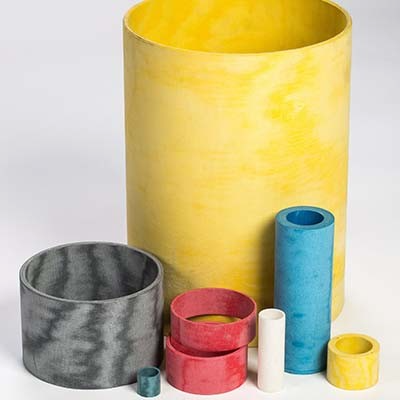
5. The Numbers Don't Lie—Composite Bearings Are Taking Over
If you’re still skeptical, look at the market data. The numbers tell a clear story.
Global Market Growth
The global composite bearings market was valued at approximately $6.2 billion in 2024 and is projected to reach $9.1 billion by 2030, growing at a CAGR of 6.7% .
But here’s the interesting part. The metal-plastic composite bearings segment—the exact type we’re discussing—is growing even faster, at 8.86% CAGR, reaching $128 million by 2032 .
What’s Driving the Growth?
Several factors are pushing engineers toward composites :
Electrification: EVs and hybrids need bearings that handle higher torque densities and start-stop cycles without stick-slip.
Sustainability: Companies are eliminating lubricants where possible. Less grease means less environmental impact.
Maintenance reduction: Labor costs are up. If a bearing can run for years without attention, that’s pure profit.
Lightweighting: Every kilogram saved in automotive and aerospace improves efficiency.
Corrosion resistance: In marine, chemical, and outdoor applications, composites simply last longer.
Regional Hotspots
Asia-Pacific is the growth leader, with China projected to grow at 9.9% CAGR through 2030 . The region’s massive industrial base and rapid adoption of automation are driving demand.
North America and Europe remain strong markets, with emphasis on high-performance applications and regulatory compliance .
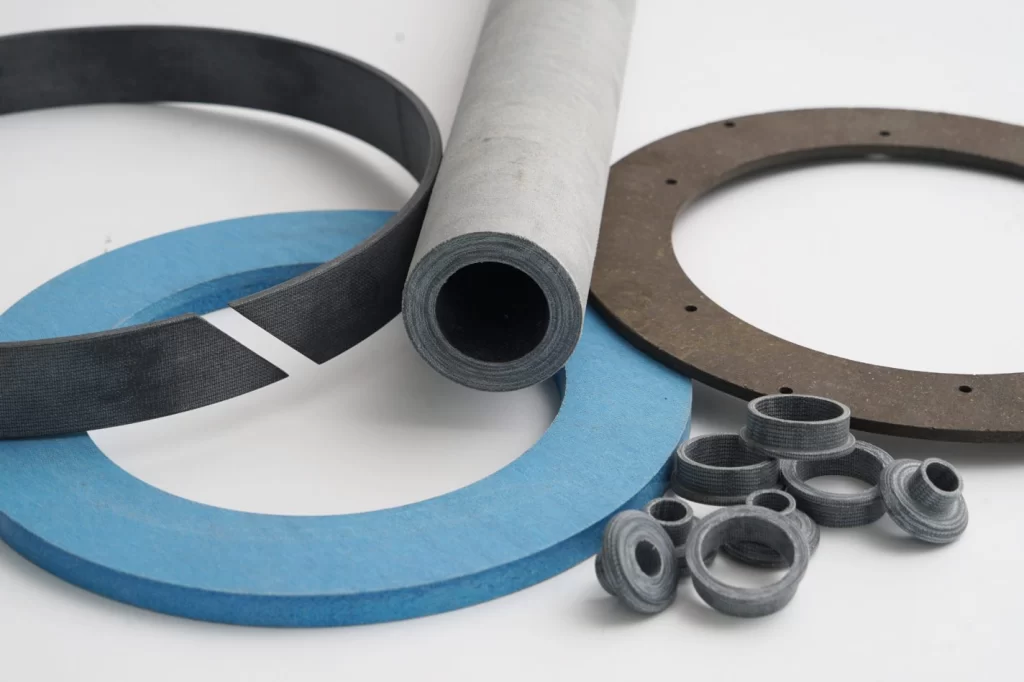
6. The MYWAY Advantage—Why Our Bushings Stand Out
Now, let’s talk about MYWAY.
We’re not just another bearing supplier. We’re engineers who understand that your machinery deserves better than yesterday’s technology. Our composite bushings are designed for one purpose: to make your equipment run longer, smoother, and with less maintenance.
What MYWAY Brings to the Table
1. Precision Engineering
Every MYWAY bushing starts with high-quality steel backing, precision-sintered bronze, and carefully formulated polymer linings. We don’t cut corners because we know your application won’t either.
2. Two Complete Product Lines
We offer both PTFE-based and POM-based composite bushings, so you can match the material to the application. Not sure which you need? Our engineers will help you decide.
3. Custom Solutions
Standard catalog parts are great—until they’re not. MYWAY specializes in custom designs for unique applications. Need a specific flange configuration? A special lining formulation? We can make it happen.
4. Consistent Quality
Our manufacturing processes are ISO-controlled and continuously monitored. When you buy MYWAY, you get the same high quality every time.
5. Technical Support That Actually Helps
Got a question about load ratings? Wondering about shaft hardness requirements? Need help with installation? Our team is here to help—not to give you the runaround.
The MYWAY Difference: Real Talk
Look, there are plenty of bearing companies out there. Some are huge multinationals with fancy websites. Some are small shops selling whatever they can source. MYWAY sits in a sweet spot: we’re big enough to have real engineering capability, but nimble enough to care about your specific needs.
When you spec MYWAY bushings, you’re getting:
Better value than the premium European brands
Better quality than the cheap commodity imports
Better support than the catalog houses
Applications We Excel In
MYWAY composite bushings are already working hard in:
Hydraulic cylinders (guide rings and wear bands)
Construction equipment (pivot points, linkage bearings)
Agricultural machinery (planter linkages, baler mechanisms)
Industrial automation (linear motion guides, robot joints)
Automotive (suspension components, steering systems)
Marine (rudder bearings, deck hardware)
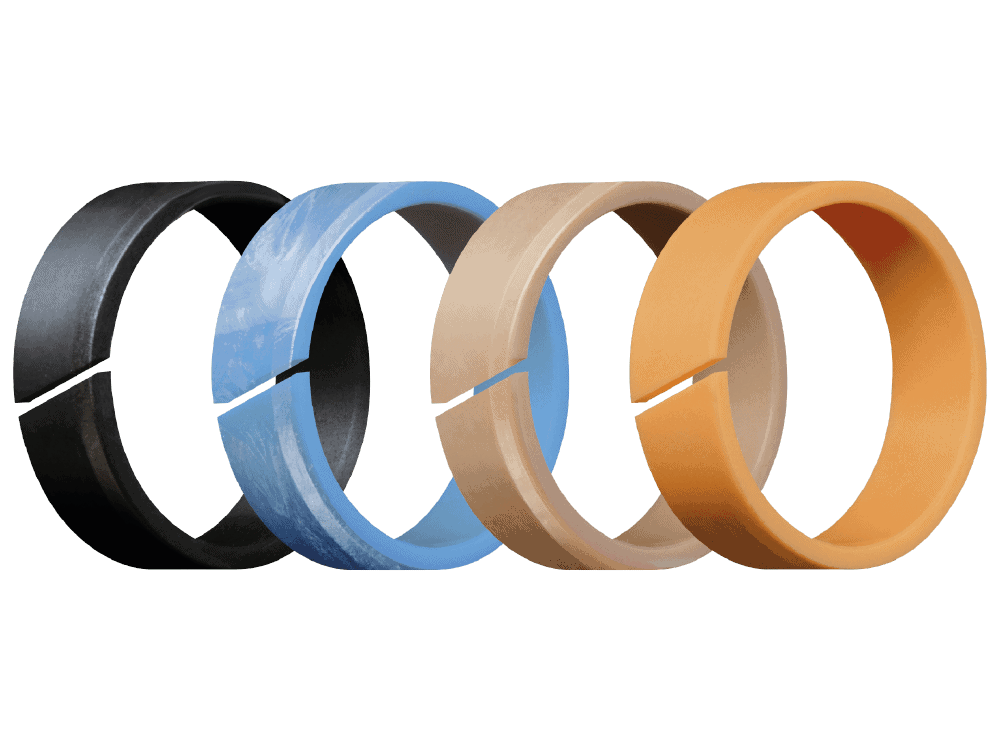
7. How to Choose the Right Composite Bushing
Selecting the right bushing isn’t complicated, but you do need to consider a few factors.
Step 1: Define Your Operating Conditions
Load: How much pressure will the bearing see? (psi or N/mm²)
Motion: Rotary, oscillating, or linear? Continuous or intermittent?
Speed: How fast does the shaft move? (m/s or fpm)
Temperature: What’s the range? Ambient plus any frictional heating?
Environment: Wet? Dusty? Chemically aggressive? Cleanroom?
Step 2: Choose Your Material Family
| If you need… | Choose… |
|---|---|
| True dry running, no lubrication ever | PTFE composite |
| Chemical resistance | PTFE composite |
| High temperatures | PTFE composite |
| Extended lubrication intervals (with grease) | POM composite |
| Vibration damping | POM composite |
| Forgiveness for misalignment | POM composite |
| Lowest cost | POM composite |
Step 3: Check the Counterface
Your shaft matters. For composite bearings, we typically recommend:
Hardness: 400+ HB (hardened steel is best)
Roughness: Ra 0.2–0.6 µm (ground finish)
Material: Stainless steel for corrosion resistance, hard chrome for wear resistance
Step 4: Consider Installation
Composite bushings are typically press-fit. The metal backing provides the interference fit strength, while the polymer lining conforms to the shaft after running-in.
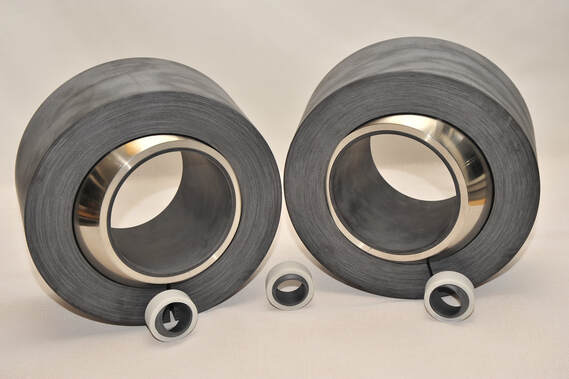
FAQ: Your Composite Bearing Questions, Answered
Q: Can composite bearings really run without any lubrication?
A: Yes—that’s their superpower. PTFE-based composites contain solid lubricants throughout the polymer layer. As the bearing runs, microscopic PTFE particles transfer to the shaft, creating a low-friction transfer film . No oil, no grease, no problem.
Q: How long do composite bearings last?
A: It depends on the application, but expect 2–5 times longer than bronze in most cases . In some tests, composites lasted 5x longer than bronze before failure .
Q: Are composite bearings more expensive than bronze?
A: The initial purchase price may be higher, but the total cost of ownership is almost always lower. Factor in:
No lubrication costs
Reduced maintenance labor
Longer service life
Less downtime
No corrosion-related failures
When you add it up, composites win every time.
Q: Can I replace a bronze bushing with a composite one without modifying my equipment?
A: Usually, yes. Composite bushings are available in standard inch and metric sizes that match bronze dimensions. The press-fit requirements are similar.
Q: Do composite bearings work in water?
A: Absolutely. Many composites are specifically designed for water lubrication . Unlike bronze, they won’t corrode. And unlike some polymers, they won’t swell.
Q: What about FDA compliance?
A: Certain MYWAY materials are available with FDA-compliant formulations for food contact applications .
Q: Can you make custom sizes?
A: Yes. MYWAY specializes in custom bearings for OEM applications. Contact us with your requirements.
Q: How do I install composite bushings?
A: Standard press-fit installation works well. Some customers also use freeze fitting (shrinking the bushing in liquid nitrogen) for easier assembly. We recommend using an installation mandrel that contacts the steel backing, not the polymer lining.
Q: Will composite bearings damage my shaft?
A: No. In fact, composites are generally gentler on shafts than bronze. If a bronze bearing fails, it can gall and score the shaft. Composite failure is usually gradual and doesn’t damage the counterface.
Q: What’s the temperature limit?
A: PTFE composites can handle -200°C to +260°C continuous. POM composites are typically rated -40°C to +130°C .
Conclusion: The Future Is Composite
Bronze bearings had a good run. For decades, they were the default choice for plain bearing applications. But technology moves forward, and what worked in 1950 isn’t necessarily what works best in 2026.
Composite bearings are better. They last longer. They require less maintenance. They handle harsh environments. They’re lighter. They’re often cheaper in the long run.
And MYWAY is here to help you make the switch.
Whether you’re designing new equipment or looking to upgrade existing machinery, our team can help you select the right composite bearing for the job. We’ll work with you on material selection, sizing, and installation. We’ll provide samples for testing. We’ll support you long after the sale.
Because at MYWAY, we’re not just selling bearings. We’re selling better performance, less downtime, and lower costs.
Ready to leave bronze in the past? Contact MYWAY today for a quote or to discuss your application. Your machinery will thank you.
100000+ Types of Bushings – Contact Us for Details