
Recent Posts
Bushings for Construction Equipment in Dirty Environments: Why Most Fail and How to Choose Ones That Don't
Introduction
Dust, mud, and grit destroy construction equipment bushings faster than almost anything else. A single dust particle that slips past a worn seal can turn lubricant into abrasive paste and accelerate wear within hours. This article breaks down why bushings fail in contaminated environments, compares bushing materials side by side, and shows how to extend service life without adding massive maintenance costs. Real-world cost data, lubrication strategies, and selection criteria are covered—plus what to look for in a bushing supplier who actually understands heavy equipment.
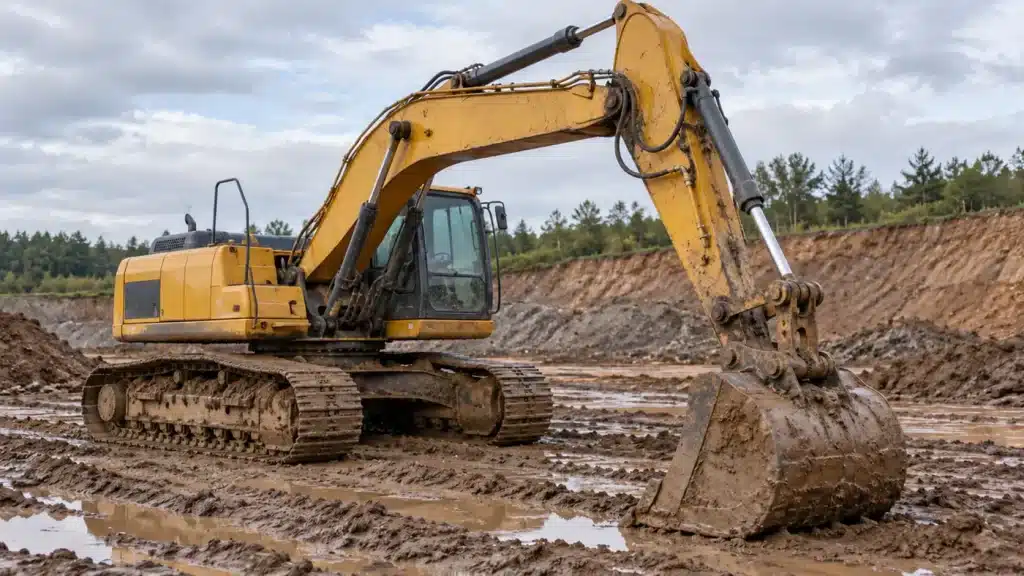
Table of Contents
1. Why Dirty Environments Are So Brutal on Construction Equipment Bushings
Anyone who’s spent time on a job site knows the reality: excavators, loaders, and bulldozers operate in clouds of dust, mud pits, and constant grit. Bushings sit right in the middle of that chaos.
The problem isn’t just about dirt being abrasive. It’s about what happens when contaminants mix with lubricant. Construction equipment bushings operate with running clearances measured in microns. When a dust particle enters that gap, the grease doesn’t reduce friction anymore—it becomes an abrasive compound that grinds away both the bushing and the pin.
Three failure mechanisms dominate:
Abrasive wear. Sand and silt particles are harder than most bushing alloys. Once embedded, they act like sandpaper every time the joint oscillates.
Adhesive wear (galling). When lubrication fails, metal-to-metal contact causes microscopic welding between pin and bushing surfaces. The joint seizes, then tears itself apart.
Corrosive wear. Water intrusion—rain, wash-down, or groundwater—breaks down grease and rusts steel components. A locked bushing from corrosion can crack the surrounding boss structure–.
A mining lubrication specialist put it bluntly: “The best protective grease isn’t the one with the most load capacity—it’s the one that seals the best”. Over-greasing actually makes things worse by creating escape paths that pull grit into the joint
2. The Real Cost of Bushing Failure: Beyond the Part Price
Too many fleet managers focus on the unit price of a replacement bushing. That misses the point entirely.
Consider the downstream damage. When a bushing wears past its tolerance, the joint develops excessive play. That looseness creates impact loading, which accelerates wear on both pin and bushing—a vicious cycle that eventually damages the structural bore itself–.
Line boring costs run around $500 per hole, plus welding, refitting, and days of machine downtime–. A single excavator bushing replacement event can cost $1,500 in parts and labor alone, not counting lost production–.
One construction fleet tracked their outsourced track bushing repairs at $4,200 per machine, with an average of 72 hours of downtime per event. After switching to in-house pressing with better components, downtime dropped to 10 hours—an 86% reduction.
The real cost math isn’t “bushing A costs $30, bushing B costs $60.” It’s “how many production hours does this machine lose over 5,000 operating hours?”
3. Materials That Actually Work in Contaminated Environments
Not all bushing materials handle dirt the same way. Here’s how the main options compare:
Hardened Steel Bushings. Typically 48–60 HRC surface hardness. Good for high-load pivot points and low-speed oscillation. However, steel-on-steel contact requires reliable lubrication—once the grease film breaks, galling starts fast–. Best suited for joints with sealed lubrication systems.
Bronze Alloys (Manganese, Aluminum, Tin Bronze). Bronze bushings have a unique advantage: they can embed microscopic sand and grit particles into their softer surface, preventing those particles from scoring the hardened steel pin–. Manganese bronze (C86300) is the workhorse for track roller bushings on mining shovels, often lasting 30,000+ hours on smaller machines. Aluminum bronze offers higher strength but can gall if lubrication is inconsistent.
Self-Lubricating Composite Bushings. Materials like PTFE-based or graphite-embedded composites eliminate the need for grease entirely. This is a game-changer in environments where grease nipples disappear under layers of mud and daily lubrication is unreliable. These work well for moderate loads and oscillating motion, but may not handle extreme shock loading as well as metallics.
High-Performance Alloys (Spinodal Bronze). Copper-nickel-tin alloys like ToughMet bridge the gap between steel’s strength and bronze’s lubricity. Field tests on excavator bucket bushings showed 0.0235″ wear after 8,100 hours, versus OEM steel bushings that wore 0.837″ in just 3,500 hours. Total cost savings per bushing: $2,663 at 8,100 hours.
The honest answer is: there’s no universal best material. The right choice depends on load, speed, oscillation frequency, and how reliably lubrication can be maintained.
4. Sealing and Contamination Exclusion: Where Most Solutions Fall Short
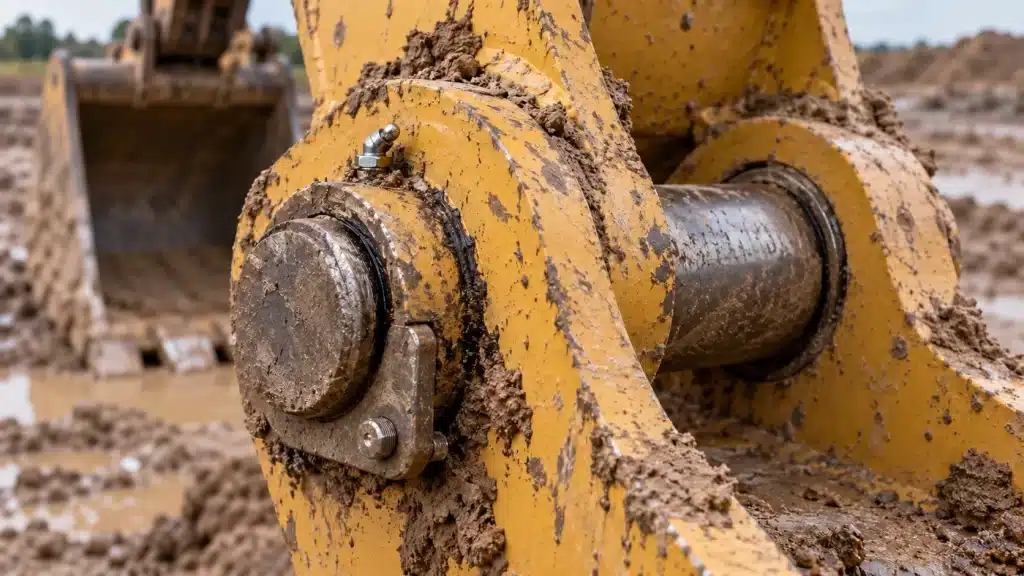
You can’t talk about bushing life in dirty environments without addressing seals. This is where most equipment designs and aftermarket solutions fail.
Standard lip seals degrade quickly when exposed to mud caking and chemical wash-down. Once the seal lip wears or the rubber hardens, contaminants walk right in.
Modern solutions include:
Multi-stage seal systems with a primary wiper seal and secondary backup, creating two barriers against ingress–.
First-line defense seals designed for greaseless bushings, capable of bridging gaps from 1mm to 12mm and rated to last 15,000 hours at the joint.
Sealed-for-life composite bushings that combine the bearing surface and the seal into one unit, removing the failure point where a separate seal wears out before the bushing does.
For tracked vehicle applications, even elaborate seals can’t always keep dirt out. One tracked vehicle manufacturer switched to igutex TX1 plain bearings after testing showed an 8x service life improvement over the previous machined bearing, even with dirt infiltration
5. Smart Lubrication: Less Can Be More
The instinct to pump more grease is understandable but often counterproductive.
Research on pin-bushing bearings in heavy construction machinery evaluated different grease viscosities and re-greasing intervals. The findings: a 12-hour lubrication interval with ISO VG 460 lithium complex grease (with MoS2) gave the most balanced performance in high-temperature slag-handling conditions. Grease NLGI grade thickened from 2 to 3–4 during service, and oil release rates dropped by up to 60%—meaning grease degradation is real and measurable.
Practical guidelines that work:
In normal conditions, grease daily or every 8–10 hours of operation.
In wet or sandy conditions, reapply every 4 hours to flush out contamination.
Always clean the fitting before greasing. Pushing dirt into a Zerk fitting is worse than not greasing at all–.
Consider automatic lubrication systems for joints that are hard to reach or frequently neglected. These reduce human error and maintain consistent grease delivery.
For composite or self-lubricating bushings, lubrication downtime drops to zero—which matters when a machine has hundreds of grease points and every minute of maintenance stops production.
6. Case Studies: What Works in the Field
Municipal Grader, 450,000 km. A Vesconite kingpin and center cone bushing was tested on a municipal grader. After 450,000 km, the large bushing showed only 0.2mm wear; the small bushing 0.08mm. Cost was lower than OEM replacement, and shaft wear was reduced.
38-Ton Dump Trucks in Quarries. A UK dump truck manufacturer switched to Vesconite Hilube articulation bushings in 2014 after testing. The 355.95mm-OD bushings performed well across construction sites, quarries, and mine sites. The manufacturer continues ordering them for its 38-ton fleet.
Large Electric Mining Shovel. Standard manganese brass load roller bushings were failing prematurely on P&H 4100XPB shovels due to point loading exceeding 100,000 psi. Switching to ToughMet spinodal bronze extended maintenance intervals and reduced unplanned downtime.
Tracked Vehicle in Mud and Bog. igutex TX1 plain bearings on swing axles and tension axles of the PowerBully tracked vehicle achieved 8x service life over the previous bearing—tested under real conditions, not lab simulations.
The common thread: these solutions weren’t just “better material.” They combined material selection with application-specific engineering
7. How to Choose Bushings for Your Specific Application
There’s no one-size-fits-all answer. Use this decision framework:
Step 1: Identify the joint type and motion pattern.
Oscillating pivot (bucket pins, linkage arms): prioritize embeddability and galling resistance.
Continuous rotation (track rollers, idler wheels): prioritize fatigue strength and surface hardness.
High-impact joints (ripper tips, breaker points): prioritize toughness over hardness.
Step 2: Assess the contamination level.
Light dirt, accessible grease points: standard bronze or hardened steel with good sealing.
Heavy mud/sand, neglected maintenance: self-lubricating composites or sealed units.
Submerged/wash-down: corrosion-resistant alloys or composites that don’t absorb water.
Step 3: Calculate the real cost.
Compare not just purchase price, but projected life, downtime cost per replacement, and whether the bushing protects the more expensive structural components. A bushing is sacrificial—it should wear, not the $50,000 bore it sits in.
Step 4: Verify dimensional accuracy.
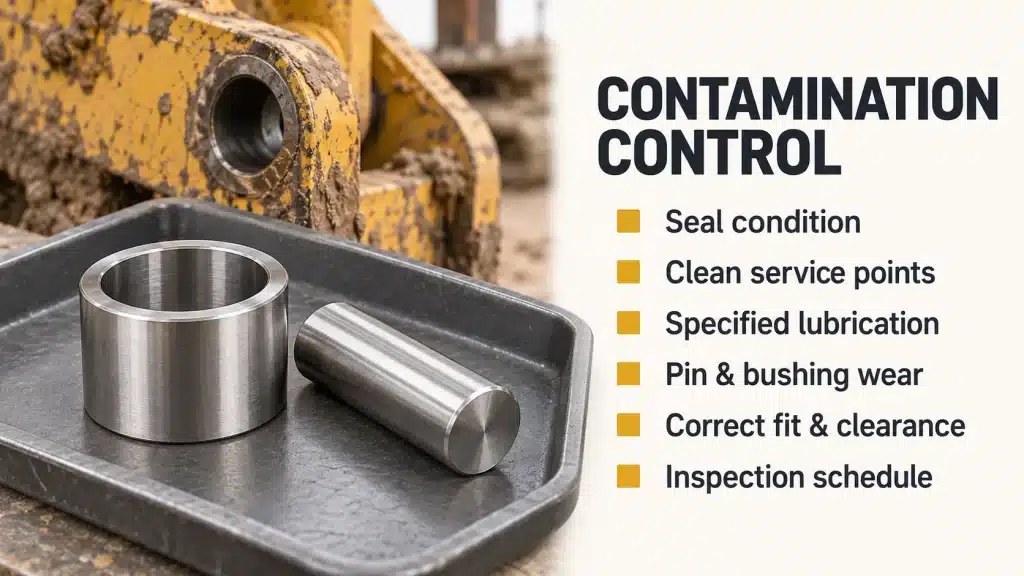
Size tolerance matters. A bushing that’s 0.2mm off-spec can cause premature failure or require machining during installation. Look for suppliers with automated production and documented quality control.
8. What to Look for in a Bushing Supplier
The supplier matters as much as the product. Here’s what separates a real partner from a parts catalog:
Application engineering support. Can they recommend the right material and dimensions for your specific machine and operating conditions—or do they just match part numbers?
Materials breadth. A supplier who only offers bronze will push bronze for every job. The right partner offers bronze, hardened steel, composites, and bimetal options.
Quality certification. ISO 9001 is the baseline. IATF, CE, and material traceability add confidence.
Tolerance consistency. Batch-to-batch variation kills joint life. Ask about their dimensional control specs.
Cross-reference capability. Can they match or exceed OEM specifications for Caterpillar, Komatsu, Volvo CE, Hitachi, and other major brands?
After-sales responsiveness. When a bushing fails early, you need a root cause analysis—not a warranty form and a six-week wait.
FAQ:
Q: How often should I replace bushings on an excavator working in sandy soil?
A: Inspect every 2,000–3,000 operating hours. In high-abrasion conditions like sand or slag handling, expect replacement closer to the 1,500–2,000 hour mark unless you’re using self-lubricating composites or premium alloys that extend intervals–.
Q: Can I use bronze bushings without greasing them?
A: Standard bronze bushings need regular lubrication to work properly. However, graphite-embedded bronze bushings (like JDB series) and self-lubricating composite bushings are designed for maintenance-free operation. They’re ideal for joints where grease points are inaccessible or frequently buried under mud.
Q: What’s the biggest cause of premature bushing failure in construction equipment?
A: Contaminated lubricant. When dirt particles mix with grease, the lubricant becomes abrasive and accelerates wear dramatically. Poor lubrication ranks second, followed by misalignment and using low-quality replacement parts with incorrect heat treatment.
Q: How do I know when a bushing needs replacing?
A: Watch for excessive play in the joint, unusual noises (squealing, grinding), visible grooves or galling on the pin surface, and difficulty maintaining alignment. If the pin spins freely inside a bushing designed for interference fit, severe internal wear has already occurred–.
Q: Are aftermarket bushings as good as OEM?
A: It depends entirely on the manufacturer. OEM bushings match exact specifications for fit and material. Quality aftermarket bushings (like MYWAY) can match OEM performance at lower cost—but cheap aftermarket parts often skip proper heat treatment and dimensional control, leading to premature failure that damages the pin and bore.
Q: What bushing material is best for underwater or wet applications?
A: Polymer composite bushings (PTFE-based, Vesconite-type, or similar) work best in wet environments because they don’t corrode, don’t swell in water, and don’t require grease that can wash out. Bronze can work with proper sealing, but corrosion resistance varies by alloy.
Q: How much does an excavator bucket pin and bushing replacement cost?
A: Parts and labor typically run $200–$640 in labor plus the cost of the pin and bushing set. Total parts cost can reach up to $1,500 per joint. If the bore is damaged and requires line boring, add $500 per hole plus welding and refitting–.
Q: Does MYWAY offer custom bushings for non-standard applications?
A: Yes. MYWAY has over 2,000 bushing molds and provides custom manufacturing based on drawings or samples. They can produce bushings compatible with Caterpillar, Komatsu, Volvo CE, Sandvik, Metso, and other major brands, as well as fully custom designs
100000+ Types of Bushings – Contact Us for Details