Graphite Dry Bushings: The Complete Guide to Self-Lubricating Bearing Technology
Introduction to lubricating graphite bushing
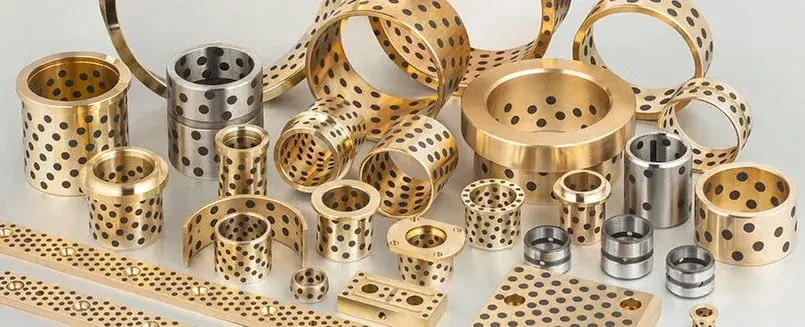
Graphite dry bushings are self-lubricating bearings that eliminate the need for external oil or grease. They combine a strong bronze or brass matrix with embedded solid graphite plugs, which continuously release lubricant during operation. This design delivers low friction, high load capacity, and excellent wear resistance across a wide temperature range. From excavators and cone crushers to hydropower turbines and agricultural machinery, graphite dry bushings provide maintenance‑free performance in dirty, high‑load, or hard‑to‑reach applications. They are a proven alternative to traditional lubricated bearings, reducing downtime and total operating costs.
1. What Is a Graphite Dry Bushing and How Does It Work?
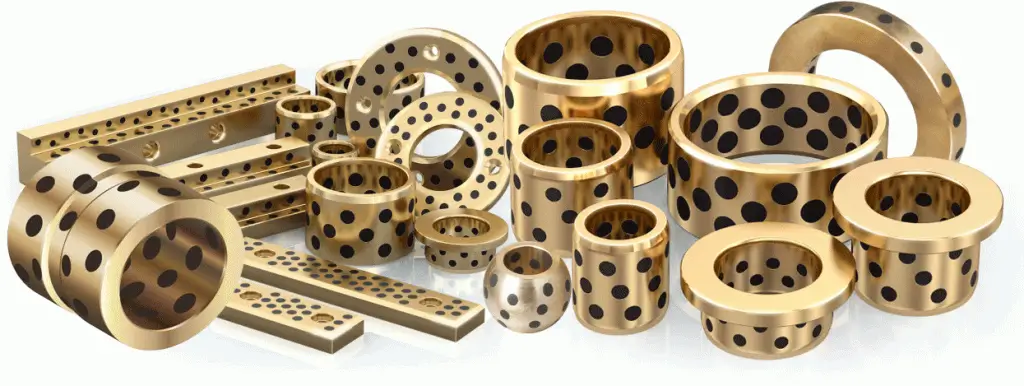
A graphite dry bushing is a sliding bearing that combines a strong metal matrix with embedded solid graphite lubricants. The metal—typically bronze, brass, steel, or cast iron—provides mechanical strength and load-carrying capacity. The graphite plugs or particles provide continuous self-lubrication.
How the lubrication mechanism works:
Graphite has a unique hexagonal layered crystal structure. The bonds between layers are weak (van der Waals forces), allowing the layers to slide over each other with minimal resistance.As the shaft rotates or slides against the bushing surface, microscopic graphite particles transfer onto the contact surfaces, forming a low-friction film. This happens automatically during operation. No external oil or grease required.
The manufacturing process:
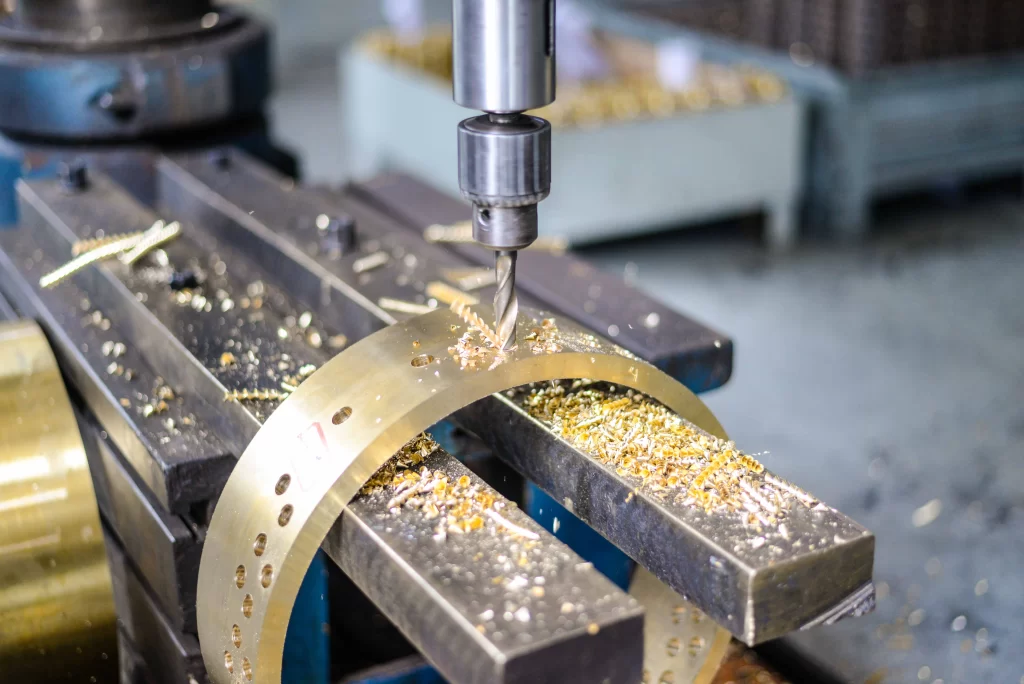
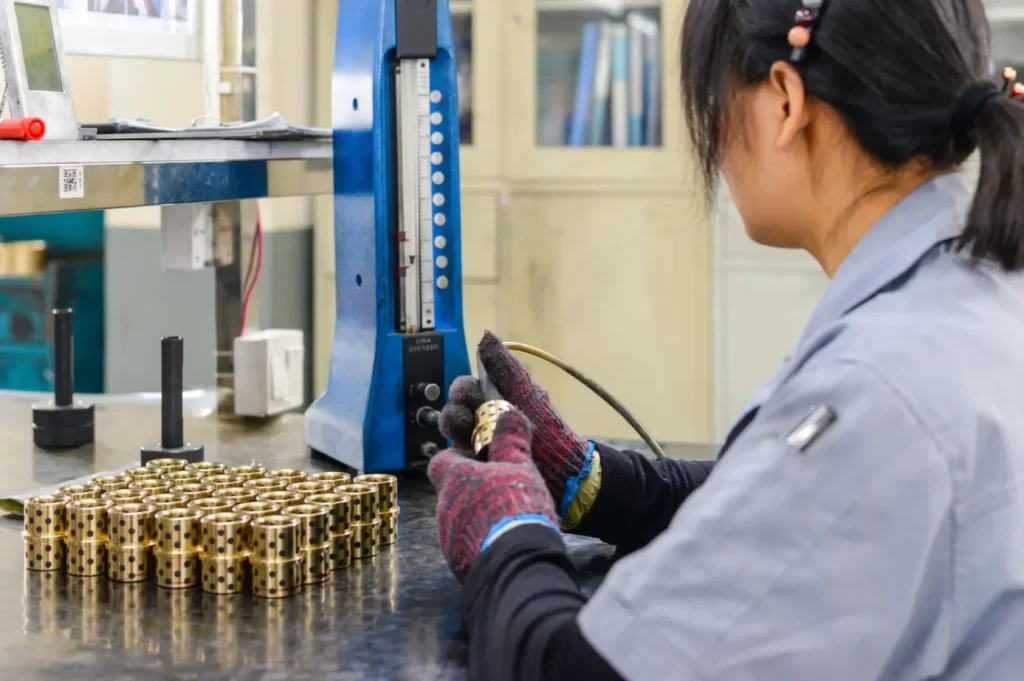
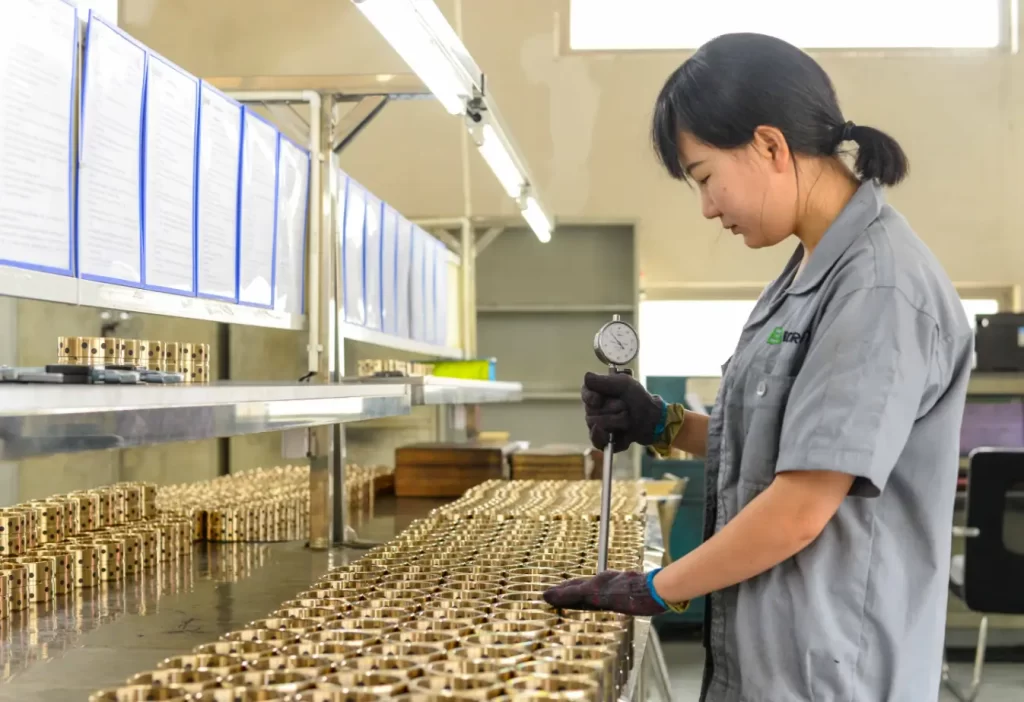
Quality graphite dry bushings are produced through precision machining and advanced impregnation techniques.First, the metal matrix is cast—often through centrifugal or continuous casting to ensure a dense, porosity-free microstructure. Then, holes of appropriate size and orderly arrangement are machined into the friction surface.– High-purity graphite plugs are mechanically pressed under extreme pressure into these grooves. Finally, the bushing undergoes CNC machining to achieve tight tolerances and proper surface finish.
The result is a self-lubricating, maintenance-free bearing that can handle high loads, high temperatures, and dirty environments.
2. The Core Advantages of Self-Lubricating Graphite Bushings
Let’s break down why engineers are switching to graphite dry bushings in growing numbers.
 Self-Lubricating and Maintenance-Free
This is the headline feature. Graphite dry bushings do not require external oil or grease. The embedded graphite plugs release lubricant continuously during operation.– No grease fittings. No lubrication schedules. No messy oil leaks. Just set it and forget it.
High Load-Carrying Capacity
Don’t let the “self-lubricating” label fool you. These are not lightweight bearings. Graphite dry bushings can handle heavy radial and axial loads, ranging from dozens to hundreds of megapascals. The metal matrix—typically high-strength tin bronze or aluminum bronze—provides excellent mechanical properties and impact resistance.
For demanding applications, C95500 nickel aluminum bronze bushings can handle static loads up to 350 MPa. That’s serious load capacity.
High Temperature Resistance
Traditional lubricants break down when temperatures rise. Grease melts. Oil evaporates. Graphite does not. Graphite dry bushings operate reliably in temperatures from -50°C to 300°C. Some specialized formulations can handle even higher temperatures.
Excellent Performance in Dirty Environments
Dust, sand, mud, and abrasive debris are the enemies of traditional bearings. Contaminants mix with grease to form a grinding paste that accelerates wear. Graphite dry bushings don’t have this problem because there is no grease to attract contaminants.– The solid lubricant stays where it belongs—between the bearing and shaft surfaces.
Corrosion Resistance
Graphite dry bushings resist attack from many corrosive substances, including acids, alkalis, seawater, and industrial chemicals.– This makes them ideal for chemical processing equipment, marine applications, and hydropower turbines exposed to water and silt.
Long Service Life
Field data shows that graphite-plugged bushings extend mean time between failures (MTBF) by 3 to 5 times compared to traditional bearings in mining equipment. Less downtime. Lower total cost of ownership.
Reduced Operational Costs
When you eliminate the need for external lubrication, you also eliminate:
Lubricant purchase and storage costs
Labor costs for greasing
Downtime for lubrication access
Environmental cleanup from oil leaks
Product contamination risks in food and pharmaceutical applications
Clean and Environmentally Friendly
No oil means no oil spills. No grease means no grease disposal problems. For industries with strict environmental regulations—hydropower, food processing, pharmaceuticals—this is a major advantage.
3. Limitations and Considerations
No technology is perfect. Graphite dry bushings have some limitations you should know about.
 Higher Initial Cost
Graphite dry bushings cost more upfront than standard bronze bushings due to the specialized materials and manufacturing processes involved. But here’s the thing: when you factor in the reduced maintenance, longer service life, and avoided downtime, the total cost of ownership is usually lower.
Speed Limitations
The self-lubricating properties of graphite bushings become less effective at very high velocities. For high-speed applications exceeding 2–3 m/s sliding speed, you may need to consider alternative bearing types or consult with an engineer about your specific operating conditions.
Not Ideal for Vacuum Environments
Standard graphite dry bushings contain trace moisture and gases that can outgas in vacuum conditions. For vacuum applications, specialized carbon-graphite bushings are available, but that is a different product category.
Graphite Residue
Graphite can leave minor dark residue on contact surfaces. In most industrial applications, this is not a problem. But in cleanroom environments or applications where absolute cleanliness is required, you should consider this factor.
Requires Proper Installation Alignment
Like all precision bearings, graphite dry bushings need correct installation. Misalignment can cause uneven wear and reduced performance. Follow proper press-fit procedures and clearance specifications.
4. Graphite Dry Bushing Materials: Choosing the Right Bronze Alloy
The metal matrix is the backbone of any graphite dry bushing. Different applications require different alloys. Here is a practical guide to the most common options.
Tin Bronze (CuSn8, CuSn10, CuSn12)
What it is: Tin bronze is the classic general-purpose bearing bronze. CuSn8 contains approximately 8% tin, CuSn10 contains 10% tin, and CuSn12 (RG7) contains 12% tin.
Properties: Good balance of strength, wear resistance, and machinability. CuSn12 offers superior embeddability and can handle loads up to 150 MPa.
Best for: General industrial machinery, pumps, conveyors, agricultural equipment, and applications where cost-effectiveness matters.
Operating temperature: -50°C to 250°C.
Aluminum Bronze (C95400, C95500, CuAl10Fe5Ni5)
What it is: Aluminum bronze contains aluminum as the primary alloying element, often with iron and nickel additions.
Properties: Superior strength and exceptional corrosion resistance, especially in seawater and chemical environments. C95500 nickel aluminum bronze handles static loads up to 350 MPa and offers excellent wear resistance.
Best for: Mining crushers, excavators, marine applications, chemical processing equipment, and heavy construction machinery.
Operating temperature: -50°C to 300°C+
Manganese Bronze (C86300)
What it is: Manganese bronze offers very high tensile strength and hardness.
Properties: C86300 manganese bronze has hardness of 180–220 HB and load capacity up to 250 MPa. It is shock-resistant and ideal for extreme heavy-load, low-speed applications.
Best for: Bulldozers, mining shovels, crushers, and high-stress bushings.
High-Strength Brass (CuZn25Al5)
What it is: High-strength brass with aluminum and manganese additions.
Properties: Good physical performance and casting capability, with excellent anti-erosion resistance in air, freshwater, and seawater.
Best for: Light to medium-duty industrial equipment, food processing machinery, and applications requiring good corrosion resistance.
Graphite Dry Bushing Product Forms
Graphite dry bushings are available in several configurations to suit different applications:
5. Industry Applications: Where Graphite Bushings Shine
Graphite dry bushings are used across virtually every heavy industry sector. Let’s walk through the major applications.
 Construction Machinery
Excavators, bulldozers, loaders, backhoes, and cranes operate in brutal conditions. Mud, sand, dust, shock loads, and pivot points that are nearly impossible to grease regularly.
Graphite dry bushings are widely used in:
Upper arm, lower arm, and pin connections
Bucket hinges and lift arms
Track wheels and steering joints
Eccentric shafts and spindle assemblies
For heavy-duty machines like excavators and bulldozers, graphite-plugged copper alloy bushings provide the load capacity and contamination resistance needed to keep equipment running.
 Mining Equipment
Mining might be the toughest environment for bearings. Abrasive dust, extreme loads, shock impacts, and remote locations where maintenance access is difficult or impossible.
Applications include:
Cone crusher eccentric bushings and bottom shell bushings
Drilling rig kelly drives and swivel joints
Conveyor belt idlers and tension supports
Excavator bucket joints and linkages
Jaw crusher pivot arms and wear plates
Bronze bushes with graphite are self-lubricating bearings designed specifically for heavy-duty, low-maintenance performance in mining applications.The graphite plugs release lubricant during operation, reducing friction and wear without external grease.
In cone crushers, graphite-impregnated bronze bushings provide excellent performance under extreme pressure up to 300 MPa, significantly extending service life compared to standard bushings.
 Agricultural Machinery
Farm equipment operates in open fields, exposed to dust, dirt, moisture, and temperature extremes. Tractors, combine harvesters, balers, potato harvesters, sprayers, and planting equipment all benefit from self-lubricating bushings.
Graphite bushes are used in agricultural machinery to reduce wear and friction in moving parts, providing long-lasting performance with minimal maintenance. Graphite-filled grooves and wear plates are designed for applications that need continuous lubrication in hard-to-reach areas.–
 Hydropower and Renewable Energy
Hydropower plants have a unique challenge: bearings that operate underwater, in silt-laden rivers, and in locations where regular maintenance is impractical. Traditional oil-lubricated bronze bearings require constant attention and pose environmental risks from oil leakage.
Self-lubricating graphite bronze bushings are increasingly replacing oil-lubricated bearings in hydropower applications. Testing conducted by Pacific Northwest National Laboratory for the U.S. Army Corps of Engineers found that self-lubricated bushings outperformed traditional oil-lubricated bronze bushings in durability and cyclic load bearing properties.
The shift to self-lubricating graphite bronze alloys marks a major advancement in hydropower, improving efficiency, reducing environmental impact, and ensuring reliable operation for turbines, gates, and valves.–
Wind energy applications also benefit from graphite bushings, particularly in pitch control mechanisms, yaw drives, and generator components where maintenance access is difficult.–
 Industrial Machinery
Steel mills, rolling mills, injection molding machines, extrusion presses, and conveyor systems all rely on graphite dry bushings.
Specific applications include:
Injection molding machine bronze bush: Graphite-plugged bronze bushings provide self-lubrication in the high-temperature, high-load environment of plastic injection molding.
Bronze wear plates for extrusion presses: Slide plates with graphite plugs reduce friction and extend equipment life.
Oilless bearings for conveyor belts: Self-lubricating bearings eliminate the need for greasing along long conveyor lines.
Brass bushings for rolling mills: High-strength C85700 brass sleeves with graphite lubrication handle the extreme conditions of metal rolling.
 Automotive and Transportation
Graphite bushes are used in suspension systems, steering systems, throttle linkages, brake systems, and various pivot points. They reduce friction, improve wear resistance, and provide durability in applications where traditional greasing is difficult.
Other Applications
6. Graphite Dry Bushing vs Traditional Bearings: A Side-by-Side Comparison
| Feature | Traditional Bronze Bushing (Oil/Grease) | Graphite Dry Bushing (Self-Lubricating) |
|---|
| Lubrication | Requires external oil or grease | Self-lubricating, no external lubrication needed |
| Maintenance | Regular greasing required | Maintenance-free |
| Dirty Environments | Grease attracts abrasive dust, accelerates wear | No grease to attract contaminants |
| High Temperature | Limited by lubricant flash point | Up to 300°C+ |
| Corrosive Environments | Lubricant can wash away | Graphite resists many corrosive substances |
| Environmental Impact | Risk of oil/grease leakage | Zero leakage, environmentally friendly |
| Initial Cost | Lower | Higher |
| Total Cost of Ownership | Higher due to maintenance and downtime | Lower over equipment life |
| Clean Applications | Risk of product contamination | Oil-free, safe for food/pharma |
| Hard-to-Reach Locations | Difficult to lubricate | No lubrication access needed |
7. Market Outlook: Why Graphite Bushings Are the Future
The numbers tell a clear story. The global carbon-graphite bushings market is experiencing steady growth, driven by increasing demand across industrial sectors. Here are the key statistics:
2024 market size: Approximately USD 14.5 billion
2032 projected market size: USD 25.3 billion
CAGR (2025–2032): 7.1%
Fastest growing region: Asia-Pacific (38.6% share)
Leading country: China (22.8% share)
Largest application segment: Power generation equipment (41.5% share)
What is driving this growth?
Industrialization in emerging economies. As manufacturing and infrastructure development accelerate in Asia, Africa, and South America, demand for reliable, low-maintenance machinery components increases.
Focus on reducing operational costs. Companies are recognizing that lower initial cost often means higher long-term cost. Total cost of ownership calculations increasingly favor self-lubricating solutions.
Environmental regulations. Stricter environmental standards are pushing industries away from oil-lubricated bearings toward cleaner alternatives.
Advancements in manufacturing technology. Improved casting, machining, and impregnation techniques are producing higher-quality graphite bushings with better performance and longer life.
Growing renewable energy sector. Hydropower, wind, and solar all require bearings that can operate in challenging conditions with minimal maintenance.
8. Installation Tips for Maximum Performance
Getting the most from your graphite dry bushings starts with proper installation.
Housing Fit (Interference Fit)
The bushing should be press-fitted into its housing to prevent rotation or axial movement. The bushing outer diameter should be slightly larger than the housing inner diameter. Use a press for installation, and ensure both surfaces have a lead-in chamfer of 15–30 degrees.
Shaft Fit (Running Clearance)
A precise clearance must exist between the bushing inner diameter and the shaft to allow for thermal expansion and the lubricant film without causing seizure. The required clearance depends on shaft diameter, operating temperature, and speed.
Surface Finish Recommendations
Following these guidelines ensures optimal performance and maximum service life.
9.FAQ: Your Most Common Questions Answered
Q1: What is a graphite dry bushing?
A graphite dry bushing is a self-lubricating bearing that combines a strong metal matrix (usually bronze) with embedded solid graphite lubricant plugs. It requires no external oil or grease to operate.
Q2: How do graphite bushings work without oil?
Graphite has a hexagonal layered crystal structure. The weak bonds between layers allow them to slide over each other easily. As the shaft rotates, microscopic graphite particles transfer onto the contact surfaces, forming a low-friction film.
Q3: Can graphite dry bushings handle heavy loads?
Yes. Depending on the bronze alloy selected, graphite dry bushings can handle static loads from 150 MPa (CuSn12) up to 350 MPa (C95500 nickel aluminum bronze).
Q4: What is the temperature range for graphite bushings?
Most graphite dry bushings operate reliably from -50°C to 300°C. Some specialized formulations can handle even higher temperatures.
Q5: Are graphite bushings suitable for high-speed applications?
Graphite bushings are best suited for low to medium speed applications, typically sliding speeds below 2–3 m/s. For very high-speed applications, consult with an engineer to evaluate your specific operating conditions.
Q6: How long do graphite dry bushings last?
Service life varies by application, but field data shows graphite-plugged bushings typically extend MTBF by 3 to 5 times compared to traditional bearings in mining equipment.
Q7: Can graphite bushings be used underwater?
Yes. Graphite dry bushings perform well in submerged applications, including hydropower turbines, marine propeller shafts, and rudders. They do not require grease that would wash away.
Q8: What bronze alloys are available for graphite bushings?
Common options include tin bronze (CuSn8, CuSn10, CuSn12), aluminum bronze (C95400, C95500), manganese bronze (C86300), and high-strength brass (CuZn25Al5). Each offers different properties for specific applications.
Q9: Are custom sizes available?
Yes. Reputable manufacturers like MYWAY offer custom machining to any specification, including special dimensions, flanged designs, thrust washers, and slide plates.
Q10: Why should I choose graphite bushings over traditional bearings?
If your application involves high loads, high temperatures, dirty environments, hard-to-reach lubrication points, or environmental compliance requirements, graphite bushings offer superior performance and lower total cost of ownership.
10. Why Choose MYWAY for Your Graphite Dry Bushing Needs
Now for the part you have been waiting for.
You have read about the technology, the benefits, the applications, and the installation requirements. You understand why graphite dry bushings are replacing traditional bearings across heavy industry. The question is: where do you get them?
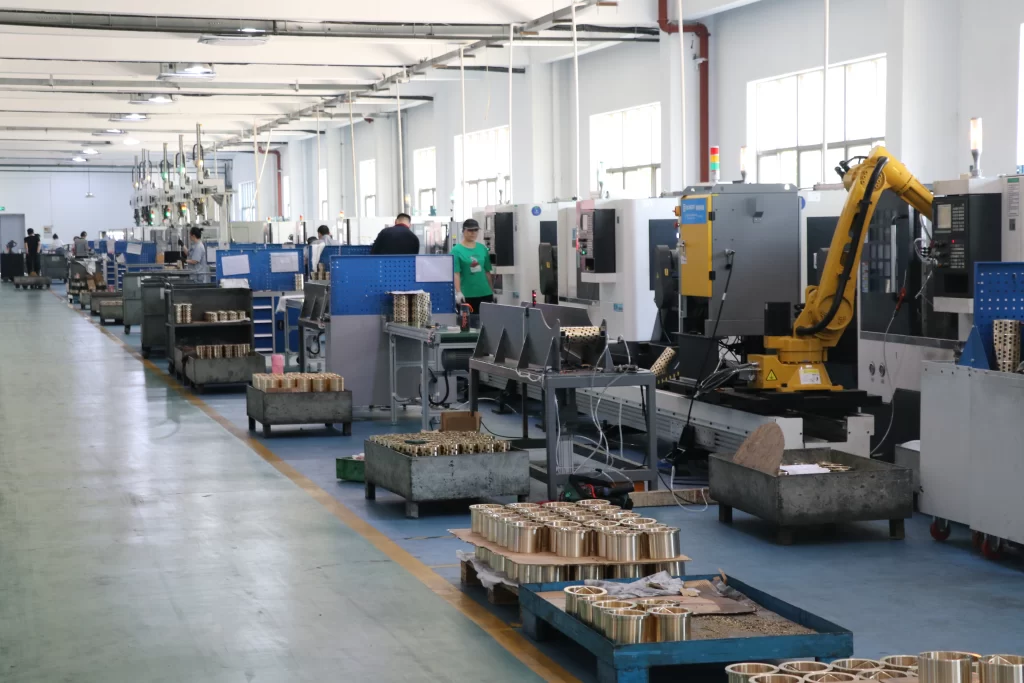
MYWAY Bushing is a mature, ISO9001-certified bushing production factory with extensive experience manufacturing self-lubricating graphite dry bushings for demanding industrial applications.
What MYWAY Offers:
*Wide product range:
Graphite plugged bronze bushings (plain sleeve and flanged)
JDB solid lubricated bushings
Bronze bushings for excavators, bulldozers, and construction machinery
Wear plates and slide plates for extrusion presses and farming equipment
Brass bushings for rolling mills
Custom bushings for any application
*Brand compatibility:
MYWAY bushings are designed as direct replacements for major equipment brands, including Caterpillar, Komatsu, Volvo CE, Sandvik, and Metso. Perfect fit. No modifications needed.
*Quality assurance:
ISO, CE, IATF, UL, and other authoritative certifications ensure that every bushing meets exacting standards. Fully automated equipment ensures batch-to-batch consistency with size tolerance no more than 0.2 mm.
*Competitive pricing:
Mature supply chain management and large-scale production allow MYWAY to offer highly competitive pricing without compromising quality.
*Material expertise:
MYWAY uses high-quality raw materials from reliable suppliers, including tin bronze, aluminum bronze, manganese bronze, high-strength brass, cast iron, stainless steel, and more.The right material for your specific application.
*Custom manufacturing:
Send your drawings or samples. MYWAY provides made-to-order manufacturing services for any size, quantity, or specification.
How to Get Started
Ready to reduce maintenance costs, eliminate lubrication headaches, and keep your equipment running longer?
Contact MYWAY today:
 Reach out through the website: mybushing.com
 Send your inquiry or drawing for a quick quote
 Provide your application details for material recommendations
Whether you need standard graphite dry bushings or custom-engineered solutions for your specific machinery, MYWAY has the expertise, manufacturing capability, and quality commitment to deliver.
Don’t let lubrication problems hold your operation back. Make the switch to graphite dry bushings from MYWAY—and experience the difference that real self-lubricating technology makes.
100000+ Types of Bushings – Contact Us for Details