
Recent Posts
Types of Bronze Bushings: Properties, Applications, and Selection Tips
Bronze bushings are the unsung heroes of mechanical systems. These unassuming cylindrical components quietly reduce friction, support rotating shafts, and absorb shock loads in everything from your car’s suspension to massive industrial machinery. But not all bronze bushings are created equal. The world of bronze bushings is surprisingly diverse, with different alloys and designs engineered for specific applications.
Whether you’re a maintenance engineer looking for replacement parts, a designer specifying components for a new machine, or just curious about how things work, this comprehensive guide will walk you through the various types of bronze bushings, their unique properties, and how to choose the right one for your needs.
Let’s dive into the fascinating world of bronze bushings.
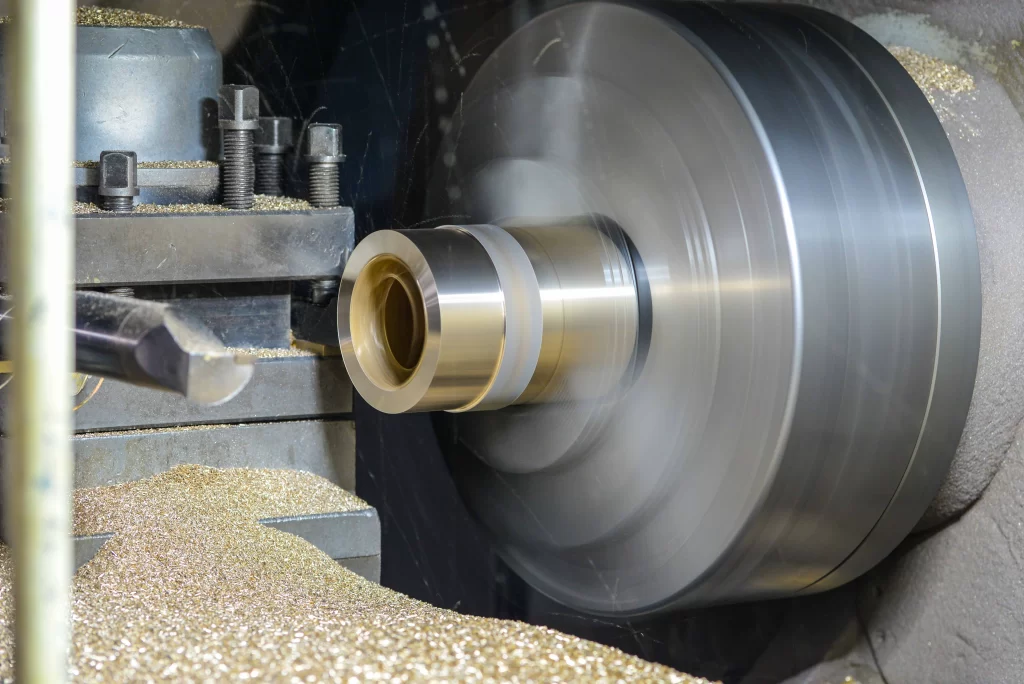
Table of Contents
1. What Are Bronze Bushings and Why Are They So Popular?
Before we explore the different types, let’s understand what makes bronze such a fantastic material for bushings.
Bronze is an alloy primarily composed of copper and tin, though other elements like aluminum, lead, silicon, and phosphorus are often added to enhance specific properties . This copper-based alloy offers an impressive combination of characteristics that make it ideal for bearing applications:
Excellent wear resistance – Bronze can withstand continuous friction without degrading quickly
Natural corrosion resistance – Unlike steel, bronze doesn’t rust, making it perfect for marine and outdoor applications
Good load-bearing capacity – It handles heavy radial and axial loads without deforming
Self-lubricating properties – Some bronze alloys contain materials that provide internal lubrication
Thermal conductivity – Bronze dissipates heat effectively, preventing overheating in high-friction applications
Machinability – It can be precision-machined to tight tolerances
These properties explain why bronze bushings have been used for centuries and remain irreplaceable in modern engineering .
2. Classification by Structure and Design
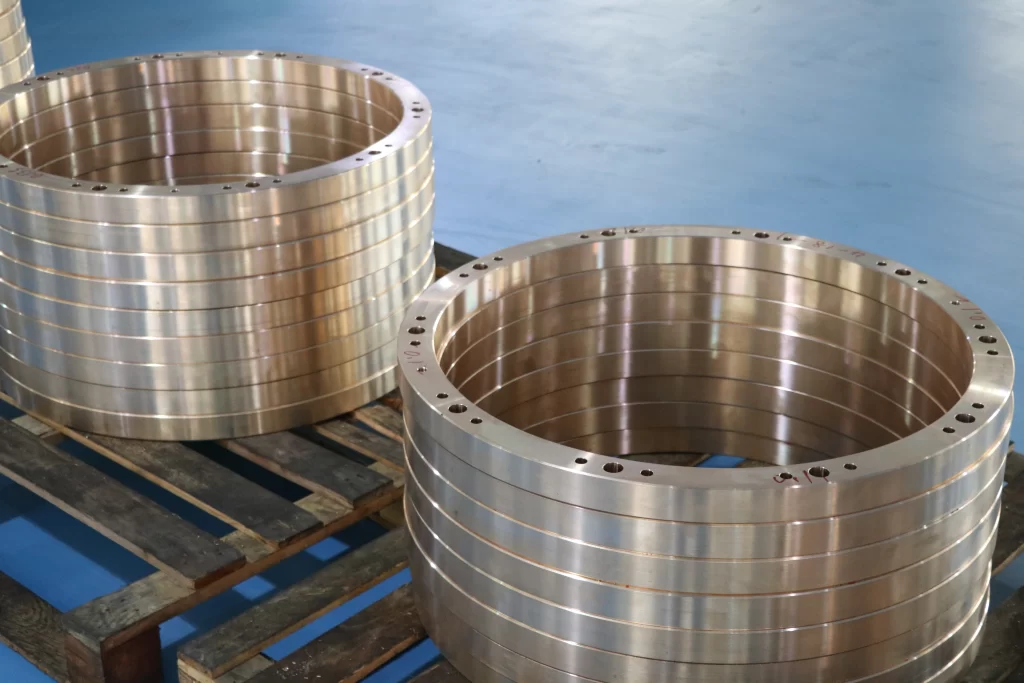
Bronze bushings come in several structural configurations, each designed for specific load conditions and installation requirements .
Standard Sleeve Bushings
The simplest and most common type, standard sleeve bushings are straight cylindrical components that provide radial support for rotating or oscillating shafts. They’re the go-to choice for general-purpose applications where axial loads are minimal .
Key characteristics:
Simple cylindrical design with no flanges or grooves
Provides radial load support only
Easy to install and replace
Cost-effective for high-volume applications
Available in a wide range of standard sizes
Typical applications:
Agricultural equipment
Conveyor systems
Pumps
Light-duty machinery
Electric motors
Size ranges: ID from 3mm to 80mm, OD from 6mm to 100mm, length from 5mm to 100mm .
Flanged Bronze Bushings
Flanged bushings feature an integrated flange at one end that acts as a shoulder, providing both radial and axial (thrust) load support . The flange prevents the bushing from migrating within the housing and helps absorb thrust loads.
Key characteristics:
Integrated flange provides axial positioning and support
Eliminates need for separate thrust washers
Improves lubricant retention
Prevents axial movement during operation
Reduces wear on mating components
Advantages:
Handles both radial and thrust loads
Simplifies assembly by combining two functions in one component
Maintains better alignment in applications with axial forces
Typical applications:
Gearboxes
Automotive suspension links
Pivot points
Industrial actuators
Electric motors
Marine propulsion systems
Size ranges: ID from 6mm to 100mm, OD from 10mm to 120mm, length from 10mm to 150mm (including flange) .
Grooved Bronze Bushings
Grooved bushings feature precision-cut channels on the inner or outer diameter that act as lubricant reservoirs . These grooves ensure consistent oil or grease distribution across the bearing surface, even in high-load, low-speed applications.
Key characteristics:
Internal or external lubrication grooves
Enhanced lubricant retention and distribution
Reduces friction and heat buildup
Extends service life under heavy loads
Ideal for intermittent lubrication systems
Advantages:
Maintains lubrication film under boundary conditions
Reduces maintenance frequency
Performs well in applications with start-stop operation
Considerations:
May trap debris if not properly sealed
Slightly reduced structural wall thickness
Higher cost than standard bushings
Typical applications:
Construction machinery
Hydraulic systems
Heavy-duty presses
Mining equipment
Applications with intermittent or unreliable lubrication
Size ranges: ID from 8mm to 90mm, OD from 12mm to 110mm, length from 15mm to 130mm, with groove depth typically 0.5–2mm .
Thin-Walled Bronze Bushings
Engineered with reduced wall thickness, these bushings save space and weight while maintaining functionality . They’re ideal for compact designs where every millimeter counts.
Key characteristics:
Compact design for tight spaces
Lightweight with efficient material use
Easy integration into precision assemblies
Cost-effective for high-volume applications
Limitations:
Lower load capacity than solid bushings
More sensitive to misalignment
Requires precise housing bore
Typical applications:
Small electric motors
Compact gearboxes
Consumer appliances
Robotics
Precision instruments
Solid Bronze Bushings
Machined from a single piece of bronze alloy, solid bushings offer exceptional durability and the highest load capacity among bronze bushing types . They’re the choice for the most demanding applications.
Key characteristics:
Highest strength and wear resistance
Excellent performance under heavy loads
Precise dimensional stability
Longest service life in demanding environments
Typical applications:
Gearboxes
Heavy machinery
Industrial equipment with high torque
High-load rotating systems
Mining equipment
3. Classification by Material Composition
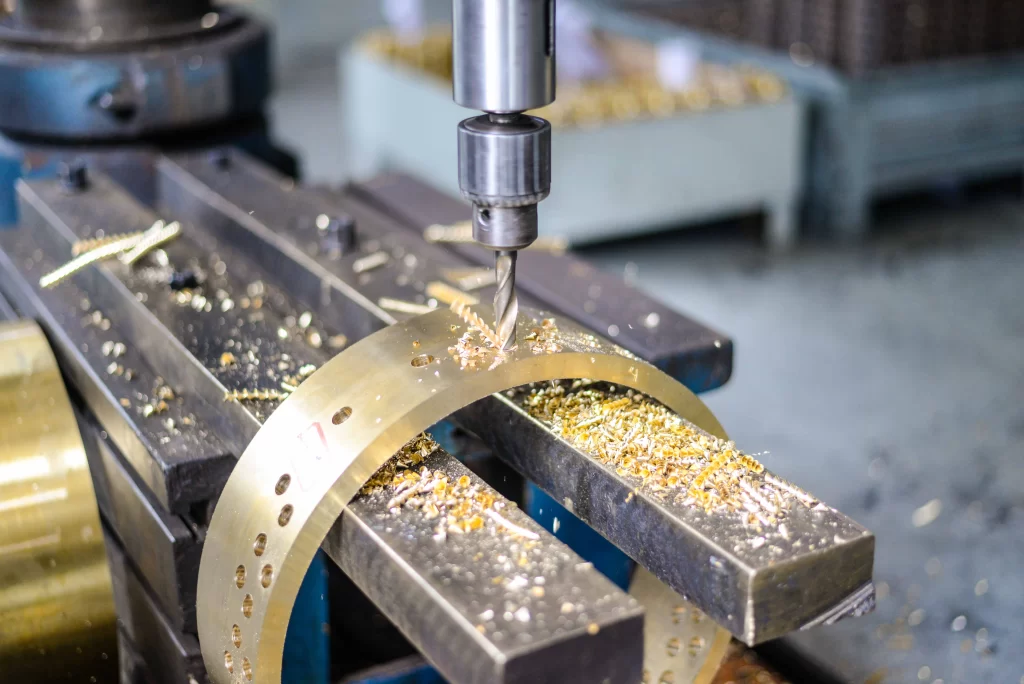
The type of bronze alloy used in a bushing dramatically affects its performance characteristics. Here are the most common bronze alloys used in bushing manufacturing .
Tin Bronze Bushings
Tin bronze is the “classic” bronze, composed primarily of copper with 5-10% tin . This alloy offers an excellent balance of strength, wear resistance, and corrosion resistance.
Properties:
Good wear resistance and low friction coefficient
Excellent corrosion resistance, particularly against saltwater
Good fatigue strength
Dimensional stability under load
Typical tensile strength: 240 – 450 MPa
Applications:
Heavy machinery components
Marine shafts and propellers
Gears and bearings
Pump bodies
Electrical connectors (for phosphor bronze variants)
Common grades: C90300, C90500, C90700
Aluminum Bronze Bushings
Aluminum bronze contains 5-12% aluminum, often with iron and nickel additions . This alloy offers exceptional strength comparable to medium-carbon steels, combined with outstanding corrosion resistance.
Properties:
High tensile and fatigue strength
Superior corrosion resistance, especially in seawater
Good performance at elevated temperatures
Resistant to biofouling in marine environments
High strength-to-weight ratio
Typical tensile strength: 520 – 800 MPa
Applications:
Marine hardware and propulsion systems
Aerospace components (landing gear, control systems)
Chemical processing equipment
High-load rotating systems
Valve components and pumps
Offshore oil and gas equipment
Common grades: C95400, C95500, C63000
Nickel Aluminum Bronze Bushings
Building on aluminum bronze, nickel aluminum bronze adds significant nickel content (typically 4-5%) to further enhance strength, toughness, and corrosion resistance . This represents the pinnacle of strength among commonly used bronze families.
Properties:
Very high strength (highest among common bronzes)
Superior corrosion and erosion resistance
Excellent performance in aggressive seawater environments
Often heat-treatable for even higher strength
Outstanding wear resistance
Typical tensile strength: 650 – 900+ MPa
Applications:
Marine propulsion components
Offshore hardware
Aerospace bushings
High-stress valve components
Subsea equipment
Desalination plants
Common grades: C95510, C95800, C63020
Phosphor Bronze Bushings
Phosphor bronze contains tin and a small amount of phosphorus (0.01-0.5%), which acts as a deoxidizer and increases hardness, wear resistance, and fatigue strength . It’s known for its spring-like qualities.
Properties:
Excellent fatigue resistance
High strength and toughness
Low coefficient of friction
Fine grain structure
Good electrical conductivity
Anti-sparking properties
Typical tensile strength: 350 – 780 MPa
Applications:
Springs and electrical contacts
Precision instruments
Aerospace components
High-strength fasteners
Bellows and diaphragms
Applications requiring fatigue resistance
Common grades: C51000, C52100, C54400
Leaded Bronze Bushings
Leaded bronze contains 5-15% lead, which improves machinability and provides self-lubricating properties . The lead particles act as a solid lubricant, reducing friction even under boundary lubrication conditions.
Properties:
Excellent machinability
Reduced friction and galling
Good load-bearing capacity
Self-lubricating characteristics
Good conformability
Typical tensile strength: 200 – 300 MPa
Applications:
Automotive engines
Hydraulic systems
General industrial machinery
Applications requiring frequent start-stop operation
Environmental note: Due to lead content, these bushings are not suitable for food-grade or potable water applications. Lead-free alternatives like bismuth bronze are available for environmentally sensitive uses .
Silicon Bronze Bushings
Silicon bronze contains silicon (typically 1-3%) as the primary alloying element, which improves strength and corrosion resistance . It offers good weldability and a pleasing reddish-gold color.
Properties:
Good mechanical strength
Excellent corrosion resistance (similar to copper)
Good weldability and brazability
Attractive appearance
Typical tensile strength: 345 – 630 MPa
Applications:
Marine hardware (where extreme strength isn’t primary)
Architectural elements
Process equipment components
Art and sculpture (when used visibly)
Welded assemblies
Manganese Bronze Bushings
Despite the name, manganese bronze is technically a high-strength brass due to its significant zinc content . It contains manganese, aluminum, and iron to achieve very high strength.
Properties:
Very high strength
Good wear resistance
Reasonable corrosion resistance
Excellent for heavy-duty applications
Typical tensile strength: 450 – 830 MPa
Applications:
Propeller hubs
Gears
Bridge components
Heavy-duty mechanical parts
Construction equipment
Common grades: C86300, C86500
Bismuth Bronze Bushings (Lead-Free)
Bismuth bronze is a modern, environmentally friendly alternative to leaded bronze . Bismuth replaces lead to provide similar machinability and lubricity without toxicity concerns.
Properties:
Environmentally friendly (lead-free)
Good machinability
Safe for sensitive environments
Comparable performance to leaded bronze
Typical tensile strength: 200 – 310 MPa
Applications:
Potable water systems
Food processing equipment
Medical equipment
Eco-sensitive applications
Plumbing fixtures
4. Specialized Bronze Bushing Types
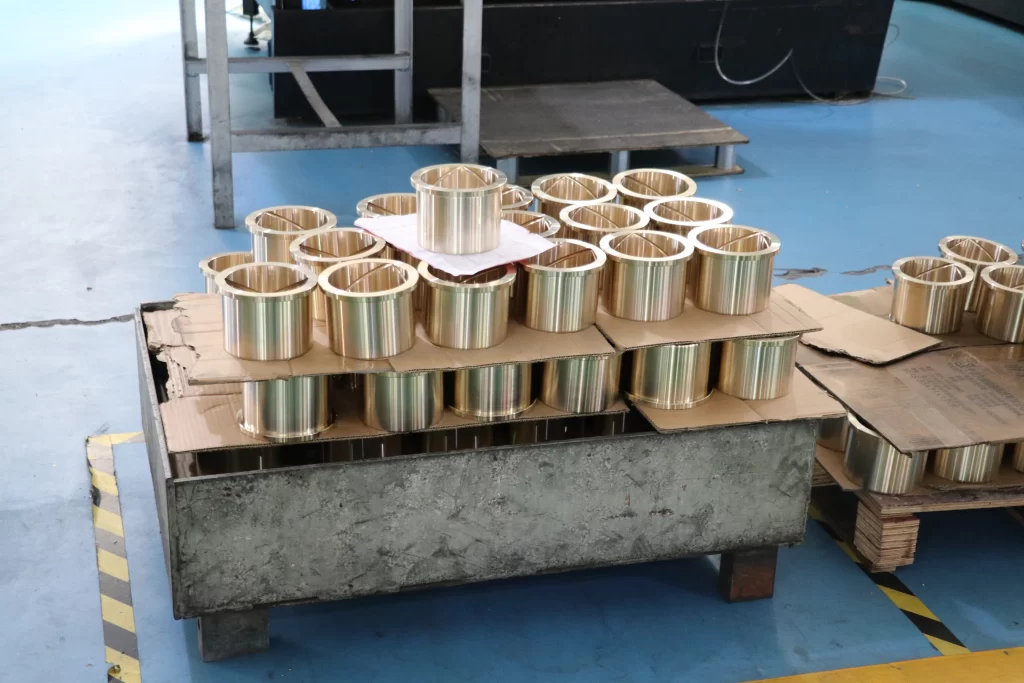
Beyond the standard classifications by structure and material, several specialized bronze bushing types deserve attention.
Sintered Bronze Bushings (Powder Metallurgy)
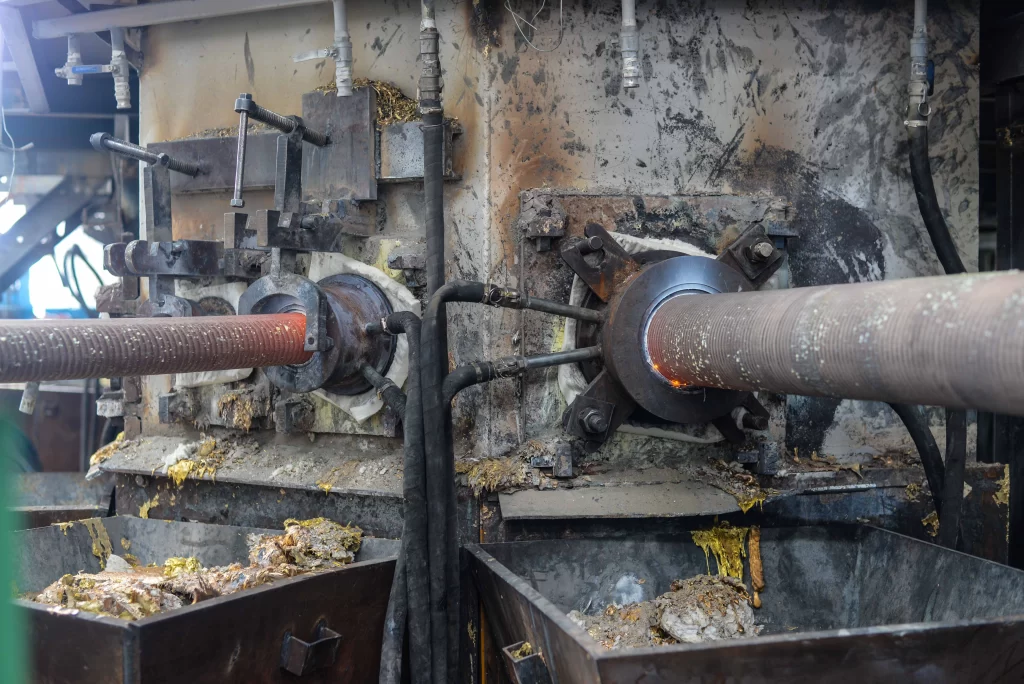
Sintered bronze bushings are manufactured through a powder metallurgy process rather than traditional casting . Metal powders are compressed under high pressure and heated to just below their melting point, creating a porous structure that’s then impregnated with oil.
Manufacturing process:
Compacting: Metal powder is pressed into shape under high pressure
Sintering: The “green” part is heated to fuse particles while maintaining porosity
Sizing: Optional calibration for precise dimensions
Oil impregnation: Vacuum process forces oil into the porous structure
Key properties:
Porosity of 10-40% allows oil storage
True self-lubricating operation
Maintenance-free in many applications
Cost-effective for complex shapes
Good for moderate loads and speeds
How they work:
At rest, oil is retained within the porous matrix. When the shaft rotates, friction generates heat, causing the oil to expand and seep onto the bearing surface. When operation stops and cooling occurs, capillary action draws most oil back into the pores .
Typical materials:
CuSn10, SAE841, SINT A51 (tin bronze)
Iron-based alloys (more economical, 30-50% lower cost than bronze)
Stainless steel 304/316 for food and medical applications
Typical applications:
Automotive engines and chassis
Industrial pumps
Food processing machinery
Household appliances
Power tools
Aerospace components
Size ranges: OD 6mm to 150mm, ID 3mm to 130mm, length 5mm to 300mm
Oil-Impregnated Bushings
These are essentially sintered bronze bushings that have been vacuum-impregnated with lubricating oil . They’re often called “self-lubricating” or “maintenance-free” bushings.
Properties:
Oil content of 15-30% by volume
Operating temperature range: -20°C to 200°C
Maintenance-free operation in most applications
Ideal for inaccessible locations
Applications:
Sealed mechanisms
Equipment where external lubrication is impractical
Clean environments where oil mist is undesirable
Graphite-Plugged Bronze Bushings
These bushings feature solid graphite plugs inserted into holes drilled through the bushing wall . The graphite provides continuous lubrication without oil.
Properties:
Solid lubrication (no oil needed)
High temperature capability
Works in dirty or dusty environments
Excellent for applications with oscillating motion
Applications:
Metallurgical rolling equipment
Gas turbines
Mining machinery
Shipbuilding
Aerospace navigation systems
High-temperature applications
Spherical Bronze Bushings
Spherical bushings have a concave spherical inner surface that accommodates misalignment between the shaft and housing . They’re ideal for applications where perfect alignment cannot be guaranteed.
Properties:
Self-aligning capability
Even load distribution
High load-carrying capacity
Wear resistance
Applications:
Linkages and pivoting mechanisms
Heavy machinery with deflection
Construction equipment
Suspension systems
5. Comparison of Bronze Bushing Types
To help you select the right bushing, here’s a comparison of common bronze bushing types and their characteristics:
| Bushing Type | Load Capacity | Lubrication Needs | Corrosion Resistance | Typical Applications |
|---|---|---|---|---|
| Standard Sleeve | Medium to High | Moderate (requires external lubrication) | Good | General industrial, automotive |
| Flanged | High | Moderate | Good | Gearboxes, motors, thrust applications |
| Grooved | High (radial) | Low (excellent retention) | Good | Heavy machinery, intermittent lube |
| Tin Bronze | Medium-High | Moderate | Excellent (marine) | Marine shafts, gears, pumps |
| Aluminum Bronze | Very High | Moderate | Excellent | Marine hardware, aerospace |
| Nickel Aluminum Bronze | Very High | Moderate | Superior | Offshore, subsea, high-stress |
| Phosphor Bronze | High | Moderate | Good | Springs, electrical, fatigue applications |
| Leaded Bronze | Medium | Low (self-lubricating) | Moderate | Automotive, hydraulic systems |
| Sintered Bronze | Medium | None (self-contained) | Good | Maintenance-free applications |
| Graphite-Plugged | High | None (solid lubricant) | Good | High-temp, dirty environments |
Based on data from multiple sources
6. How to Choose the Right Bronze Bushing
Selecting the optimal bronze bushing involves balancing multiple factors. Here’s a step-by-step approach:
1. Analyze Your Load Conditions
Radial loads only? Consider standard sleeve bushings
Combined radial and axial loads? Flanged bushings are your friend
High shock loads? Aluminum bronze or manganese bronze offer superior strength
Misalignment possible? Spherical bushings accommodate movement
2. Consider Operating Environment
Marine or wet environment? Aluminum bronze or nickel aluminum bronze provide excellent seawater resistance
Chemical exposure? Check specific alloy resistance
High temperature? Aluminum bronze performs well at elevated temperatures
Dusty or dirty? Graphite-plugged or sealed designs prevent contamination
3. Evaluate Lubrication Access
Regular maintenance possible? Standard bronze with external lubrication works fine
Hard-to-reach location? Sintered or oil-impregnated bushings eliminate maintenance
No lubrication possible? Graphite-plugged bushings provide solid lubrication
Food or clean environment? Bismuth bronze or stainless steel sintered bushings
4. Consider Speed and Operating Cycle
Continuous high-speed operation? Ensure adequate lubrication and heat dissipation
Intermittent or oscillating motion? Grooved bushings help maintain lubrication film
Frequent start-stop? Self-lubricating types reduce wear during boundary conditions
5. Check Regulatory Requirements
Potable water contact? Use lead-free alternatives like bismuth bronze
Food processing? Stainless steel sintered or lead-free alloys
Export restrictions? Be aware of lead content regulations in different markets
Installation Best Practices
Proper installation is crucial for bronze bushing performance and longevity :
Press-Fit Guidelines
Housing tolerance: H7 recommended
Shaft fit: f7 for most applications
Ensure proper surface finish on mating components
Use appropriate installation tools to prevent damage
Lubrication
Pre-lubricate during installation even for self-lubricating types
Follow manufacturer recommendations for lubricant type
Allow break-in period for optimal performance
Alignment
Ensure proper shaft alignment to prevent edge loading
Consider spherical bushings if alignment cannot be guaranteed
Check housing bore perpendicularity
FAQ: Common Questions About Bronze Bushings
Q: What’s the difference between bronze and brass bushings?
A: Bronze is primarily copper with tin, while brass is copper with zinc. Bronze is harder, stronger, and more wear-resistant than brass, making it better for bearing applications. Brass is softer and more likely to deform or gall under load .
Q: Do bronze bushings need grease?
A: Most standard bronze bushings require external lubrication (oil or grease) for optimal performance. However, sintered (oil-impregnated) and graphite-plugged bushings are designed for maintenance-free operation .
Q: How do I lubricate a sintered bronze bushing?
A: For new sintered bushings, soak them in oil before installation—place the bushing in your palm, fill the cavity with oil, and squeeze to force oil into the pores. This “primes” the self-lubricating mechanism .
Q: What’s the strongest type of bronze bushing?
A: Nickel aluminum bronze offers the highest tensile strength among common bronze alloys (650-900+ MPa), followed closely by manganese bronze and aluminum bronze .
Q: Can bronze bushings be used underwater?
A: Absolutely! Bronze’s natural corrosion resistance makes it ideal for marine applications. Nickel aluminum bronze and aluminum bronze are particularly well-suited for submerged or seawater applications .
Q: How long do bronze bushings last?
A: Service life varies dramatically based on load, speed, lubrication, and environment. Properly selected and maintained bronze bushings can last for decades—some early 20th-century machines still run on their original bronze bushings .
Q: What’s the difference between cast and sintered bronze bushings?
A: Cast bushings are machined from solid bronze, offering maximum strength for heavy loads. Sintered bushings are made from compressed metal powder and oil-impregnated, providing self-lubricating properties ideal for maintenance-free applications .
Q: Are leaded bronze bushings safe for drinking water applications?
A: No. Due to lead content, traditional leaded bronze should not be used in potable water systems. Bismuth bronze or other lead-free alternatives are available for such applications .
Why Choose MYWAY for Your Bronze Bushing Needs?
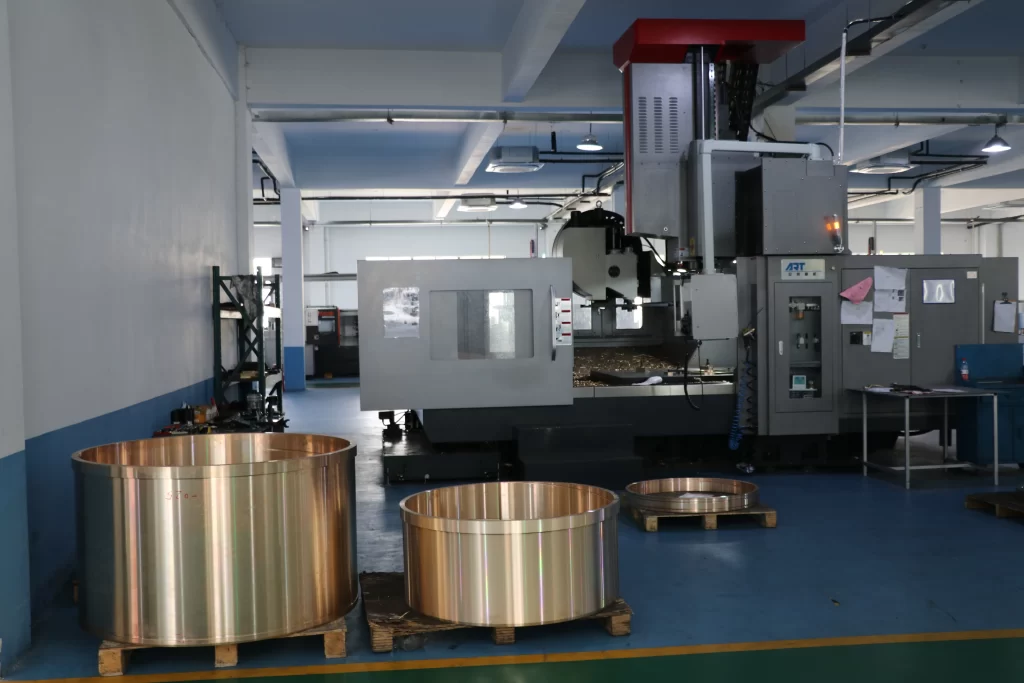
With over 20 years of manufacturing experience, MYWAY has established itself as a trusted partner for bronze bushing solutions worldwide . Here’s what sets us apart:
Comprehensive Product Range
We offer all types of bronze bushings discussed in this guide—from standard sleeve bushings to custom-engineered solutions. Our portfolio includes:
Sintered bronze bushings (powder metallurgy)
Cast bronze bushings in various alloys
Graphite-plugged bronze bushings
Flanged, grooved, and spherical designs
Custom shapes and sizes for unique applications
Quality You Can Trust
IATF/ISO certified manufacturing processes
Rigorous testing including oil content detection, nondestructive testing, and pressure resistance testing
Compliance with international standards (ASTM, BS, EN, DIN, JIS, AS, ISO)
Engineering Expertise
20 years of metallurgical experience
Custom alloy development for specific requirements
Application engineering support
Solutions for automotive, aerospace, marine, industrial, and food processing industries
Global Reach
Serving customers in 40+ countries
Reliable logistics network
Fast, competitive delivery
Cost-Effective Solutions
Optimized manufacturing processes
Economies of scale
Value engineering without compromising quality
Direct Replacements for Major Brands
Our products are designed as drop-in replacements for industry-standard components, including:
GGB (CSM, CBM, BP25)
SKF (PSM)
DAIDYNE (THERMALLOY, DAILUBO)
PTI (BNZ, BNZF)
And many others
Ready to Find Your Perfect Bronze Bushing?
Choosing the right bronze bushing doesn’t have to be complicated. Whether you need a standard maintenance-free sintered bushing, a high-strength aluminum bronze component for marine service, or a custom-engineered solution for a unique application, MYWAY has the expertise and manufacturing capability to deliver.
Contact us today for:
Expert application assistance
Competitive quotes
Technical data and material certifications
Samples for testing and validation
Get in touch:
Request a quote through our website
Email us with your specifications
WhatsApp for quick responses
Let MYWAY be your partner in precision—delivering bronze bushings that keep your machinery running smoothly, efficiently, and reliably for years to come.
FAQ: Comprehensive 608 Bearing Guide
What do the different suffixes mean in 608 bearing codes?
Suffixes indicate sealing type: Z (metal shield), ZZ (double shield), RS (rubber seal), 2RS (double rubber seal)
How do I choose between shielded and sealed bearings?
Metal shields (ZZ) offer better speed capability, while rubber seals (2RS) provide superior contamination protection
What are the temperature limits for different 608 bearing types?
Standard steel: -30°C to +120°C
Stainless steel: -30°C to +150°C
High-temperature variants: up to +250°C
How important is the ABEC rating for my application?
ABEC-1 sufficient for most applications; ABEC-3 or higher recommended for precision equipment
What lubrication options are available?
Standard grease, high-temperature grease, oil, or dry lubrication for specific environments
100000+ Types of Bushings – Contact Us for Details