
Recent Posts
METAL BUSHINGS: HIGH-PERFORMANCE PLAIN BEARINGS
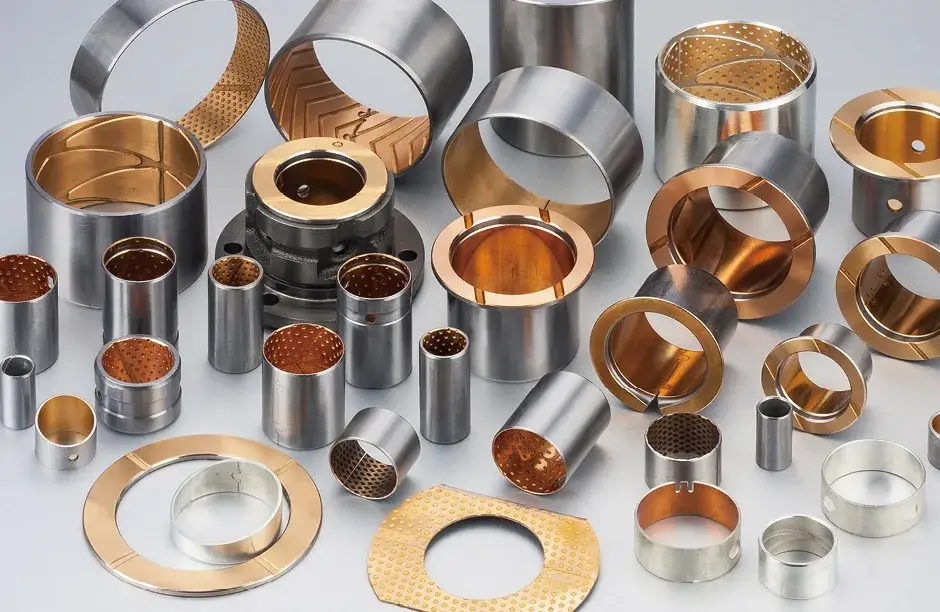
Table of Contents
1. Introduction to Metal Bushings
Metal bushings—also referred to as metallic bushes, plain bearings, sleeve bearings, or journal bearings—are precision-engineered cylindrical components installed between mechanical parts to support shafts or pins, reduce friction, and absorb vibration and shock–. These components act as liners between a rotating or sliding shaft and a housing, minimizing friction, absorbing dynamic loads, and preventing wear on critical parts.
Unlike rolling-element bearings such as ball bearings or roller bearings, metallic bushes have no moving parts, making them simpler, more robust, and ideally suited for harsh operating environments. From hardened steel bushes and bronze alloy sleeves to self-lubricating metal-polymer composites, metallic bushes deliver unmatched durability, cost-efficiency, and reliability across industries including automotive, aerospace, construction machinery, agricultural equipment, industrial automation, fluid power, and renewable energy
2. Metal Bushings vs. Bearings: Understanding the Distinction
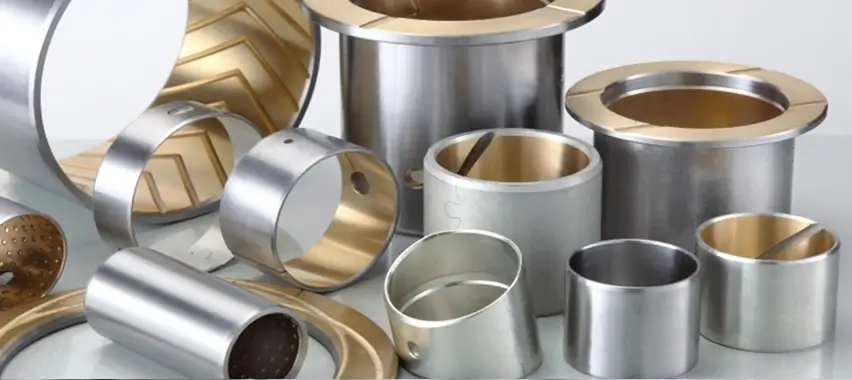
A fundamental question frequently encountered in engineering procurement is the distinction between bushings and bearings. A bushing is one classification within the broader category of bearings. However, significant operational differences exist between these component types.
Bushings are single-component cylindrical sleeves that support a rotating or oscillating shaft, with load carried over area without rolling elements. Bushings slide, while bearings roll. They function via a sliding action instead of the rolling action used by ball, roller, and needle bearings.
Bearings (in the narrow sense) are distinguished by their multiple-component designs, which include a cage containing rolling elements (balls or rollers), the rolling elements themselves, and inner and outer races upon which the rolling elements interact.
The practical implications of this distinction are substantial:
Cost: Bearings are typically 25–400% more expensive than bushings
Shock load sensitivity: Bushings are significantly less sensitive to shock loads or oscillations; bearings can develop brinelling, leading to race damage and eventual failure
Weight: Bushings tend to be 50% lighter than comparable needle bearings
Mounting: Bushings allow for more compact mounting schemes
Motion characteristics: Bushings slide; bearings roll
Bushings are ideal for distributing the weight of heavy or high load-bearing tolerances. They act as shock absorbers and decrease noise and wear. Many are self-lubricating, saving labor and time
3. Types and Material Classifications of Metal Bushings
3.1 Primary Classification by Material
Metal plain bushes are typically manufactured from brass, steel, and bronze. Bushings can be categorised into three main types: composite self-lubricating bushings, metallic self-lubricating bushings, and plastic compound bushings.
3.2 Common Metal Bushing Materials
Bronze Bushings (Copper Alloy Bushings)
Bronze bushings are among the most widely utilized metal bushings in industrial applications. They withstand static loads up to 60 MPa and dynamic loads up to 35 MPa. Standard bronze alloys include C93200/SAE 660 (83% Cu, 7% Pb, 7% Sn, 3% Zn). Bronze offers excellent corrosion resistance, high load capacity, and good wear resistance. Applications span automotive connecting rods, crankshafts, suspension systems, and various rotating or oscillating machinery components.
Steel Bushings
Steel bushings can handle over 100 MPa static loads in high-pressure applications. Hardened steel bushes, in particular, offer exceptional compressive strength, resisting deformation under extreme pressure—ideal for heavy machinery, construction equipment, and hydraulic systems. Stainless steel variants (Grade 304 or 316 with 18–20% Cr and 8–12% Ni) maintain dimensional stability up to 800°C in oxidizing environments.
Bimetallic Bushings
Bimetallic bushes combine a steel backing with a bronze or copper alloy lining, offering the strength of steel with the bearing properties of bronze. These are commonly used in automotive and heavy machinery applications.
Self-Lubricating Metal Bushings
Self-lubricating metallic bushes incorporate solid lubricants such as PTFE (polytetrafluoroethylene) or graphite, eliminating the need for external oil or grease lubrication. PTFE-coated steel bushings achieve friction coefficients as low as μ=0.05–0.10 with minimal lubrication.
Sintered Metal Bushings
Sintered bronze bushings are manufactured through powder metallurgy—metal powder is blended, pressed into green compacts, and sintered under high temperature. These bushings feature 10–30% porosity for oil retention and are commonly oil-impregnated for self-lubricating operation.
Aluminum Bronze Bushings
Aluminum bronze alloys (such as CuAl11Ni5Fe5) are utilized in aerospace landing gear bushings, guides, nuts, and heavy industry applications including civil engineering, iron and steel industry, manufacturing guides, and rolling mills
4. Manufacturing Processes for Metal Bushings
4.1 Casting Methods
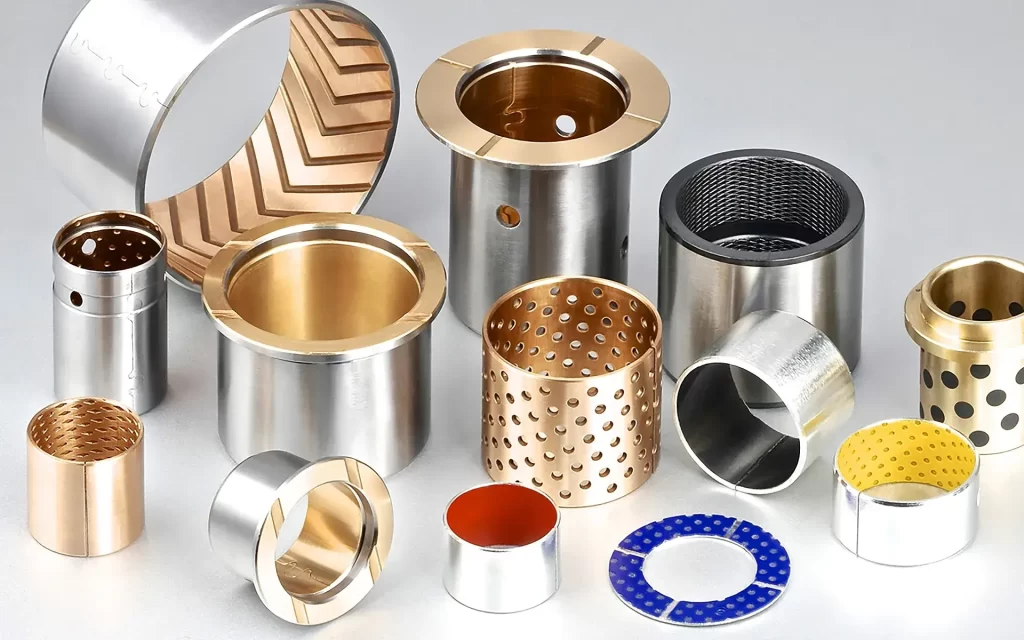
Centrifugal Casting: This advanced process enhances the density and uniform structure of the metal, ensuring each bushing possesses the durability required for demanding applications. MYWAY utilizes precision centrifugal casting to ensure uniform density and optimal material properties.
Sand Casting: Molten metal alloy is poured into sand molds of the desired bushing shape. Once cooled and solidified, the bushing is removed from the mold and finished to required dimensions through machining.
Investment Precision Casting: This method produces high-temperature and friction-resistant components with superior dimensional accuracy.
4.2 Powder Metallurgy (Sintering)
The production of porous self-lubricating metal bushes involves three basic steps: blending and mixing of metal powder, pressing (die compaction of green briquettes), and pre-sintering followed by sintering. Sintered bronze powder is mold-pressed under high pressure, sintered under high temperature, and oil is soaked into the homogeneously distributed tiny pores under vacuum.
4.3 Machining and Finishing
Precision machining processes include turning, grinding (centerless grinding or bore honing) to achieve highest dimensional accuracy. Precision-ground metal bushings maintain IT6-IT7 tolerance grades (ISO 286) with surface finishes of Ra 0.4–0.8 μm for critical applications
5. Technical Specifications and Performance Characteristics
5.1 Load Capacity
Bronze bushings: Static loads up to 60 MPa, dynamic loads up to 35 MPa
Steel bushings: Over 100 MPa static loads in high-pressure applications
Bronze alloys: Up to 300 MPa specific load capacity
5.2 Temperature Range
Standard bronze bushings: -40°C to +250°C, with special alloys extending to 400°C
Stainless steel: Maintains dimensional stability up to 800°C in oxidizing environments
Steel and bronze: Withstand temperatures from -40°C to +300°C
5.3 Friction Coefficients
Oil-impregnated sintered bronze: μ=0.08–0.12 under lubricated conditions
PTFE-coated steel bushings: μ=0.05–0.10 with minimal lubrication
Solid metal bushes (steel/bronze): μ=0.15–0.3 when lubricated
5.4 Wear Resistance
Hardened steel bushings (HRC 58–62) demonstrate wear rates below 0.001 mm³/Nm in abrasive environments, outperforming polymer alternatives by 5–10 times in lifespan.
5.5 Dimensional Precision
Precision-ground metal bushings maintain IT6-IT7 tolerance grades (ISO 286) with surface finishes of Ra 0.4–0.8 μm for critical applications
6. Applications Across Industries
6.1 Automotive Systems
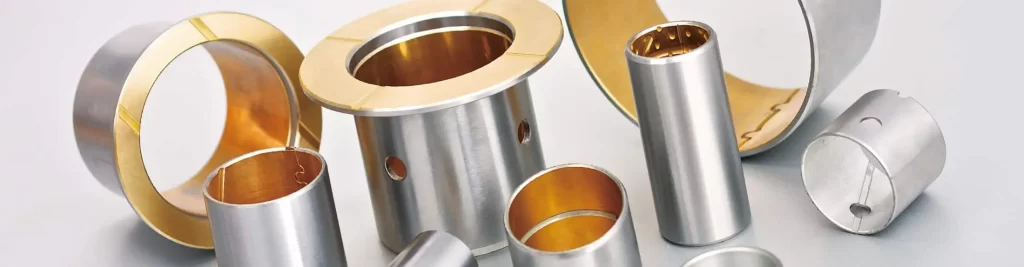
Metal bushings serve critical functions in suspension components, with control arm bushings withstanding peak loads of 5–8 kN while damping vibrations at 10–100 Hz frequencies. Transmission systems utilize bronze guide bushings operating at PV factors up to 3.5 MPa·m/s with continuous oil lubrication. Steering linkages employ hardened steel bushings maintaining ±0.05 mm radial clearance over 150,000 km service intervals. Additional applications include camshaft bushings, shock absorbers, gears, and strut bushes for anti-wear and anti-friction performance.
6.2 Industrial Machinery
Hydraulic cylinders utilize stainless steel wear bands providing 0.1–0.3 mm running clearance at 21 MPa system pressures. Conveyor systems employ sintered bronze bushings operating with 30–50% less lubrication compared to standard bearings. Pump shafts utilize silicon bronze bushings resisting cavitation erosion at flow velocities exceeding 15 m/s.
6.3 Aerospace and Defense
Actuator systems employ self-lubricating bronze bushings meeting MIL-B-5687F specifications for -54°C to +175°C operation. Landing gear utilizes hard-coated aluminum bushings reducing weight by 40% while maintaining 200,000 cycle durability.
6.4 Construction and Heavy Equipment
Metal bushes are extensively used in excavators, hoisting machines, construction machinery, tractors, and trucks. Applications include pivot points, hydraulic cylinder connections, and track systems.
6.5 Additional Industries
Agricultural equipment
Marine and offshore equipment
Renewable energy (solar and wind)
Steel metallurgy
Food machinery and office equipment
7. Selection Criteria for Metal Bushings
When selecting metal bushings for specific applications, engineers must evaluate multiple parameters:
7.1 Load and Velocity (PV Value)
Bushings are generally selected based on the applied load and velocity of an application. The PV value (product of specific load P and sliding speed V) significantly influences service life—lower PV values correspond to longer bushing life.
7.2 Environmental Conditions
High temperature: Select steel or bronze with appropriate thermal stability
Corrosive environments: Choose bronze alloys (tin-bronze, aluminum-bronze) resistant to rust, saltwater, and chemicals
Dusty/gritty settings: Self-lubricating metallic bushes perform reliably without oil films that attract contaminants
Washdown/food applications: Stainless shells with inert chrome or Ni-P on shafts, polymer liners validated for H1 food-grade compliance
7.3 Motion Type
Continuous rotation: Size for hydrodynamic film
Oscillation/start-stop: Prioritize boundary performance (PTFE/composite)
Low-speed/oscillating: Metallic bushes handle slow, frequent back-and-forth movements better than rolling bearings, which suffer from “false brinelling”
7.4 Geometry and Fits
Typical L/D ratio: 0.5–1.0; shorter designs aid misalignment tolerance. Shaft surface finish: Ra typically ≤0.2–0.4 μm for polymer/PTFE; harder/ground for bronze/babbitt. Housing fits: k5–m6 / H7 for rotating shaft applications
8. MYWAY: Your Trusted Partner for Precision Metal Bushings
8.1 Company Overview
Established in 2005, Zhejiang Myway Co., Ltd. is a national high-tech enterprise specializing in the R&D, production, and sales of bushings, bearings, and related raw materials. With 20 years of dedicated innovation, MYWAY has become a leading expert in the bushing manufacturing industry.
8.2 Manufacturing Capabilities
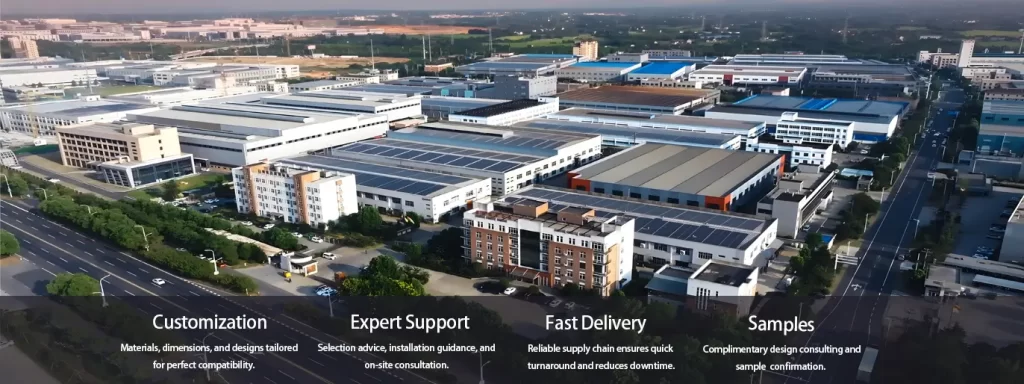
MYWAY operates a manufacturing facility spanning over 35,000 square meters, alongside a dedicated foreign trade sales and operations center. The company offers end-to-end manufacturing capabilities, from raw material casting and sintering to finished product production. Equipped with more than 2,000 precision molds, advanced sintering lines, and the latest automated machinery and inspection systems, MYWAY ensures a highly efficient and reliable supply chain.
8.3 Product Portfolio
MYWAY provides a comprehensive range of plain bearings, including:
Self-lubricating bearings (DU/SF-1) : PTFE-lined, maintenance-free operation
Oil-free bushings (DX/SF-2) : Boundary-lubricated for demanding applications
Graphite-inlaid copper bushings: Solid lubricating for high-temperature environments
Bimetallic bearings: Steel-backed bronze for heavy-duty applications
Bronze bushings: C93200/SAE 660 standard bronze sleeve bearings
Wrapped steel bushings: Spring steel strips, through-hardened and internally ground
Composite bushings: Engineered combinations of polymers, fibers, and solid lubricants
8.4 Quality Assurance
MYWAY delivers custom and standard parts from casting to finish, with IATF/ISO certifications recognized in over 40 countries. Products are manufactured using high-precision CNC machinery and strict ISO/TS 16949 quality control protocols. Products are exported to over 40 countries and regions, including Germany, Italy, Japan, and the United States.
8.5 Why Choose MYWAY
20+ years of industry expertise
400+ employees and RMB 300M+ annual output value
35,000 m² manufacturing facility
2,000+ precision molds for rapid custom production
End-to-end manufacturing: From raw material casting to finished product
One-stop bushing design and production services
Cost-effective solutions with reliable logistics
MYWAY doesn’t just manufacture bushings—they engineer success stories through superior manufacturing excellence and unwavering commitment to quality
9. Frequently Asked Questions (FAQ)
Q1: What is the difference between a metal bushing and a bearing?
A bushing is a type of bearing, specifically a single-component cylindrical sleeve that supports a rotating or oscillating shaft through sliding motion. Bearings in the narrow sense involve rolling elements (balls or rollers) with multiple components including cages and races. Bushings slide; bearings roll.
Q2: What materials are commonly used for metal bushings?
Metal plain bushes are typically made of brass, steel, and bronze. Common alloys include bronze (C93200/SAE 660), steel (including stainless steel grades 304 and 316), aluminum bronze, and bimetallic combinations.
Q3: How do I select the right metal bushing for my application?
Selection should be based on applied load and velocity (PV value), environmental conditions (temperature, corrosion, dust), motion type (rotation, oscillation, start-stop), and geometric requirements (L/D ratio, fits, surface finish).
Q4: What is a self-lubricating metal bushing?
Self-lubricating metallic bushes incorporate solid lubricants such as PTFE or graphite into the bearing surface, eliminating the need for external oil or grease lubrication. PTFE-coated steel bushings achieve friction coefficients as low as μ=0.05–0.10.
Q5: What temperature range can metal bushings withstand?
Standard bronze bushings operate effectively from -40°C to +250°C, with special alloys extending to 400°C. Stainless steel variants maintain dimensional stability up to 800°C in oxidizing environments.
Q6: What is the PV value and why is it important?
PV value is the product of specific load (P) and sliding speed (V). It significantly influences bushing service life—lower PV values correspond to longer bushing life.
Q7: What industries use metal bushings?
Metal bushings are used across automotive, aerospace, construction machinery, agricultural equipment, industrial automation, fluid power, renewable energy, steel metallurgy, food machinery, and office equipment industries.
Q8: How are metal bushings manufactured?
Manufacturing methods include centrifugal casting, sand casting, investment precision casting, powder metallurgy (sintering), and precision machining (turning, grinding, honing).
Q9: What is the typical load capacity of bronze bushings?
Bronze bushings withstand static loads up to 60 MPa and dynamic loads up to 35 MPa.
Q10: Why choose MYWAY as my bushing supplier?
MYWAY offers 20+ years of expertise, 35,000 m² manufacturing facility, 2,000+ precision molds, IATF/ISO certifications, end-to-end manufacturing capabilities, and exports to over 40 countries
100000+ Types of Bushings – Contact Us for Details