
Recent Posts
Flanged Bronze Bushing Metallurgy: Engineering the Bearing Surface That Carries Both Load and Thrust
Introduction
A flanged bronze bushing is a deceptively compact tribological component. Its cylindrical wall supports radial load, while the integral flange locates the assembly and accepts axial thrust. In a pump, hydraulic cylinder, agricultural pivot, construction machine, gear reducer, marine mechanism, or heavy-duty OEM assembly, that two-direction role makes alloy selection and manufacturing control consequential. The best bushing is not simply the hardest bronze or the lowest-priced sleeve: it is the material, geometry, lubrication arrangement, shaft condition, clearance, and inspection plan that work together under the actual duty cycle.
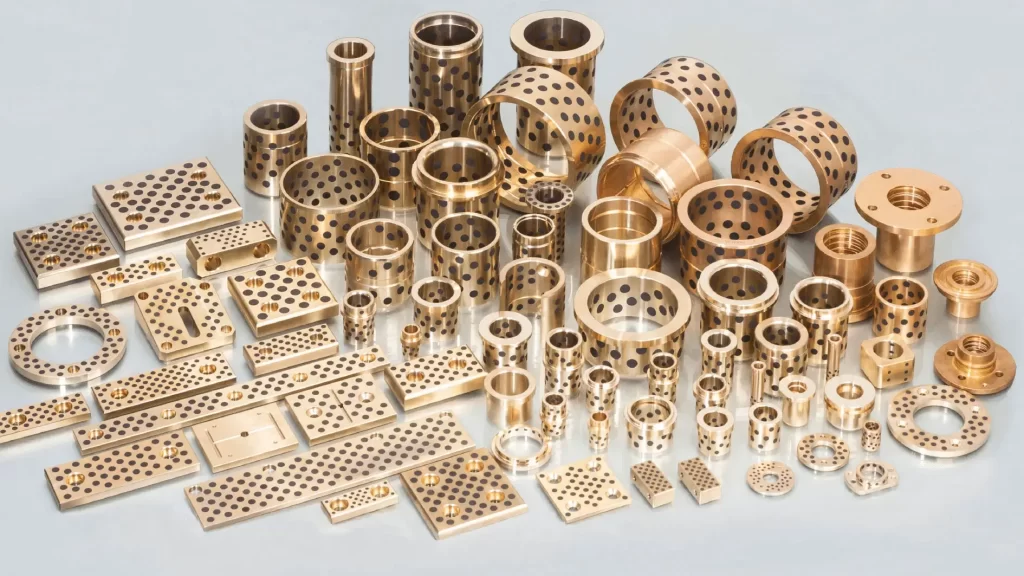
Table of Contents
1. Why a Flange Changes the Bearing Problem
A conventional sleeve bushing controls a rotating or oscillating shaft mainly in the radial direction. A flange bushing adds a shoulder, usually at one end of the sleeve, to locate the component in a housing and react thrust in the axial direction. The configuration is also called a flanged plain bearing, bronze flange bearing, or flange sleeve bushing.
The radial contact area is approximately \(\pi D L\), where *D* is journal diameter and *L* is bearing length. The flange has a separate annular thrust face. A useful first calculation is therefore:
Interface | Nominal projected area | First screening pressure |
Radial sleeve | \(D \times L\) | radial load / \(D L\) |
Flange thrust face | \(\pi/4 \times (D_o^2-D_i^2)\) | axial load / annular area |
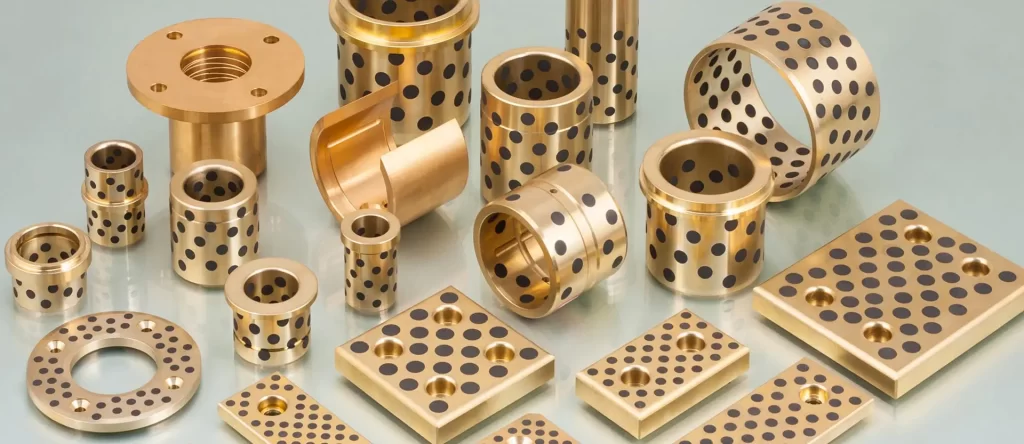
The configuration brings clear benefits: a single component may provide radial support, thrust retention, simple assembly orientation, and a sacrificial wear surface against a more expensive shaft or housing. It is especially practical where a housing cannot accept a separate thrust washer. The tradeoff is that the flange can create a second friction interface. Lubricant must reach the cylindrical bore *and* the thrust face, while the designer must prevent the rotating mating face from fretting, galling, or running dry.
2. Metallurgy: Why Bearing Bronze Works Against Steel
Bronze bushings succeed through a deliberately balanced microstructure, not through a generic label. Copper provides thermal conductivity and corrosion resistance; tin strengthens the copper matrix; lead in traditional bearing bronzes can improve conformability, machinability, embeddability, and anti-seizure behavior; zinc can influence castability and cost; and aluminum, iron, nickel, or manganese can create much higher-strength bronze families. The optimal balance changes with lubrication regime and load spectrum.
For a classic SAE 660 bronze bushing, the commonly used UNS designation is C93200. The Copper Development Association identifies it as a high-leaded tin bronze, lists a nominal composition near Cu-83%, Sn-7%, Pb-7%, Zn-3%, and notes its frequent use for bushings, low friction, wear resistance, good machinability, and comparatively modest strength. Its published room-temperature values for continuously cast material include minimum tensile strength of 35 ksi, minimum 0.5% extension yield strength of 20 ksi, and a nominal Brinell hardness of 65. Those properties help explain why C93200 is broadly specified for lubricated general-service bronze bearings, but also why it is not automatically the correct choice for a high-unit-load flange bearing.
The metallurgical distinction matters in service:
Alloy family | Representative UNS alloy | Principal design character | Typical flanged-bushing fit |
Leaded tin bearing bronze | C93200 | Good anti-friction behavior, machinability, conformability | General lubricated sleeves and thrust-flange bushings |
Tin bronze | C90300/C90500/C90700 | Higher strength than leaded bearing bronzes; less forgiving of poor lubrication | Moderate-to-higher load where lubrication and shaft finish are controlled |
High-lead tin bronze | C93700/C93800 | Excellent embeddability and anti-seizure behavior; lead segregation requires process control | Contaminated or boundary-lubricated duties, subject to compliance review |
Aluminum bronze | C95400 | High strength, hard wear-resistant matrix, corrosion resistance | Heavy duty, marine, steel-mill, or abrasive environments when pairing is engineered |
Manganese/high-strength yellow brass | C86300 | High mechanical strength; relatively low machinability rating | Heavy construction and hydraulic equipment, typically with strong shaft and lubrication control |
Lead in a bearing bronze should never be described merely as “lubrication built into the metal.” A leaded bronze still needs the designed lubricant system when the application requires it. Instead, dispersed lead-rich regions help the surface accommodate local distress and particles under difficult boundary conditions. A solid, continuous fluid film remains preferable wherever speed, load, and lubricant supply make it achievable.
Aluminum bronze deserves separate treatment. CDA describes C95400 as an aluminum bronze containing roughly 10% to 11.5% aluminum, with high strength and acid resistance. Its hard, strong microstructure can be a major advantage, yet it may demand more attention to shaft hardness, surface finish, alignment, lubrication, and run-in behavior than a softer leaded bearing bronze. “Higher strength” does not mean “immune to seizure.”
3.Selecting the Alloy From the Duty Cycle, Not From a Habit
The correct material selection begins with data from the mating system. A meaningful request for quotation should identify journal diameter, bushing length, flange OD and thickness, radial and axial loads, speed, oscillation angle, temperature, lubricant, exposure, shaft material and hardness, housing material, operating cycle, annual quantity, and applicable standards. Without those inputs, an alloy recommendation is necessarily provisional.
The following decision framework helps organize early selection:
Operating condition | Engineering priority | Likely starting point | Questions that must be closed |
Moderate load, grease or oil available, general machinery | Stable performance and machining economy | C93200 / SAE 660 bronze | Is the duty continuous or oscillating? Is lead acceptable? |
High radial or thrust load | Strength, fatigue margin, bearing geometry | Tin bronze, aluminum bronze, C86300-type alloy | What are actual projected pressures and shock loads? |
Corrosive water or marine atmosphere | Corrosion resistance plus galvanic compatibility | Aluminum bronze or a specified marine-appropriate alloy | What is the water chemistry, shaft alloy, and isolation strategy? |
Dirt, intermittent grease, low-speed motion | Embeddability, grooves, seals, maintainability | Leaded bearing bronze where permitted | Can contamination be excluded or lubricant renewed? |
Food, potable water, regulated or lead-sensitive product | Regulatory and application suitability | Lead-free alloy selected to the governing requirement | Which law, market, contact condition, and certification apply? |
High speed, oil-film design | Thermal balance, clearance, lubricant viscosity | Bearing alloy selected with a full hydrodynamic design | What oil flow, heat removal, and start-stop exposure are present? |
The phrase “bronze bushing material” covers too much territory to be an engineering answer. A well-specified custom flanged bronze bushing instead names the UNS alloy, material form, manufacturing route, final dimensions and tolerances, inspection requirements, lubrication feature, traceability expectation, and any restriction on repair welding or material substitution.
Compliance deserves an early gate. C93200 nominally contains about 7% lead, so it cannot be assumed suitable for every regulated product. RoHS and other restrictions are jurisdiction- and product-specific; exemptions can have scope and expiry conditions. For example, the European Commission’s RoHS materials listing identifies an exemption for copper alloys containing up to 4% lead by weight, which would not by itself cover C93200. A buyer should obtain the current compliance determination for the finished equipment rather than rely on an alloy nickname or an old declaration.
4. Manufacturing Route Determines More Than Lead Time
The same nominal alloy can arrive at very different quality and cost positions depending on its manufacturing route. ASTM B505/B505M covers continuously cast copper-alloy rod, bar, tube, and shapes. ASTM B271/B271M covers copper-base alloy centrifugal castings, while ASTM B584 addresses copper-alloy sand castings for general applications. These are material and process references, not blanket performance certificates; the purchase order should state which requirements, tests, and acceptance records apply.
Continuous cast bronze bar and tube
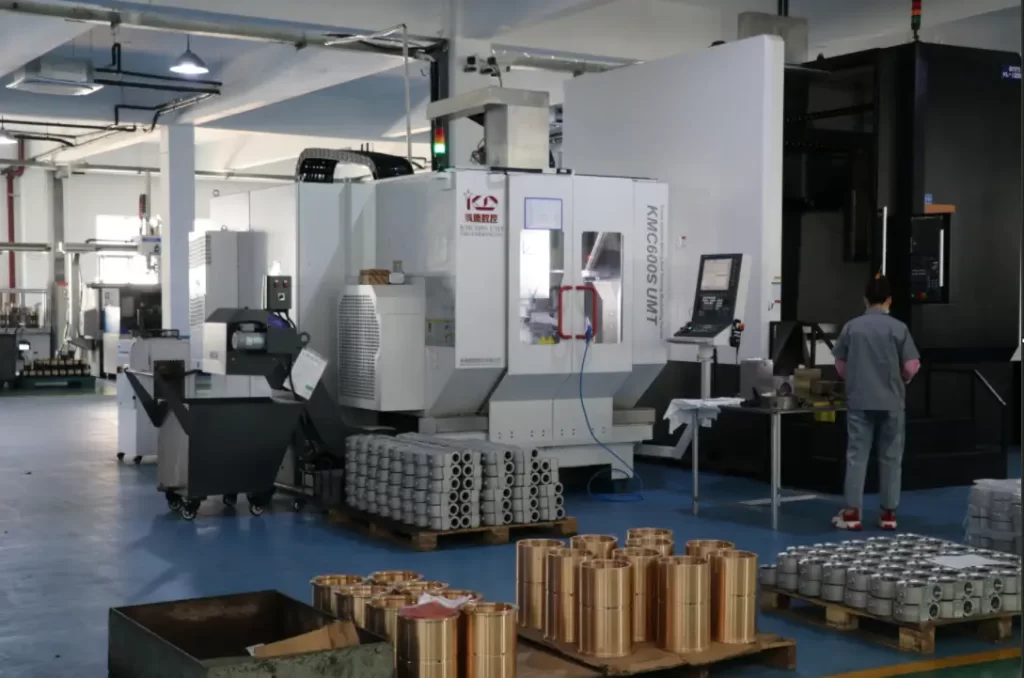
Continuous casting is often an efficient route for repeatable bushing blanks. The material is produced in bar or tube form, then turned, bored, faced, grooved, drilled, and deburred. For medium- to high-volume bronze bushing production, this route can reduce material waste and shorten machining time, especially when the starting tube is close to the finished geometry. ASTM B505/B505M states that mechanical tests are required only when the purchaser specifies them, so procurement documents should explicitly request mechanical-property certification when it matters.
Centrifugal cast bronze bushing blanks
Centrifugal casting is especially relevant for ring-like parts. Molten bronze is distributed against a rotating mold, producing a dense tubular blank that is subsequently machined. It can be an attractive route for larger diameters, thick walls, or bushing shapes where material integrity at the bearing surface matters. Machining allowance, alloy chemistry, wall thickness, and inspection method must still be agreed. Do not infer defect-free material from the phrase “centrifugal cast” alone.
Sand casting and near-net shapes
Sand casting may be commercially sensible for prototypes, large flanges, unusual contours, low-volume custom parts, or components with integral external geometry. It usually requires more machining allowance and a robust plan for shrinkage, porosity control, and dimensional inspection. A large flanged bearing can sometimes be cast closer to final form than a part carved from solid bar, but casting feasibility needs a drawing review.
Route | Commercial strength | Technical watchpoint | Best procurement use |
Continuous cast | Efficient standard stock, repeatability, strong machining economics | Confirm chemistry, property test requirement, and traceability | Standard sleeves and repeat custom flange bushings |
Centrifugal cast | Suitable tubular geometry, potential density benefit | Specify machining allowance and inspection expectations | Large OD/ID rings, thick-wall or high-duty designs |
Sand cast | Flexible for size and complex form | Shrinkage, porosity, extra machining, lot variability | Low-volume, oversized, or unusual flanged castings |
Machined from wrought bronze | Good dimensional control in available sizes | Alloy/form availability and material utilization | Smaller precision parts or specified wrought alloys |
Powder-metal self-lubricating bronze | Oil-impregnation capability in suitable duty | Load, speed, porosity, mounting and thermal limits differ from solid bronze | Maintenance-limited, lower-load applications designed for sintered bearings |
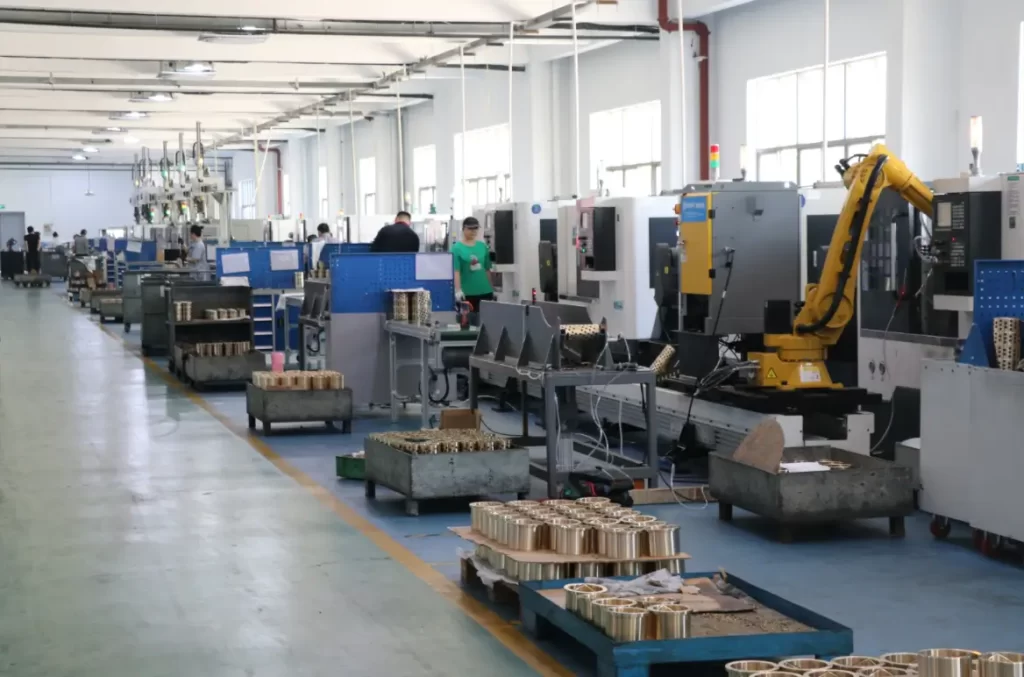
An experienced supplier will select the route after reviewing volume, size, material availability, tolerances, and service condition. The lowest piece price is not always lowest total cost when a low-cost route adds scrap, rework, long machining cycles, or a poor fit for the operating environment.
5. Geometry, Tolerances, and the Details That Protect the Flange
There is no universal ISO fit that can be copied onto every bronze flange bearing. Interference at the OD must be considered with housing material and wall thickness; bronze, steel, aluminum, and cast iron respond differently to temperature and assembly stress. Bore clearance must accommodate lubricant viscosity, speed, temperature rise, shaft surface, and the possibility of misalignment. A press fit that closes the bore more than expected can consume the intended running clearance.
For a flanged bronze bushing drawing, the following controls are often more valuable than a long list of generic tolerances:
- ID size and cylindricityafter installation or after any planned sizing operation.
- OD size and roundnessmatched to the housing fit and installation method.
- Flange thickness and face flatnessbecause thrust load is sensitive to uneven contact.
- Flange-to-bore perpendicularityto avoid one-sided axial contact.
- Concentricity/runoutbetween bore and flange OD or locating diameter.
- Corner radii and reliefsso the bushing seats against the housing shoulder without a radius clash.
- Chamfers and lead-insthat prevent shaving, pickup, or flange cracking during press installation.
- Lubrication geometryincluding groove width, depth, land area, drill intersections, and port orientation.
- Surface finish requirementson the bore and thrust face, written in the drawing’s selected unit and measured with an agreed method.
Grooves must be treated as a lubrication system, not visual decoration. Spiral, figure-eight, axial, circumferential, and cross grooves each distribute lubricant differently. Grooving over the entire loaded zone can reduce load-bearing area and disrupt film formation; grooves that terminate poorly can also concentrate stress. A separate feed path to the flange thrust face may be needed. In oscillating applications, groove placement should account for the limited travel path rather than assuming rotation will distribute grease everywhere.
Shaft condition is equally important. A scored, corroded, excessively rough, soft, out-of-round, or bent shaft can destroy a new bushing quickly. The bushing is intentionally the more replaceable wear component in many assemblies, but that does not justify a damaged journal. A maintenance program should inspect both parts and correct root causes such as misalignment, seal failure, inadequate grease interval, contaminated lubricant, or housing movement.
6. Lubrication, PV, Heat, and Failure Prevention
Plain bearings operate in different lubrication regimes. In hydrodynamic operation, shaft motion draws lubricant into a pressure-generating film that separates most of the surfaces. In mixed lubrication, some asperity contact remains. In boundary lubrication, the surfaces carry substantial contact through the lubricant boundary layer and material response. Starting, stopping, reversing, slow oscillation, shock loading, and grease starvation push a bushing toward the latter regimes.
The PV value is a screening product of bearing pressure *P* and sliding velocity *V*. It is useful because higher pressure and higher speed both raise the severity of frictional heating and wear, but it is not an independent material rating that guarantees life. Two bushings with the same PV can behave very differently when one has continuous oil circulation and excellent shaft alignment while the other sees abrasive dust and stop-start oscillation. The Copper Development Association’s sleeve-bearing material explains the importance of thermal conductivity, thermal expansion, lubricant viscosity, and heat-transfer assumptions in a bearing calculation; those factors belong in real design work.
Use a structured lubrication review:
Review item | Why it matters to a flanged bronze bushing |
Lubricant type and base-oil viscosity | Determines film-building capacity at operating temperature |
Grease consistency and feed method | Affects whether lubricant can reach both sleeve and flange interfaces |
Relubrication interval | Must reflect duty, contamination, temperature, and travel length |
Groove and port layout | Directs lubricant without needlessly reducing loaded area |
Seal and wiper design | Controls ingress of grit, water, and abrasive debris |
Shaft finish/hardness | Influences film stability, wear, and risk of adhesive damage |
Heat path through housing | Limits temperature rise and clearance change |
Start-stop and reversing frequency | Increases time spent in mixed or boundary lubrication |
Common field failures are informative. Adhesive scoring and blueing often point to lubricant loss, excessive clearance reduction, overload, poor shaft finish, or thermal runaway. Embedded hard particles point to seal failure or dirty lubricant. One-sided bore wear usually indicates misalignment, bent shaft, distorted housing, or a flange that is not seating squarely. Crushed grooves or a cracked flange can signal installation damage, an interference mismatch, a corner-radius conflict, or a load path not considered in the original drawing. A supplier should be willing to review returned components, photographs, shaft measurements, and operating history before recommending a replacement alloy.
7. Quality Assurance: Turn a Bronze Bushing PO Into a Verifiable Contract
The word “bronze” is insufficient for purchase control. A disciplined RFQ and purchase order establish what the supplier must make, what evidence must be delivered, and how conformity will be checked. For a production flange bushing, the starting checklist below is more protective than a vague request for “high quality bronze.”
Control point | What to specify or request |
Alloy identity | UNS designation, allowed equivalent only with written approval |
Material standard | Applicable ASTM/EN/customer specification and manufacturing form |
Chemistry | Heat or lot chemical analysis; sampling method where required |
Mechanical properties | Test requirements, sampling, report format, and condition of material |
Dimensions | Controlled drawing, revision, GD&T, units, critical-to-function features |
Surface condition | Burr limits, machining marks, porosity acceptance, groove cleanliness |
NDT/inspection | Dye penetrant, ultrasonic, radiography, or visual criteria only when justified |
Traceability | Heat/lot identification linked to certificates and packing labels |
First article | Sample quantity, inspection report, fit trial, and approval route |
Packaging | Corrosion protection, separation of faces, identification, and export requirements |
ASTM B824 provides general requirements common to several copper-alloy casting specifications, including B271, B505, and B584. It is useful context when setting common casting requirements, but the buyer must still select the product-specific standard and define the contractual acceptance criteria. Stating “ASTM material” without an exact number, revision, product form, and test requirement leaves too much open to interpretation.
Material certificates deserve a practical reading. Confirm the certificate identifies the actual alloy and traceable heat or lot; check reported elements against the chosen alloy limits; confirm that test values apply to the specified form and condition; and make sure the certificate belongs to the received goods, not an unrelated stock batch. A COC is a supplier statement of conformity; an MTR/MTC contains recorded test information. Both may be useful, but they are not interchangeable when the application needs verified chemistry or mechanical performance.
8. Applications, Search Intent, and How to Ask for a Quote
Search traffic around flanged bronze bushing, bronze bush bearing, SAE 660 flange bushing, C93200 bronze bushing, oil groove bushing, bronze thrust washer, and custom bronze bushing manufacturer reflects several buyer intents. Some buyers need a stock size immediately. Others need a dimensionally controlled replacement from a sample. OEM engineering teams usually need a documented alloy and inspection route that can be repeated across lots. One page can address these needs only when it stays technically specific.
Typical industries include hydraulic cylinders and pinned joints, agriculture and forestry equipment, mining machinery, lifting equipment, conveyors, pumps and valves, steel processing, marine hardware, diesel engines, gearboxes, construction machinery, industrial automation, and renewable-energy mechanisms. The operating condition, not the industry name, should control the final proposal. A marine hinge may prioritize corrosion behavior and galvanic pairing; a dry dusty pivot may prioritize sealing and grease retention; a hydraulic gland component may require close tolerances and compatibility with hydraulic fluid; a hot rolling-mill mechanism may need strength, heat management, and a controlled shaft pair.
A useful RFQ can be sent in one page:
Part: flanged bronze bushing / bronze flange bearing Drawing or sample: attach PDF, 3D model, or measured sample Material: C93200, C95400, another specified UNS alloy, or request an engineering recommendation Dimensions: ID, OD, length, flange OD, flange thickness, grooves, holes, chamfers, tolerances Duty: radial/axial load, shaft speed or oscillation, temperature, lubricant, contamination, environment Mating parts: shaft material, hardness, surface finish; housing material and fit Quality: certificates, first-article inspection, lot marking, critical features Commercial: annual volume, release quantity, destination, requested delivery date |
This level of detail lets a manufacturer assess cast-versus-machined route, make a technically defensible alloy proposal, quote realistic tooling or setup costs, and identify risks before production. It also reduces the chance that a supplier quotes a thin generic sleeve while the actual component must control high thrust through the flange.
9. A Practical Specification Strategy for Durable, Quotable Bushings
The strongest purchasing result is a specification that preserves functional intent but gives the supplier enough information to manufacture efficiently. Start with the function: radial support, axial location, or both. Identify the harmful conditions: shock load, low-speed oscillation, abrasive contamination, salt water, high temperature, poor lubrication access, tight compliance requirements, or difficult field replacement. Then align material, route, geometry, lubrication, inspection, and packing to those conditions.
For a routine grease-lubricated replacement, a documented C93200 continuous-cast flange bushing with suitable press-fit allowance, controlled bore finish, practical grease grooves, chamfered installation edges, and a material certificate may be the value choice. For a severe load, corrosive, or high-consequence position, an aluminum bronze or higher-strength family may be justified, but should be evaluated with the mating shaft, thermal clearance, and lubrication plan. For applications where lead restrictions matter, identify the product-market compliance route before selecting an alloy; do not leave the question until after a long production run.
The commercial conclusion is straightforward: a flanged bronze bushing should be bought as an engineered bearing component, not as an unnamed copper-colored ring. When a supplier can connect alloy chemistry, casting method, machining accuracy, oil-groove design, inspection evidence, and actual service inputs, the conversation moves from price comparison to life-cycle reliability. That is the basis for a credible quotation and a part that earns repeat orders.
FAQ: Flanged Bronze Bushing
- What is a flanged bronze bushing?
It is a plain bronze bearing with an integral flange. The sleeve supports radial load and the flange locates the part and supports axial thrust.
- Is a bronze flange bushing the same as a flanged bearing?
In plain-bearing contexts, the terms are commonly used for the same geometry. Confirm whether the request is for a solid bronze bearing or a rolling-element housed flange unit.
- What is SAE 660 bronze?
SAE 660 is a common market name for UNS C93200 leaded tin bearing bronze, also called bearing bronze.
- Is C93200 always the best bronze bushing material?
No. It is widely used for general lubricated service, but heavy load, corrosion, lead restrictions, temperature, or lubrication conditions may favor another alloy.
- What loads does the flange carry?
The flange normally carries axial thrust. Its annular contact face, flatness, thickness, lubrication, and mating surface determine performance.
- Can a flanged bronze bushing run dry?
It should not be assumed to. A conventional solid bronze bushing is generally designed around an appropriate lubrication regime. Assess any dry-running requirement separately.
- Do oil grooves increase bushing life?
Properly located grooves can distribute lubricant. Excessive or poorly placed grooves may reduce loaded area or interrupt the film, so the pattern must suit motion and load zone.
- What is the difference between continuous-cast and centrifugal-cast bronze?
They are different production routes. Continuous casting efficiently supplies bar or tube; centrifugal casting is often suited to tubular rings and larger bushing blanks. Specify the required standard and inspection evidence.
- Which ASTM standard applies to a bronze bushing?
It depends on the product form and route. B505/B505M concerns continuous castings, B271/B271M centrifugal castings, and B584 sand castings. Review the current standard and PO requirements.
- Can C93200 bronze meet RoHS?
Its nominal lead content is around 7%, so do not assume compliance. Verify the exact legislation, product category, geography, and any valid exemption with a qualified compliance review.
- When should aluminum bronze be considered?
Consider it for demanding load, wear, or corrosion conditions, provided the shaft pairing, lubrication, installation, and thermal behavior are engineered for the harder alloy.
- What shaft material should be used with a bronze bushing?
The answer depends on duty. A clean, properly finished, adequately hard, round, and aligned shaft is essential. State the shaft grade, hardness, and finish in the RFQ.
- What clearance is required for a bronze flange bushing?
There is no single safe value. It depends on diameter, speed, temperature, lubricant, fit, housing, and loading. Use a bearing calculation and validate after assembly where needed.
- Can the flange replace a separate thrust washer?
Often yes, if its area, thickness, material, lubrication, and perpendicularity meet the axial-load requirement.
- Why did a bronze bushing score or seize?
Typical causes include poor lubrication, contaminant ingress, overload, misalignment, incorrect clearance, shaft damage, heat, or an unsuitable alloy and groove design.
- What certificates should a bushing supplier provide?
Specify a certificate of conformity, chemistry report, mechanical-property report when required, dimensional report, and heat/lot traceability appropriate to the application.
- Can a bronze bushing be machined from a customer sample?
Yes, but a measured drawing and operating information are safer than copying worn dimensions. Inspect the mating shaft and housing before defining the final size.
- How do I calculate PV for a bronze bushing?
Multiply projected bearing pressure by sliding velocity, using consistent units. Use the result only as an initial screen alongside lubrication, heat, duty cycle, and contamination analysis.
- Are self-lubricating bronze bushings the same as solid cast bronze bushings?
No. Sintered oil-impregnated bronze and solid cast/machined bronze have different structures, mounting rules, and load-speed limits.
- What should be included in a custom bronze bushing inquiry?
Send a drawing or sample, alloy request, dimensions and tolerances, loads, speed or oscillation, temperature, lubrication, mating materials, quality documents, quantity, and delivery destination.
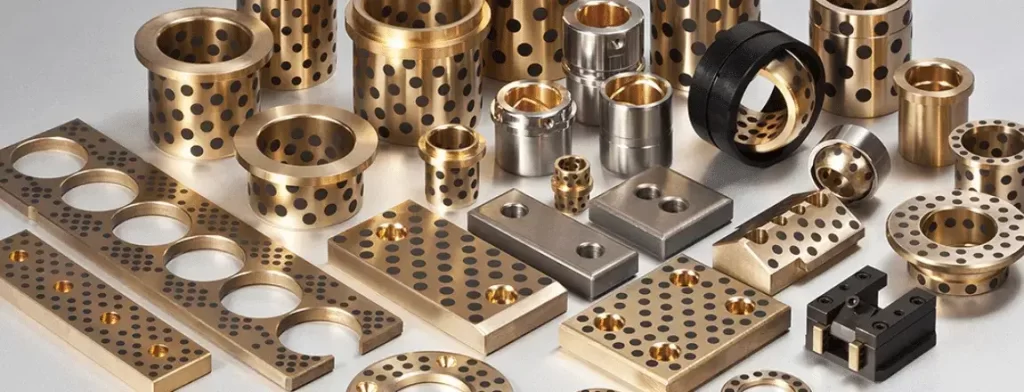
100000+ Types of Bushings – Contact Us for Details