
Recent Posts
Oilless Bushing Metallurgy: Solid Lubricants, Bronze, and Composite Layers Under Load
Introduction
The phrase “oilless bushing” is useful in search and procurement, but it can conceal important engineering differences. Some self-lubricating bushings rely on graphite plugs embedded in cast bronze. Others use a steel-backed, porous bronze interlayer with a PTFE-based sliding surface. A third category is a sintered bronze bearing whose connected porosity stores oil released during service. Each system reduces or eliminates routine external oiling in a defined operating window; none removes the need to control pressure, speed, heat, shaft finish, alignment, and contamination. The metallurgy determines how the bearing carries load, transfers lubricant, and survives wear.
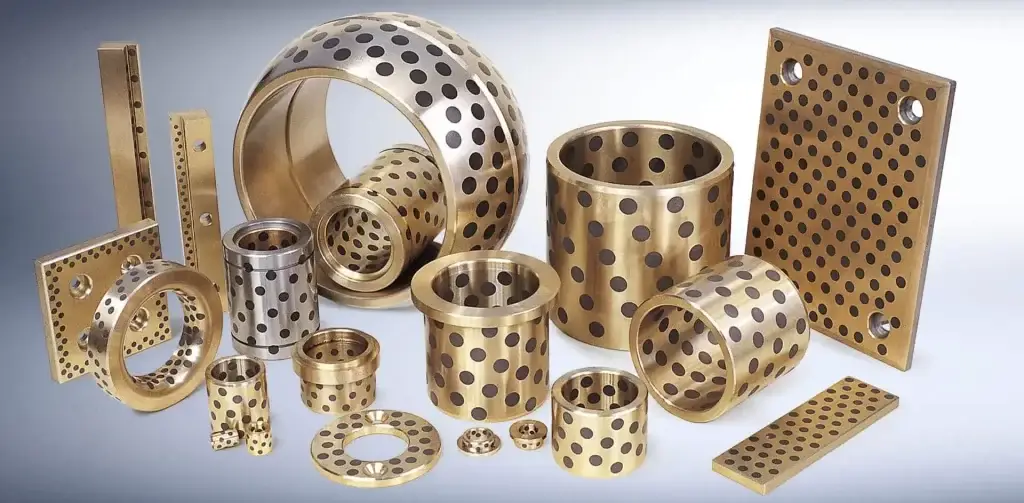
Table of Contents
1.What “Oilless Bushing” Means in Modern Plain-Bearing Engineering
An oilless bushing is a plain bearing designed to operate with its lubricating function supplied by the bearing itself rather than by a continuously delivered external oil film. Search terms such as self-lubricating bushing, maintenance-free bearing, graphite bronze bushing, solid lubricant bearing, dry bearing, PTFE composite bushing, oil-impregnated bronze bushing, and plain bearing may point to different constructions. A correct selection begins by naming the mechanism of lubrication, not by treating the terms as identical.
In an embedded-solid-lubricant bearing, discrete graphite, PTFE, or other qualified plugs are arranged in a bronze or iron-base body. Motion transfers a thin solid-lubricant film to the mating shaft. In a metal-polymer composite bushing, a low-friction polymer-based sliding layer is supported by porous sintered bronze and a metal backing. In an oil-impregnated sintered bushing, capillary-connected pores retain lubricant and feed it to the contact under temperature and pressure changes. These structures have different limits for impact, speed, water exposure, chemical compatibility, and machining.
- Oilless does not mean frictionless: heat generation and wear remain governed by load, speed, duty cycle, and mating-surface condition.
- Maintenance-free does not mean inspection-free: contamination, mounting deformation, and misalignment can still shorten service life.
- Self-lubricating does not mean interchangeable: embedded graphite, PTFE composite, and oil-impregnated bronze are distinct material systems.
2.The Three Principal Metallurgical Routes: Embedded Solids, Composite Liners, and Porous Bronze
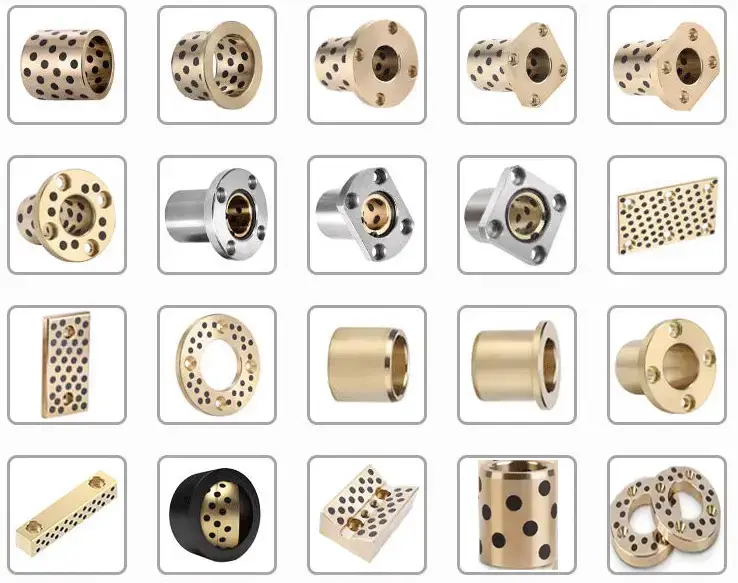
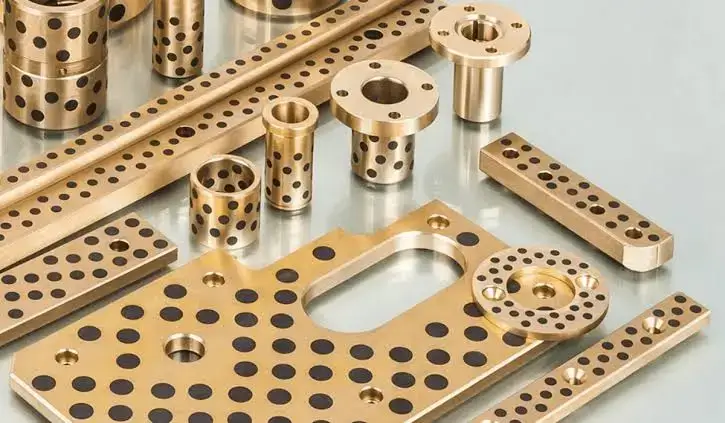
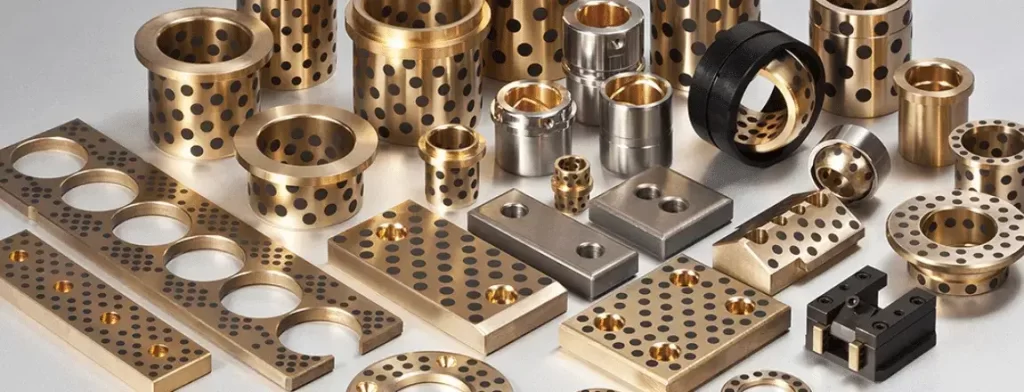
Graphite-plugged bronze bushings start with a load-bearing copper alloy body, often a cast bronze, aluminum bronze, or high-strength brass selected for strength, corrosion resistance, and machinability. Engineers machine pockets or holes into the bearing surface and press or form solid-lubricant inserts into a controlled distribution pattern. The metal matrix bears the structural load; the plug system supplies a lubricating transfer film. ISO 19259 addresses plain bearings with embedded solid lubricants, while ISO 20054 covers bearings containing dispersed solid lubricants. These standards reinforce that “solid-lubricant bearing” is a material and design category, not simply a marketing label.
Metal-polymer self-lubricating bushings use a different architecture. GGB describes one representative structure as a rigid steel or corrosion-resistant bronze backing, a porous sintered bronze interlayer, and a PTFE-based bearing surface. The backing gives dimensional rigidity, the porous bronze anchors the polymer layer, and the sliding layer manages low-friction contact. Lead-free formulations may use PTFE plus fillers or other polymer systems. The design trade-off is that the functional surface is thinner than a solid bronze wall, so post-installation machining, sharp shaft edges, and excessive interference require careful control.
Oil-impregnated sintered bronze bushings are neither graphite-plugged castings nor PTFE-lined composites. ASTM B438 covers porous bronze-base sleeve, flange, thrust, and spherical bearings made by powder metallurgy and then impregnated with oil. Their porosity is functional: density, oil content, and radial crushing strength are part of the material specification. They work especially well in moderate, repeatable duty where retained oil can replenish the interface, but they should not be described as dry-running graphite bearings.
Technology | Load-bearing structure | Lubricating mechanism | Typical selection question |
Embedded graphite or PTFE bronze | Cast or wrought copper-alloy body with solid inserts | Solid transfer film forms on mating surface | Is high load, slow motion, or difficult re-lubrication the dominant challenge? |
Metal-polymer composite | Steel/bronze backing + porous bronze + PTFE-based lining | Low-friction polymer running surface | Does the duty favour a thin, low-friction, self-lubricating liner and controlled shaft finish? |
Oil-impregnated sintered bronze | Porous powder-metallurgy bronze | Oil stored and released through interconnected pores | Can retained lubricant remain compatible with temperature, speed, and environment? |
Dispersed solid-lubricant material | Metal matrix containing distributed solid lubricant | Solid lubricant exposed during service | Is an integrated solid-lubricant material required rather than discrete plugs? |
3.Solid Lubricants and the Transfer-Film Mechanism
Graphite, PTFE, molybdenum disulfide, and engineered solid-lubricant blends do not reduce friction in the same way. Graphite is often chosen for its layered crystal structure and thermal stability in compatible environments. PTFE can provide low friction and good anti-stick behaviour, but its temperature capability, creep resistance, and chemical compatibility depend on the compound and bearing construction. Molybdenum disulfide is useful in selected dry or vacuum-oriented applications, but oxidation, humidity, counterface, and temperature must be considered. A product must be evaluated as a complete bearing system rather than by the solid-lubricant name alone.
For embedded plugs, lubrication begins with running-in. A thin film is transferred from the plug pattern to the shaft or mating surface as relative motion begins. The plug geometry, area fraction, spacing, direction of travel, and loaded-zone position influence how consistently that film is renewed. Too few inserts can limit transfer-film renewal; too much removed matrix area can lower local load support. GGB notes that its cast-bronze bearings with PTFE inserts are supplied with a 15 to 20 micrometre running-in film to initiate transfer. This illustrates why a plug layout should be treated as an engineered pattern rather than decoration.
In metal-polymer materials, the running surface itself is the lubricant-bearing layer. The sintered bronze beneath it provides anchoring and heat-path support, while the backing carries press-fit stress. Once the polymer layer is damaged by abrasive particles or a sharp shaft edge, the tribological system can change quickly. Good design therefore includes shaft surface quality, edge radii, installation tooling, and contamination control, even when routine lubrication is eliminated.
4. Pressure, Velocity, PV, Temperature, and Why Catalog Values Cannot Be Mixed
Contact pressure P is the maximum load divided by projected bearing area; relative velocity V is the speed at the interface; PV is their product. PV is a useful screening parameter because it captures a major source of frictional heat, but it is not a universal life formula. OILES explicitly notes that P, V, and PV are interrelated design values, and that higher environmental temperature calls for lower PV because friction characteristics and heat dissipation can deteriorate. Start-stop motion, oscillation angle, housing conductivity, shaft size, duty factor, and local edge loading all influence the real thermal balance.
Published ratings must remain attached to their named material and conditions. For example, OILES publishes for one 500SP metallic dry-bearing series a maximum pressure of 49 N/mm2, maximum dry velocity of 0.25 m/s, maximum dry PV of 1.65 N/mm2 x m/s, and -40 to +150 deg C service range. GGB publishes for its DS metal-polymer material a different dry envelope: 110 N/mm2 static load, 45 N/mm2 dynamic load, 1.5 m/s maximum dry speed, 1.4 N/mm2 x m/s maximum dry PV, and -60 to +130 deg C. These figures illustrate selection logic only. They are not a promise for another manufacturer, size, shaft, or duty cycle.
Parameter | Published example | What it indicates | What still requires validation |
Embedded-solid bronze | OILES 500SP: P 49 N/mm2; dry V 0.25 m/s; dry PV 1.65 N/mm2 x m/s | An example material-specific dry-running envelope | Plug distribution, alloy grade, temperature, motion, housing, and shaft |
Metal-polymer composite | GGB DS: static P 110; dynamic P 45 N/mm2; dry V 1.5 m/s; dry PV 1.4 N/mm2 x m/s | A different trade-off between load, speed, and liner construction | Real duty cycle, abrasive exposure, thermal path, clearance, and mounting |
Temperature | OILES 500SP: -40 to +150 deg C; GGB DS: -60 to +130 deg C | Material-family service windows from public data | Local interface temperature, chemical exposure, and thermal cycling |
Shaft finish | GGB DS recommendation: Ra <= 0.40 micrometres | A representative counterface target for one composite grade | Lay direction, hardness, shaft coating, debris, and selected material data sheet |
5.Shaft, Housing, Clearance, and Installation Are Part of the Bearing System
The bushing cannot correct a poor mating surface. A shaft that is too rough can abrade a polymer liner or interrupt a solid transfer film; a shaft that is too soft can be damaged by contamination; an incorrect grinding lay can compromise lubricant retention. For composite bushings, use the selected manufacturer’s finish and hardness guidance. GGB DS, for example, lists Ra no greater than 0.40 micrometres and higher shaft hardness for longer service life under the stated conditions. These are starting points, not a substitute for the specific material data sheet.
Press fitting changes geometry. The housing bore, wall thickness, material modulus, bushing OD tolerance, backing or matrix stiffness, and installation method all affect final bore size and clearance. An embedded-solid bronze bushing may be finish-machined to size, while a thin-lined composite bushing may have a limited machinable surface and needs a different process plan. For either type, avoid striking the bearing surface, use proper lead-in chamfers, remove burrs, and maintain radial support around the housing. A free-state diameter alone is not the final installed dimension.
- Specify housing bore tolerance, housing material, shaft tolerance, bearing length, and any allowed finish operation.
- Place oil holes, grease grooves, or plug-free high-load zones according to the actual load direction and motion.
- State whether the application is rotation, oscillation, linear sliding, or intermittent indexing; the same nominal speed can create different wear behaviour.
- Control corrosion and galvanic couples when a bronze bearing, steel housing, plated shaft, and moisture are present.
6. Failure Analysis: Reading Wear, Transfer Films, and Material Damage
A self-lubricating bushing should be inspected as evidence, not simply replaced. Smooth burnishing can be normal. Deep longitudinal scoring usually indicates abrasive ingress, roughness, or incompatible debris. Local material transfer, discoloration, or smearing can indicate high contact temperature, insufficient clearance, excessive load, or incomplete transfer-film formation. A polished band at one edge commonly points to misalignment, housing distortion, or a local load path rather than to insufficient nominal bearing strength.
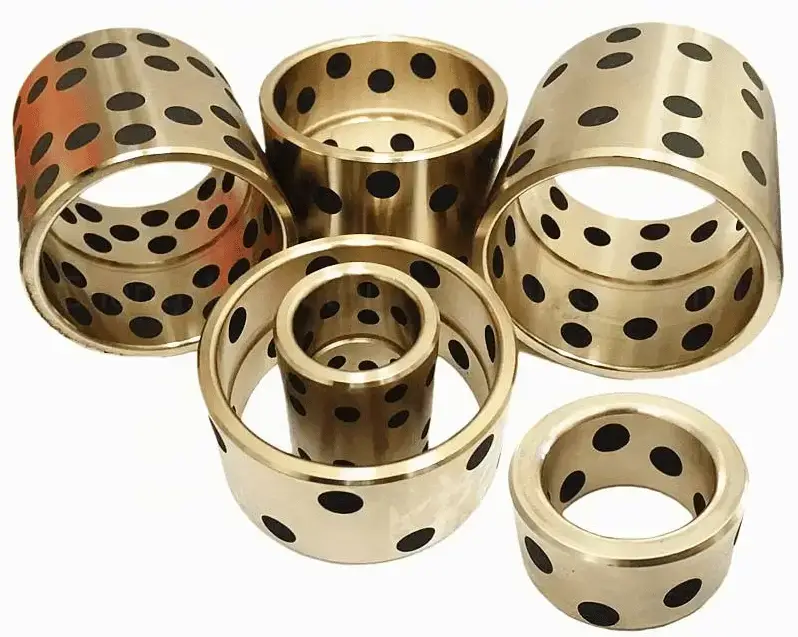
Graphite-plugged bearings can show plug recession, cracking around insert pockets, or loss of matrix support if impact and local stress exceed design assumptions. Metal-polymer bearings can show liner wear-through, delamination, creep, or fretting damage when the shaft oscillates at low amplitude. Oil-impregnated sintered bearings can suffer lubricant depletion, pore blockage, corrosion, or overheating. The corrective action differs in every case. “Use a harder bushing” is not a diagnosis; it may worsen shaft damage or fail to address the cause of inadequate lubrication or alignment.
- Scoring: inspect particulate ingress, filters, seals, shaft damage, and cleanliness during assembly.
- Liner wear-through: inspect shaft finish, edge radius, pressure peaks, and whether post-installation machining exceeded the permitted liner thickness.
- Plug damage: inspect impact load, pocket geometry, thermal shock, and plug pattern in the loaded zone.
- Seizure or smearing: inspect temperature, PV, clearance, counterface compatibility, and whether the intended dry-running range was exceeded.
7.Selecting Oilless Bushings for Construction Machinery, Mold Equipment, Valves, and Industrial Motion
Application labels do not select materials by themselves. Construction equipment pivots may need graphite bronze bushings because access for grease service is limited and static or oscillating load is high. Injection molds and die sets may need clean operation, repeatable sliding, and temperature-aware material selection. Valve, damper, bridge, and renewable-energy pivots may prioritize corrosion resistance, slow oscillation, high static load, and long inspection intervals. Packaging equipment may emphasize low noise, clean operation, and high cycling. The right oilless bearing is the one whose lubrication mechanism matches the dominant failure risk.
For example, a dry slow-speed actuator with high load and a rigid housing may favor an embedded-solid bronze bearing with a robust metal matrix. A compact mechanism with controlled shaft finish, moderate load, and frequent motion may favor a metal-polymer composite bushing. A small electric motor or appliance mechanism with steady, moderate duty may suit an oil-impregnated sintered bronze bearing. Water, vacuum, high temperature, food-contact requirements, and PFAS or restricted-substance policies can reverse that initial preference. The supplier should provide a material recommendation with assumptions, not simply a part number.
8.Quality Evidence, Standards, and Sustainable Sourcing
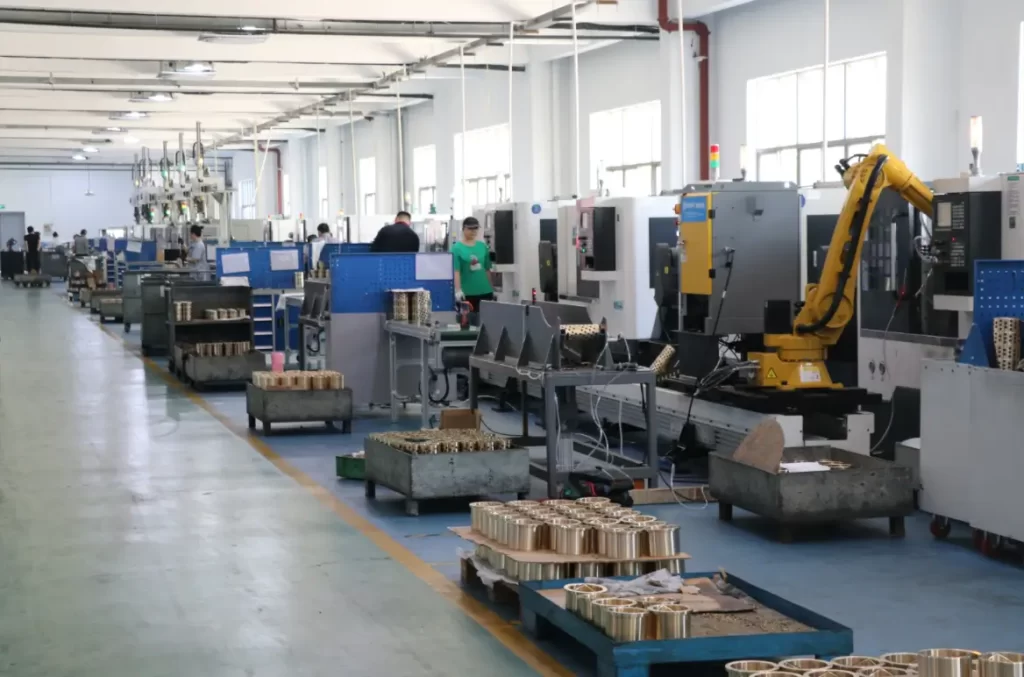
Self-lubricating bearings should be sourced with evidence proportionate to risk. For embedded-solid bronze, useful evidence includes matrix alloy certification, insert material identity, plug pattern or drawing control, bore and OD inspection, hardness where relevant, and visual inspection for cracks around pockets. For metal-polymer material, request backing and liner identification, thickness control, bond or sinter integrity where specified, forming controls, and restricted-substance declarations. For oil-impregnated sintered bronze, ASTM B438 is relevant because it addresses composition, density, oil content, radial crushing strength, and other acceptance requirements.
Standards provide a common language, not an automatic design approval. ISO 19259:2021 covers bearings with embedded solid lubricants; ISO 20054:2022 covers bearings containing dispersed solid lubricants; ISO 4379:2024 addresses dimensions and tolerances for copper-alloy bushes. Drawings should still identify the actual geometry, target tolerances, finish condition, inspection basis, corrosion exposure, and material restrictions. For export programs, confirm RoHS, REACH, PFAS-related customer policies, or market-specific restrictions before material is released for production.
- Lot traceability: connect alloy, liner or plug material, process route, and inspection report to the shipped parts.
- Dimensional control: verify bore, OD, length, flange or thrust geometry, plug pattern, and permitted machining allowance.
- Material documentation: request applicable alloy, self-lubricant, oil-content, and restricted-substance records.
- Application validation: use representative shaft, housing, temperature, and duty cycle for high-risk or safety-critical parts.
9.From Operating Data to a Supplier Inquiry That Produces a Defensible Quote
A useful inquiry for an oilless bushing manufacturer contains more than an OD, ID, and length. Provide the drawing or sample, shaft and housing materials, radial and axial load, speed or oscillation angle, frequency, duty cycle, ambient and operating temperature, intended lubricant condition, contamination, corrosion exposure, service target, annual volume, and required quality documents. State whether external grease is prohibited, unavailable, occasional, or allowed during start-up, because that distinction changes the recommended material system.
Inquiry note: Ask the supplier to answer with the proposed bearing family, base alloy or backing, solid-lubricant or liner chemistry, finishing method, final-clearance basis, expected inspection plan, and any limitation that needs application testing. This makes quotations comparable and prevents a graphite-bronze, PTFE composite, and oil-impregnated part from being compared by unit price alone. For a custom oilless bushing, graphite plugged bronze bushing, self-lubricating bearing, dry bushing, flange bearing, thrust washer, or sliding plate, a drawing plus real operating data is the shortest path to a technically credible offer.
FAQ: Oilless Bushing and Self-Lubricating Bearing
1. What is an oilless bushing?
It is a plain bearing designed to provide lubrication through embedded solids, a low-friction liner, or retained oil in a porous structure rather than by continuous external oil delivery.
2. Is an oilless bushing truly maintenance-free?
It can reduce routine lubrication, but the assembly still needs inspection for contamination, alignment, shaft condition, corrosion, and wear.
3. What is a graphite plugged bronze bushing?
It is a copper-alloy bearing body with graphite or other solid-lubricant inserts arranged on the sliding surface. The metal body carries load while the inserts help form a transfer film.
4. What is a self-lubricating composite bushing?
It is commonly a metal-backed bearing with a porous bronze interlayer and a PTFE-based or similar low-friction sliding layer.
5. Is oil-impregnated bronze the same as graphite bronze?
No. Oil-impregnated sintered bronze stores lubricant in pores. Graphite bronze normally refers to a metal matrix containing graphite plugs or solid lubricant.
6. Can an oilless bushing run dry?
Only within the dry-running conditions published for the selected bearing material and verified for the application. Do not assume this from the name alone.
7. What does PV mean for a bushing?
PV is contact pressure multiplied by relative sliding velocity. It is a selection screen, but heat, duty cycle, alignment, and counterface condition must also be checked.
8. How do graphite plugs lubricate a shaft?
During running-in and service, the plug material transfers a thin film to the mating surface. Plug geometry and loaded-zone placement affect renewal of that film.
9. What shaft finish should be used?
Follow the selected material data sheet. For one GGB DS composite material, a shaft finish of Ra 0.40 micrometres or lower is recommended; different grades can require different conditions.
10. Can I machine an oilless bushing after installation?
It depends on the construction. Solid bronze bearings are often finish-machined; thin-lined composite bearings can have a limited machinable layer and require controlled processing.
11. Why do self-lubricating bearings still fail?
Common causes are overload, high temperature, abrasive debris, improper shaft finish, insufficient clearance, misalignment, housing distortion, and using the wrong material family.
12. Are oilless bushings suitable for water?
Some materials are suitable and some are not. Check corrosion resistance, water absorption, lubrication mechanism, and the manufacturer’s material-specific data.
13. Can a graphite bronze bushing carry impact load?
The metal matrix can provide high structural capacity, but plug layout, base alloy, pocket geometry, housing support, and impact spectrum must be evaluated.
14. What is the difference between a dry bearing and a grease-lubricated bearing?
A dry bearing is designed to operate without applied lubricant in a defined window. A grease-lubricated bearing uses external grease, even if it also contains self-lubricating features.
15. Do oilless bushings need oil grooves?
Often no for dry-running designs, but geometry depends on the material and duty. A groove can reduce bearing area and may be unsuitable in a high-load dry-running zone.
16. Which standards apply to solid-lubricant bearings?
ISO 19259 covers embedded solid lubricants and ISO 20054 covers dispersed solid lubricants. Material, dimension, and customer specifications may add further requirements.
17. What material is used for oil-impregnated bronze bearings?
They are powder-metallurgy bronze bearings, typically based on copper and tin with specified additions and oil content. ASTM B438 defines key requirements for this family.
18. Can an oilless bushing take axial load?
A flanged bushing or thrust washer can support controlled axial load when its projected area, material, lubrication mechanism, and temperature are assessed separately.
19. What information is needed for a quotation?
Provide a drawing, sizes, shaft/housing material, load, speed, motion, temperature, environment, lubrication restrictions, quantity, service target, and quality-document requirements.
20. How should I compare supplier quotations?
Compare the proposed material family, design assumptions, final-clearance basis, inspection plan, tooling, validation needs, and documentation, not just the unit price.
100000+ Types of Bushings – Contact Us for Details