
Recent Posts
How Excavator Bushings Reduce Downtime, Prevent Costly Repairs, and Protect Your Fleet‘s Uptime
Introduction
Meta Description: Excavator bushings are small, inexpensive components that have an outsized impact on machine uptime. Learn how quality bushings prevent catastrophic wear, reduce repair costs, and keep your equipment productive.
Excavator bushings sit at the heart of every pivot point on your machine. They absorb shock, reduce friction, and protect expensive structural components from damage. When bushings fail prematurely, the consequences cascade through the entire undercarriage and attachment system—turning a few-hundred-dollar part into a five-figure repair bill. This article examines how quality bushings directly impact excavator uptime, what causes premature bushing failure, and how choosing the right components can dramatically reduce total cost of ownership.
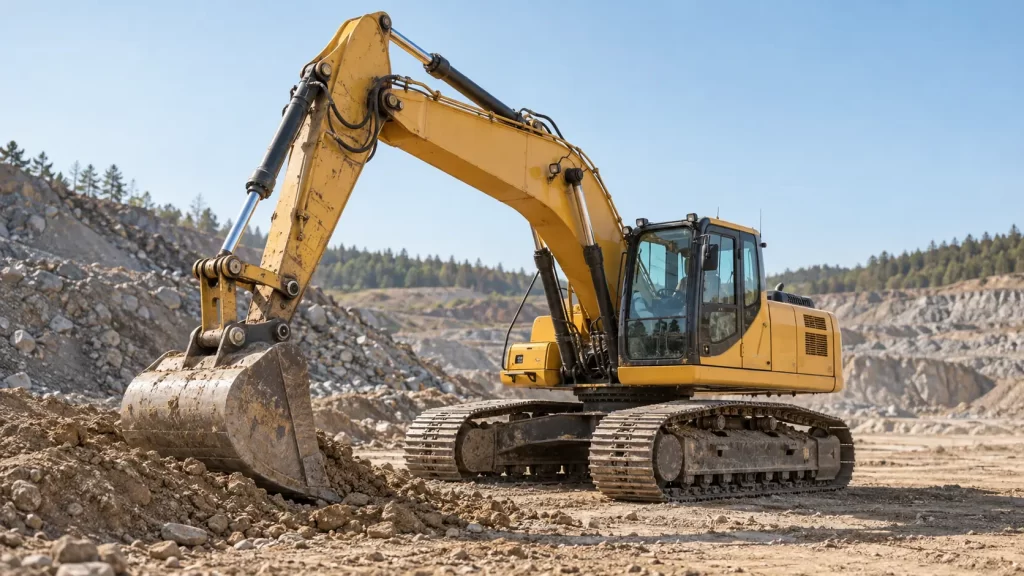
Table of Contents
1. Introduction: The Small Part That Controls Your Big Iron‘s Fate
Walk around any job site and you‘ll see excavators swinging, digging, and loading. What you won‘t see are the dozens of small cylindrical components silently taking punishment at every hinge point on the machine. These are bushings—sleeve bearings that sit between pins and the structural steel of the boom, arm, bucket, and undercarriage.
Bushings are not glamorous. They don‘t look impressive on a spec sheet. But make no mistake: they are one of the most critical wear components on your excavator. They dictate how long your structural components last, how often your machine goes down for repairs, and ultimately, how much money you make per operating hour.
The math is simple. A bronze or steel bushing costs a fraction of what a boom arm or bucket boss costs. When a bushing wears out, you replace the bushing. When a bushing fails completely and the pin starts grinding into the parent metal, you‘re looking at line boring, welding, and refacing—or worse, structural replacement. That‘s when a $50 part becomes a $15,000 repair, plus days of lost production.
This article breaks down exactly how excavator bushings work, why they fail, and what you can do to protect your fleet‘s uptime. Whether you run a single mini excavator or manage a fleet of 50-tonne mining machines, the principles are the same.
2. What Excavator Bushings Actually Do (And Why They Matter More Than You Think)
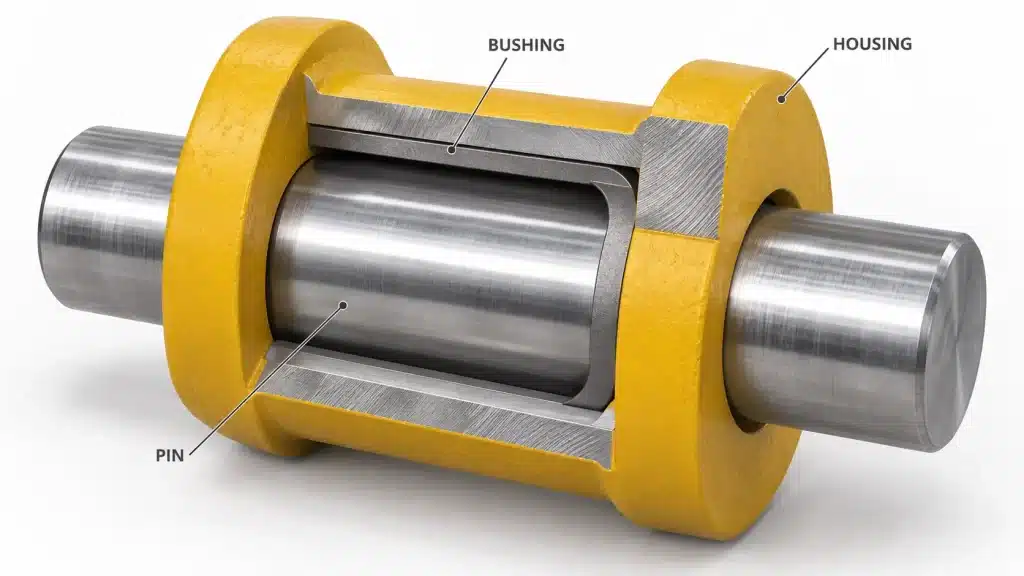
Let‘s start with the basics. An excavator bushing is a cylindrical bearing surface that sits inside a bore on one component, allowing a pin to rotate or pivot within it. The bushing takes the wear so the surrounding structure doesn‘t have to.
The Function
When your excavator digs, every bucket load sends massive force through the pin-bushing interface at the bucket, arm, and boom joints. Without a bushing, steel would grind directly against steel. That sounds tough, but it‘s actually terrible for longevity. Steel-on-steel contact creates friction, heat, galling, and accelerated wear that destroys expensive structural components.
The bushing acts as a sacrificial barrier. It‘s made from materials selected specifically to absorb load and reduce friction—bronze, hardened steel, or composite materials depending on the application. When it wears out, you replace it. The structural components survive.
The Consequences of Neglect
Here‘s where things get expensive. When a bushing wears past its limit, several things happen in sequence:
First, the pin starts to develop play within the bore. This play allows the joint to move in ways it wasn‘t designed to move. The component alignment shifts, and the structural steel starts taking loads it wasn‘t meant to handle.
Second, the pin begins contacting the parent metal directly. Instead of wearing out a cheap, replaceable bushing, you‘re now wearing out a boom boss or bucket ear. These are not quick-change components. Repairing them requires welding, machining, and in many cases, removing the component from the machine entirely.
Third, the wear cascades. A worn bushing at the bucket-stick joint accelerates wear on the thrust plate, which accelerates wear on adjacent bushings and pins. What started as a single worn component becomes a full pivot group rebuild.
Industry data makes this brutally clear: replacing a damaged pin and bushing set costs up to $1,500 and takes 5 to 8 hours of labor. If the structural steel is damaged, you‘re looking at line boring costs of $500 per hole, plus welding, refitting, and days of downtime
3. How Bushings Directly Impact Machine Uptime
Uptime is the only metric that matters in heavy equipment. Every hour your excavator sits in the shop is an hour it‘s not moving dirt, not earning revenue, and not justifying its financing payment.
Bushings influence uptime through three distinct mechanisms.
Planned Replacement vs. Emergency Breakdown
A well-managed bushing replacement program is predictable. You measure wear at regular intervals, you schedule replacement during planned maintenance windows, and you lose hours—not days—of production. You control the timing.
When bushings are neglected until failure, the equation flips. The machine breaks at the worst possible moment. Parts need to be sourced, possibly air-freighted. The repair is more complex because collateral damage has occurred. Instead of a two-hour planned job, you‘re looking at a multi-day emergency repair.
The difference between planned and unplanned bushing work is often the difference between a minor maintenance expense and a major capital hit.
The Cascade Effect
Worn bushings don‘t just fail themselves—they take other components with them. This is called the cascade effect, and it‘s why undercarriage and pivot maintenance is so critical.
Here‘s how it works on the undercarriage side: worn track bushings allow the chain pitch to stretch. A stretched chain doesn‘t mesh properly with the sprocket. The poor mesh accelerates sprocket tooth wear. Worn sprocket teeth then hammer the chain, which accelerates bushing wear further. Before long, you‘re not replacing a few bushings—you‘re replacing the entire chain, sprocket, and possibly rollers and idlers.
The same principle applies to the attachment side. A worn bucket bushing allows the bucket to move laterally and axially. That movement wears the thrust plate. A worn thrust plate causes bolt heads to wear and the plate to dislodge. A dislodged thrust plate damages the bucket mounting faces.
Every step in the cascade costs more and takes longer to fix than the step before it. The bushing is always the cheapest component in the chain—and the one that can prevent the entire sequence.
Structural Protection
Perhaps the most underappreciated role of bushings is protecting the structural integrity of the machine itself. Excavator booms, arms, and buckets are massive steel weldments. They‘re designed to handle enormous loads, but they‘re not designed to be wear surfaces.
When bushings do their job, the structural components never see direct wear. They maintain their original bore dimensions, their alignment stays true, and their fatigue life remains as designed.
When bushings fail, the structural components become the wear surface. Bores go oval. Mounting faces get chewed up. Cracks develop at stress points. At that stage, you‘re not doing maintenance—you‘re doing structural repair, which is a fundamentally different and far more expensive proposition
4. Common Causes of Premature Bushing Failure
Understanding why bushings fail early is the first step toward preventing it. In the field, premature failure almost always traces back to one of four root causes.
Contamination
This is the number one killer of excavator bushings. Dirt, grit, and abrasive particles work their way into the pin-bushing interface and act like grinding paste. The bushing material wears away rapidly, clearances open up, and the joint starts hammering.
Contamination enters through failed seals, inadequate lubrication purging, and simply working in dirty environments without proper protection. The grease groove in a bushing is designed to distribute lubricant and purge contaminants—but only if fresh grease is regularly pumped through the system.
Lubrication Failures
Inadequate or infrequent lubrication has two effects. First, it allows metal-to-metal contact between the pin and bushing, which accelerates wear dramatically. Second, it prevents the purging action that clears contaminants from the joint.
Automatic lubrication systems dramatically improve outcomes here. They deliver consistent, measured doses of grease while the machine operates, ensuring the entire pin circumference is coated and purged. Manual greasing, by contrast, is inconsistent. Some joints get missed. Some get over-greased. Some don‘t get greased at all on busy days.
Incorrect Installation
Bushings that are installed with incorrect interference fit, improper alignment, or without proper cleaning of the bore will fail prematurely. A bushing that isn‘t seated correctly will move under load, creating abnormal wear patterns and potentially damaging the bore itself.
Similarly, installing a new bushing on a worn pin (or vice versa) is a recipe for rapid failure. The two components need to match dimensionally to develop the proper lubricant film and load distribution.
Material and Quality Issues
Not all bushings are created equal. The material specification, heat treatment, and manufacturing tolerances all influence how long a bushing lasts in service.
A properly hardened steel bushing with a case depth of 0.8–1.0 mm and hardness of 58–62 HRC will outlast a soft, improperly heat-treated bushing by a factor of two or more in abrasive conditions. Similarly, bronze bushings vary widely in alloy composition and quality—cheap bronze wears fast, quality bronze lasts.
The cheapest bushing on the market is rarely the cheapest bushing to own. The cost difference upfront is trivial compared to the downtime cost of premature failure.
5. The Financial Case for Quality Bushings
Let‘s talk numbers. This is what fleet managers actually care about.
The Cost of a Bushing
A standard excavator bucket bushing or arm bushing typically costs between $5 and $150 depending on size, material, and application. Even large, custom-engineered bushings for 50-tonne machines rarely exceed a few hundred dollars per unit.
The Cost of Bushing Failure
When a bushing fails catastrophically and damages the surrounding structure, the costs escalate rapidly:
Line boring: approximately $500 per hole
Welding and refacing: several hundred to several thousand dollars depending on scope
Component removal and reinstallation: labor-intensive, potentially requiring crane support
Downtime: the biggest cost of all—a 30-tonne excavator can generate $2,000 to $10,000 per day in revenue depending on the application
A single structural repair caused by a neglected bushing can easily exceed $15,000 when parts, labor, and downtime are included. That‘s the cost of 100 to 1,000 quality bushings.
The Uptime Equation
Here‘s the calculation that matters: what does an extra 500 hours of uptime per year per machine mean for your operation?
If your excavator earns $200 per hour, 500 additional hours is $100,000 in incremental revenue. Even a 100-hour improvement—achieved simply by preventing one unplanned bushing-related breakdown—is worth $20,000.
Quality bushings don‘t just reduce parts cost. They protect the revenue-generating capacity of the entire machine. That‘s the real financial case.
6. Choosing the Right Bushings for Your Excavator
Selecting bushings isn‘t complicated, but it does require attention to a few key factors.
Material Selection
Hardened steel bushings are the standard for most excavator pivot applications. They offer excellent load capacity, wear resistance, and cost-effectiveness. Case-hardened steel with a hardness of 58–62 HRC and case depth of 0.8–1.0 mm is the benchmark for quality.
Bronze bushings are common in applications where self-lubricating properties or corrosion resistance are priorities. Quality bronze alloys offer good wear characteristics but generally lower load capacity than hardened steel.
Composite and bi-metal bushings combine materials to optimize different performance characteristics—steel backing for strength, bronze or polymer lining for friction reduction.
Dimensional Accuracy
The bushing must match the bore and pin dimensions within the specified tolerances. Too much clearance and the joint hammers; too little and it seizes. OEM specifications exist for a reason—follow them.
Grease Groove Design
The internal grease groove configuration affects lubricant distribution and contaminant purging. Different groove patterns suit different applications. The goal is to ensure lubricant reaches the load zone and contaminants can escape.
The Top Hat Solution
One innovation worth noting is the integrated thrust plate and bushing design, sometimes called a “Top Hat” bushing. In conventional bucket-stick arrangements, the thrust plate and bushing are separate components. The thrust plate is often the weak link—it wears prematurely and can dislodge, damaging mounting faces.
A Top Hat bushing combines the thrust plate and bushing into a single piece, eliminating the dislodgement risk and extending service life. Mining operators have reported extending bucket change-out intervals by 2,000 to 4,000 hours after switching to this design
7. Maintenance Practices That Maximize Bushing Life
Even the best bushing will fail prematurely if maintenance practices are poor. Here‘s what actually works in the field.
Regular Lubrication
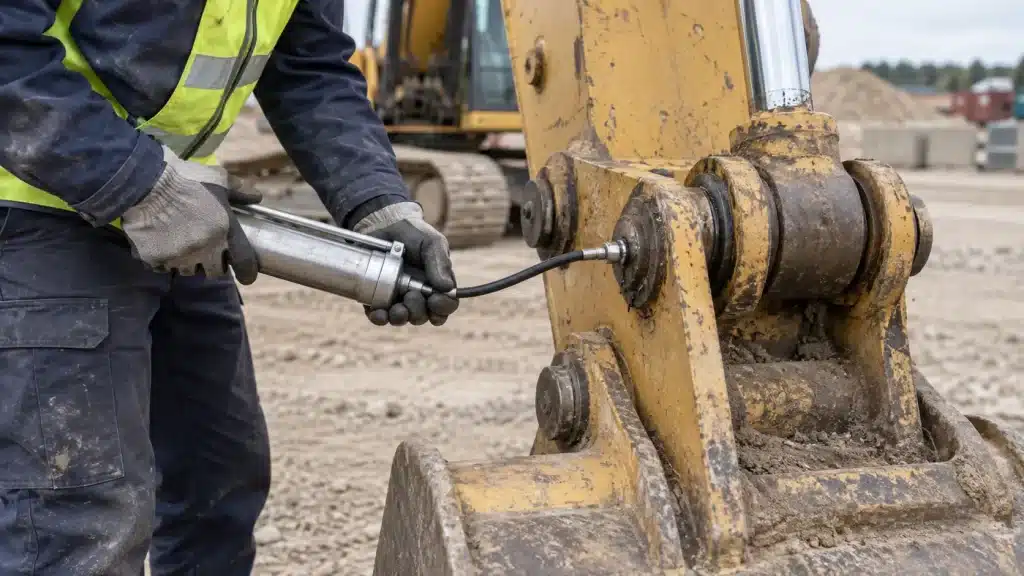
Lubrication is the single most impactful maintenance activity for bushing life. Grease reduces friction, carries away heat, and purges contaminants. The key word is “purges”—you need to pump enough fresh grease through the joint to push old, contaminated grease out.
Automatic lubrication systems are strongly recommended for any machine working in abrasive conditions. They eliminate the human error factor and ensure consistent delivery.
Inspection and Measurement
You cannot manage what you don‘t measure. Bushing wear should be measured at regular intervals—every 250 hours is a reasonable baseline for undercarriage components. Attachment bushings should be checked at every service interval.
Look for:
Visible play at the joint
Uneven wear patterns
Squeaking or grinding noises
Grease leakage around seals
Ovality in the bushing bore
The Bushing Turn
For track chain bushings, turning the bushing at approximately 50% of its wear life can roughly double its service life. The bushing is rotated 180 degrees to present the unworn surface to the sprocket. Missing this window means you lose half the bushing‘s potential life.
Preventive Replacement
Don‘t wait for failure. Replace bushings at the specified wear limit, during planned maintenance windows, with the machine already in the shop. This converts unplanned downtime into planned downtime, which is vastly cheaper
8. Why MYWAY Bushings Belong on Your Excavator
At this point, you understand the stakes. Bushings are small components with enormous influence over your machine‘s uptime, repair costs, and structural integrity. Choosing the right supplier matters.
MYWAY has been manufacturing precision bushings since 2005, serving equipment owners in over 40 countries. We operate three production bases with more than 2,000 existing molds, covering excavators from mini machines to 100-tonne mining class units
What Sets MYWAY Apart
Material Integrity: Our hardened steel bushings are manufactured to a case depth of 0.8–1.0 mm and hardness of 58–62 HRC—the benchmark for wear resistance in abrasive conditions–. We don‘t cut corners on heat treatment.
Application Coverage: Whether you run Cat, Komatsu, Volvo, Hitachi, Kobelco, or Hyundai equipment, MYWAY has the bushing specifications to match. Our catalog includes bucket bushings, arm bushings, boom bushings, cylinder bushings, and undercarriage components.
Custom Manufacturing: If you need bushings with specific grease groove configurations, non-standard dimensions, or specialized materials, our engineering team can produce them. From casting to finishing, everything happens under our roof.
Certifications: MYWAY is IATF and ISO certified, with quality systems designed for OEM-level consistency. Every batch is traceable, and every shipment is inspected before it leaves our facility.
Cost Efficiency: As a direct manufacturer with 20 years of experience, we control our supply chain and our pricing. You get quality bushings without the markup that comes from multiple layers of distribution.
What Our Customers Achieve
Equipment owners who switch to MYWAY bushings report longer service intervals, reduced unplanned downtime, and lower total maintenance costs. The bushings fit correctly, they last, and they protect the components around them.
Ready to reduce your excavator downtime? Contact MYWAY today for a quote on bushings for your specific equipment models. Our team will help you identify the right part numbers, discuss material options, and arrange logistics to your location.
Frequently Asked Questions (FAQ)
Q: How often should I replace excavator bushings?
A: It depends on application severity, but a reasonable baseline is to inspect attachment bushings every 1,000–1,500 hours for machines in intensive use, and every 2,000–3,000 hours for lighter-duty applications. Undercarriage bushings should be measured every 250 hours. Replace when wear reaches the OEM-specified limit—don‘t wait for failure.
Q: Can I replace just the bushing, or do I need to replace the pin too?
A: In most cases, pins and bushings should be replaced as a set. A new bushing on a worn pin will fail prematurely because the surface finish and dimensions won‘t match properly. Similarly, a new pin in a worn bushing won‘t achieve the correct clearance. Replace them together.
Q: What‘s the difference between a standard bushing and a “Top Hat” bushing?
A: A Top Hat bushing combines the function of a thrust plate and a bushing into a single integrated component. In conventional bucket-stick arrangements, these are two separate parts. The integrated design eliminates thrust plate dislodgement, reduces installation complexity, and extends service life in high-load applications.
Q: How do I know if my bushings are worn enough to cause structural damage?
A: The early warning signs are visible play at the joint, unusual noises (squeaking, grinding, knocking), and grease leakage around seals. If you can see the pin moving within the bore, or if the component alignment is visibly off, wear has progressed significantly. At that point, structural damage may already be occurring. Measure wear before you reach this stage.
Q: Does MYWAY make bushings for my specific excavator model?
A: Very likely. MYWAY maintains over 2,000 molds covering major OEM brands including Caterpillar, Komatsu, Volvo, Hitachi, Kobelco, Hyundai, and more. We also produce custom bushings for specialized applications. Contact us with your machine model and part number, and we‘ll confirm availability and pricing.
Q: What information do I need to provide to get a bushing quote?
A: The more information you can provide, the faster we can quote. Ideally: machine make and model, OEM part number, dimensions (inner diameter, outer diameter, length), material preference, and quantity. If you only have the OEM part number, that‘s usually sufficient—we can cross-reference it to our catalog.
100000+ Types of Bushings – Contact Us for Details