
Recent Posts
Heavy-Duty Suspension Linkage Bushings: What Fleets, Engineers, and Buyers Actually Need to Know
Introduction
Nobody pulls over to admire a suspension bushing. But when one fails, the whole truck feels it — wandering steering, uneven tire wear, clunking noises, and sometimes a roadside inspection violation that puts you out of service. This article cuts through the marketing fluff and looks at what heavy-duty suspension linkage bushings really do, how rubber and polyurethane compare in actual fleet service, how to spot failure before it becomes a breakdown, what specs belong on your purchase order, and where the global bushing market is heading. We also explain why MYWAY has become a go-to supplier for self-lubricating and polyurethane bushings in commercial vehicle applications across 40+ countries — and how to get a quote that matches your exact application.
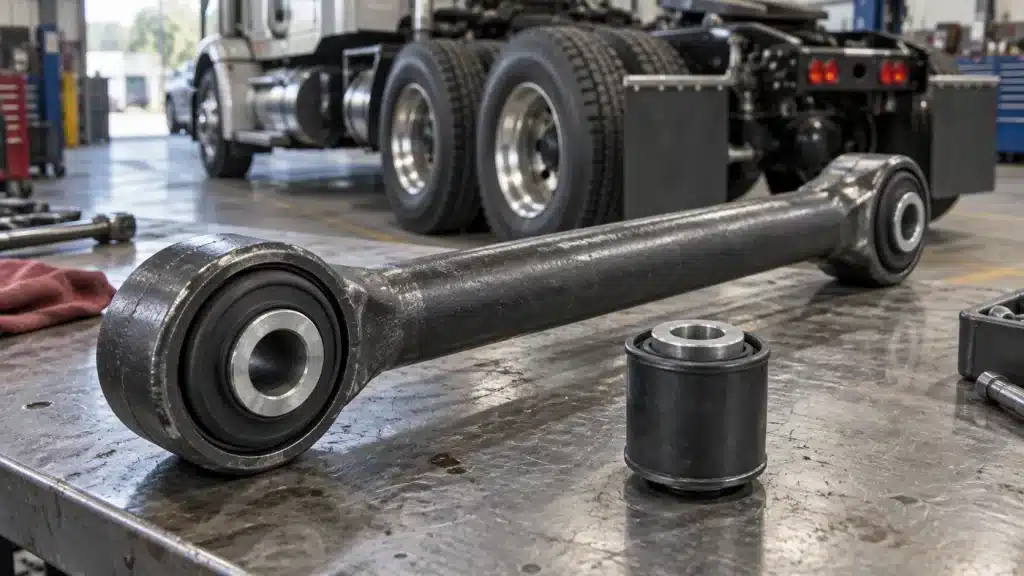
Table of Contents
1. The Unsexy Part That Keeps Your Rig on the Road
Let’s be real: bushings don’t get the glory. Shocks, air springs, and brakes get all the attention. But the pivot points in a heavy-duty suspension are doing some of the hardest work on the entire chassis.
A suspension linkage bushing sits at every critical joint — torque rods, leaf spring eyes, control arms, stabilizer bars, shock mounts — and has to soak up constant road shock, vibration, and load cycling while keeping the axle pointed in the right direction. When they wear out, the problems snowball fast: irregular tire wear, vague steering, chassis vibration, and in serious cases, a full out-of-service violation.
FMCSA violation code 207ASTBW is blunt about it: a suspension connecting rod or tracking component is out of service if the rubber bushing is missing or worn to the point that the component can be moved by hand along its axis. That’s not a suggestion. It’s a hard fail.
So when we say “heavy-duty” bushings, we’re not talking about bigger versions of passenger car parts. We’re talking about components that have to survive:
GVW loads of 16 tons and above
Constant exposure to oil, hydraulic fluid, brake fluid, antifreeze, and road de-icers
Temperature swings from -40°C to well over 100°C in the same duty cycle
Multi-axis rotation and compression at the same time, often in the same joint
That combination is why material choice and design precision matter far more in commercial vehicles than in light-duty applications.
2. Rubber vs. Polyurethane vs. DU Composite: Picking the Right Material
This is probably the most argued-about topic in heavy-duty suspension maintenance. There’s no universal winner — but there is a right answer for your specific application. Here’s the honest breakdown.
Rubber Bushings
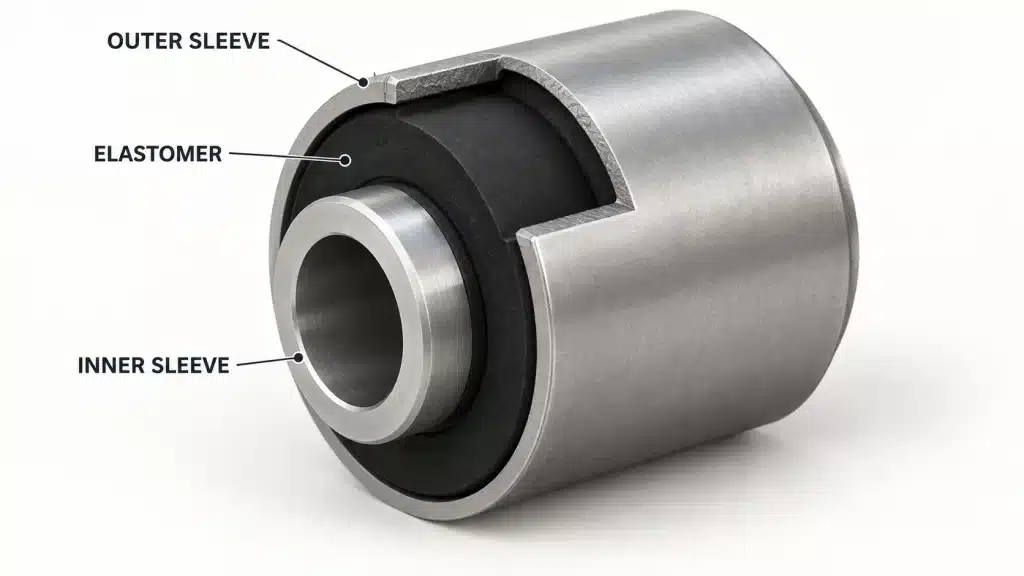
Rubber is still the OEM default for good reason. It’s naturally compliant, stretches in multiple directions, and does an excellent job of isolating noise, vibration, and harshness (NVH). OEM-style rubber bushings are typically vulcanized — chemically bonded — to both the inner and outer steel sleeves. That seals out dirt and moisture and prevents premature wear from contamination.
The catch? Rubber degrades faster than polyurethane under heavy loads, especially when exposed to oils and chemicals. It’s also prone to compression set — the permanent deformation that happens when rubber is squeezed under load for long periods. And in heavy-duty applications, rubber often needs to be pre-compressed during manufacturing to achieve enough load-bearing capacity, because its internal porous structure can’t handle the pressure on its own.
Polyurethane (Urethane) Bushings
Polyurethane has been mainstream in trucking since the late 1980s, when companies like ATRO Engineered Systems started producing urethane bushings for Hendrickson beam-style suspensions. Today, urethane shows up in everything from torque rod bushings to cab mounts to transmission mounts.
Here’s what makes urethane stand out:
Chemical resistance: It can withstand oil, hydraulic fluid, brake fluid, antifreeze, and de-icing compounds. As one industry veteran put it, “the only chemicals that will affect polyurethane are chemicals that have no business being anywhere near a vehicle.”
Longevity: A properly formulated urethane bushing can last up to 10 times longer than its rubber counterpart, because manufacturers can fine-tune shape memory, rebound, hardness, tensile strength, and elongation during formulation.
Less deflection: Urethane is less compressible than rubber, so it holds its shape under load and resists deflection more effectively — which translates to sharper handling and more precise suspension geometry.
Tunable hardness: Urethane formulations can be adjusted across a wide durometer range, from around 80A to 95A Shore for typical bushings, and up to 60D–80D Shore for extreme heavy-duty applications.
The trade-offs: Polyurethane is stiffer, so it transmits more NVH than rubber in applications that experience a lot of vibration. It also struggles with multi-axis rotation — if the joint needs to move in more than one plane, urethane can bind and squeak unless it’s properly lubricated and designed with enough clearance. Unlike rubber, urethane doesn’t bond well to metal, so most urethane bushings rely on relative motion between the sleeve and the bushing body, which introduces friction and requires maintenance.
DU Self-Lubricating Composite Bushings
For applications where you absolutely cannot afford downtime for greasing — or where contamination from dirt and grit would destroy a greased joint — DU (dry, self-lubricating) bushings are the answer. A DU bushing is a three-layer composite: a steel backing for strength, a porous bronze interlayer that stores the lubricant, and a PTFE-based surface that transfers a solid lubricant film onto the mating shaft.
The friction coefficient can be as low as 0.08 dry and 0.02 when lubricated. Load capacity reaches up to 140 N/mm² dynamic pressure, and temperature range spans from -200°C to +280°C. That’s a completely different performance envelope from either rubber or urethane.
Quick comparison table:
| Property | Rubber | Polyurethane | DU Composite |
|---|---|---|---|
| NVH isolation | Excellent | Fair | Poor |
| Load capacity | Moderate | High | Very High |
| Chemical resistance | Poor | Excellent | Excellent |
| Maintenance | None needed | Periodic greasing | None needed |
| Multi-axis motion | Excellent | Limited | Limited |
| Service life (HD) | Baseline | 4–10× rubber | 5–10× rubber |
| Temperature range | -40°C to 100°C | -30°C to 120°C | -200°C to 280°C |
The practical rule of thumb: use rubber where complex articulation and maximum NVH isolation are priorities (trailing arms, lift axles). Use urethane where load capacity and chemical resistance matter most (torque rods, leaf spring eyes, shock mounts). Use DU composites where maintenance-free operation is non-negotiable (high-contamination environments, hard-to-reach pivot points).
3. Design Types: Bonded, Press-Fit, and What Actually Survives Under Load
Bushing design is just as important as material selection. A great material in a poorly designed bushing will fail just as fast as a cheap one.
Bonded (Vulcanized) Bushings
In a bonded bushing, rubber is chemically vulcanized to both the inner and outer metal sleeves during manufacture. The outer sleeve is then press-fitted into the suspension component (control arm, spring eye, etc.) with an interference fit, and the whole assembly is bolted to the chassis.
The key design principle here: the metal sleeves stay still, and suspension movement is accommodated by the rubber twisting between them. This is a clean, sealed design that keeps contaminants out and requires zero maintenance. The downside is that the rubber must be soft enough to allow sufficient rotational movement while still maintaining alignment settings — a delicate compromise that limits how stiff you can make a bonded rubber bushing.
Press-Fit / Non-Bonded Bushings
Most polyurethane bushings fall into this category. The urethane is mechanically fitted with minimal crush, and the center pin is lubricated so the component pivots freely. This free-pivoting design provides sharper handling response and better suspension control than bonded rubber — but it also means the bushing relies on a gap between the urethane and the sleeve, which can let in dirt, grit, and sand that act like an abrasive and wear the bushing prematurely.
This is why the best urethane bushings use greaseable pins and are designed with proper sealing to keep contaminants out.
Voided Pivot Bushings
Many heavy-duty truck suspensions use voided bushings — rubber bushings with deliberate cavities (“voids”) molded into the design. These voids are positioned at the 12 o’clock and 6 o’clock positions when the suspension is at ride height, and they’re designed to settle under load. The voids allow the bushing to deflect in a controlled way, providing compliance where you need it while maintaining stiffness in other directions.
When inspecting voided bushings, normal settling is expected and doesn’t require replacement. But cracks extending from the void to the inner metal, or excessive vertical movement, are red flags that mean replacement is due.
4. How to Diagnose Bushing Failure Before It Becomes a Roadside Problem
Catching a worn bushing early is the difference between a planned shop visit and an unplanned tow. Here’s what to look for, in order of how the failure typically progresses.
Stage 1: Early Warning Signs
The first symptom is usually noise — a knocking or squeaking sound heard at low speed during turns or on rough ground. Drivers may also notice a slight increase in vibration through the steering wheel or cab floor. These are easy to dismiss as “just an old truck,” but they’re the earliest indicators that a bushing is on its way out.
Stage 2: Visible Symptoms
At this stage, you’ll start to see:
Uneven tire wear — the suspension geometry has shifted, causing the axle to track incorrectly
Vehicle leaning to one side under load — the bushing has compressed beyond its design limits
Visual cracking or separation — look for cracks in the rubber extending between the void and the bushing’s inner metal, or rubber that has completely separated from the inner sleeve
Smeared blackened rubber or hanging strands of rubber around the bush tube edges — this is a sign the bushing is overheating and melting, usually caused by an imbalanced wheel end on the same side
Stage 3: Out-of-Service Conditions
At this point, you’re looking at a violation, not just a maintenance item:
The rubber bushing is missing, or worn to the point that the component can be moved by hand along its axis (FMCSA violation code 207ASTBW)
Vertical movement of 1/8 inch (3.2 mm) or more before the axle is raised indicates excessive wear
The bracket bore has become oval — a condition that bushing replacement alone cannot fix
Inspection Tips
For routine inspection, raise the vehicle and leave the suspension unloaded, then load the bracket area by hand or with a pry bar to check for abnormal movement. Examine the rubber surface for cracking, hardening, or swelling caused by oil contact. Always check the symmetric bushing on the opposite side too — both sides are usually exposed to similar loads, so if one is worn, the other is likely close behind.
A predictive maintenance study on Hino 500 dump trucks found that the potential for bushing failure increases measurably with every 1,000 additional operating hours, and recommended preventive replacement at 6,000–7,000 operational hours, particularly for rear axle positions. If you’re running a scheduled maintenance program, build bushing inspection into your 50,000–75,000 km intervals.
5. Specification Essentials: What to Put in Your Purchase Order
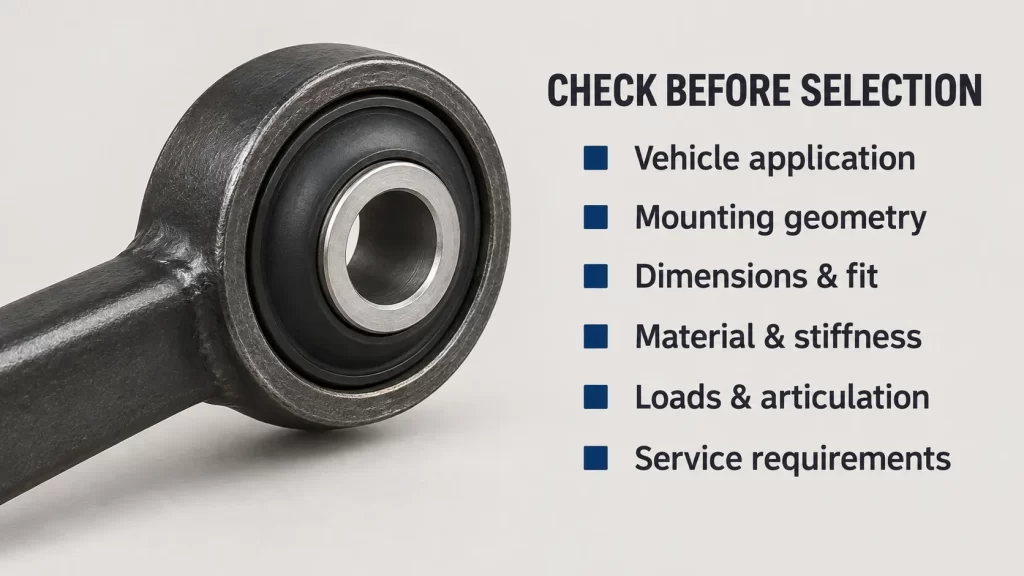
If you’re sourcing bushings for a fleet or a manufacturing line, here are the specifications that actually matter.
Material Standards
For rubber bushings, ASTM D2000 / SAE J200 is the global benchmark. It classifies rubber compounds by type (based on heat aging resistance — tested at temperatures from 70°C for Type A up to 300°C for Type K) and class (based on oil swelling resistance). A typical line call-out like “ASTM D2000-04 M2BG714 B14 EA14” tells you the revision year, grade, type, class, hardness, tensile strength, and any additional suffix requirements.
For polyurethane bushings, specify Shore A or Shore D durometer. Most heavy-duty suspension bushings fall in the 80A–95A range for general applications, or 60D–80D for extreme load cases. Also specify tensile strength, tear resistance, and elongation at break — these are the properties that determine how the bushing behaves under multi-directional loading.
Dimensional Tolerances
Heavy-duty suspension bushings are press-fitted, so dimensional accuracy is non-negotiable. A typical interference fit for a bushing outer sleeve into a suspension arm is around 0.005 inch (0.127 mm). The inner bore must match the pin diameter precisely — too loose and the bushing rotates on the pin instead of deflecting, too tight and installation becomes impossible without damaging the bushing. Always specify bore diameter, outer diameter, length, and any flange dimensions.
Hardware Compatibility
For torque rod bushings specifically, bolt grade matters. Hendrickson specifies Grade 8 bolts and Grade C locknuts for all torque rod attachments. Torque specifications typically range from 175–225 ft-lbs for smaller fasteners up to 450–600 ft-lbs for larger locknuts on suspension bracket connections. Always confirm the bolt grade and torque spec against the vehicle manufacturer’s service manual — under- or over-torquing will cause premature bushing failure.
6. Market Trends Driving Bushing Demand in 2025 and Beyond
The global automotive suspension bushings market was valued at approximately USD 4.85 billion in 2025 and is projected to grow at a CAGR of 5.8% through 2035. The sway bar bush segment alone is projected to expand from USD 15.56 billion in 2025 to USD 25.27 billion by 2031, driven by a CAGR of 8.42%.
Several trends are driving this growth — and changing what buyers need:
EV Weight Is Reshaping Bushing Requirements
Battery electric vehicles are significantly heavier than comparable ICE vehicles due to battery pack weight. This places intensified stress on chassis components and demands bushings with superior load-bearing capacity and abrasion resistance. The shift is pushing suppliers toward advanced polyurethane formulations over standard rubber to ensure durability under higher torque loads.
Polyurethane Adoption Is Accelerating
Polyurethane is the fastest-growing material segment in the suspension bushing market. The material’s higher load-bearing capacity, better chemical resistance, and longer service life are driving adoption in both EV platforms and heavy-duty commercial vehicles. Manufacturers are also developing “platformised” polyurethane systems — a single material system that covers multiple hardness and damping versions, supporting faster vehicle model development.
Aftermarket Demand Is Strong
Vehicle longevity trends are creating sustained aftermarket demand. Aging truck fleets need regular suspension maintenance, and the aftermarket segment is projected to grow at a stable CAGR through 2033. The leaf spring bushings market alone is predicted to grow from USD 17.93 billion in 2025 to USD 25.31 billion in 2032.
Bio-Based Materials Are Coming
Material innovation is also moving toward sustainability. Bio-based polyurethane compounds derived from plant sources (such as castor oil-based elastomers) are being developed to reduce CO2 emissions during raw material production while maintaining the mechanical properties required for heavy-duty applications. Some formulations have achieved a 48% biomass content with no sacrifice in performance.
Raw Material Price Volatility Is a Risk
Natural rubber and petrochemical derivative prices remain volatile, which squeezes margins for bushing manufacturers and complicates long-term supply agreements. This makes reliable sourcing partners — particularly those with in-house manufacturing control — more valuable than ever.
7. Where MYWAY Fits In: Self-Lubricating and Heavy-Duty Bushing Solutions
If you’ve read this far, you know the problem. Now here’s the solution.
Zhejiang MYWAY Co., Ltd. has been manufacturing bushings since 2005, and today supplies IATF 16949 and ISO 9001 certified components to automotive brands including Hyundai, Honda, Toyota, Nissan, Ford, Chery, Geely, Lexus, and Mazda, across more than 40 countries. The company operates three production bases with over 2,000 bushing moulds.
What MYWAY Makes for Heavy-Duty Suspension Applications
DU Self-Lubricating Bushings (SF-1 Series): Three-layer composite construction with a steel backing, porous bronze interlayer, and PTFE-based surface. These bushings run without external lubrication, resist contamination, and deliver a friction coefficient as low as 0.08 dry. They handle dynamic pressures up to 140 N/mm² and operate from -200°C to +280°C. For heavy suspension arms, hydraulic cylinders, and construction equipment, they eliminate the greasing downtime that plagues conventional bushings.
Polyurethane Bushings: Available in custom formulations across a wide durometer range, designed for torque rod, leaf spring eye, and shock absorber applications. MYWAY’s urethane compounds are formulated for oil resistance, abrasion resistance, and long-term shape retention under heavy cyclic loads.
Rubber and Metal Bushings: For applications where NVH isolation and multi-axis articulation are the priority, MYWAY produces OEM-spec rubber-to-metal bonded bushings compatible with major truck brands.
Bronze and Bimetal Bushings: For high-load, low-speed applications requiring superior wear resistance.
Why Fleets and OEMs Choose MYWAY
IATF 16949 certified — the same quality management standard required by automotive OEMs
20 years of bushing manufacturing experience with over 2,000 moulds in production
From casting to finished part — full in-house control over quality and lead times
Custom and standard parts — whether you need 50 pieces for a fleet repair or 50,000 for an OEM production line
Competitive pricing with reliable logistics to 40+ countries
MYWAY’s self-lubricating bushings have also been integrated into the supply chain of HAITIAN International, one of the world’s largest injection moulding machine manufacturers — a credential that speaks to the reliability of MYWAY’s manufacturing processes.
Ready to spec bushings for your next project? Request a quote or download the product catalogue at mybushing.com. Tell us your application, load requirements, and dimensions — MYWAY’s engineering team will recommend the right material and design, and provide samples for testing.
Frequently Asked Questions (FAQ)
Q1: How long do heavy-duty suspension bushings typically last?
It depends heavily on material, application, and operating conditions. Rubber bushings in heavy-duty truck applications typically last 50,000–100,000 km. Polyurethane bushings can last 4–10 times longer than rubber under equivalent conditions, and DU composite bushings often exceed 10 times the life of a greased metal bushing. However, a predictive maintenance study on dump trucks recommended preventive replacement at 6,000–7,000 operational hours for torque rod bushings, particularly at rear axle positions.
Q2: Can I replace rubber bushings with polyurethane without modifying the suspension?
In most cases, yes — especially for single-axis pivot points like torque rods and leaf spring eyes. However, polyurethane transmits more NVH than rubber, and it doesn’t handle multi-axis rotation as gracefully. For applications that require complex articulation (like trailing arms on lift axles), rubber may still be the better choice. Always consult the vehicle manufacturer or a suspension engineer before switching materials.
Q3: What’s the difference between a DU bushing and a conventional greased bushing?
A DU bushing is a self-lubricating composite that uses a PTFE-based surface to transfer a solid lubricant film onto the shaft — no grease required, ever. A conventional greased bushing relies on periodic lubrication (typically every 10,000–20,000 km) to maintain a grease film between the bushing and the pin. The DU design eliminates maintenance, resists contamination, and works across a much wider temperature range (-200°C to +280°C vs. -30°C to +120°C for grease).
Q4: How do I know when a bushing needs replacement?
Look for these signs: knocking or squeaking at low speed, uneven tire wear, vehicle leaning under load, visible cracking or separation of the rubber/urethane from the metal sleeve, and vertical movement exceeding 1/8 inch (3.2 mm) at the pivot point. If the bushing is missing or the component can be moved by hand along its axis, the vehicle is out of service under FMCSA regulations.
Q5: Does MYWAY offer custom bushing solutions?
Yes. MYWAY provides both standard and custom bushings. You can specify dimensions, material type, durometer, surface finish, and flange configuration. For OEM and fleet customers, MYWAY’s engineering team can reverse-engineer existing bushings or design new ones from application requirements. Samples are available for testing before full production.
Q6: What certifications does MYWAY hold?
MYWAY holds IATF 16949 (the automotive industry’s most stringent quality management standard), ISO 9001, and additional certifications including CE and UL. The company serves automotive, construction, agricultural, and industrial customers in over 40 countries.
Q7: What’s the typical lead time for a MYWAY bushing order?
Standard parts ship within 2–4 weeks. Custom orders typically take 4–8 weeks depending on complexity and quantity. MYWAY operates from three production bases with over 2,000 moulds, so most standard configurations are available quickly.
This article is provided for informational purposes. For specific application advice, contact MYWAY’s engineering team at mybushing.com.
100000+ Types of Bushings – Contact Us for Details