
Recent Posts
Bimetal Bushings Where They Fit and How to Choose Them
Introduction
A bimetal bushing is worth a look when a machine has room for a sleeve bearing, needs a durable sliding surface and has a workable oil or grease supply. The familiar steel-backed bronze version puts a copper-alloy lining inside a steel shell. The lining runs against the pin or shaft; the backing supports it in the housing.
That sounds straightforward until an order arrives with little more than three dimensions and the word “bimetal.” Is it for a slowly swinging pin, a rotating shaft or a part that barely moves under load? Will someone grease it, or is oil already circulating through the machine? Those questions can change the choice even when the dimensions stay exactly the same.
This guide concentrates on lubricated steel-backed bronze bushings: where they fit, where the comparison with solid bronze is useful, and which details help turn an inquiry into a part you can approve. It also covers the checks worth making before fitting a replacement. An ordinary bronze-lined sleeve should not be treated as an oil-free bearing merely because it looks like one.
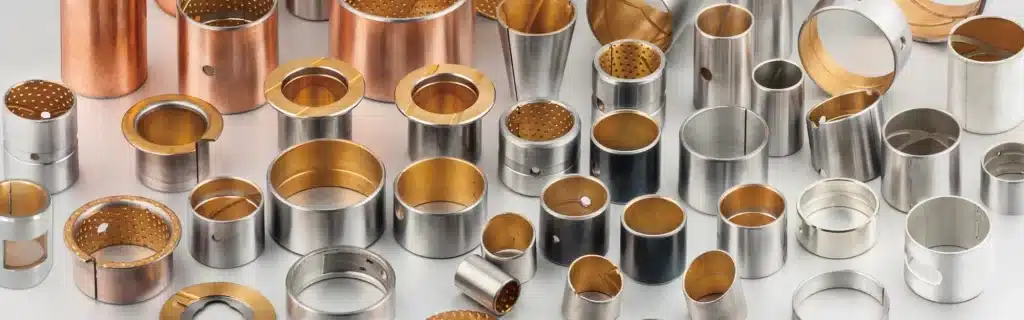
Table of Contents
1. What makes a bimetal bushing different
Two metals with different jobs
Look through the open end and there are two materials to account for. The copper alloy at the bore is the bearing surface. Behind it sits the steel that forms the supporting wall. They are bonded, rather than supplied as two loose sleeves pushed together. One common production route starts with bearing-alloy powder on steel strip, followed by sintering and further processing before the strip is formed into a bush.
A wrapped sleeve usually gives away its construction through a longitudinal joint. That line can be perfectly normal. It is quite different from an unexpected crack, although a photograph alone may not settle which you are looking at. Keep the joint detail on the drawing, particularly when the installation calls for a specific orientation.
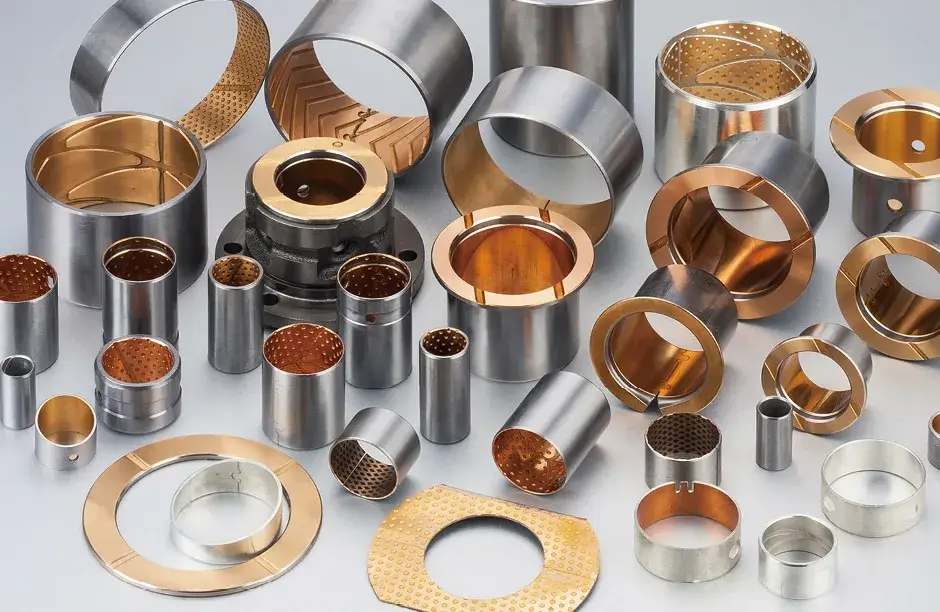
There may be little else to see on the outside. Inside, a smooth bore, shallow pockets or a groove pattern each tells you something about the intended lubrication arrangement. None tells the whole story. For instance, an oil hole is useful only when the assembly gives the oil somewhere to come from.
MYWAY’s bimetal bushing range covers the product family. When making an inquiry, go beyond search names such as bi-metal bush or composite sleeve bearing. Ask for the lining designation and the supplied bore condition. Those are details you can compare between quotations; a general product name leaves too much open.
Why the construction can suit a compact assembly
Suppose the shaft diameter is already fixed. There may be very little space left between the shaft and nearby parts, so making the housing larger is awkward. A steel-backed sleeve gives the designer a way to use a bearing alloy at the bore without making the whole wall from that alloy. Whether it works in the available space still needs checking, but it’s a reasonable option to put on the shortlist.
The housing is part of the arrangement. A thin sleeve needs the support and fit specified for it. If the old bush has turned in the housing and damaged the bore, ordering another sleeve of the original outside diameter may leave that problem untouched. Measure the housing before deciding what the replacement order should contain. It’s easier to discuss a repair with actual dimensions than after a new batch fails to fit.
2. Where bimetal bushings fit in machinery
Grease serviced pivots and linkages
Consider a pin that swings through a short arc every time a linkage moves. It may travel very little yet spend much of the cycle carrying a load. Lubricated bimetal bushes are candidates for this sort of duty, including suitable joints in agricultural equipment, construction machinery and industrial mechanisms. The particular joint matters more than the industry label.
“Low speed” is not much of a description on its own. Give the angle of movement, how often it moves and what the load is doing during that movement. Does the highest force arrive at the end of the stroke? Does it reverse? A sketch with a few operating notes can be more helpful than several pages of general machine information.
Then look at the grease point as the person servicing the machine will see it. A fitting hidden behind a guard is easily overlooked. A passage that ends in the wrong place is another problem altogether. Show how grease is meant to reach the sleeve and whether the joint has seals. For a machine washed at the end of a shift, include that detail too; it belongs in the service conditions.
Oil supplied rotating assemblies
Rotating equipment presents another set of questions. Bimetal bearing materials are used in application families such as transmissions, compressors and certain engine or pump arrangements. That doesn’t make a sleeve chosen for a greased linkage an appropriate replacement in an oil-fed rotating assembly. The lining and the lubrication duty may both be different.
Start with the speed of the shaft at the bearing, not a motor speed taken from elsewhere in the drive. Explain how oil reaches the contact. An oil bath, an intermittent supply and a circulating system are different arrangements, and the description should make clear which one the machine actually uses.
Starting conditions deserve a line in the inquiry. Is this a machine that runs through the week, or one left standing for long periods? Is oil supplied before the shaft turns? These are practical questions for the application review, especially when the old part wore quickly after a change in the operating routine.
If the purchase list simply says “pump bush,” mark the component on an assembly drawing. Two parts in the same pump can have very different jobs. A sleeve around a shaft should not be confused with a thrust plate just because both are listed as bearing parts.
Agricultural and construction equipment
Outdoor machinery brings dirt and water into the discussion. A bronze-lined bimetal bush may suit a serviced joint, but it can’t keep grit out by itself. The surrounding seals and lubrication route deserve attention alongside the alloy. State whether the part sees rain, muddy wash water, dust or long periods in storage; these are more useful descriptions than “harsh environment.”
A replacement job also offers evidence that a new design doesn’t have: the old parts. Before throwing them away, record where the wear appears and what was happening when the problem began. A pin that became tight after an impact calls for a different investigation from clearance that grew gradually over many hours.
The worn sample is useful, but it is not the original specification. Its bore may have enlarged, and its outside surface may have been damaged during removal. Send the drawing when available, together with the sample dimensions and a clear note that they were measured after service.
Production machinery and repeat orders
Some purchases are much less dramatic. A production machine needs the same compact bearing arrangement, repeatedly, with parts that assemble as expected. Here, keeping the specification consistent is part of the value of the order. The buyer needs a repeatable part, not a fresh interpretation of a photograph each time stock runs low.
Keep the drawing revision with the order and with any approved sample. Say who can authorize changes. If a later delivery has a different oil-hole position or joint detail, there should be something clear to compare it with before the workshop starts fitting parts. Nominal bore and length alone won’t reveal every relevant change.
This also makes repeat quotations easier. A supplier can review the same defined requirement, while purchasing can identify whether a proposed change affects the part or only the commercial terms. There is less room for an unnoticed substitution to become the new standard.
3. Bimetal bushings compared with other bearing choices
Bimetal versus solid bronze
In a solid bronze bush, the copper alloy continues through the body. In a steel-backed bronze bush, it forms the lining. That’s the first distinction to establish. Neither description, by itself, tells you which part will last longer in your machine.
For a thick machined sleeve with drawing-specific shoulders or other features, solid bronze may be worth considering. For a compact wrapped sleeve, a bimetal construction may fit the design more naturally. Bring the actual dimensions and proposed manufacturing features into the comparison. MYWAY’s bronze bushing options are relevant when the requirement points toward a solid copper-alloy component.
Ask what condition the quoted part arrives in. Is the bore finished for the specified installation, or does the workshop have another machining operation to do? Include that operation in the comparison, with its setup time and inspection. A price for an unfinished part and a price for a ready-to-fit component are answering different purchasing questions.
For a worn assembly, either choice may be premature until the shaft and housing have been measured. Changing from one bearing construction to another doesn’t restore metal already lost from the mating parts.
Bimetal versus porous or polymer lined bearings
An oil-impregnated bronze bush carries oil in a porous structure. Don’t infer the same arrangement from the word “sintered” in a bimetal description. That word can describe how the lining was made, without telling you that the finished sleeve has the same oil storage or service requirements.
Metal-polymer bearings add another possible source of confusion. The running surface is a polymer-based layer, even though metal may provide the backing. Some grades are intended for dry running; others need lubrication. A dark or bronze-colored surface is no substitute for identifying the material.
If the machine can’t be greased and has no oil supply, put that fact at the top of the inquiry. It changes the shortlist. Buying a conventional bronze-lined bimetal bush and hoping it will behave like an oil-free product is a poor way to resolve an incomplete specification.

4. How to select a bimetal bushing
For continuous rotation, use the shaft speed at the bearing. The sliding-speed formula is v = πdn / 60,000, where d is the bore in millimeters and n is rpm. At 100 rpm, the hypothetical 30 mm bore gives about 0.157 m/s. Multiply that by 5 MPa and the PV value is approximately 0.785 MPa·m/s.
Now there are three quantities to review: pressure, sliding speed and PV. A catalog may give limits for each, subject to its stated conditions. The largest pressure and largest speed are not an invitation to use both at once. Read the conditions attached to the data, including lubrication, rather than transferring an isolated maximum into a drawing.
An oscillating joint needs its own motion description. Give the angle, frequency and loading sequence. If the pin swings back and forth through a small arc, calling each swing a revolution would misstate its movement. For an inquiry, a short explanation of the cycle is better than an rpm figure invented to fill an empty box.
Identify the lining and the supplied condition
“Bronze lining” is a beginning, not a material specification. Copper-alloy linings differ, and the broader bimetal family also includes materials such as aluminum-tin. Put the required designation on the drawing. If the selection is still open, say that and ask for a proposal against the operating conditions.
Commercial series numbers deserve the same care. A number may be familiar in the market without guaranteeing identical material and construction in every catalog. Match the written specification. Where a customer requires restrictions on lead or other substances, include the requirement with the inquiry and request the appropriate material documentation. Color can’t establish composition.
Also settle the condition of supply. Is final bore machining part of the order, part of the customer’s workshop process, or not permitted for this product? Leaving that question until the sleeves arrive can create a surprisingly large gap between what purchasing ordered and what assembly expected.
Check the housing shaft and running clearance
A loose wrapped sleeve is not the whole bearing arrangement. Its installed bore matters, and the inspection method should reflect the housing condition specified for the part. Agree on the housing and shaft dimensions together. If acceptance requires a particular checking fixture, identify it before making or inspecting the batch.
The shaft deserves more than a nominal diameter. Material, hardness, finish and current condition all belong in the review. On a repair, check the pin at several relevant positions for wear or taper. A photograph can show a scored track; it can’t supply the missing size measurement. Keep both kinds of evidence when sending the inquiry.
Temperature can complicate a fit that appears satisfactory on the bench. Include the housing material and the temperature reached in service. Different materials don’t all expand at the same rate. Ask for the proposed fit and clearance to be reviewed for that assembly, rather than borrowing a tolerance pair because it worked on another machine.
5. Lubrication features that need a clear purpose
Match grooves and pockets to the supply
Follow the oil or grease route with the drawing in front of you. Start at the supply point, go through the housing and finish at the bearing surface. Where does the route enter the bush? Does the required hole line up after installation? These checks can be made before ordering, when a correction is much easier to handle.
A recess in the bore can hold lubricant, and a groove can distribute it according to the intended arrangement. More grooves are not automatically better: they also alter the contact surface. Keep an existing drawing’s pattern intact unless a change has been reviewed. For a new part, describe the motion and supply instead of choosing a pattern solely because it looks familiar.
Make maintenance achievable
“Grease regularly” leaves the workshop with several unanswered questions. Which lubricant? Applied where? How is the point reached once the machine is assembled? Define the actual procedure and establish an interval suited to the duty. There is no useful universal interval that covers every bimetal bush, from a dirty outdoor pivot to a protected industrial mechanism.
Remember the hours when the machine is stopped. Storage, washing and a long shutdown can be relevant to the lubricant and exposed surfaces. Add those conditions to the application notes. If keeping the specified lubrication in place is impractical, that is a reason to reopen the bearing choice before the order goes ahead.
6. Installation and early wear checks
Prepare the assembly before pressing
Inspect the housing entry and bore before placing the sleeve in the press. Burrs, debris or damage can interfere with an otherwise correct part. Set up the specified support and a suitable pressing tool, then start the bush squarely. Follow the instructions for the actual construction being fitted; a tool appropriate for one bearing form may damage another.
Set any required seam orientation and oil-hole alignment before pressing. If the resistance is unexpected, pause and check the setup and sizes. More force is not a diagnosis. Once the bush is seated, inspect the installed bore and check the shaft’s movement by the agreed procedure before applying working load.
Confirm the permitted bore finishing process
A cutting tool may fit inside the sleeve. That doesn’t settle whether you should use it. The product must allow the proposed finishing operation, with enough bearing layer left afterward. Some parts are supplied for final machining; others are ready for their specified installation. Confirm the allowance and process rather than treating every tight bush as an unfinished component.
If the shaft binds, check the installed size, alignment and entry condition first. Establish why it binds. An unplanned cut may make the shaft turn while leaving the cause unresolved, or remove material that was meant to remain. The corrective action should follow the inspection findings, not precede them.
Preserve useful evidence when wear appears
Before cleaning a failed part, photograph the bearing surface, pin and lubrication route. Mark the fitted orientation. Record when the symptom first appeared: immediately after assembly, only when warm, or after a change in the job. These observations give the supplier something more useful than a request for “a stronger bush.”
Keep the mating parts in the investigation. A harder lining won’t restore an enlarged housing, straighten a bent pin or open a blocked passage. Decide which component or procedure needs to change after reviewing the evidence. That helps avoid buying a different material for a problem that has little to do with the material.
7.What to include in a bimetal bushing inquiry
Send the current drawing, order quantity and required timing. Then add the operating information you actually know. Mark unknown values as unknown; a guessed load can acquire undeserved authority once it appears on an inquiry sheet. If the part is a replacement, distinguish original drawing dimensions from measurements taken on the worn sample.
Information | Useful details | Why it matters |
Part and drawing | Bore, outside diameter, length, revision | Identifies the required component |
Bearing construction | Lining alloy, backing, joint, surface features | Defines what is being compared |
Operating duty | Load, movement, speed, temperature, lubricant | Supports an application review |
Mating components | Shaft, housing, fit, finish, condition | Connects the sleeve to the assembly |
Order requirements | Quantity, timing, inspection documents | Makes quotations comparable |
For a first order, decide how the initial parts will be accepted. Is the check a dimensional inspection in a defined fixture, an assembly trial, or both? Who records the result? Agree on the procedure in advance. A sleeve sliding over a loose pin is only that observation; it doesn’t establish the running clearance after the sleeve is fitted.
Compare quotations on the same basis. Include the supplied condition, inspection documents, packaging and any workshop finishing. Keep approved changes with the revised specification so that the next purchase repeats the accepted part. A helpful suggestion made during one order should not become an undocumented substitution on the next.
8.Bimetal bushing FAQ
Are bimetal bushings self lubricating
An ordinary steel-backed bronze bush needs its specified oil or grease supply. Neither a sintered lining nor visible lubricant pockets establish dry-running capability. There are special solid-lubricating constructions, but they have to be identified and selected as such. Ask for the instructions for the exact product being quoted.
Are bimetal bushings better than solid bronze bushings
The answer depends on the assembly. Compare the space available, geometry, loading, mating parts and lubrication, then compare the cost of the supplied parts and any finishing. A steel-backed lining and a solid copper-alloy body give the designer different options. Neither name supplies a universal life or load advantage.
Why is there a seam in a bimetal sleeve
A wrapped bush is formed from strip, leaving a longitudinal joint. That can be a normal design feature. Compare it with the specified joint before rejecting the part. Unexpected damage still needs attention; the presence of a designed seam doesn’t make every crack or opening acceptable.
Can a bimetal bushing carry axial load
A plain sleeve primarily supports radial load at its bore. Axial load needs a suitable bearing face, such as a specified flange or thrust washer, assessed for the duty and lubrication. Contact with the end of a cylindrical sleeve does not, by itself, give that end a thrust capacity.
Can I machine a bimetal bushing after installation
Check the product specification first. The answer depends on its supplied condition, bearing-layer allowance and permitted finishing process. If machining was not part of the agreed route, investigate a tight fit before removing material. A dimensional correction is useful only when it is allowed and addresses the cause.
Can bimetal bushings operate in wet or corrosive conditions
They need an application-specific review. Identify the fluid or chemical exposure, storage, lubrication and any proposed protective finish. The lining, backing and exposed edges may behave differently. A bronze-colored bore is not evidence that the whole component has the corrosion behavior of a solid bronze part.
How long will a bimetal bushing last
No single number covers the range of applications. Loading, sliding distance, alignment, lubrication and dirt all affect wear. Use records from an existing machine to describe the target, then agree on inspection criteria or a trial for the proposed part. Treat another application’s service history as context, not a guarantee.
9.Discuss your bimetal bushing requirements with MYWAY
MYWAY offers bimetal bushings and other plain bearing constructions. Send your drawing with the quantity and a short description of the job. For a replacement, photographs of the sleeve, pin and housing are useful alongside the measured dimensions. Include the lubrication route and any available notes on how the old part wore.
If you are still designing the assembly, identify what can change. The shaft may fix the bore diameter, while length, lining or lubrication details remain open. Making that distinction early lets the proposed component be reviewed against the real design constraints.
Contact MYWAY for a bimetal bushing quotation with the drawing revision, quantity and operating notes. Ask the offer to identify the proposed lining, supplied condition and inspection scope. With those details agreed, purchasing and assembly have the same definition of the part, and future orders have a clear reference to follow.

100000+ Types of Bushings – Contact Us for Details