
Recent Posts
Molybdenum in Steel Metallurgy: Building Hardenability, Temper Resistance, Corrosion Resistance, and Creep Strength
Introduction
Molybdenum is often specified as a percentage on a mill test certificate, yet its commercial value comes from the microstructures it helps create and preserve. In carbon and low-alloy steel, molybdenum can delay transformation, improve hardenability, resist temper softening, and support elevated-temperature strength. In chromium-molybdenum pressure materials, it contributes to creep resistance and process reliability. In stainless steel, it strengthens resistance to localized corrosion in appropriate alloy systems. These functions are not automatic. Carbon, chromium, nickel, nitrogen, boron, section size, austenitising cycle, cooling rate, tempering, welding heat input, and service environment determine whether molybdenum produces the intended result.
Table of Contents
1.What “Steel Molybdenum” Means: An Alloying System, Not a Standalone Grade
Searches for steel molybdenum, molybdenum alloy steel, Cr-Mo steel, Mo steel, high-temperature steel, molybdenum stainless steel, 4140 steel, 4130 steel, P11 pipe, P22 pipe, P91 pipe, tool steel, and alloy steel plate often refer to very different material families. A low-alloy shaft steel, carburizing gear steel, boiler tube, pressure-vessel plate, 316 stainless product, duplex stainless part, high-speed tool steel, and cast mill roll may all contain molybdenum, but they use it through different thermal histories and operating conditions. The material name must therefore be expanded into chemistry, product form, heat treatment, standard, dimensions, fabrication route, and service duty.
Molybdenum is a substitutional alloying element and a medium-strong carbide former. It affects diffusion, phase boundaries, carbide stability, and high-temperature deformation. IMOA describes its broad role in carbon steels as promoting microstructures that contribute to strength and toughness, while potentially allowing desired strength at reduced carbon equivalent in suitable designs. This is a design opportunity rather than a shortcut: reducing carbon may help weldability, but the final welding procedure, cooling rate, hydrogen control, and heat-affected-zone hardness still require qualification.
- Hardenability is not the same as hardness: Mo can help a section transform to martensite or bainite at a slower cooling rate, while final hardness still depends on carbon, quench, and tempering.
- Creep strength is not a generic high-temperature rating: it depends on grade, heat treatment, stress, exposure time, welds, and code design rules.
- Corrosion resistance is not supplied by Mo alone: chromium, nickel, nitrogen, microstructure, surface condition, chlorides, temperature, and crevice geometry all matter.
2.Transformation Control and Hardenability: Why Mo Changes the Cooling Requirement
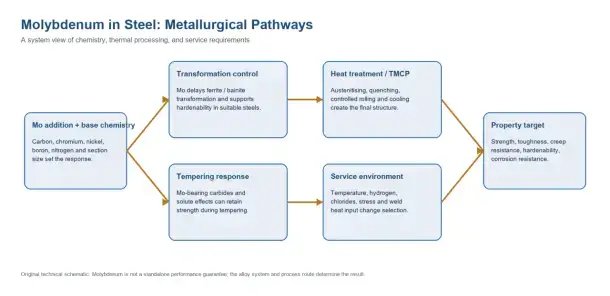
Hardenability describes the capacity of steel to form a hard transformation product through the section under a given cooling condition. It is usually evaluated comparatively by methods such as the Jominy end-quench test. Molybdenum delays ferrite and bainite transformation through effects that include solute drag at the austenite-to-ferrite interface and reduced carbon activity. IMOA states that this can substantially reduce the critical cooling rate needed to form bainitic or martensitic microstructures. The effect is valuable in thicker sections, where the core cools much more slowly than the surface, and in direct-quench or quench-and-temper routes where a target hardness or strength must be achieved throughout the component.
The practical benefit is alloy synergy. Cr-Mo and Ni-Cr-Mo steels combine the hardenability contribution of molybdenum with chromium and nickel effects. Boron can be highly efficient at very low addition levels when it remains in solution at austenite grain boundaries; IMOA notes that molybdenum can support boron effectiveness by helping prevent iron-boron carbide formation at those boundaries. However, a chemistry that makes heavy sections easier to harden can also increase heat-affected-zone hardenability during welding. The same transformation control that helps a quench-and-temper forging can demand stricter preheat, low-hydrogen consumables, interpass control, and post-weld heat treatment in a welded pressure component.
The correct question for a supplier is not “does this steel contain Mo?” It is “what through-section microstructure must this part achieve after its actual cooling cycle?” Supply the maximum section thickness, austenitising condition, quench medium, transfer time, temper range, target hardness or strength, and notch-toughness requirement. Without this data, an alloy-steel designation cannot prove core properties or fabrication reliability.
3.Tempering Resistance and Molybdenum Carbides: Preserving Strength After Quenching
A quenched steel is rarely the final engineering condition. Tempering relieves stress and adjusts hardness, toughness, ductility, and dimensional stability. Molybdenum improves resistance to temper softening through both solid-solution effects and, in suitable carbon and molybdenum ranges, carbide precipitation. IMOA identifies Mo2C as a characteristic molybdenum carbide that can form during tempering, typically in the 600 to 690 deg C range under applicable conditions. In higher-Mo steels, fine Mo2C precipitation can contribute to secondary hardening; IMOA reports that the strength contribution can approach 200 MPa in favourable cases.
These statements need boundaries. IMOA also notes that Mo2C is not expected in extra-low-carbon HSLA steel and is unlikely below roughly 0.3% Mo. It can compete with cementite and with stronger carbide formers such as titanium, niobium, and vanadium. Consequently, the same nominal Mo content can lead to different precipitation behavior when carbon, nitrogen, tempering time, prior austenite condition, and other alloying additions change. A tempering specification must state temperature, time, heating rate where relevant, section thickness, atmosphere, cooling, and hardness or mechanical-property acceptance criteria.
Tool steels and high-speed steels use molybdenum in a different but related manner. Their alloy systems are designed around carbide populations, hot hardness, abrasion resistance, red hardness, and dimensional response to heat treatment. ISO 4957:2018 specifies broad categories of wrought tool steels, including alloy cold-work, hot-work, and high-speed steels. A buyer should never substitute a general Cr-Mo machine steel for a specified tool steel simply because both show molybdenum on the certificate.
Mo-driven mechanism | Metallurgical result | Where it is useful | Specification caution |
Transformation delay and solute effects | Higher hardenability; lower critical cooling rate in suitable steels | Quench-and-temper parts, direct-quenched plate, thicker sections | Verify section size, quench severity, and HAZ behavior rather than using alloy percentage alone |
Carbide formation during tempering | Temper-softening resistance and possible secondary hardening | Tool steels, selected Cr-Mo and high-Mo heat-treated grades | Mo2C behavior depends on carbon, Mo level, time, temperature, and competing carbide formers |
Solid-solution strengthening at temperature | Improved creep and elevated-temperature strength in suitable ferritic alloys | Boilers, superheaters, petrochemical piping, rotors, pressure equipment | Use code-qualified grade, heat treatment, design stress, weld procedure, and service-temperature limits |
Alloy-system corrosion contribution | Improved localized-corrosion resistance in Mo-bearing stainless families | Chloride-bearing, marine, chemical, and process equipment | Check alloy family, PREN where appropriate, welding, surface finish, and actual fluid chemistry |
4.Cr-Mo Steels for Pressure and High-Temperature Service
Chromium-molybdenum steels are core materials for power generation, refinery, petrochemical, and high-temperature pressure applications because they can combine hardenability, tempering stability, elevated-temperature strength, and resistance to certain degradation mechanisms. IMOA describes molybdenum as a key alloying element in creep-resistant ferritic steels for service temperatures up to 530 deg C, while the actual permissible design temperature and stress remain governed by the relevant code, grade, product form, heat treatment, and long-term data. Components include boiler tubes, superheaters, headers, pressure vessels, collectors, pumps, heavy turbine rotors, and piping.
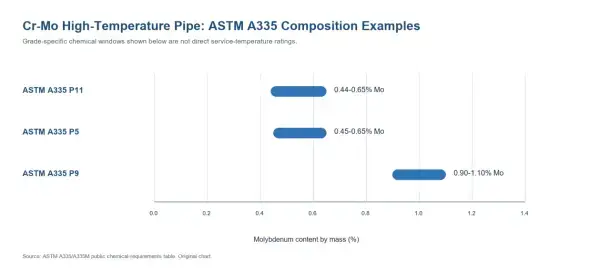
ASTM A335/A335M is a principal specification for seamless ferritic alloy-steel pipe for high-temperature service. Its public chemistry table demonstrates why generic labels can be misleading. P11 has 1.00 to 1.50% chromium and 0.44 to 0.65% molybdenum; P5 contains 4.00 to 6.00% chromium with 0.45 to 0.65% molybdenum; P9 contains 8.00 to 10.00% chromium with 0.90 to 1.10% molybdenum. These are grade-specific chemical requirements, not a direct ranking of service temperature, corrosion resistance, weldability, or code allowables. P22, P91, P92, and other grades have different alloy designs and fabrication requirements
For pressure equipment sourcing, request the exact ASTM/ASME or EN grade, product form, heat treatment, thickness or schedule, design code, calculated design temperature and pressure, creep-life basis, impact requirement, hydrogen or sour-service exposure, welding procedure, PWHT requirement, NDE, hydrostatic or other test, and traceability. A material certificate listing “Cr-Mo steel” is not enough to establish fitness for a specific pressure boundary.
5.Molybdenum in Stainless Steel: Localized Corrosion Resistance Has a System Context
In stainless steel, molybdenum is primarily associated with increased resistance to pitting and crevice corrosion in chloride-containing conditions, as well as elevated-temperature strength in appropriate alloys. IMOA notes that approximately 2% molybdenum in Type 316 stainless steel substantially increases corrosion resistance relative to a molybdenum-free austenitic alternative. The improvement is connected to passive-film stability and localized-corrosion behavior, but it does not make 316 universally resistant to seawater, hot chlorides, reducing acids, or crevice conditions. Chloride concentration, temperature, oxygen availability, deposit formation, redox condition, stress, fabrication, and surface finish still determine the actual result.
Molybdenum is also used across duplex and superduplex stainless steels, where chromium, molybdenum, nitrogen, nickel balance, and phase proportion must be controlled. A duplex product may offer high strength and useful chloride resistance, but incorrect heat input or solution annealing can create harmful intermetallic phases or phase imbalance. A stainless-steel inquiry should include the fluid composition, maximum chloride level, pH, temperature, pressure, stagnant or flowing condition, crevice geometry, cleaning chemistry, welding method, corrosion allowance, and required testing. “316 Mo stainless steel” is too vague for a process vessel, pump, fastener, heat exchanger, or marine assembly.
For fabricated product, surface condition is part of corrosion performance. Heat tint, weld scale, iron contamination, embedded abrasive media, crevices, and poor drainage can turn a nominally suitable Mo-bearing stainless steel into an early corrosion problem. Specify pickling, passivation, mechanical finishing, cleanliness controls, weld treatment, and inspection alongside chemistry. The most durable corrosion solution is usually a matched material-and-fabrication system, not the highest nominal Mo content.
6.Manufacturing Routes: Steelmaking, Rolling, Forging, Heat Treatment, and Machining
Molybdenum alloying must remain controlled from melt to finished part. Steelmaking practice governs chemistry accuracy, inclusion control, and segregation. Continuous casting, forging reduction, or rolling reduction affects soundness and microstructural uniformity. For heavy sections, slow cooling through the core makes hardenability and quench design especially important. For plates made by thermomechanical controlled processing, molybdenum may be combined with niobium, nickel, chromium, and boron to obtain a transformation response appropriate to direct quenching or controlled cooling. IMOA describes such Mo-containing combinations as supporting required hardenability in direct-quenched structural steels.
Heat treatment should be qualified to the actual geometry. Austenitising temperature and time must dissolve or retain alloy phases as intended without excessive prior-austenite grain growth. Quenching must provide adequate cooling at the slowest-transforming location; polymer, oil, gas, water, or press quenching has different severity and distortion behavior. Tempering must stabilise the desired property combination. A hardness result on the surface cannot establish core transformation in a heavy shaft, gear, mould block, or pressure-wall component. Use cross-section test locations, metallography when necessary, and mechanical tests at the locations relevant to service stress.
Machining and finishing need the same precision. Mo-containing alloy steels may be supplied annealed, normalized, quenched-and-tempered, solution annealed, aged, or rough-machined. The chosen condition affects machinability, distortion, tool life, and residual stress. For stainless grades, cold work and machining can change local strain condition and surface finish. For tool steels, decarburization, carbide distribution, EDM recast layer, grinding burn, and final polish can dominate performance even after the correct bulk chemistry has been achieved.
- Match the MTC chemistry to the applicable standard and heat number, then verify the supplied heat-treatment condition.
- For heavy sections, define where hardness, tensile, impact, or microstructure will be sampled.
- For high-temperature service, treat long-term creep data, PWHT, and weld procedure as part of the material system.
- For corrosion service, define the final fabricated surface condition, not only the base metal grade.
7.Welding and Fabrication: Mo Can Improve Design Efficiency but Increases Process Responsibility
Molybdenum can help alloy designers meet strength with lower carbon in some steel families, which can support weldability. It can also increase hardenability and therefore the tendency of certain low-alloy steels to form hard, crack-sensitive heat-affected microstructures when cooling is rapid. These are not contradictory effects. Weldability is a system property governed by carbon equivalent, restraint, thickness, hydrogen level, heat input, preheat, interpass temperature, joint design, consumable selection, cooling rate, and required post-weld heat treatment.
Cr-Mo pressure steels are frequently welded, but they require disciplined procedures. Welding procedure qualification records should establish base-metal group, thickness range, filler metal, preheat, interpass temperature, heat input, PWHT cycle, hardness limits where required, tensile and bend tests, impact tests where required, and NDE. In service involving hydrogen, high temperature, cyclic loading, or sour process streams, customer and code requirements may be more restrictive. A fabrication shop should not assume that a WPS proven on a low-carbon structural steel transfers to a P11, P22, P91, 4140, or high-strength Mo-bearing plate.
For Mo-bearing stainless steel, the key risks may be different: ferrite balance, sensitisation, heat tint, intermetallic-phase formation, dilution, and loss of corrosion resistance in the weld or HAZ. Select filler metal and heat input for the alloy family, control interpass temperature, and specify cleaning or passivation. When resistance to pitting or crevice corrosion is critical, test coupons and post-fabrication surface treatment should mirror the delivered product rather than an ideal laboratory sample.
8.Quality Assurance, Certificates, and Verification for Molybdenum Alloy Steel
A defensible purchase package starts with material identity. The mill test certificate should link heat number, product form, chemistry, mechanical properties, heat-treatment condition, dimensions, and applicable standard. Depending on the application, it may also need hardenability data, Jominy results, grain size, inclusion rating, macroetch, ultrasonic examination, impact tests at defined temperature, hardness traverses, metallography, corrosion testing, creep documentation, or positive material identification. The required evidence should match the consequence of failure, not a generic template.
Test data must be interpreted with location and direction. A longitudinal tensile test from a rolled bar may not characterize transverse toughness; a surface hardness check may not characterize a large quenched cross-section; a chemistry analysis may confirm Mo but not heat-treatment success; and a short corrosion immersion test may not model a hot chloride crevice. Define sampling positions, acceptance criteria, test methods, retest rules, and certificate level before material is produced. This avoids disputes after machining or fabrication has already added cost.
For stock material, preserve traceability during cutting, heat treatment, rough machining, and subassembly. For high-value items, use physical marking, barcode or digital traveler, segregated storage, and PMI at key transfer points. For critical pressure or energy service, confirm that the supplier’s quality system, NDE capability, furnace uniformity, calibration, and subcontract control are appropriate to the project. Traceability is most useful when it connects a future field observation to a specific heat, process, and test record.
9.From Alloy Requirement to Supplier Inquiry: How to Receive a Technically Useful Offer
An effective inquiry for molybdenum alloy steel begins with function rather than an element percentage. Identify whether the part is a gear, shaft, fastener, boiler tube, pressure-vessel plate, pipe fitting, valve, mould insert, rolling-mill roll, pump component, marine fastener, chemical vessel, or structural plate. Then state the standard and grade if known, product form, dimensions and section thickness, required supply condition, target mechanical properties, hardness, impact temperature, surface condition, machining allowance, weld requirements, corrosion media, design temperature and pressure, quantity, documentation, and required lead time.
Ask the supplier to state the proposed chemistry and standard basis, manufacturing route, heat-treatment condition, test plan, property limits, dimensional tolerance, certificate content, and any restriction that requires application validation. If an alternative grade is proposed, request an explicit comparison of transformation behavior, weldability, corrosion suitability, temperature capability, availability, and inspection requirements. This moves the conversation from “molybdenum steel price” to a comparable technical quotation.
Inquiry note: For molybdenum alloy steel, Cr-Mo steel pipe, alloy steel plate, 4140 steel, 4130 steel, P11 pipe, P22 pipe, P91 steel, 316 stainless steel, duplex stainless steel, hot-work tool steel, high-speed steel, or custom forged alloy steel inquiries, supply the drawing and operating envelope first. A reliable offer identifies not only the Mo content but also the microstructure, process route, certificate evidence, and validation still needed for the intended service.
FAQ: Steel Molybdenum and Molybdenum Alloy Steel
1. What does molybdenum do in steel?
It can improve hardenability, temper-softening resistance, high-temperature strength, creep resistance, and in appropriate stainless systems localized-corrosion resistance. The result depends on the complete alloy and process route.
2. Is molybdenum steel a specific grade?
No. It is a broad description covering many alloy, stainless, tool, and high-temperature steels containing molybdenum.
3. What is Cr-Mo steel?
Chromium-molybdenum steel is an alloy-steel family combining chromium and molybdenum for properties such as hardenability, temper resistance, and high-temperature capability in selected grades.
4. Does Mo make steel harder?
It improves hardenability, meaning a section can transform to harder structures at lower cooling rates. Final hardness still depends strongly on carbon content, quenching, and tempering.
5. What is hardenability?
Hardenability is the ability of steel to form martensite or bainite through a section under a particular cooling condition. It is not the same as the hardness value measured on a part.
6. Why is Mo useful in thick sections?
Thick sections cool slowly at the core. Mo can reduce the critical cooling rate in suitable steels, helping the desired transformation reach deeper into the section.
7. What is secondary hardening?
It is strength or hardness retention or increase during tempering due to fine alloy-carbide precipitation under appropriate chemistry and thermal conditions.
8. At what temperature does Mo2C form?
IMOA notes that Mo2C commonly forms during tempering around 600 to 690 deg C under applicable carbon and molybdenum conditions. It is not expected in every Mo-bearing steel.
9. Does every Mo steel have better weldability?
No. Lower-carbon alloy design can support weldability in some cases, but Mo can also increase HAZ hardenability. Welding requires a qualified WPS based on the actual grade and thickness.
10. What is ASTM A335 P11?
It is a seamless ferritic alloy-steel pipe grade for high-temperature service. Its public chemistry requirements include 1.00-1.50% Cr and 0.44-0.65% Mo.
11. What is ASTM A335 P5?
It is a Cr-Mo seamless ferritic alloy-steel pipe grade. Its public table lists 4.00-6.00% Cr and 0.45-0.65% Mo.
12. What is ASTM A335 P9?
It is a Cr-Mo seamless ferritic alloy-steel pipe grade. Its public table lists 8.00-10.00% Cr and 0.90-1.10% Mo.
13. Is P11 the same as P22 or P91?
No. They are different alloy systems with different chemistry, heat treatment, weld procedures, and code requirements. Do not substitute by Mo content alone.
14. Why is molybdenum added to 316 stainless steel?
It improves resistance to localized corrosion in chloride-containing environments compared with a molybdenum-free austenitic alternative, but selection still needs process-fluid and fabrication review.
15. Can 316 stainless steel be used in seawater?
Not automatically. Temperature, stagnancy, crevices, deposits, chlorides, and design details can cause localized corrosion. The environment must be assessed before selection.
16. What certificate is needed for Mo alloy steel?
At minimum, request traceable chemistry, mechanical properties, heat-treatment condition, dimensions, and standard compliance. Critical service may need NDE, impact, hardness, metallography, PMI, or additional records.
17. How should 4140 steel be specified?
Specify the governing standard, product form, chemistry or grade, supply condition, section size, heat treatment, hardness or mechanical-property target, tolerances, and test requirements.
18. What is the difference between Mo alloy steel and tool steel?
Tool steels are purpose-designed alloy systems for hardness, carbide control, wear, hot hardness, and heat treatment. A general Mo alloy steel is not necessarily a suitable substitute.
19. What information is needed for a quotation?
Provide part function, drawing, standard/grade, product form, dimensions, heat-treatment condition, properties, service temperature, corrosion or pressure environment, fabrication needs, quantity, and documentation.
20. How should supplier quotes be compared?
Compare the proposed grade and standard, process route, heat treatment, section-property capability, test plan, certificate content, weldability, corrosion suitability, lead time, and validation assumptions, not only price.
100000+ Types of Bushings – Contact Us for Details