
Recent Posts
Split Bearing Bushes: Metallurgy, Shell Geometry, Lubrication Film, and Serviceable Heavy-Machinery Design
Introduction
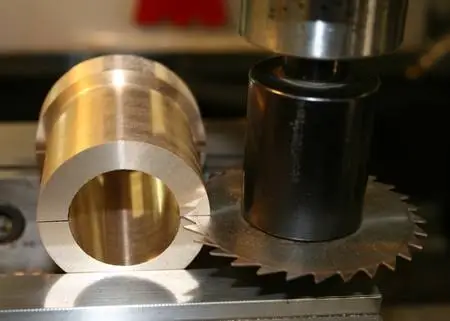
A split bearing bush, also called a split plain bearing, split sleeve bearing, bearing shell, split journal bearing, or split bearing bush, is made from two or more fitted shell halves that surround a rotating shaft or journal. The split form allows the bearing to be installed, inspected, scraped, replaced, or adjusted without removing a large shaft or dismantling an entire machine. It is common in turbines, generators, compressors, engines, gearboxes, rolling-mill drives, pumps, marine machinery, and large industrial transmissions.
The split line is only one part of the design. Reliable operation depends on the shell backing, babbitt or bronze sliding layer, oil holes, grooves, reliefs, crush, housing fit, journal surface, radial and axial clearance, alignment, oil-film formation, load direction, temperature, contamination, and assembly procedure. This article organizes those factors into a technical basis for SEO content and a credible supplier inquiry.
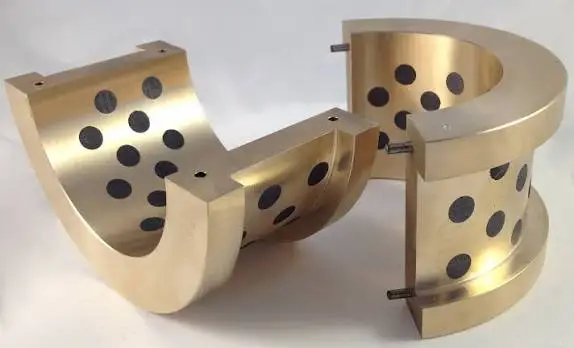
Table of Contents
1.What a Split Bearing Bush Is and Why the Split Line Exists
A split bearing bush supports a journal through a conformal sliding surface made from replaceable shell halves. The shell can contain a steel backing, a bronze intermediate layer, a white-metal or babbitt lining, an aluminum bearing alloy, a polymer layer, or a specialized solid-lubricant surface. The halves are located by the housing and joint faces; correct crush prevents movement while the installed bore provides the intended running clearance.
In a large hydrodynamic split bearing, oil enters through a radial hole, axial or circumferential groove, pocket, or controlled distribution passage. The shaft drags oil into the converging clearance to form a pressure-generating film. Groove location matters: a groove in the loaded zone can interrupt pressure development, while an incorrectly sized hole can weaken the shell or disturb oil flow. ISO 12128 addresses lubrication holes, grooves, and pockets for bearing bushes; ISO 7902 addresses calculation of hydrodynamic plain journal bearings under steady-state conditions.
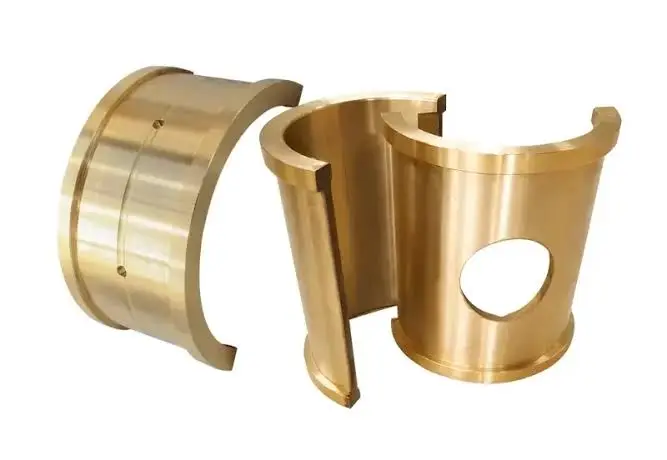
Split shell materials are selected by duty. Steel-backed babbitt shells support high-speed hydrodynamic operation when oil-film separation is maintained. Bronze or aluminum alloy shells can provide strength and embedability for industrial machines. Multi-layer shells combine a strong backing, a bearing alloy, and sometimes a surface overlay. The correct layer system depends on load, speed, shaft material, oil cleanliness, fatigue, cavitation, temperature, and repair practice.
Bushing system | How lubricity is supplied | Typical strength | Primary limitation to check |
Oil-impregnated sintered bronze | Oil stored in interconnected porosity | Economical, compact, suitable for many moderate-duty rotary uses | Oil compatibility, temperature, moisture, load and speed limit |
PTFE metal-polymer composite | Low-friction PTFE transfer layer on metal backing | Dry-running capability, thin wall, good mixed-motion use | PV, heat rejection, counterface finish, liner thickness |
POM composite bushing | Engineered polymer overlay, often grease-assisted when allowed | Good wear resistance and practical assembly performance | Temperature, lubrication condition, swelling and chemicals |
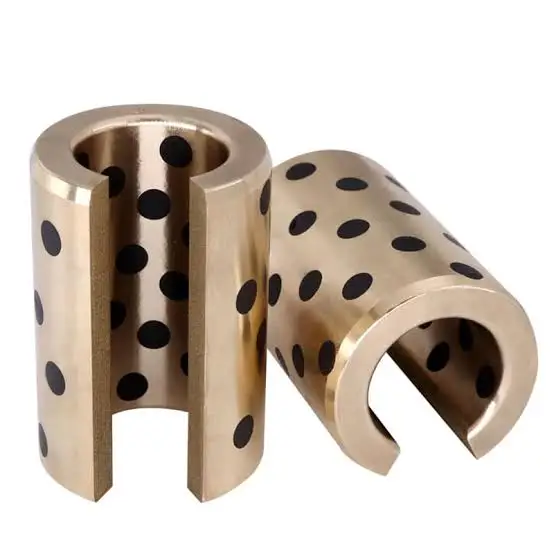
Graphite-plugged bronze | Solid lubricant plugs embedded in bronze body | High-load, slow-speed or inaccessible-lubrication applications | Plug layout, shaft condition, startup friction, machining design |
Solid-lubricant dispersed metal or polymer | Graphite/PTFE/MoS2 or other solid phase in matrix | Tailored dry-running and corrosion options | Matrix strength, temperature, contamination and true PV duty |
2.Bearing Shell Metallurgy: Steel Back, Bronze, Babbitt, and Composite Layers
Plain-bearing performance is governed by tribology: the interaction of friction, wear, contact pressure, speed, heat, and lubrication. The PV value, pressure multiplied by sliding velocity, is often used as a screening parameter for bushing materials. It is useful but incomplete. A low average PV can still fail if the contact has edge loading, shock, poor heat removal, shaft roughness, contaminant ingress, high frequency reversal, long dwell under load, or a temperature that softens a polymer layer or degrades oil.
Rotation and oscillation create different risks. Continuous rotation may allow a stable transfer film or hydrodynamic contribution in some conditions. Short-stroke oscillation can repeatedly disturb the same contact zone and increase fretting or adhesive wear. Slow, high-load movement can be demanding for graphite-plugged and metal-backed bushings; fast movement can make heat dissipation and shaft finish dominant. Impact introduces local stress that a nominal pressure calculation may not reveal.
Temperature must be considered at the bearing interface, not only in the surrounding room. Frictional heat, hot shafts, nearby welding, radiant heat, poor housing conduction, and duty cycle all raise the interface temperature. Thermal expansion changes clearance. Oil viscosity changes. Polymer strength and creep response change. A data sheet maximum temperature should be treated as an application boundary that requires derating with load, speed, and heat removal, not as an automatic approval for every condition below that number.
A reliable duty description lists the maximum and normal radial load, axial load, bore diameter, projected area, sliding speed, travel angle or stroke, cycle rate, dwell time, operating temperature, peak temperature, lubrication availability, shaft material, hardness, roughness, and environment. These details are more valuable than an isolated request for a self-lubricating bushing price.
3.Why Split Bearings Serve Large Shafts and Serviceable Machinery
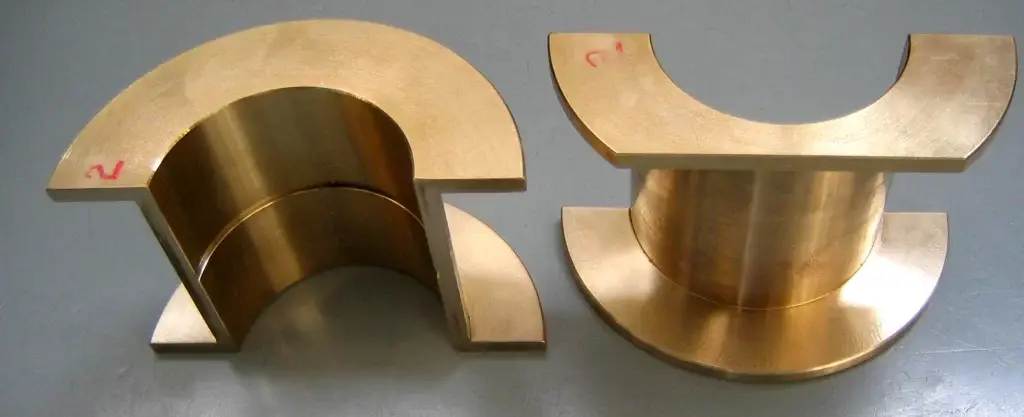
The split form is valuable because the shell halves can be fitted around a crankshaft, turbine journal, generator rotor or gearbox shaft without removing the shaft. Large bearings may be white-metal lined and then finish-bored, scraped, or blue-checked in the housing. The joint faces, locating tangs, back fit, wall thickness and oil features must be controlled together. A split shell is serviceable only when the two halves remain a matched geometric system.
The alloy and oil are selected together. Bronze provides corrosion resistance and useful compatibility in many environments; iron-based PM bearings can provide a different strength and cost balance. Lubricant selection considers viscosity, temperature, oxidation resistance, volatility, food-contact or regulatory needs, and compatibility with the surrounding atmosphere. A standard mineral oil may be unsuitable near aggressive chemicals, high temperature, vacuum, clean-room service, or food processing. Do not specify only the metal while leaving oil type undefined.
ASTM B438 identifies density ranges, minimum oil-content requirements, composition controls, and crushing-strength requirements for bronze-base PM bearings. ASTM test methods also address density, oil content, impregnation efficiency, and surface-connected porosity. These references are useful anchors for quality planning, but an OEM should still validate real shaft finish, press fit, temperature, alignment, and duty cycle. A compliant coupon does not automatically validate a complete machine assembly.
PM bushing variable | Engineering role | Failure if ignored | Verification |
Density and interconnected porosity | Balances lubricant reservoir against load-carrying structure | Low oil capacity or weak/porous bearing matrix | Density and porosity test on representative lot |
Oil content and oil type | Creates boundary lubrication and affects temperature response | Starvation, leakage, oxidation, incompatible lubricant | Oil-content method, lubricant certificate, compatibility review |
Radial crushing strength | Indicates resistance to installation and operating radial stress | Cracking during press fit or housing distortion | Agreed crushing-strength or breaking-load criterion |
Bore sizing after press fit | Maintains clearance after housing installation | Tight bore, seizure, noisy operation or accelerated wear | Housing tolerance, sizing method, final bore inspection |
4.Lubrication Holes, Grooves, Oil Film, and Thermal Balance
Composite bushings use a layered construction to separate structural support from the bearing surface. A common arrangement has a steel backing, a porous bronze interlayer, and a PTFE-based sliding layer. Other products use bronze backing or POM overlays. The thin bearing layer can offer low friction, conformability, and dry-running performance where grease supply is difficult. Its limits are strongly connected to heat flow into the housing, mating-shaft quality, edge load, creep resistance, and the material’s actual operating PV envelope.
Graphite-plugged bronze, sometimes marketed as oilless bronze bushing, uses a cast bronze body with strategically placed solid-lubricant plugs. It is common in slow-moving, heavily loaded equipment such as molds, dies, presses, construction machinery, gates, lifting equipment, and dry-running fixtures. The plug pattern, plug-to-bearing-area ratio, bronze alloy, lubrication grooves, shaft finish, housing support, and movement pattern all affect performance. A plug layout suited to long sliding travel may behave poorly in a short, high-frequency oscillation.
Solid-lubricant-dispersed materials distribute the lubricant phase through the matrix instead of locating it in visible plugs. They may be metallic, polymeric, or hybrid materials and can include graphite, PTFE, MoS2, or engineered fillers. ISO 20054 covers bearings containing dispersed solid lubricants and includes characteristics, materials, dimensions, assembly, and surface finish. Buyers should request the actual matrix and lubricant description because two products called graphite bushing can have very different strength, thermal conductivity, corrosion behavior, and machinability.
A material comparison should not reduce the decision to coefficient of friction. Published coefficients are usually test-condition values. Real wear is determined by load distribution, temperature, counterface, motion, contaminants, and time. Use friction data as a comparison input, then qualify the candidate bushing under a duty cycle that represents the application.
5.Journal, Housing, Crush, Clearance, and Alignment
The journal is a bearing component. Diameter, roundness, taper, hardness, surface finish, runout, fillet radius, coating condition and cleanliness control oil-film formation and wear. A scored or tapered journal can destroy a new shell. Before replacement, measure the journal at multiple axial and circumferential positions, compare with the repair limit, inspect fillets and confirm that the shaft is not bending the shell at one edge.
A split shell is not normally pressed into a tight interference fit like a small sleeve. Its back must seat fully in a machined housing, and the designed crush at the joint provides radial retention when the cap is torqued. Incorrect cap torque, dirt behind the shell, a damaged locating tang, joint mismatch or an out-of-round housing can close the bore or create a local high spot. Measure the installed condition, not only the free shell.
Clearance is a thermal and tribological variable. Too little clearance risks seizure when temperature rises or the housing distorts. Too much clearance permits impact, noise, poor load distribution, and edge wear. Lubrication grooves, if used, must have a purpose: external grease distribution, contaminant escape, or thermal behavior. Do not add grooves to a dry-running liner merely because a greased bronze design used them; grooves can reduce bearing area and disrupt the intended layer.
Installation quality should be audited with go/no-go or measured bore checks, visual inspection for cracking and liner damage, alignment confirmation, and a controlled run-in where appropriate. Hammering directly on a thin bushing edge, forcing a shaft through a distorted bore, or machining through a functional liner can destroy the self-lubricating mechanism before service begins.
6.Installation, Scraping, Measurement, and Commissioning
Environmental conditions select materials as strongly as nominal load. Water washdown, salt spray, chemicals, abrasive dust, metal chips, food-contact requirements, vacuum, outdoor ultraviolet exposure, radiation, or marine immersion can eliminate otherwise attractive bushing options. Bronze may suit many corrosive environments but not every chemical. Steel backing needs protection when corrosion is possible. Some polymers absorb fluids or swell. Oil-impregnated materials need lubricant compatibility. Solid lubricants can be affected by humidity, counterface chemistry, and particulate contamination.
Contamination changes the wear mechanism. Abrasive particles can turn a sliding interface into a grinding system; fibers or dirt can pack into clearance; metal debris can score the shaft and break transfer films. Consider seals, wipers, labyrinths, shields, purge arrangements, shaft coatings, and the accessibility of inspection. A self-lubricating bearing can reduce the need for periodic grease, but it cannot replace contamination control in a dirty machine.
Compliance should be specified by application, not by generic statements. The buyer may need RoHS/REACH declarations, material traceability, food-contact support, smoke/toxicity requirements, export documentation, or restricted-substance information. For safety-critical machinery, request lot traceability, PPAP or first-article documentation, control plans, and defined change-notification procedures. These requirements can influence powder, oil, resin, plating, and packaging choices.
7.Environment, Failure Analysis, and Planned Maintenance
Self-lubricating bushing failure is often a system signal. Uniform wear can indicate a consumable bearing approaching its planned life. Local wear at one edge may show misalignment, shaft deflection, housing distortion, or insufficient bearing length. Smearing can indicate overheating or adhesive wear. Cracks may result from excessive press interference, impact, poor chamfer, or a brittle material choice. Blackened oil, corrosion, debris, liner delamination, plug loss, or polished shaft tracks each point to a different investigation.
A practical failure review preserves the worn bushing, mating shaft, housing measurements, duty history, environmental observations, and installation records. Measure shaft roughness and hardness where relevant; inspect clearance, contact pattern, temperature, contamination, and alignment. Compare the actual load and stroke against the original assumption. Replacing the bushing with a more expensive grade without correcting shaft scoring or a distorted housing normally repeats the failure.
Self-lubricating does not mean inspection-free. Maintenance plans should include periodic checks for play, noise, temperature, vibration, contamination, shaft condition, and mounting integrity. Where grease is prohibited or inaccessible, condition monitoring is especially valuable because the bearing cannot be rescued by increasing relubrication frequency. A defined replacement criterion protects the mating shaft and avoids a small bushing wear issue becoming a large assembly repair.
8.Selection, Testing, Lifecycle Cost, and Supplier Qualification
A disciplined selection workflow has five stages: describe motion and load; define temperature and environment; select candidate material families; design the shaft, housing, clearance, and installation; then validate with representative testing. Start with design limits rather than a catalogue cross-reference. A part number may fit the nominal bore and outside diameter while remaining unsuitable for the true movement pattern, shock load, or chemical exposure.
Useful commercial KPIs are total installed cost, expected service life, unplanned downtime avoided, shaft protection, assembly time, inspection burden, supply continuity, lot consistency, and field-failure rate. Unit price matters, but it is rarely the dominant cost when a bushing is installed inside a difficult-to-access actuator, articulated arm, die set, pump, conveyor, or outdoor structure. Ask the supplier to state the assumed duty, not only its material designation.
For qualification, agree on a sample plan, drawing revision, material certificate, dimensional report, bore and wall checks, hardness or density where relevant, oil-content or porosity results for PM bearings, visual liner or plug inspection, and traceability. Test under realistic load, speed, oscillation, temperature, contamination, and misalignment tolerance. This makes bearing selection evidence-based and gives procurement teams a transparent basis for comparing manufacturers.
9.From Split Bearing Bush Data to a Technical RFQ
A high-value split-bearing RFQ includes the shaft and housing drawings, shell number and orientation, upper/lower or left/right half identification, joint details, locating tangs, back fit, installed bore, nominal and measured clearance, crush, journal material and finish, oil-hole and groove layout, radial and axial loads, speed, temperature, oil type and cleanliness, alignment data, failure history, annual demand, outage schedule and inspection documents.
Request a response that identifies bearing family, backing or matrix, lubricant mechanism, recommended shaft condition, housing fit, installed-bore expectation, clearance, maximum duty assumptions, temperature limit assumptions, test evidence, dimensional tolerance, inspection plan, packaging, traceability, lead time, MOQ, tooling requirement, and exclusions. When a supplier gives only a quoted bushing price, the buyer has not yet received enough information to judge suitability.
RFQ topic | Buyer input | Supplier response expected |
Geometry and assembly | Drawing, ID/OD/length, flange, housing, installation and final-bore requirement | Manufacturing route, tolerance, fit and calibration recommendation |
Motion and load | Radial/axial load, speed, stroke, oscillation, shock, duty cycle | Material family, PV/temperature assumptions, bearing-length and shaft guidance |
Environment | Temperature, media, dust, water, corrosion, external lubrication rule | Compatibility statement, sealing or material recommendations, limitations |
Quality and business | Annual volume, samples, certificates, traceability, delivery destination | Control plan, inspection data, MOQ, tooling, lead time and change control |
Technical inquiry: Technical inquiry: Send the drawing, shaft and housing information, motion profile, loads, temperature, environmental media, lubrication restriction, target life, annual quantity, and current failure symptom. A self-lubricating bushing manufacturer can then recommend an oil-impregnated, composite, graphite-plugged, polymer, or custom bearing solution tied to actual service conditions.
FAQ: Self-Lubricating Bushings
1. What is a self-lubricating bushing?
It is a plain bearing that provides lubricity from stored oil, a low-friction liner, embedded solid lubricant, dispersed lubricant, or an engineered polymer system without routine external lubrication in its intended duty.
2. Is a self-lubricating bushing the same as an oilless bushing?
The terms overlap in marketing, but the actual mechanism may be oil-impregnated, PTFE-lined, graphite-plugged, or solid-lubricant dispersed. Specify the material family.
3. What is an oil-impregnated bronze bushing?
It is a porous powder-metallurgy bronze bearing impregnated with lubricant. The interconnected porosity acts as an oil reservoir.
4. What is a PTFE composite bushing?
It is commonly a metal-backed plain bearing with a low-friction PTFE-based bearing layer designed for dry or marginally lubricated service within its limits.
5. What is a graphite-plugged bronze bushing?
It is a bronze bushing containing mechanically embedded graphite or other solid-lubricant plugs that transfer lubricity to the mating shaft.
6. What does PV mean for a bushing?
PV is pressure multiplied by sliding velocity. It is a useful screening value but does not replace analysis of heat, shock, alignment, shaft finish, and contamination.
7. Can a self-lubricating bushing run dry?
Some material families are designed for dry running, but permitted duty depends on load, speed, temperature, shaft, environment, and the supplier data for the exact product.
8. Do sintered bronze bushings need grease?
They are usually oil impregnated. Additional grease may be unsuitable or unnecessary unless the manufacturer and application design specifically allow it.
9. Why do oil-impregnated bushings have pores?
Controlled interconnected porosity stores and releases lubricant. It must be balanced against strength and wear resistance.
10. What shaft finish is needed?
The required hardness and roughness depend on the bushing material. Use the supplier recommendation and validate against the actual shaft coating and duty.
11. What causes bushing seizure?
Possible causes include insufficient clearance, thermal expansion, misalignment, overload, wrong material, dry friction beyond limit, contamination, shaft damage, or housing distortion.
12. Can a bushing be machined after installation?
Only if the supplier permits it. Machining can damage a thin liner, close porosity, disturb plugs, or create an unsuitable running surface.
13. How does press fit affect a bushing?
Housing interference can reduce the installed bore and change roundness. Final clearance must be calculated after assembly, not only from free-state dimensions.
14. Are self-lubricating bushes suitable for oscillation?
Many are, but short-stroke oscillation can be demanding. State stroke angle, frequency, dwell, load, and reversal behavior during selection.
15. Can they work in water or corrosive media?
Some can, but material, backing, oil, shaft, and corrosion protection must be selected for the medium. Do not assume generic water resistance.
16. What tests are important for sintered bearings?
Density, oil content, impregnation efficiency, porosity, composition, crushing strength, dimensions, and application-specific running tests are common controls.
17. What is the difference between sleeve and flange bushings?
A sleeve bushing primarily supports radial load; a flange bushing adds an axial thrust face. The flange must be sized for the actual thrust duty.
18. How should I compare bushing suppliers?
Compare material definition, assumptions, test evidence, dimensional control, traceability, shaft and housing guidance, lead time, and lifecycle cost, not unit price alone.
19. What information is needed for a bushing RFQ?
Provide drawing, dimensions, loads, motion, speed, temperature, shaft and housing details, environment, life target, quantity, and quality-document requirements.
20. When should a self-lubricating bushing be replaced?
Replace it when measured clearance, noise, temperature, wear, vibration, or inspection results reach the assembly limit before the shaft or housing is damaged.
100000+ Types of Bushings – Contact Us for Details