
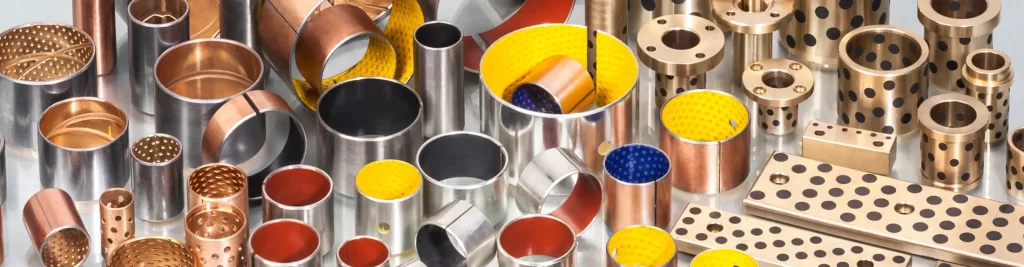
industrial machinery bearing

Self-Lubricating Bushings: The Maintenance-Free Solution for Demanding Industrial Applications
Interpretation of Bushing Knowledge

Sleeve Bearing Metallurgy: Material Architectures, Performance Optimization, and Application Engineering

Sleeve bearings, also known as plain bearings, journal bearings, bushings, or sliding bearings, represent one of the most fundamental and widely applied mechanical components in engineering history. Unlike rolling element bearings that utilize balls or rollers to separate moving parts, sleeve bearings employ a sliding action between two conforming surfaces to facilitate linear or rotational movement while reducing friction, absorbing vibration, and supporting loads. The metallurgical composition, material architecture, and manufacturing processes of sleeve bearings directly determine their performance characteristics, service life, and application suitability.

Self-Lubricating Bushings: The Maintenance-Free Solution for Demanding Industrial Applications
Interpretation of Bushing Knowledge

Self-Lubricating Bushings: The Maintenance-Free Solution for Demanding Industrial Applications

In the realm of mechanical engineering, friction remains the perennial adversary of efficiency, reliability, and longevity. Traditional bearing systems that depend on external lubricants—oils, greases, or other liquid formulations—introduce a host of operational challenges: scheduled maintenance interruptions, contamination risks, lubrication breakdown under extreme temperatures, and the ever-present possibility of dry-running failures when lubrication systems falter. Self-lubricating bushings represent a paradigm shift in plain bearing technology, offering engineers a path to maintenance-free operation, enhanced reliability, and significant cost reduction across a broad spectrum of industrial applications

Scroll to Top