
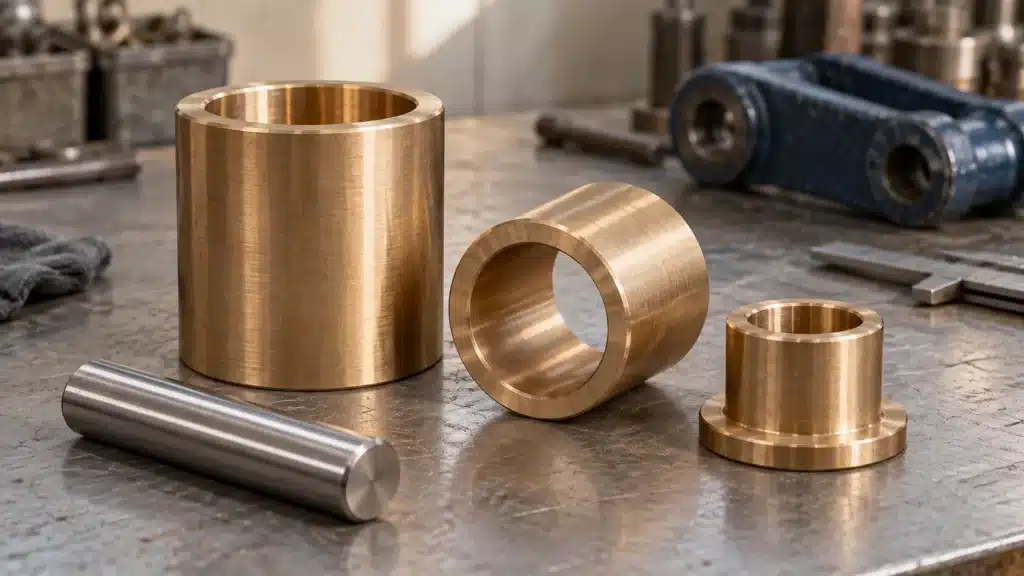
SAE 660 bronze bushing

When Should You Choose a Bronze Bushing
Interpretation of Bushing Knowledge

When Should You Choose a Bronze Bushing

I’ve been in this industry for over two decades, and I still see engineers overcomplicate this. A bronze bushing is a fairly simple part. Choosing one gets more difficult when the catalog has to stand in for a proper description of the machine. ‘Heavy load’ might mean a steady load all afternoon, or a sharp impact every few seconds. Those aren’t the same enquiry.

Take lubrication. A grease fitting on the drawing looks straightforward. Put the joint behind a guard, then put another assembly in front of the guard, and servicing it becomes a different job. Or take the load: the figure during steady running may tell you very little about the impact when the machine jams.

Here are eight reasons to put bronze on the shortlist, with a few details to settle before ordering.
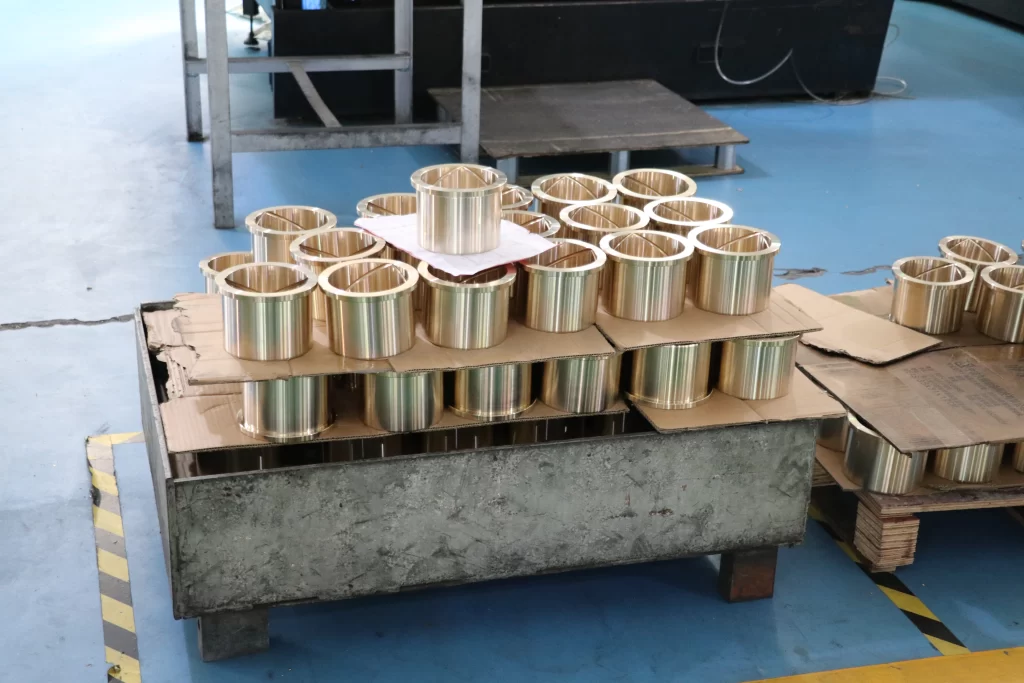
The Bronze Bushing
Interpretation of Bushing Knowledge

Flanged Bronze Bushing Metallurgy: Engineering the Bearing Surface That Carries Both Load and Thrust

A flanged bronze bushing is a deceptively compact tribological component. Its cylindrical wall supports radial load, while the integral flange locates the assembly and accepts axial thrust. In a pump, hydraulic cylinder, agricultural pivot, construction machine, gear reducer, marine mechanism, or heavy-duty OEM assembly, that two-direction role makes alloy selection and manufacturing control consequential. The best bushing is not simply the hardest bronze or the lowest-priced sleeve: it is the material, geometry, lubrication arrangement, shaft condition, clearance, and inspection plan that work together under the actual duty cycle.

Scroll to Top