
Recent Posts
When Should You Choose a Bronze Bushing
Introduction
I’ve been in this industry for over two decades, and I still see engineers overcomplicate this. A bronze bushing is a fairly simple part. Choosing one gets more difficult when the catalog has to stand in for a proper description of the machine. ‘Heavy load’ might mean a steady load all afternoon, or a sharp impact every few seconds. Those aren’t the same enquiry.Take lubrication. A grease fitting on the drawing looks straightforward. Put the joint behind a guard, then put another assembly in front of the guard, and servicing it becomes a different job. Or take the load: the figure during steady running may tell you very little about the impact when the machine jams.Here are eight reasons to put bronze on the shortlist, with a few details to settle before ordering.
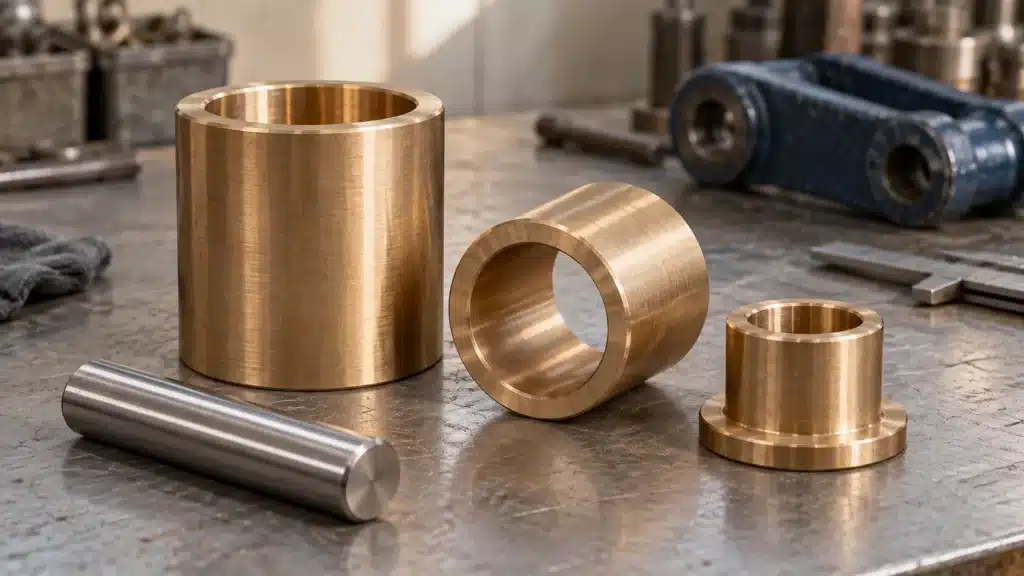
Table of Contents
1 Heavy loads and moderate speeds
Think of a pin in a loaded linkage. It may turn through only a small angle, then sit still until the next cycle. A bronze sleeve is worth looking at for that kind of joint: there is plenty of contact area along its length, and the wall can fit into a fairly compact housing.
Continuous rotation brings another possibility. Oil carried round by the journal enters a converging gap and develops pressure. Properly designed, the bearing supports its load on that oil film. Engineers call this hydrodynamic operation. Clearance and oil viscosity are part of the design calculation; the bronze on its own doesn’t produce the effect.
The start of the cycle is another matter. So is a reversal. Don’t use the steady-running condition to describe everything the joint will experience. And don’t dismiss a rolling bearing simply because there is shock loading; plenty of heavy machines use them successfully.
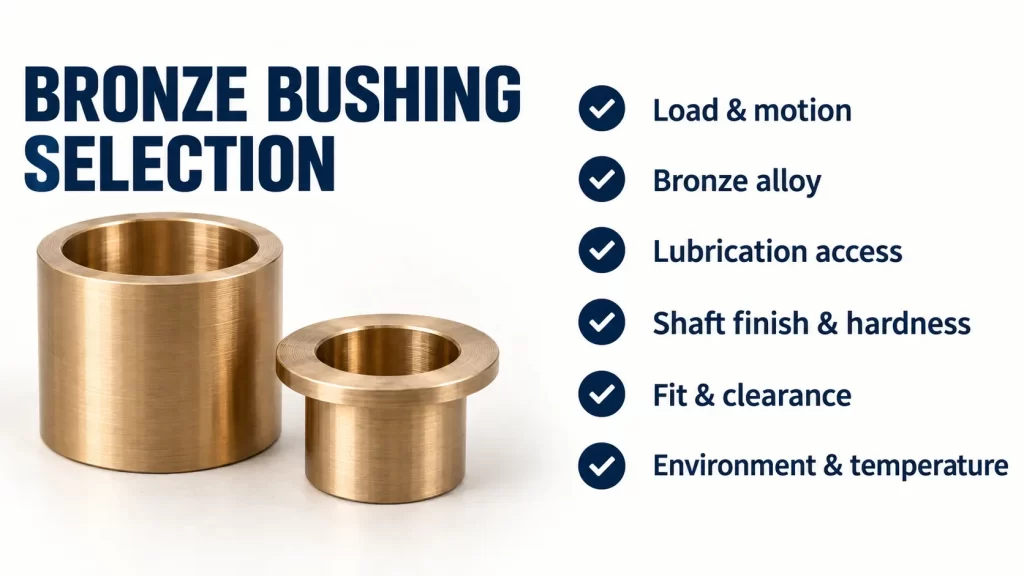
MYWAY’s C93200 / SAE 660 cast bronze bushings are a starting point for general-purpose work. C93200 contains 81–85% copper and 6.3–7.5% tin, along with lead, zinc and controlled minor elements. We make sleeve, flanged and custom forms. For a severe impact load, ask us to review the alloy as well as the dimensions.
2 When adding grease is difficult
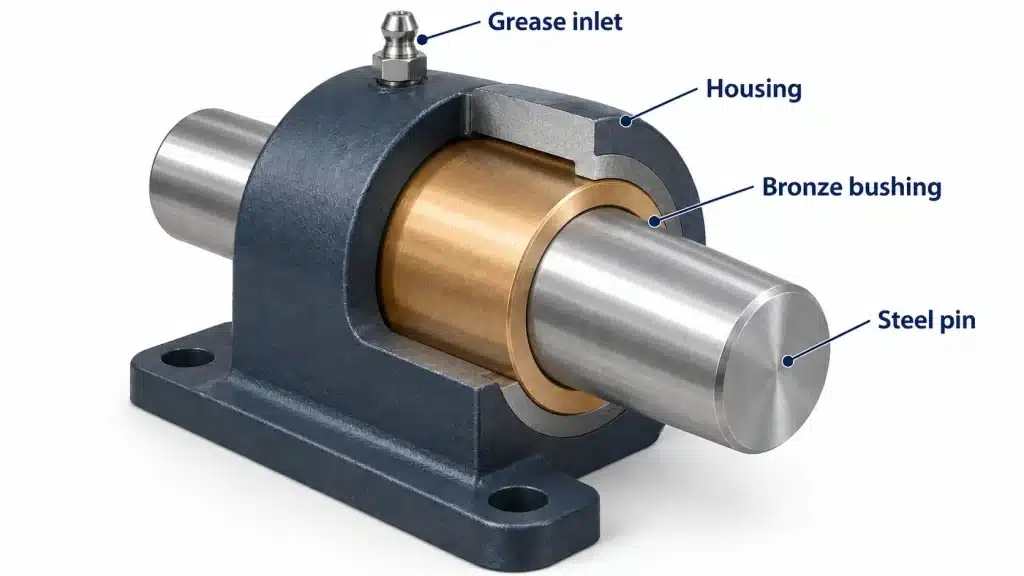
You can’t always get someone to the bearing with a grease gun. For a small assembly that will rarely be opened, I’d look at an oil-impregnated sleeve early in the design.
There is a reason this bronze is porous. The powder is compacted, then bonded by heating without turning it into a fully dense casting. Oil fills the connected spaces left between the particles. Those spaces provide the lubricant reservoir inside the part.
Consider the two bearings inside a little fan motor. Getting to them could mean dismantling most of the product. If the impregnating oil and the bearing material suit the duty, the manufacturer can dispense with that regular lubrication visit. The same reasoning applies to other compact motor-driven mechanisms.
The oil still needs to suit the operating temperature and speed. It is a stored supply, not an unlimited one. MYWAY offers sintered bronze options including CuSn10, SAE 841 and SINT A51 designations. Include the oil requirements when you send the drawing; they belong in the specification too.
3 Dust around the bearing
A worn shaft often tells you more than the catalog does. If the surface is scored, look for where the grit entered the joint. Putting in a new bushing without dealing with that entry point leaves the same problem waiting for the replacement.
Some softer bearing bronzes can embed small particles in the sliding surface. This can help protect the shaft. It isn’t a matter of all bronze “swallowing” dust through microscopic pores: particle embedment and the pore network used to store oil are different features.
But if it’s extremely dusty, porous sintered bushings can get clogged. A solid bronze or graphite-inlaid design may be worth considering, together with better sealing. The bushing itself does not seal the joint, and abrasive dirt can damage either design.
We supply both solid bronze and bronze with solid lubricant inserts. C86300 manganese bronze is a high-strength option, but it doesn’t have the same particle-embedding behavior as a soft leaded bronze. Tell us what the joint is exposed to, including the dirt that reaches it during cleaning and servicing.
4 Moisture and chemical exposure
“Bronze doesn’t rust” is easy to say and easy to misunderstand. It doesn’t form iron rust. Corrosion is a wider subject.
For a marine installation, an appropriate aluminum bronze grade may be a sensible candidate. For a chemical plant, the name of the chemical and its concentration are essential. A part splashed occasionally during cleaning is also in a different situation from one permanently immersed in the same liquid.
You may see a patina on exposed bronze. I wouldn’t accept that color change as evidence that everything underneath is sound. The important area is often hidden inside the bore, and the adjacent metal may affect corrosion too. In some environments the film helps protect the bronze; in others, the damage needs closer investigation.
MYWAY offers manganese bronze and aluminum bronze bushings. Send the exposure details with the load and temperature information so the material choice can be reviewed together.
5 Keeping the noise down
If you’ve ever stood next to a machine with a bad bearing, you know the sound. Squealing, knocking, rattling. Before choosing a replacement, find out which of those noises you’re dealing with.
A bronze sleeve has no rolling elements or cage. That removes some possible sources of noise, and oil-impregnated sleeves can work well in small motors and fans. You still need the right fit. Too much clearance may let the shaft knock; too little can make the assembly run hot. Take away the lubricant or scratch the running surface and a sleeve can make plenty of noise.
An appliance intended for a quiet room needs a listening test as a complete assembly. Listen through startup and shutdown as well as at normal speed. A material substitution may help, but it won’t correct an unbalanced rotor.
On a motor or fan enquiry, tell MYWAY how the noise will be assessed. A decibel limit, a test speed and the mating shaft drawing are much more useful than ‘quiet operation’ on its own.
6 A production run large enough to justify tooling
The production quantity can change the answer. With a sintered part, the pressing tool does much of the shaping before the part reaches a finishing operation. There may be less material to cut away and less machining time than with a part made from solid stock.
There is still a tool to pay for. There may also be sizing, finishing and inspection work after sintering. Put fifty pieces on one quotation and fifty thousand on another, and the tooling cost lands very differently on each piece.
That is why a settled drawing and a repeat order make such a difference to the calculation. If dimensions are still changing between prototypes, machining can avoid committing to tooling too early.
MYWAY has more than 2,000 molds and carries out sintering in-house. Our quality-system certifications include ISO 9001 and IATF 16949. If you’re comparing our quote with another, look at what’s included. A cheaper part made to a looser tolerance isn’t a like-for-like price.
7 An expensive shaft and a replaceable sleeve
Price a replacement shaft before deciding how much a bushing is worth. On a large assembly, the shaft may be expensive to make and awkward to remove. Having a sleeve that can be replaced during a planned shutdown is useful even when that sleeve costs a little more.
With a suitable grade and a harder steel shaft, the bronze can take much of the wear. The shaft doesn’t become immune to damage, though. Grit can still cut it, and a joint left running loose or short of lubricant can damage both parts. Nor are all bronze grades equally soft.
Once the old sleeve is out, measure the shaft instead of assuming it is still at its original diameter. Scoring or ovality may explain why a replacement remains loose. The maintenance instructions should give the fitter an allowable clearance, rather than leaving that decision until the machine is already apart.
For a custom MYWAY bushing, provide the shaft material and finish together with the installed clearance you need. The bore measurement before pressing is only part of that job.
8 A size that the catalog cannot supply
Sometimes you’re working around an existing housing and shaft. Changing either one would cost more than making a special bushing. An unusual flange or a lubricant groove in a particular position can be enough to make a standard part unsuitable.
Machined bronze is useful here. With dense bronze stock, those features can be cut to the drawing. A special pressing tool may be hard to justify for three replacement bushes or a prototype whose dimensions haven’t settled yet.
C93200, C86300 and C95400 are different material choices. Write out the required grade and standard, and say which certificate must accompany the order. Sintered parts can have material documentation too; certification isn’t exclusive to machining.
We handle custom bronze bushings through casting, CNC finishing and inspection. A cropped sketch of the bush may leave out the feature that causes trouble during installation. Give us the relevant mating dimensions too, and say whether the fitter has access to both ends of the housing.
Questions buyers ask about bronze bushings
What the supplier means by a bronze bearing
The word ‘bearing’ doesn’t pin down the shape. A sleeve around a pin is a bushing. A bronze thrust washer or a sliding plate is also a plain-bearing component, but it does a different job. The broader word “bearing” covers all of them.
Running without added lubricant
A plain sleeve machined from solid bronze isn’t automatically ready to run dry. Usually, something has to deliver oil or grease to it. The oil may already be inside a sintered sleeve; in a plugged bearing, solid-lubricant inserts have a different job at the contact. Before deleting the grease fitting, get the lubrication instructions for the exact grade, including what is required at installation.
Choosing the manufacturing route
I’d price both routes if the quantity or geometry leaves the decision open. A standard sintered sleeve may already do the job. A special machined part may avoid tooling costs on a small order. Put the finishing, oil and paperwork requirements into both enquiries so that neither quotation leaves necessary work for somebody else.
Checking the working load
“How much load can bronze take?” needs more information before it has a useful answer. For example, a 10 kN radial load on a 20 mm bore with 25 mm of effective bearing length gives a nominal projected pressure of 20 N/mm². That calculation still says nothing about the acceptable speed. Pressure and sliding velocity together give PV, which must be compared with the selected product’s rating. This is a calculation example, not a load recommendation. The duty cycle and any impact load still need to be supplied.
Installing the bushing
Start with the specified housing fit. Don’t carry an interference value from a small, thick sleeve over to a large, thin one. The housing material makes a difference as well. Before pressing, remove burrs and dirt, orient the oil holes, and support the part with the specified tooling. Thermal assembly needs its own agreed temperature and procedure; there is no universal heating temperature for every bronze bush and housing.
Bore size after pressing
Yes, pressing a bush into its housing can reduce the bore. There isn’t a dependable percentage that applies to every assembly. The interference and the stiffness of the housing and bush affect the result. Inspect the bore in its installed condition. Finishing a solid sleeve in place may be part of the drawing requirements. With porous bronze, careless reaming can smear the openings that are supposed to deliver oil, so get the machining instructions first.
Choosing oil or grease
Oil is not an exceptional choice for a bronze journal bearing. A slowly moving pivot and a continuously rotating journal may have quite different lubrication arrangements. Begin with the equipment specification, including the delivery method. If there isn’t one, establish it from the duty before commissioning the joint. That includes keeping the lubricant clean.
Recognizing a worn bush
A clearance measurement against the machine’s stated limit is more useful than waiting for an obvious rattle. A new knock, heat rise or visible scoring is reason to inspect earlier. The shaft belongs in that inspection too. A damaged mating surface can shorten the next bushing’s life as soon as the machine is restarted.
Working with MYWAY
At MYWAY, we have been making bushings since 2005. Our 35,000 m² production facility supports work from casting and sintering through to CNC finishing, and we supply customers in more than 40 countries.
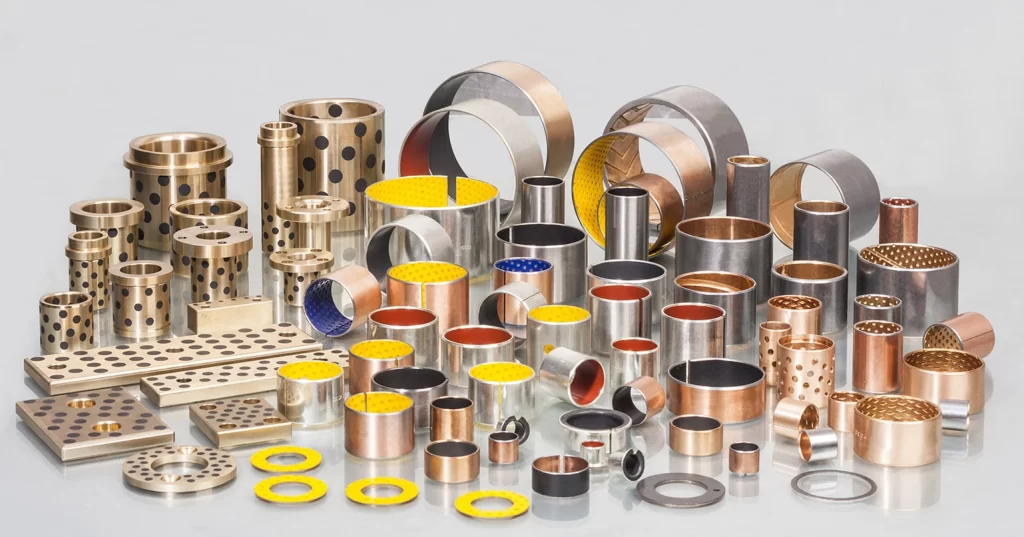
Send us the drawing and the order quantity for a new part. If you’re replacing a failed bush, a photograph of the worn bore and shaft is useful as well. Tell us how it was lubricated and what the machine was doing when the problem appeared. We can then discuss a cast, sintered, wrapped or graphite-inlaid bronze option, or consider a composite or bimetallic part if the application calls for it.
100000+ Types of Bushings – Contact Us for Details