SF-1 Bushing

What “Self-Lubricating” Actually Means (And Why Half the Industry Uses the Term Wrong)
Interpretation of Bushing Knowledge

What “Self-Lubricating” Actually Means (And Why Half the Industry Uses the Term Wrong)

Let me be blunt: “self-lubricating” is one of those phrases that sounds great in a brochure and causes headaches on the factory floor. It does not mean the bushing never wears. It does not mean you can ignore load, speed, or shaft finish. What it really means is that the lubricant is already inside the material — PTFE, graphite, oil trapped in pores — and it gets released while the thing runs. This article breaks down what that looks like in real life, where self-lubricating bushings win, where they fail, and how MYWAY’s eight core bushing lines solve specific problems. If you spec bushings for a living, this is the no-BS version.
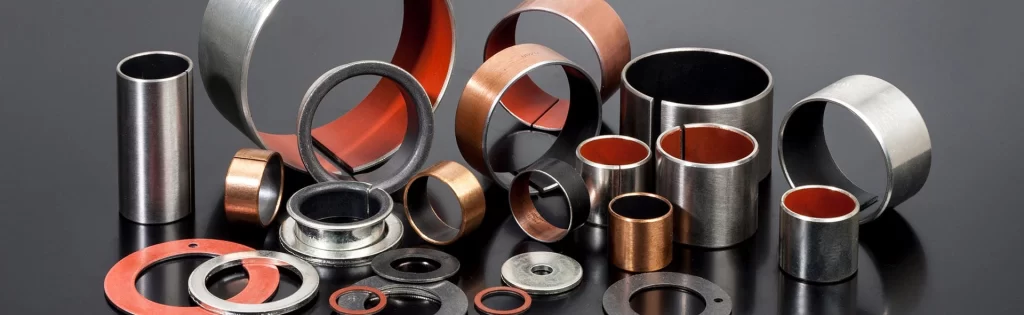
Oil‑Free Bushings – Core Performance, Applications, and the MYWAY Solution
Interpretation of Bushing Knowledge

Beyond Conventional Constraints: The DU Bushing Advantage in High-Stress Rotating Systems

Industrial rotating assemblies have long been constrained by a fundamental dilemma: achieving low friction without compromising load capacity. Traditional plain bearings require continuous lubrication, while self-lubricating alternatives often sacrifice strength for convenience. The DU bushing—a metal-polymer composite plain bearing—has emerged as the definitive solution that reconciles these opposing requirements. Unlike conventional bronze bushings that depend on external lubricants, DU-type composite bushings integrate a PTFE-based sliding layer with a porous bronze interlayer and steel backing, creating a self-lubricating system that maintains structural rigidity under extreme loads.

MYWAY DU Bushing: The Maintenance‑Free Self‑Lubricating Solution for High‑Load & Extreme‑Temperature Applications
Interpretation of Bushing Knowledge

MYWAY DU Bushing: The Maintenance‑Free Self‑Lubricating Solution for High‑Load & Extreme‑Temperature Applications

Unexpected bearing failures and frequent lubrication of hard-to-reach components lead to costly downtime and reduced productivity. A DU bushing—also known as a dry, self-lubricating, or oil‑free bushing—eliminates these issues. Engineered for maintenance‑free operation, it resists contamination and prevents unexpected failures.

When combined with the manufacturing precision of Zhejiang MYWAY Co., Ltd., DU bushings deliver reliable performance at a competitive cost.

This guide explains what a DU bushing is, how it works, its key applications, and why MYWAY DU Bushings are the preferred choice for demanding industrial and automotive environments.

DU Bearings: Self-Lubricating Technology That Transforms Industrial Performance
Self lubricating bushings

DU Bearings: Self-Lubricating Technology That Transforms Industrial Performance

Introduction: Why a Tiny Component Matters More Than You Think
Have you ever wondered how heavy machinery keeps running smoothly year after year without constant greasing? Or how your car’s suspension absorbs bumps silently without lubrication fittings everywhere? The answer often lies in a small but ingeniously engineered component: the DU bearing (also called DU bushing, self-lubricating bearing, or composite plain bearing).

Scroll to Top