
Recent Posts
The Metallurgical Engineering of Bronze Sleeve Bearings: Alloy Selection, Load Dynamics, and Industrial Application
Introduction
Bronze sleeve bearings, classified as plain bearings or journal bearings, constitute a foundational component within mechanical engineering, providing a critical interface for rotating or linear motion between a shaft and a housing. Functioning as bushings, these components leverage the inherent tribological advantages of copper-based alloys to reduce friction, manage heat dissipation, and absorb operational loads. The extensive utility of bronze sleeve bearings, from automotive powertrains and heavy construction equipment to precision machine tools and marine propulsion systems, is attributable to the versatile metallurgical properties of bronze. Unlike rolling element bearings that rely on point contact, sleeve bearings employ a larger surface contact area, enabling them to support significant radial loads, accommodate shock loading, and offer resistance to mechanical wear
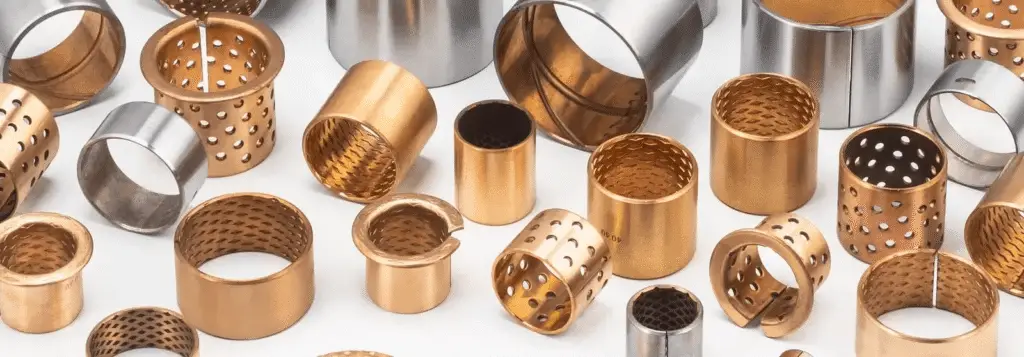
Table of Contents
1. The Core Metallurgy of Bronze Alloys for Sleeve Bearings
The performance of a bronze sleeve bearing is fundamentally determined by its chemical composition and the resulting microstructure. The selection of the specific bronze alloy is a critical metallurgical decision that dictates the component’s load capacity, wear resistance, corrosion resistance, and operational lifespan. The primary alloying elements, including tin (Sn), lead (Pb), zinc (Zn), and aluminum (Al), each contribute distinct and often trade-off properties to the final product. For instance, while tin significantly increases hardness and wear resistance, lead enhances machinability and provides solid lubrication properties. The microstructural phases, such as the alpha phase in tin bronzes or the various intermetallic compounds in aluminum bronzes, further influence hardness, ductility, and fatigue strength, determining suitability for specific operating conditions.
1.1. Tin Bronzes (SAE 40, C90500, C90700)
Tin bronzes, primarily alloyed with copper and tin, are a preferred material for high-load bearing applications. These alloys exhibit high strength, excellent hardness, and significant ductility, allowing them to withstand severe pounding and high dynamic loads. The presence of tin enhances the tensile strength (typically ranging from 40,000 to 55,000 psi) and provides substantial resistance to wear. However, a key limitation is their lower conformability compared to leaded bronzes; they are less forgiving of minor misalignments or shaft deflection. These alloys are also notably corrosion-resistant in marine environments and brines, making them suitable for naval and offshore applications. Typical applications include high-load gear reducers, large industrial gearboxes, and heavy-duty automotive components.
1.2. Leaded Tin Bronzes (SAE 64, SAE 660/C93200, C92200)
Leaded tin bronzes are among the most widely used materials for general-purpose sleeve bearings due to their balanced mechanical and tribological properties. The addition of lead (Pb) to the tin-bronze matrix enhances machinability and provides an inherent anti-friction property that is critical for boundary and mixed-film lubrication conditions. Lead acts as a solid lubricant, smearing on the bearing surface to prevent welding and seizing during metal-to-metal contact events. The SAE 660 (C93200) standard, with a typical composition of 83% Cu, 7% Sn, 7% Pb, and 3% Zn, is a workhorse in the industry. This composition is notable for its ability to accommodate shock loads and resist galling, making it ideal for pumps, electric motors, conveyors, and moderate-to-heavy industrial machinery. The zinc content in some leaded tin bronzes aids in deoxidization and provides cost-effective strengthening.
1.3. High-Leaded Tin Bronzes (SAE 65, C93700, C93800, C94300)
In applications where boundary lubrication or dry-running conditions are possible, high-leaded tin bronzes, containing more than 10% lead, are often employed. These alloys have reduced mechanical strength and hardness compared to standard tin or aluminum bronzes. However, their exceptional anti-friction characteristics, superior seizure resistance, and high machinability are paramount. They are often selected for applications with intermittent operation, high start-stop frequencies, or where lubrication is minimal. Their ability to embed wear debris and conform to shaft irregularities protects the more expensive shaft component, a critical factor for operations in dusty or contaminated environments. These alloys are found in automotive engine components, low-speed high-load equipment, and some food processing machinery.
1.4. Aluminum Bronzes (SAE 430, C95400, C95500)
Aluminum bronzes are recognized as the strongest of the copper-based bearing alloys. The addition of aluminum (Al), along with iron (Fe) and nickel (Ni), to the copper matrix results in a material with high strength, excellent corrosion resistance (particularly in seawater and acidic environments), and the ability to maintain mechanical properties at elevated temperatures. These alloys offer superior wear resistance and high fatigue strength, making them suitable for the most demanding heavy-duty applications, such as high-load hydraulic systems, aircraft landing gear components, and rolling mill equipment. The higher cost of aluminum bronzes is justified by their longevity and robustness in extreme conditions, including temperatures up to 400°F and high-impact loads.
1.5. Specialized Phosphor Bronzes (C51100, CuSn8P)
Phosphor bronzes, exemplified by C51100 or CuSn8P, are specialized tin bronzes that incorporate a small amount of phosphorus (P). The phosphorus acts as a deoxidizer during casting and enhances the alloy’s fluidity, wear resistance, fatigue strength, and corrosion resistance. This results in an exceptionally fine-grained microstructure with a high elastic limit and a low coefficient of friction. Phosphor bronze sleeve bearings are frequently used in applications requiring high precision, such as instrument bearings, aerospace actuators, and high-speed, high-load gearboxes where operational reliability and extended service life are required. The material is characterized by its high hardness, good machinability, and compatibility with harder steel shafts
2. Comparative Properties of Bearing Bronze Families
The selection of a specific bronze alloy requires a precise assessment of the operational environment and performance requirements. The following table systematically compares the key physical and mechanical properties of the major bearing bronze families, providing a high-level reference for material selection. The values presented represent typical ranges for specified alloys, acknowledging that final properties depend on manufacturing and casting processes
| Bronze Family | Key Alloys | Composition | Wear Resistance | Tensile Strength | Key Characteristic |
|---|---|---|---|---|---|
| Tin Bronzes | C90500, C90700 | Cu-Sn | Very High | 40,000 – 55,000 psi | High ductility, excellent anti-pounding, corrosion resistance in marine environments. |
| Leaded Tin Bronzes | C93200 (SAE 660), C92200 | Cu-Sn-Pb-Zn | High | 35,000 – 45,000 psi | Excellent machinability, good anti-friction, ideal for general machinery with mixed lubrication. |
| High-Leaded Tin Bronzes | C93700, C93800 | Cu-Sn-Pb (High) | Moderate | 25,000 – 35,000 psi | Superior anti-seizing, high embeddability, suitable for boundary lubrication and dusty environments. |
| Aluminum Bronzes | C95400, C95500 | Cu-Al-Fe-Ni | Very High | 75,000 – 100,000 psi | Highest strength, excellent corrosion resistance, good at elevated temperatures. |
| Phosphor Bronzes | C51100, CuSn8P | Cu-Sn-P | High | 45,000 – 70,000 psi | High fatigue strength, good elasticity, fine-grained structure for precision applications. |
The data in this table facilitates the initial screening of material options against operational demands such as load capacity, environmental exposure, and maintenance regimes. For example, an engineering application requiring a heavy load capacity in a corrosive marine environment would point towards an aluminum bronze (C95400) due to its high strength and corrosion resistance, while a project requiring cost-effective and easily machined components for moderate loads may favor SAE 660 (C93200) leaded tin bronze
3. Design, Structure, and Lubrication Mechanisms
The operational performance of a bronze sleeve bearing is not solely a function of its material but also of its structural design and the lubrication regime in which it operates. The design complexity can range from a simple cylindrical sleeve to a flanged bearing that can manage radial and axial loads. The manufacturing technique, whether it involves solid castings, powder metallurgy, or wrapped sheet metal, also significantly influences the bearing’s properties and application suitability.
3.1. Structural Types and Manufacturing
Sleeve bearings are broadly categorized into solid cylindrical bushings and flanged bushings. Cylindrical bearings are primarily designed to handle radial loads, while flanged versions can additionally support axial (thrust) loads through their flange face.
Cast Bronze Sleeve Bearings: These are produced via processes like sand casting, centrifugal casting, or investment casting. Centrifugal casting often produces a denser, non-porous structure with high mechanical integrity. Sand casting is cost-effective for larger components, and investment casting is used for complex geometries and precise dimensions. These bearings are robust and suitable for high-load, high-stress conditions where structural integrity is critical.
Oil-Impregnated or Sintered Bronze Bearings: These components are manufactured using powder metallurgy. The sintering process creates a porous bronze matrix of interconnected pores that are vacuum-impregnated with lubricating oil (typically SAE 20 or SAE 30). This unique structure results in a self-lubricating bearing, sometimes known as a “self-lubricating bronze sleeve bearing” or “oilite bearing.” During operation, the generated heat or pressure differential causes the oil to migrate to the surface, providing a thin lubricating film between the bearing and the shaft. When the motion stops, the oil is reabsorbed into the pores. These bearings, such as SAE 841, are maintenance-free and cost-effective, making them a good fit for electric motors, small appliances, and many high-volume standard products where relubrication is not feasible.
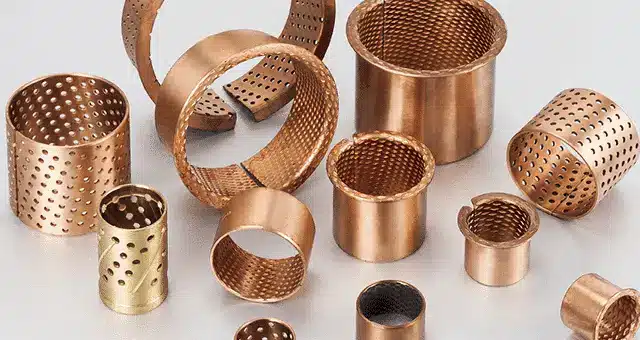
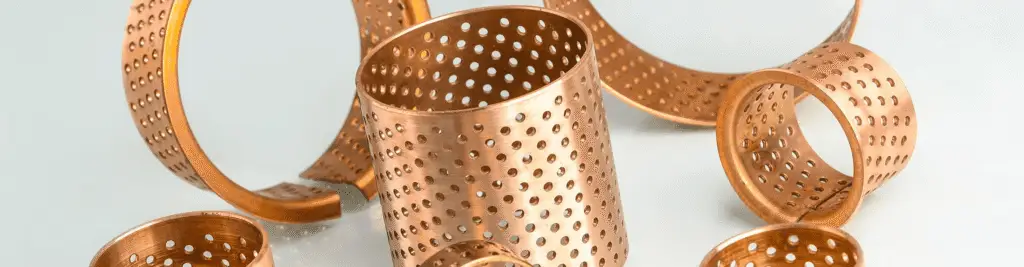
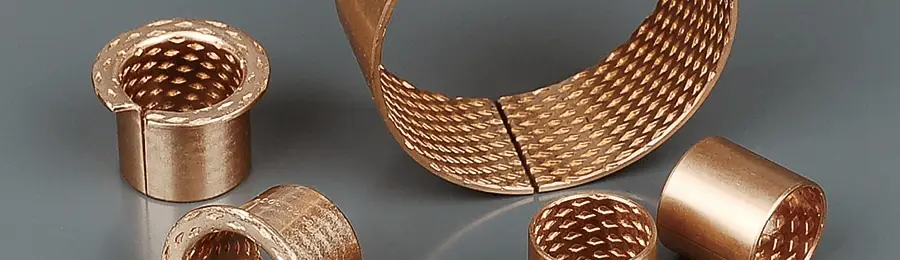
Wrapped Bronze Bushings: These components are precision-rolled from high-density copper alloy strips (like CuSn8P) into cylindrical or flanged shapes. This cold-forming method produces a hard, fine-grained surface finish ideal for sliding applications. Features like diamond or hemispherical oil pockets, lubrication grooves, or holes are often rolled into the inner surface to serve as lubricant reservoirs. They are manufactured to be cost-effective and compact while offering high load capacity and good wear resistance, serving as a replacement for traditional cast bronze bushings in many industrial applications.
3.2. Lubrication Regimes
The lubrication regime of a bronze sleeve bearing dictates its coefficient of friction, wear rate, and load capacity. These regimes are defined by the extent to which a lubricant film separates the sliding surfaces.
Hydrodynamic Lubrication (Full-Film): This is the ideal operational mode for a sleeve bearing. The relative motion between the shaft and bearing draws a continuous, pressurized film of lubricant into the space between them, completely separating the metal surfaces. In this condition, friction is governed by the lubricant’s internal shear, resulting in very low coefficients of friction. As there is no metal-to-metal contact, wear is effectively zero, and bearing life is theoretically infinite. This mode requires a continuous supply of lubricant, a shaft velocity sufficient to build the hydrodynamic wedge (usually above 25 surface feet per minute), and a suitable lubricant viscosity.
Boundary Lubrication: This is the most severe operational mode. In boundary lubrication, the bearing surfaces are in intermittent contact, with only a very thin molecular layer of lubricant separating them. Friction and wear are governed by the properties of the bearing and shaft materials, as well as any chemical additives in the lubricant. It is common in applications with low speeds (below 10 surface feet per minute), oscillating motion, or where lubrication is intermittent (e.g., periodic greasing or hand oiling). Bronze alloys, particularly high-leaded tin bronzes, are specifically selected for these conditions due to their low inherent friction and good anti-seizing properties.
Mixed-Film Lubrication: This is a transitional state between hydrodynamic and boundary lubrication. Part of the bearing’s surface is separated by a hydrodynamic oil film, while other areas are in boundary contact. It is the most common operational mode in many real-world applications. Material selection must be robust enough to survive the boundary contact events while the hydrodynamic film is forming
4. Key Material Properties for Bearing Performance
Several key material properties are critical for the successful metallurgical design of a bronze sleeve bearing. These properties are not independent but are often interdependent, requiring careful optimization for the specific application.
Wear Resistance: The capacity of a material to withstand the progressive loss of material due to mechanical action. For bronze sleeve bearings, wear resistance is directly linked to the alloy’s hardness and the presence of hard intermetallic phases. Tin and aluminum bronzes exhibit higher wear resistance compared to leaded bronzes.
Load Capacity (PV Rating): The PV (Pressure-Velocity) rating is a crucial performance metric that quantifies the allowable combination of applied load (P) and sliding velocity (V) a bearing can withstand before experiencing excessive wear or seizure. This is determined by the material’s ability to dissipate generated frictional heat. For instance, an SAE 660 cast bronze sleeve bearing has a maximum PV rating of 75,000. This parameter is essential for sizing and selecting bearings for a specific application.
Conformability and Embeddability: These are critical for the long-term reliability of a bearing. Conformability is the ability of the bearing material to yield slightly to compensate for minor shaft misalignments or deflections, preventing concentrated edge-loading. Embeddability is the ability to absorb small, hard particles of debris into the bearing surface, preventing them from scoring the softer journal. Leaded tin bronzes excel in both these areas, protecting the more expensive shaft from damage.
Fatigue Strength: The ability of a material to withstand a high number of cyclic loads without failing due to fatigue. This is a crucial requirement for bearings in high-speed or dynamically loaded applications. Aluminum bronzes and phosphor bronzes are known for their high fatigue strength, making them appropriate for such conditions
5. Diverse Industrial Applications
The versatility of bronze sleeve bearings is evident in their extensive use across all major industrial sectors, including construction, agriculture, energy, automotive, and aerospace. The specific demands of each application guide the selection of alloy and design type.
Construction Machinery: Heavy machinery, including excavators, loaders, bulldozers, and cranes, relies on bronze sleeve bearings at critical pivot points. These components must withstand high shock loads, exposure to abrasive contaminants (mud and sand), and frequent articulation. Applications include:
Track Joints and Steering Pins: The bearings in track wheels and steering joints require wear-resistant bushings to handle constant articulation and high loads. Types like solid lubricated bushings (e.g., JDB) and bimetallic bushings are often employed for their long service life.
Pivot and Bucket Hinges: Bronze sleeve bearings, such as FB090 bushings and self-lubricating variants, are used to manage high wear and frequent lifting operations in bucket linkages and arm joints.
Excavator and Crane Arm Pins: These applications benefit from self-lubricating bronze bearings (SF-1, JF) that offer simple installation and resistance to wear from dirt and sand.
Agriculture and Forestry: Agricultural equipment, including harvesters, tractors, and forestry machinery, operates in harsh, high-contamination environments. The bearings in these machines must be robust, resistant to corrosion from fertilizers and moisture, and tolerant of intermittent lubrication. Wrapped bronze bushings are often specified due to their ability to handle these conditions while maintaining cost-effectiveness.
Pumps, Motors, and Compressors: This is a classic application area for bronze sleeve bearings. They are used to support shafts in centrifugal pumps, gear pumps, hydraulic motors, and air compressors. These bearings are often designed to operate in a hydrodynamic or mixed-film lubrication regime, supported by the pumped fluid or dedicated oil systems. SAE 660 cast bronze bearings are particularly common for this due to their good machinability and durability.
Automotive and Transportation: The automotive sector relies on bronze sleeve bearings for numerous high-wear applications, such as wrist pins (piston pins), connecting rods, rocker arms, and transmission components. The ability to withstand high temperatures, shock loads, and high-speed oscillating motion makes certain bronze alloys ideal for these critical powertrain applications
6. Manufacturing and Precision Engineering
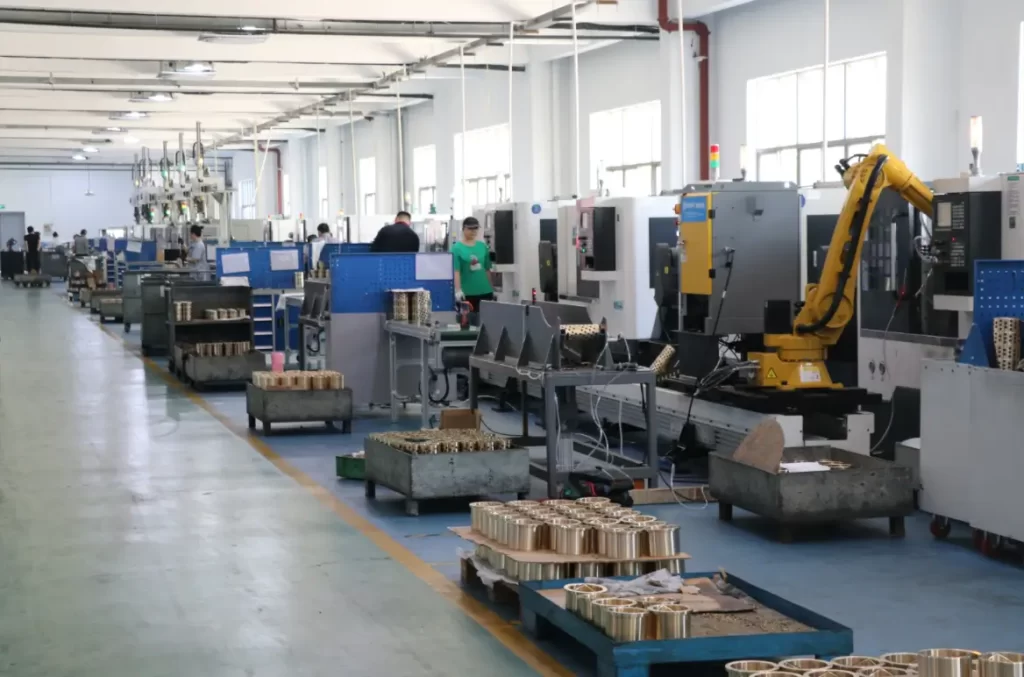
The manufacturing and precision engineering of bronze sleeve bearings are critical to ensuring the component meets its design specifications. Achieving the required dimensional tolerances, surface finish, and material properties is a multi-step process.
6.1. Casting Processes
The initial stage often involves the casting of the bronze blank. The chosen method (sand casting, centrifugal casting, or investment casting) directly influences the material’s final properties. Centrifugal casting is often preferred for high-quality, large bearings as it produces a denser structure. Investment casting (lost-wax) is used for complex shapes requiring near-net shape dimensions and high surface quality, thus reducing subsequent material removal and machining–. Control of alloy composition, melting temperature, and pouring technique is essential to minimize porosity and achieve a uniform microstructure.
6.2. Precision Machining and Tolerances
Following casting, most bronze sleeve bearings undergo precision machining to achieve the final dimensions and surface finish. Key machining operations include turning (outer diameter and face), boring (inner diameter), and drilling (lubrication holes or passages). Dimensional tolerances are critical for the bearing’s performance, ensuring the correct interference fit in the housing and adequate clearance for the shaft. Typical tolerances are often as precise as ±0.0015 inches on the inner diameter. High-precision applications, such as those using C51100 phosphor bronze bushings, demand extremely tight tolerances to guarantee proper clearance and alignment.
6.3. Quality Control Standards
Quality control for bronze sleeve bearings adheres to stringent international standards. Manufacturers ensure compliance with ASTM (American Society for Testing and Materials) standards, such as ASTM B505 for cast bronze alloys, and RoHS and REACH directives for environmental compliance. Testing involves verifying the chemical composition, mechanical properties (tensile, yield, and hardness), and dimensional accuracy to ensure the component meets the “fit for purpose” standards required in demanding industrial applications
7. Maintenance, Lifetime, and Operational Excellence
The expected service life and operational excellence of a bronze sleeve bearing are heavily influenced by proper maintenance. Understanding the specific maintenance requirements of the chosen bearing type is vital to prevent premature failure.
Self-Lubricating Bearings (Oil-Impregnated): These maintenance-free bearings require minimal intervention. If additional lubrication is desired, it is generally advisable to use a recommended oil, typically SAE 20 or SAE 30 weight, applied through lubrication holes. It is critical to avoid using heavy greases, which may not be compatible with the bearing’s porous structure and could hinder the oil metering process.
Solid Bronze Bearings (Lubricated by Oil or Grease): These bearings require regular lubrication. They often feature oil holes or grooves and may require periodic greasing. The oil or grease forms the necessary lubricant film for either mixed or hydrodynamic operation. Applying a few drops of lightweight machine oil during routine maintenance is common practice for these components.
Storage and Handling: Oil-impregnated bronze sleeve bearings can be stored for long periods without significant deterioration if kept in non-absorbent containers. Storage in paper, cloth, or cardboard boxes should be avoided as these materials can wick the lubricating oil out of the bearing’s pores, reducing its self-lubricating property
8.Frequently Asked Questions on Bronze Sleeve Bearings
What is a bronze sleeve bearing?
A bronze sleeve bearing, also known as a bushing or plain bearing, is a cylindrical component that provides a wear-resistant, low-friction support interface for a rotating or sliding shaft.What are the main alloy families used in bronze sleeve bearings?
The main families are tin bronzes, leaded tin bronzes, high-leaded tin bronzes, aluminum bronzes, and phosphor bronzes.What does the SAE 660 (C93200) grade denote?
SAE 660 (C93200) is a widely used leaded tin bronze alloy with a composition of 83% Cu, 7% Sn, 7% Pb, and 3% Zn, known for its good machinability, wear resistance, and anti-friction properties.What is a self-lubricating bronze sleeve bearing?
This type of bearing is typically made via powder metallurgy (oil-impregnated) and contains oil within its porous structure, providing lubrication during operation without external maintenance.What is the difference between a sleeve bearing and a roller bearing?
Sleeve bearings utilize a sliding motion between surfaces, while roller bearings utilize rolling elements. Sleeve bearings often have a larger contact area, offering high shock load capacity and compact design.How does a bronze sleeve bearing reduce friction?
Friction is reduced by a lubricant film separating the shaft and bearing surfaces. In hydrodynamic operation, a continuous oil film is created by motion, while boundary operation relies on the bearing material’s low friction and solid lubricants like lead.What is the PV rating of a bearing?
The PV rating is the product of the bearing’s maximum allowable pressure (P) and velocity (V). It defines the bearing’s safe operating capacity before experiencing excessive wear or seizure.What is the maximum temperature for a bronze sleeve bearing?
The operating temperature depends on the alloy. For example, SAE 660 bronze bearings can operate effectively from -40°F up to +450°F, while some specialized designs can handle up to +536°F.What is the difference between a bushing and a sleeve bearing?
The terms are often used synonymously to describe a cylindrical, plain bearing component.What are the typical applications for bronze sleeve bearings?
They are used in a wide range of applications, including pumps, motors, conveyors, construction machinery, agricultural equipment, and automotive components.What oil should be used for oil-impregnated bronze sleeve bearings?
SAE 20 or SAE 30 weight oil is commonly recommended. Standard light machine oil (like 3-in-One) is often a suitable alternative for non-critical applications.How does aluminum bronze differ from tin bronze?
Aluminum bronze is generally stronger, more wear-resistant, and offers higher corrosion resistance than tin bronze, but it can be more expensive and harder to machine.What is the importance of lubrication in a sleeve bearing?
Lubrication is essential to separate the sliding surfaces, prevent metal-to-metal contact, reduce friction and heat, and extend the bearing’s service life.What is embeddability in a bearing material?
Embeddability is the ability of the bearing material to absorb small particles of debris, preventing them from scoring the shaft.What is a hydrodynamic bearing?
A hydrodynamic bearing is one where a continuous oil film completely separates the shaft and bearing surfaces, resulting in no wear and very low friction.What is a flanged sleeve bearing?
A flanged bearing includes a flange at one end, allowing it to support both radial and axial loads.How are bronze sleeve bearings manufactured?
They are manufactured through various processes, including sand casting, centrifugal casting, investment casting, powder metallurgy (sintering), and precision rolling (wrapped bushings).What does “bronze alloy C95400” denote?
C95400 is an aluminum bronze alloy (85% Cu, 11% Al, 3% Fe) known for its very high strength and wear resistance, suitable for heavy-duty and high-impact applications.What is a thrust washer in relation to sleeve bearings?
A thrust washer is a flat bearing component used to manage axial or thrust loads. It is often used in conjunction with a cylindrical sleeve bearing to handle side loads.What is “boundary lubrication”?
Boundary lubrication is the most severe lubrication regime where there is frequent metal-to-metal contact, requiring bearing materials with low friction and anti-seizing properties
100000+ Types of Bushings – Contact Us for Details