Metallurgical Performance & Industrial Application Analysis of Sleeve Bearings
Introduction
Sleeve bearings, universally named plain bearings, journal bearings or industrial bushings, belong to sliding contact bearing families with simple integral structure and outstanding metallurgical adaptability. Unlike rolling bearings relying on rolling elements, sleeve bearings achieve motion transmission via continuous sliding friction interfaces. Through rational material metallurgy design, structural optimization and lubrication matching, these components undertake load bearing, vibration damping and friction reduction tasks in heavy machinery, automotive systems, hydraulic equipment and metallurgical facilities.
1. Definition & Working Principle of Sleeve Bearings
Sleeve bearing is a one-piece cylindrical sliding bearing assembly installed between rotating or linear moving shafts and equipment housings. Its core operating logic is forming a low-shear friction interface to isolate direct metal contact between mating components.
Rolling bearings utilize balls or rollers to convert sliding friction into rolling friction. Conversely, sleeve bearings operate based on sliding friction. Three typical working lubrication states exist in actual operation: boundary lubrication, hydrodynamic lubrication and dry self-lubrication.
Many engineers confuse sleeve bearings and bushings. Technically, bushing is a general term for splitless plain bearing sleeves; sleeve bearing is the most mainstream form of industrial bushing. The two terms are interchangeable in global mechanical procurement, including journal bearing, sliding bearing, oilless bushing as synonymous keywords frequently searched on Google.
2. Main Structural Classification of Sleeve Bearings
Two mainstream structural forms are widely adopted in global industry, matched with auxiliary thrust washers for compound load conditions.
| Bearing Type | Structural Feature | Load Adaptation | Typical Application |
|---|
| Cylindrical Sleeve Bearing | Straight inner & outer diameter, smooth cylindrical wall, flush installation inside housing | Pure radial load; low axial force | Hydraulic cylinder pin sleeves, conveyor equipment, motor auxiliary shafts |
| Flanged Sleeve Bearing | Single end integrated protruding flange surface | Radial load + axial thrust load | Automotive hinge assemblies, steering yokes, lifting pivot points |
| Split Sleeve Bearing | Axial cutting design for easy assembly without disassembling equipment | Heavy machinery with limited maintenance space | Excavator linkage, large-size metallurgical equipment |
| Thrust Washer (Matching Part) | Flat circular sliding plate | Pure axial thrust load | Gear end positioning, pump end face support |
Beyond above basic types, special customized structures including grooved oil storage sleeve bearings, tapered sleeve bearings and thin-wall composite sleeve bearings are produced to satisfy extreme working requirements.
3. Metallurgical Material System & Material Property Comparison
Material metallurgical characteristics determine load capacity, wear resistance, temperature tolerance, friction coefficient and corrosion resistance of sleeve bearings. Raw material selection becomes the core link of bearing design. Main industrial materials are sorted as follows:
3.1 Metallic Materials
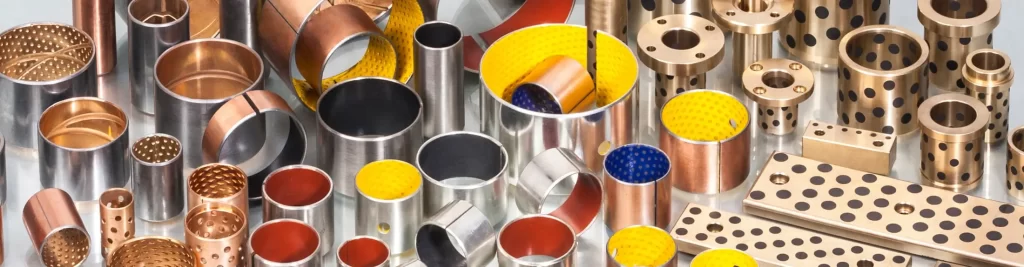
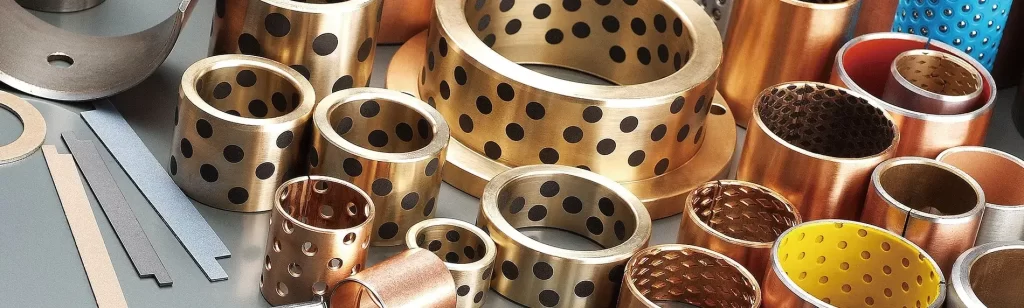
- Bronze Alloy (SAE660, CuSn8): Solid cast bronze, graphite embedded bronze, oil-impregnated sintered bronze. Good conformability, shock load resistance, excellent thermal conductivity; suitable for medium-heavy load low-speed working conditions.
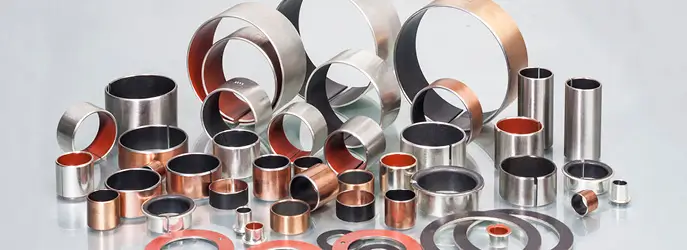
- Bimetallic Bearing Material: Low carbon steel backing + copper alloy sintered layer. Combine high structural strength of steel and low friction property of bronze, widely used in automotive chassis and hydraulic components.
- Babbitt Alloy (White Metal): Tin-based or lead-based soft alloy, strong embedding performance for tiny impurity particles, mainly used in large generator bearings and heavy pump journal bearings.
- Stainless Steel & Carbon Steel Sleeve: High hardness, anti-abrasion, usually matched with independent lubrication system, applied in high-pressure clean industrial equipment.
3.2 Composite & Polymer Materials
PTFE lined composite
sleeve bearing (SF-1/DU, SF-2/DX): Steel substrate covered with porous bronze powder and PTFE mixture layer, typical oil-free self-lubricating bearing. Fiber reinforced plastic sleeve bearings are cost-effective for light-load low-temperature equipment.
Material Performance Contrast Table
| Material Category | Maximum PV Value | Lubrication Demand | Shock Resistance | Working Temperature Range |
|---|
| Sintered Oil-impregnated Bronze | Medium | Periodic oil supplement | Good | -40℃ ~ 120℃ |
| Graphite Embedded Solid Bronze | High | Dry running available | Excellent | -60℃ ~ 250℃ |
| Steel-Backed PTFE Composite | Medium-High | Oilless operation | Medium | -200℃ ~ 260℃ |
| Babbitt Alloy | Medium | Continuous hydrodynamic lubrication | Medium | -30℃ ~ 150℃ |
| Plastic Composite Bearing | Low | Dry running | Poor | -30℃ ~ 80℃ |
4. Core Performance Advantages of Sleeve Bearings
Compared with
ball bearings and roller bearings, properly selected sleeve bearings display unique engineering advantages:
- Higher allowable shock load: Large-area surface contact disperses instantaneous impact force, not prone to fatigue pitting failure like rolling bearings.
- Compact installation space: Thin-wall design reduces housing size, effectively lightens overall equipment weight, critical for lightweight mobile machinery.
- Low noise performance under low & medium speed: Sliding interface absorbs vibration, suppresses resonance noise, superior to rolling bearings at low rotation speed.
- Lower comprehensive procurement cost: Simple one-piece forming technology, fewer processing steps, competitive price for mass procurement.
- Strong misalignment adaptability: Conformal lining material compensates minor shaft deflection and assembly misalignment, avoiding shaft clamping stagnation.
- Multiple lubrication schemes available: Support forced oil lubrication, periodic grease filling, oil-impregnated self-lubrication and fully dry graphite self-lubrication.
Meanwhile, inherent limitations should not be ignored: The friction torque during startup is higher; continuous high-speed operation easily breaks lubricant film; long-term high PV working environment accelerates surface wear.
5. Global Industrial Application Scenarios of Sleeve Bearings
Sleeve bearings belong to universal basic mechanical parts, covering almost all equipment containing rotating, linear or high-frequency oscillating movement:
Automotive Industry: Seat adjustment mechanisms, door hinges, steering yokes, suspension pin sleeves, belt tensioners, clutch assemblies. Self-lubricating bronze bushings are massively adopted in new energy vehicle chassis.
Construction & Agricultural Machinery: Excavator clevis joints, tractor pivot sleeves, harvester moving parts, crane lifting connection points, drilling rig auxiliary shafts.
Hydraulic & Pneumatic Equipment: Hydraulic cylinder pin sleeves, pump body journal parts, valve group sliding assemblies, compressor bearing sleeves.
General Manufacturing Machinery: Conveyor lines, punching equipment, packaging machinery, textile equipment, machine tool auxiliary moving components.
Household White Goods & Automation Equipment: Washing machine hinge shafts, automated production line sliding joints, small motor auxiliary bearings.
Metallurgical & Mining Equipment: Sintering machine moving hinges, mineral processing equipment supporting sleeves, high-temperature conveying machinery bearings.
6. Key Parameters for Sleeve Bearing Selection
Engineers must evaluate multiple indicators to avoid premature bearing failure. Core selection parameters:
- Load type & magnitude: Distinguish radial load, axial load, alternating shock load; calculate specific surface pressure P.
- Sliding speed V: Combined P and V to calculate PV value, the most critical evaluation index of bearing service life.
- Working environment: Temperature range, dust, moisture, corrosive medium, whether continuous maintenance can be carried out.
- Lubrication condition: Whether regular oil filling is feasible; confirm if oil-free self-lubricating structure is required.
- Shaft parameter: Shaft material, surface roughness, hardness, assembly clearance tolerance.
- Service life expectation and maintenance frequency requirements.
7. Common Failure Forms & Preventive Solutions of Sleeve Bearings
In field operation, typical failure modes include adhesive wear, abrasive wear, surface seizure, fatigue spalling and creep inside housing.
- Surface seizure: Main cause: insufficient lubrication, excessive PV value, too small assembly clearance. Solution: Upgrade self-lubricating material, increase clearance properly, add oil storage grooves.
- Abrasive wear: Dust and hard particle invasion scratch friction surface. Solution: Install sealing structure, select bearing material with embedding property.
- Creep failure: Interference fit insufficient, bushing rotates inside housing bore. Solution: Optimize outer diameter interference tolerance, adopt anti-rotation positioning structure.
8. Self-lubricating Sleeve Bearing Technology Trend
With equipment tending to maintenance-free design, self-lubricating sleeve bearings become the mainstream development direction in recent years. Two mature technical routes:
- Solid lubricant embedded bearing: Graphite or PTFE lubrication points embedded on bronze matrix; lubricant transfers to shaft surface during friction to form stable dry lubricating film.
- Composite layered oilless bearing: Steel back + porous bronze layer + PTFE surface layer, suitable for boundary lubrication and intermittent operation equipment.
Self-lubricating bushings are widely favored in equipment where regular lubrication maintenance is difficult, such as outdoor engineering machinery and unmanned automated equipment.
9. Choose Custom Sleeve Bearings from MYWAY – Reliable Metallurgical Bushing Manufacturer
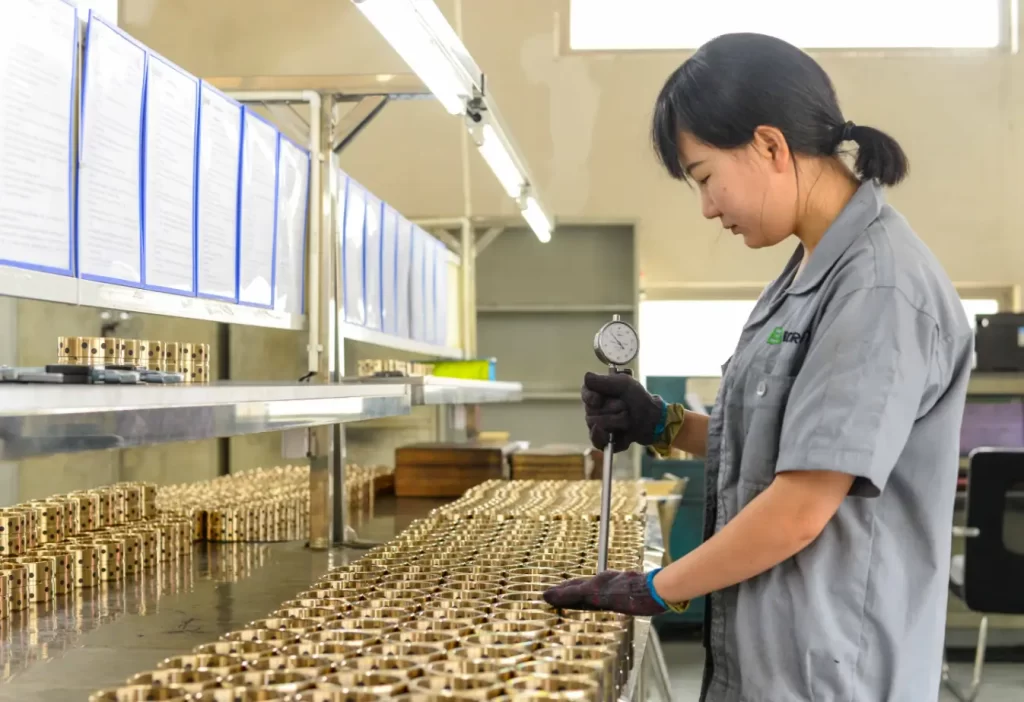
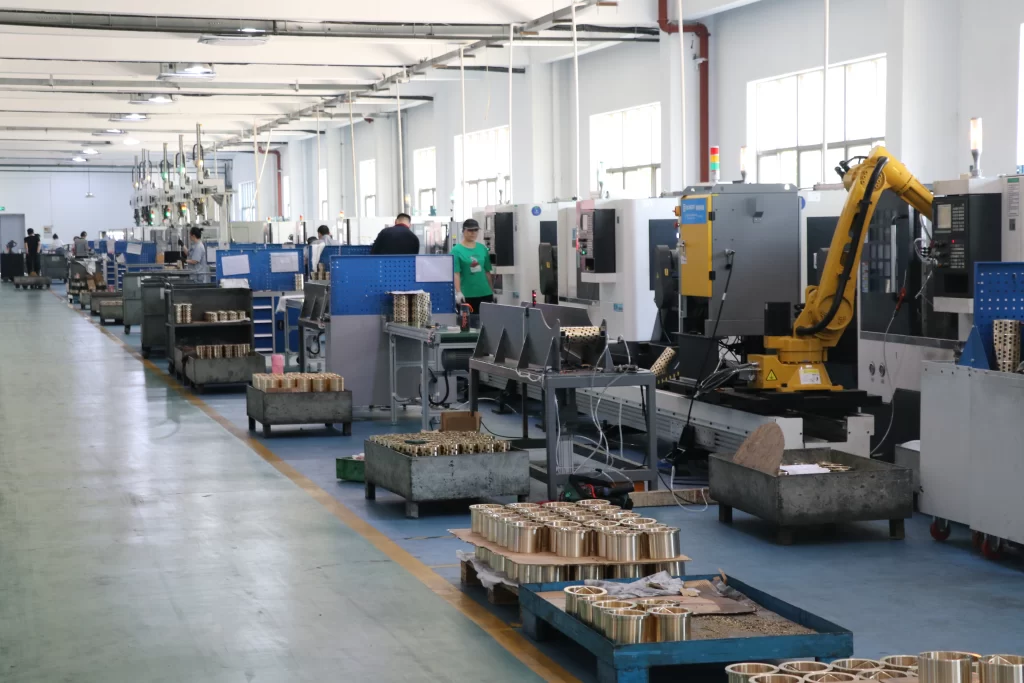
Founded in 2005, MYWAY is a professional manufacturer of various sleeve bearings and industrial bushings with over 20 years metallurgical processing experience. Our factory covers 35,000 square meters, equipped with complete production chains including raw material casting, powder metallurgy sintering, precision CNC machining, surface treatment and strict laboratory testing.
MYWAY Main Sleeve Bearing Product Range
 Solid graphite embedded bronze sleeve bearings
Sintered oil-impregnated bronze bushings
SF-1 / SF-2 steel-backed PTFE composite oilless bearings
Bimetallic sliding bushings for heavy-load hydraulic systems
Flanged, cylindrical, split and special-shaped customized sleeve bearings
Stainless steel bushings, brass sleeve bearings and engineering plastic sliding sleeves
Core Advantages of MYWAY Sleeve Bearings
Strict metallurgical raw material inspection: Every batch of copper alloy and steel substrate passes composition detection to guarantee stable friction and wear performance.
Flexible customization service: Support metric, inch standard sizes and non-standard drawing processing; zero mold cost for bulk orders.
Authorized certifications: ISO9001, IATF16949, RoHS certification, products exported to more than 40 countries across Europe, North America, Southeast Asia and Oceania.
Complete QC system: Friction coefficient testing, hardness testing, wear resistance experiment and metallographic analysis before delivery.
Short lead time: Mass stock of common standard sleeve bearings; fast delivery for customized samples.
Whether you are engaged in machinery design, equipment maintenance or component procurement, MYWAY technical team can provide targeted material recommendation, parameter calculation and cost optimization solutions. Send your drawing, dimension list or working condition parameters to us to get competitive quotation and free sample support. We sincerely expect long-term win-win cooperation with global engineering buyers.
MYWAY owns professional manufacturing base and Hangzhou sales center to serve global customers efficiently.
Sales Center: Unit 501, Building 10, Central Green Plaza, Gongshu District, Hangzhou City, Zhejiang Province, China
Manufacturing Base: 822 Taiji Avenue, Guangde Economic Development Zone, Xuancheng City, Anhui Province, China
Our sales team based in Hangzhou provides rapid technical communication, quotation and order follow-up. The large-scale production base in Anhui undertakes raw material processing, precision machining, inspection and mass delivery of all types of sleeve bearings, realizing perfect coordination of front-end sales service and back-end production.
FAQ
1.What is the working principle of a sleeve bearing?
A sleeve bearing relies on sliding friction between the bushing and mating shaft to realize rotary, linear or oscillating movement, reducing friction and absorbing vibration.
2.What other names can sleeve bearings be called in international procurement?
Common synonyms include plain bearing, journal bearing, sliding bearing, bushing, oilless bushing, self-lubricating bearing.
3.What is the core difference between sleeve bearings and ball bearings?
Sleeve bearings work via sliding contact, while ball bearings transmit motion through rolling elements. Sleeve bearings have larger contact area, better shock resistance and lower noise at low speed.
4.Can sleeve bearings compensate for shaft and housing misalignment?
Yes. Composite and bronze sleeve bearings with conformal sliding layer can tolerate slight assembly misalignment and shaft deflection.
5.What is the PV value for sleeve bearing selection?
PV value is the product of surface pressure(P) and sliding velocity(V). It is the core indicator to judge the service limit of sliding bearings.
6.Which sleeve bearing material is suitable for high-temperature dry running working conditions?
Graphite embedded solid bronze sleeve bearings are the preferred option for long-term high-temperature dry friction environments.
7.What is the difference between flanged sleeve bearings and cylindrical sleeve bearings?
Cylindrical bearings mainly bear radial loads; flanged sleeve bearings can withstand radial load plus axial thrust load with end flange structure.
8.Are sintered oil-impregnated bronze bushings considered self-lubricating bearings?
They belong to semi-self-lubricating bearings. The internal stored oil can be released under pressure, but regular supplementary lubrication will extend service life.
9.What load types can graphite embedded bronze sleeve bearings support?
They adapt to radial load, axial load and periodic impact load, widely used in medium and heavy speed-low working conditions.
10.Can steel-backed PTFE composite sleeve bearings operate continuously without grease or oil?
Yes. SF-1/DU composite bearings are designed for dry running and boundary lubrication environments without continuous oil supply.
11.What recommended hardness of mating shaft for bronze sleeve bearings?
It is suggested that the shaft hardness reaches ≥HRC40 to avoid rapid abrasive wear of the shaft surface.
12.What are the main causes of sleeve bearing seizure?
Insufficient lubrication, excessive PV value, inappropriate assembly clearance, foreign particle pollution are the top common causes of seizure.
13.What advantages do bimetallic sleeve bearings have compared with solid bronze bushings?
Bimetallic bearings adopt steel base + bronze surface layer, which have higher mechanical strength, lower raw material cost and good wear resistance.
14.Can plastic sleeve bearings be used under heavy load and impact conditions?
Not recommended. Plastic bearings are suitable for light-load, low-temperature, low-speed scenes with limited shock resistance and load capacity.
15.What industries commonly use steel-backed PTFE composite sleeve bearings?
Automotive chassis, hydraulic cylinder joints, automation equipment, engineering machinery and textile machinery are typical application industries.
16.How to select suitable sleeve bearings for hydraulic cylinder hinge points?
Give priority to shock-resistant bronze bushing or bimetallic bearing, calculate PV value, confirm radial & alternating impact load and lubrication environment.
17.What surface roughness is required for the shaft matched with sliding sleeve bearings?
Recommended Ra 0.2μm ~ Ra 1.6μm. Too rough surface will accelerate friction layer wear.
18.Where is MYWAY’s sales center and manufacturing base located?
MYWAY Sales Center is in Hangzhou, Zhejiang for global customer communication; Manufacturing Base is in Guangde, Anhui responsible for production, processing and testing.
19.Can MYWAY produce non-standard customized sleeve bearings according to customer drawings?
Absolutely. We support custom machining of flanged, cylindrical, split and special-shaped bushings based on drawings or samples.
20.Can MYWAY provide free test samples and what international certifications do you have?
We can provide samples for performance testing. Our products are certified by ISO9001, IATF16949 and RoHS to meet global export standards.
100000+ Types of Bushings – Contact Us for Details