
Recent Posts
How Bushing Clearance Affects Suspension Movement
Introduction
Suppose the shaft fits before pressing and drags afterward. Rechecking the loose-part inspection report won’t explain much. Pressing has changed the condition of the part you are trying to measure.
That small workshop puzzle gets to the heart of bushing clearance. The outside of a sliding bush must stay secure in its housing, while the shaft still needs room to move inside. Both fits belong to the same assembly. Changing one can change the other.
Table of Contents
1 Why the bore changes during assembly
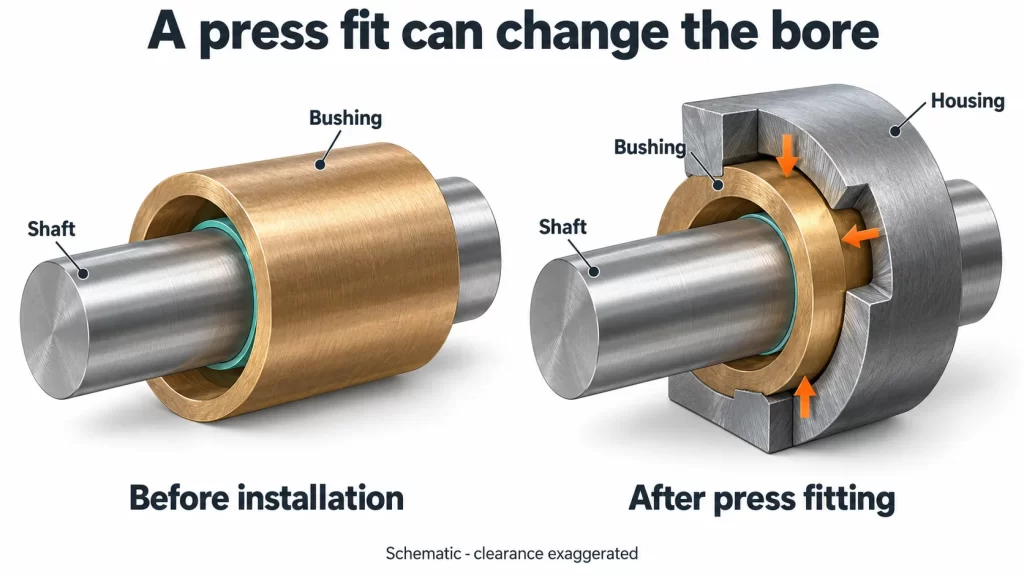
The housing squeezes the outside of a press-fit bushing. Some of that change can appear at the bore, depending on the construction of both parts. A thin housing and a stiff, heavy housing needn’t produce the same result. This is why a supplier may specify a test housing for an installed-bore check. Without an agreed housing condition, two inspectors can get different answers from the same bush.
At the shaft, too little room can mean increased friction and heat. Scuffing or seizure may follow if the running conditions are severe enough. A joint that only gets sticky once warm deserves particular attention.
It is tempting to explain that as “heat closes the gap.” Sometimes it does. But the shaft, bush and housing all contribute, and they may be at different temperatures. A freely expanding metal ring can get larger at the bore as well as outside. A polymer confined in a housing has different constraints. Work through the actual assembly before adding a cold-clearance allowance.
2 Rubber moves without a sliding gap
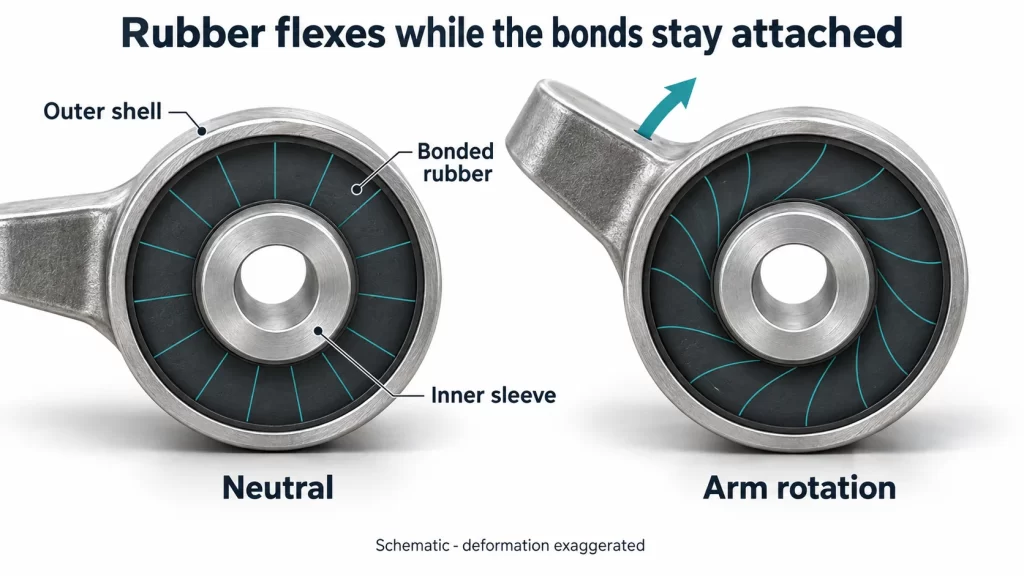
Now look at a bonded rubber control-arm bushing. The sleeve and outer shell have rubber attached between them. As the arm moves, that rubber stretches and compresses. It doesn’t need to come unstuck from the sleeve to let the suspension work. A failed bond and normal rubber deflection may both look like “movement” during a casual inspection, but they tell very different stories.
Rubber adds a complication for anyone looking for play with a lever: the inspection itself applies a load, and healthy rubber will deflect. The inspection method and limits for that vehicle matter more than an instruction to look for “any movement.”
This also explains why harder isn’t always better. The rubber in a road-car bushing can have deliberately placed voids that help tune its response to load. A much stiffer replacement may reduce deflection while allowing more road vibration to reach the body. The driver feels both changes.
3 What the clearance number actually means
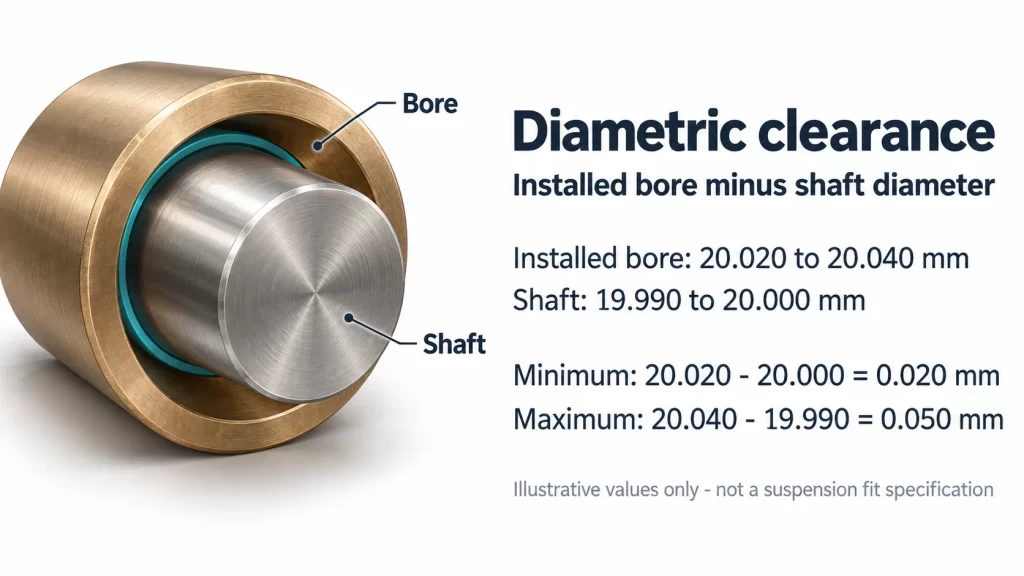
For a sliding bearing, diametric clearance is the installed bore diameter minus the shaft diameter. A radial figure describes half of it, assuming round parts with their centres lined up. Leave out that one word and two people can interpret the same drawing differently.
Here’s an illustrative calculation, not a suggested fit for a vehicle. Give the installed bore limits of 20.020 to 20.040 mm and the shaft limits of 19.990 to 20.000 mm. Pair the smallest hole with the largest shaft and you get 0.020 mm of diametric clearance. At the other extreme, the largest hole minus the smallest shaft gives 0.050 mm.
The next question is whether both ends work. That takes more than a fit table. Picture an arm moving a few degrees, stopping, then coming back. Oil-film behavior through those reversals needs its own assessment; a calculation for continuous rotation doesn’t settle it. Shaft finish and the chosen lubricant also belong in the discussion.
And diameter is only part of the inspection. A bore can be tapered. Two individually acceptable bushes can be mounted out of line. If the shaft binds despite apparently adequate clearance, those are sensible places to investigate before enlarging anything.
4 Why the car can feel loose after an alignment
Think about what happens when braking loads reach a control arm whose mounting no longer locates it properly. The arm has room to shift, taking the wheel with it. Release the brake and it may return toward its previous position. An alignment rack gives you a reading at a particular condition; it doesn’t reproduce everything the joint sees on the road.
An anti-roll bar support bushing has a different job. Play there may cause noise without having the same effect on wheel location as a failed control-arm bushing. Lumping both faults together under “bad geometry” makes diagnosis less precise.
A knock over a pothole is a symptom, not a measurement. Loose fasteners, ball joints, steering joints and mounts can sound much like a worn bushing. Finding the exact source may take more work than replacing the most accessible part.
5 The last bolt can change how rubber works
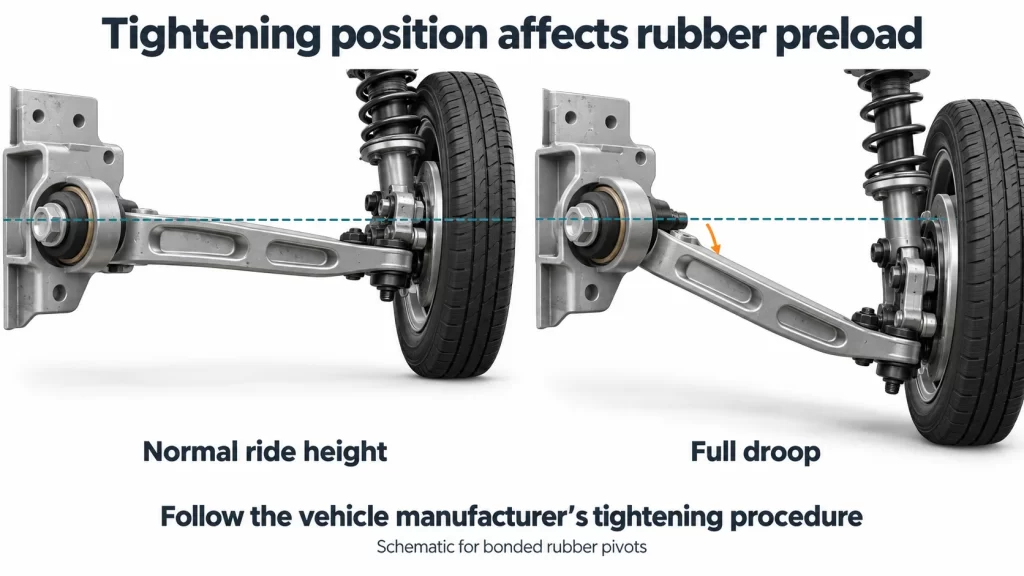
With many bonded rubber pivots, the required final tightening position is normal ride height. If the sleeve is clamped with the arm at full droop, lowering the car twists the rubber before a bump has been encountered. The manufacturer’s procedure establishes the position for that particular joint.
Sleeve length matters as well. Its ends need to seat and be clamped as intended. You can reach the specified bolt torque while still having a dimensional problem elsewhere in the assembly. If play remains, find its location. Turning the wrench farther won’t put material back into a worn bore or reattach rubber to a sleeve.
When fitting a pressed bush, spend a moment on the old housing. Scoring, an oversized seat or an oval bore can give the replacement a poor start. Once the new part is installed with the correct tool and orientation, check the bore under the specified conditions.
Don’t assume a tight lined bearing can simply be reamed until the shaft fits. The material removed may be part of its working layer. Any finishing operation needs to be permitted for that product.
6 From the drawing to the right bearing
Bronze, bimetal and lined composite bearings bring different lubrication and shaft requirements to a sliding joint. MYWAY’s catalogue covers these constructions, including DU/SF-1, DX/SF-2 and graphite-plugged copper-alloy bearings. The company has worked in bushings and bearings since 2005.
A photograph and a nominal bore size will get an enquiry started. Add the assembly drawing and the conversation becomes much more useful. For MYWAY, that means being able to discuss a bearing construction against the actual shaft, housing and duty, rather than matching only the outside appearance of an old part.
Give the supplier the load cycle, movement, lubrication and temperatures at the joint. For the dimensions, include both mating parts. Write “after installation” beside the bore requirement if that is what you mean. Agreeing on that measurement early helps answer the question that started this article: will the shaft still move properly once the bushing is in its housing?
100000+ Types of Bushings – Contact Us for Details