
Recent Posts
Wrapped vs Solid Bronze Bushings: Look Beyond the Wall Thickness
Introduction
A drawing marked ‘bronze bush’ can leave a surprisingly large question unanswered: how is the sleeve made? Rolling a strip and machining a blank are different routes to the same basic shape. Oil grooves, pockets and graphite inserts add another set of choices.
Keep those decisions separate. ‘Wrapped’ describes the body; ‘self-lubricating’ describes a lubrication system. Confusing the two can send a perfectly reasonable enquiry to the wrong product range.
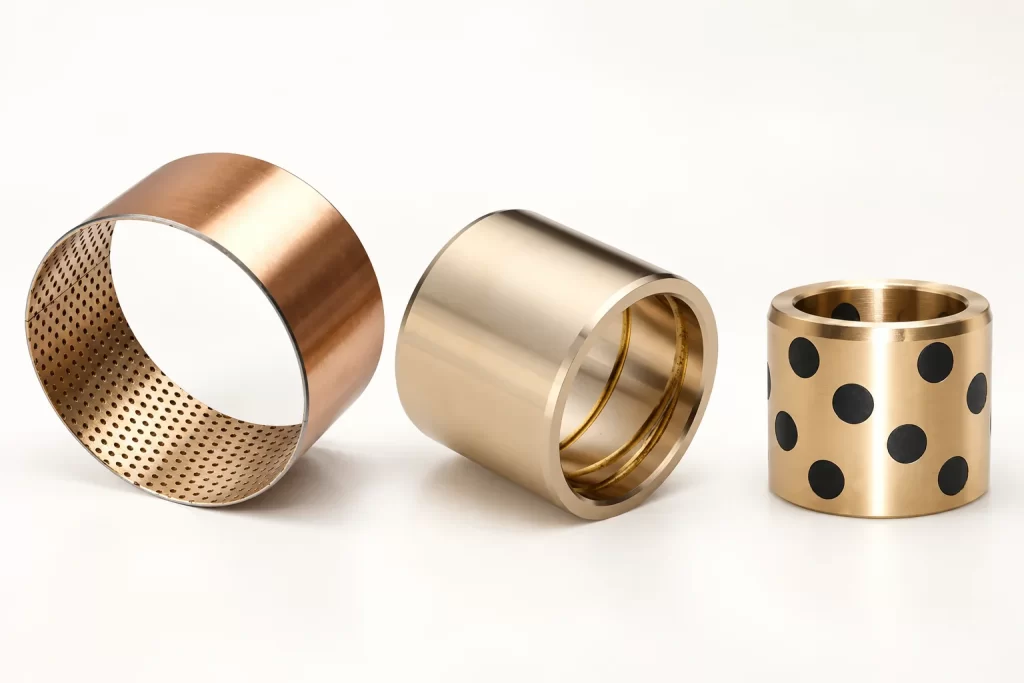
Table of Contents
What the supplier means by a bronze bearing
The word ‘bearing’ doesn’t pin down the shape. A sleeve around a pin is a bushing. A bronze thrust washer or a sliding plate is also a plain-bearing component, but it does a different job. The broader word “bearing” covers all of them.
Running without added lubricant
A plain sleeve machined from solid bronze isn’t automatically ready to run dry. Usually, something has to deliver oil or grease to it. The oil may already be inside a sintered sleeve; in a plugged bearing, solid-lubricant inserts have a different job at the contact. Before deleting the grease fitting, get the lubrication instructions for the exact grade, including what is required at installation.
Choosing the manufacturing route
I’d price both routes if the quantity or geometry leaves the decision open. A standard sintered sleeve may already do the job. A special machined part may avoid tooling costs on a small order. Put the finishing, oil and paperwork requirements into both enquiries so that neither quotation leaves necessary work for somebody else.
Checking the working load
“How much load can bronze take?” needs more information before it has a useful answer. For example, a 10 kN radial load on a 20 mm bore with 25 mm of effective bearing length gives a nominal projected pressure of 20 N/mm². That calculation still says nothing about the acceptable speed. Pressure and sliding velocity together give PV, which must be compared with the selected product’s rating. This is a calculation example, not a load recommendation. The duty cycle and any impact load still need to be supplied.
Installing the bushing
Start with the specified housing fit. Don’t carry an interference value from a small, thick sleeve over to a large, thin one. The housing material makes a difference as well. Before pressing, remove burrs and dirt, orient the oil holes, and support the part with the specified tooling. Thermal assembly needs its own agreed temperature and procedure; there is no universal heating temperature for every bronze bush and housing.
Bore size after pressing
Yes, pressing a bush into its housing can reduce the bore. There isn’t a dependable percentage that applies to every assembly. The interference and the stiffness of the housing and bush affect the result. Inspect the bore in its installed condition. Finishing a solid sleeve in place may be part of the drawing requirements. With porous bronze, careless reaming can smear the openings that are supposed to deliver oil, so get the machining instructions first.
Choosing oil or grease
Oil is not an exceptional choice for a bronze journal bearing. A slowly moving pivot and a continuously rotating journal may have quite different lubrication arrangements. Begin with the equipment specification, including the delivery method. If there isn’t one, establish it from the duty before commissioning the joint. That includes keeping the lubricant clean.
Recognizing a worn bush
A clearance measurement against the machine’s stated limit is more useful than waiting for an obvious rattle. A new knock, heat rise or visible scoring is reason to inspect earlier. The shaft belongs in that inspection too. A damaged mating surface can shorten the next bushing’s life as soon as the machine is restarted.
1. Start with the wall, then look at the surface
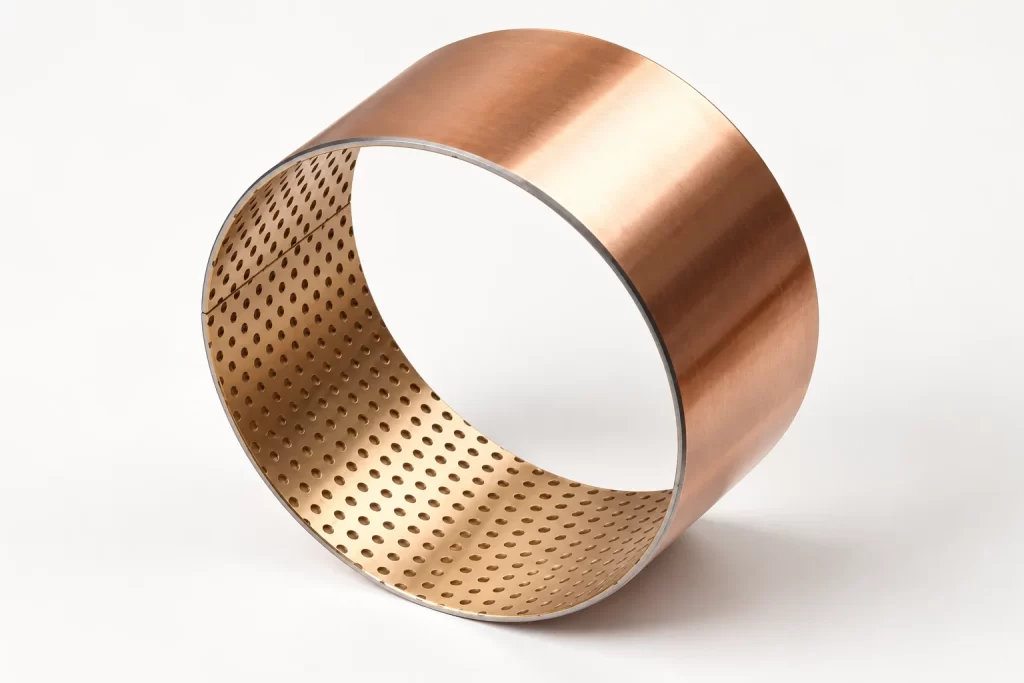
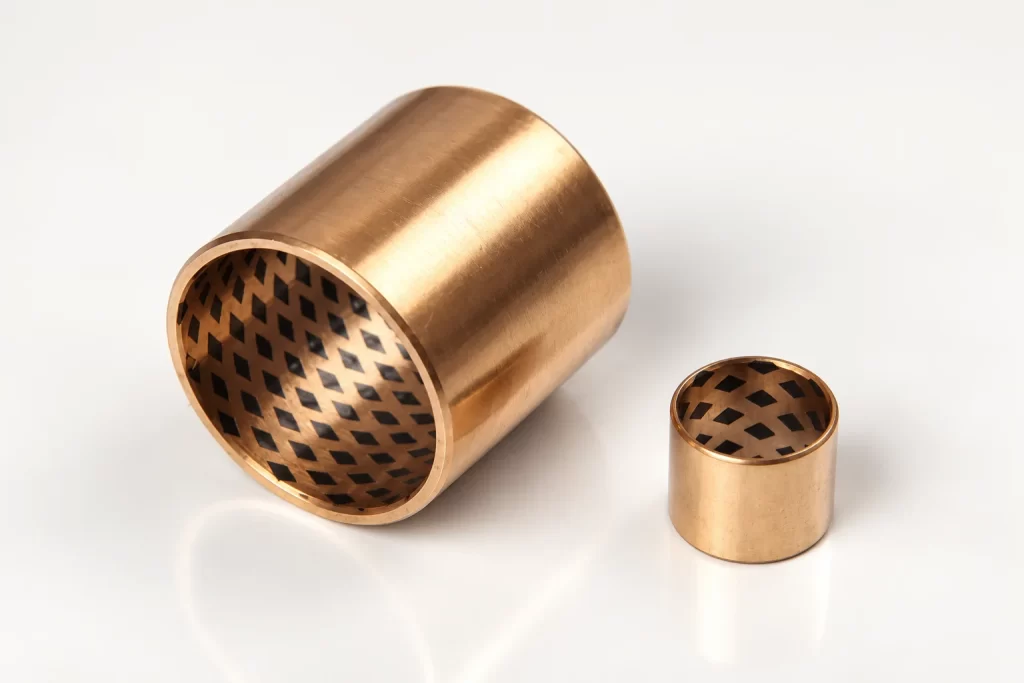
A wrapped bronze bushing starts with a strip of alloy. Forming brings its edges together along a longitudinal joint. The joint belongs to the design; seeing it on a loose sleeve is not, by itself, a reason to reject the part. The oil-pocket wrapped bronze bushing shown here has a thin wall and many small recesses on its inner surface.
A conventional one-piece solid sleeve takes a different route: suitable stock or a cast blank is machined to size. ‘Solid’ refers to that construction. The finished part still has a bore for the shaft, and it can have lubrication features machined into it.
The drawing and product specification settle the construction and alloy. A photograph helps identify details, but wall thickness or colour alone cannot prove which material you are buying.
2. Choose around the space and the features
Wrapped bronze is worth investigating when radial space is tight. A thin sleeve can leave more room for the shaft within a fixed housing diameter. Start with the sizes and wall thicknesses available in the selected series, then check the installed fit and lubrication arrangement.
Consider a repeat-production pivot with an accessible grease nipple. If a standard wrapped size fits the housing and meets the duty requirements, it belongs on the quotation list. Now change the job: an older machine needs an unusual length, a shoulder and an oil hole at a precise position. A machined solid bushing may be the more practical starting point.
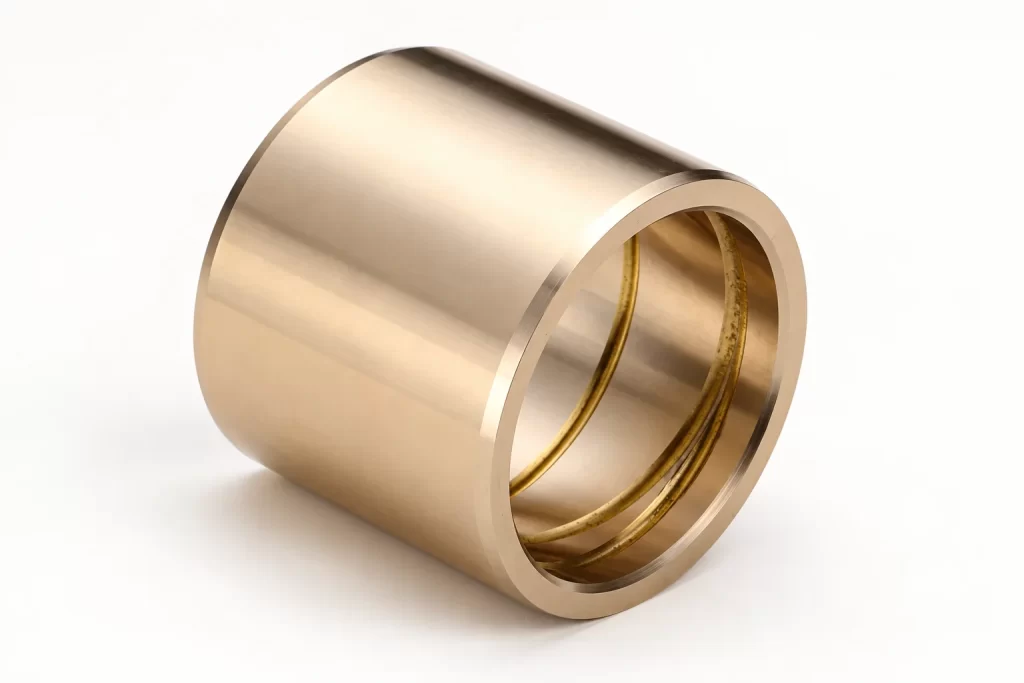
Machining gives the designer room to specify oilways, steps and shoulders where required. MYWAY’s bronze bushing range includes cast and machined copper-alloy components. The grooved plain sleeve pictured below is a useful example of the exterior and bore details to document in a replacement enquiry. It has no graphite inserts.
Specify the alloy as well as the shape. ‘High-quality bronze’ leaves the material decision unresolved. Bearing alloys differ in strength, conformability and behaviour against the shaft; the Copper Development Association discusses those trade-offs alongside lubrication.
Neither route wins every price comparison. For a special part, forming tools and order quantity can change the economics; for a machined part, stock size and machining time matter. Quote the same duty and acceptance requirements, then include any housing work or maintenance changes in the comparison.
The job calls for… | Start by reviewing… | Check before ordering |
A compact, greased pivot | A wrapped bronze series | Available wall thickness, housing fit and lubricant supply |
A special shoulder or oilway | A machined solid sleeve | Alloy, feature positions and machining allowances |
Fewer visits to a grease point | An embedded-lubricant grade | Duty limits, shaft requirements and maintenance instructions |
A thick wall is not a load rating. Compare the permissible pressure, speed and lubrication conditions for the exact grades being offered. A catalogue limit for another manufacturer’s bearing cannot establish a MYWAY product rating.
3. An oil groove and a graphite insert do different jobs
Small dark shapes inside a bronze bore can be misleading. They might be recesses holding grease, holes through the wall, or solid lubricant inserts. Those details do different jobs.
Pockets provide space for lubricant. Grooves and feed holes help route it through the bearing arrangement. The assembly and maintenance instructions must say how to supply and replenish it. Ordinary dense bronze does not become a dry-running bearing because its surface has a pattern. Porous, oil-impregnated sintered bronze is a separate construction again. [2]
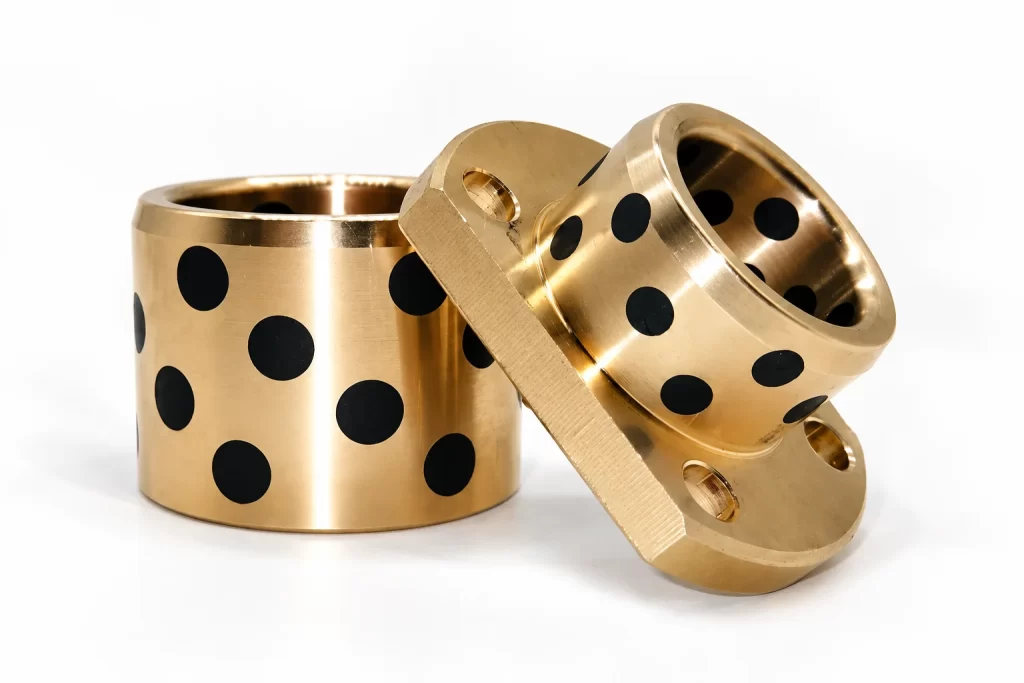
On the graphite bushings in the reference photograph, the black circular areas are solid lubricant inserts, not empty oil holes. The plain sleeve and the flanged part use visibly different shapes, but both belong to the graphite/solid-lubricating family. The holes in the flange must not be confused with the black inserts in the sleeve wall.
MYWAY’s solid-lubricating bushings use lubricant embedded in a metal matrix. During sliding, lubricant can transfer to the mating surface. If a grease nipple is difficult to reach, that is a reason to discuss this option with the supplier. It is not enough information to select a grade.
Take the load and movement data to the supplier, along with the shaft specification. Then get a written answer to a very practical question: what must the fitter do on day one, and what must maintenance do later? MYWAY’s plain solid-lubricating product data distinguishes dry and oil-lubricated limits. Use the conditions for the exact material being quoted.
4. Graphite is not proof of a solid body
There is an important exception to a common buying shortcut. MYWAY also lists graphite-inlaid wrapped bronze bushings. The website photograph shows dark inserts on the inner surface of wrapped sleeves. So ‘wrapped means grease pockets’ and ‘graphite means solid bronze’ are both incomplete descriptions.
Oil grooves are not exclusive to machined solid sleeves either: the catalogue includes oil-groove wrapped bronze bushings. Record the body construction and the lubrication feature separately on the enquiry. A black insert or a groove tells only part of the story.
5. Check the bearing in the condition that matters
A loose wrapped sleeve is not a rigid machined tube. Its joint can open slightly before installation, so a quick caliper reading across the free sleeve may not settle an acceptance dispute. Use the specified inspection procedure. ISO 3547-2 covers test data for wrapped-bush outside and inside diameters; the applicable gauges and acceptance limits need to be agreed with the supplier. [3]
For a replacement, check the housing and shaft as well as the new part. Matching three nominal dimensions does not establish the installed clearance. A worn housing, damaged shaft or blocked oil feed can undo an otherwise sensible material choice.
Trace the oil or grease route on the assembly drawing, right through to the bore. Check the position of every feed hole that has to line up. A replacement that covers an existing passage will cut off the supply, even if its three main dimensions are correct.
Reaming also needs an explicit decision. A machined bushing may be ordered with a finishing allowance; a finished thin-wall or lubricant-bearing surface cannot simply be treated the same way. Agree the final bore, allowance and permitted process before cutting metal.
6. Give the supplier a job to solve
‘Slow moving’ is a start, but a pivot needs an angle and a cycle rate. A rotating shaft needs a speed. Include peak loads and dwell periods: a joint that spends most of the day stationary may do its hardest work during a brief loaded stroke.
Send your drawing to MYWAY with the revision, quantity, material requirement, shaft and housing details, temperature range and lubrication arrangement. For a failed replacement, add photographs of the wear and say what you want to improve. Mark unknown values rather than guessing them.
Most useful of all, state what must stay fixed. If the housing cannot be modified or the shaft must be reused, put that in the enquiry. A proposal built around those constraints is easier to evaluate than a promise that one type of bronze is ‘better’.
For a change of construction or material, agree what a sample trial must demonstrate: fit at assembly, acceptable running behaviour and a defined inspection interval. That gives the purchase a clear test beyond whether the new sleeve slides into the box marked ‘bronze bush’.
100000+ Types of Bushings – Contact Us for Details