
Recent Posts
Flanged vs. Straight Bushings: Look at the Side of the Joint
Introduction
The bore is usually where a bushing enquiry starts. The enquiry might give you an ID, an OD and a length, with nothing showing either end of the housing. Enough to find a sleeve of the right size, perhaps. I’d still be reluctant to choose between a plain sleeve and a flanged one from that information.
Perhaps nothing is touching there. Perhaps the side of a moving arm is rubbing on a bracket. Or perhaps a washer already takes care of that contact. I would want to see that detail before recommending either shape.
For this comparison, let’s keep the whole joint in view.
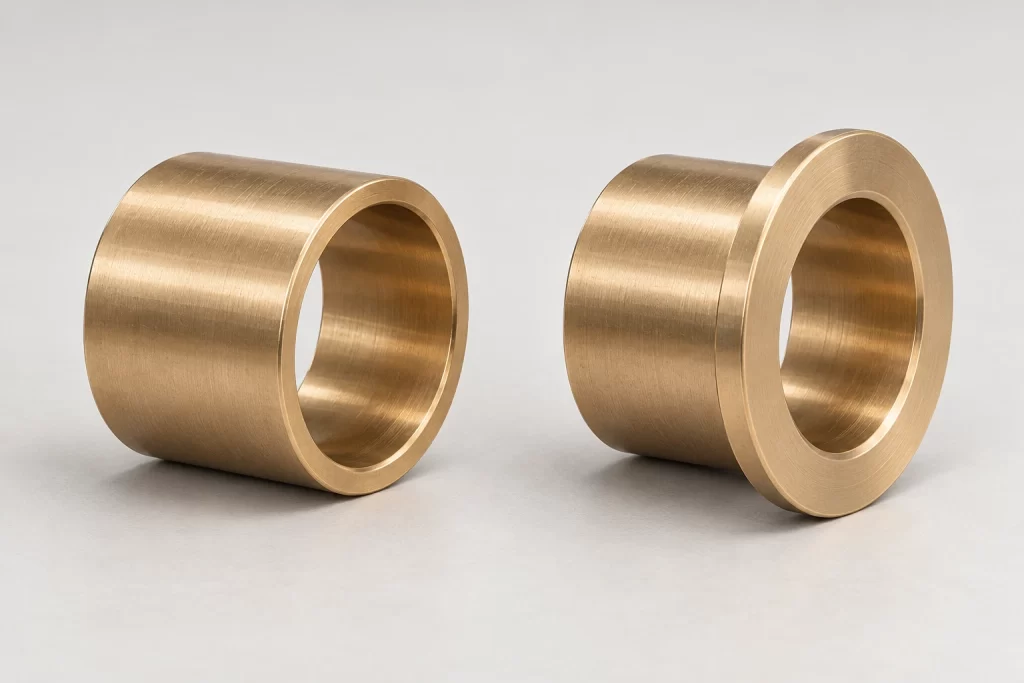
Table of Contents
1.Draw the force before choosing the sleeve
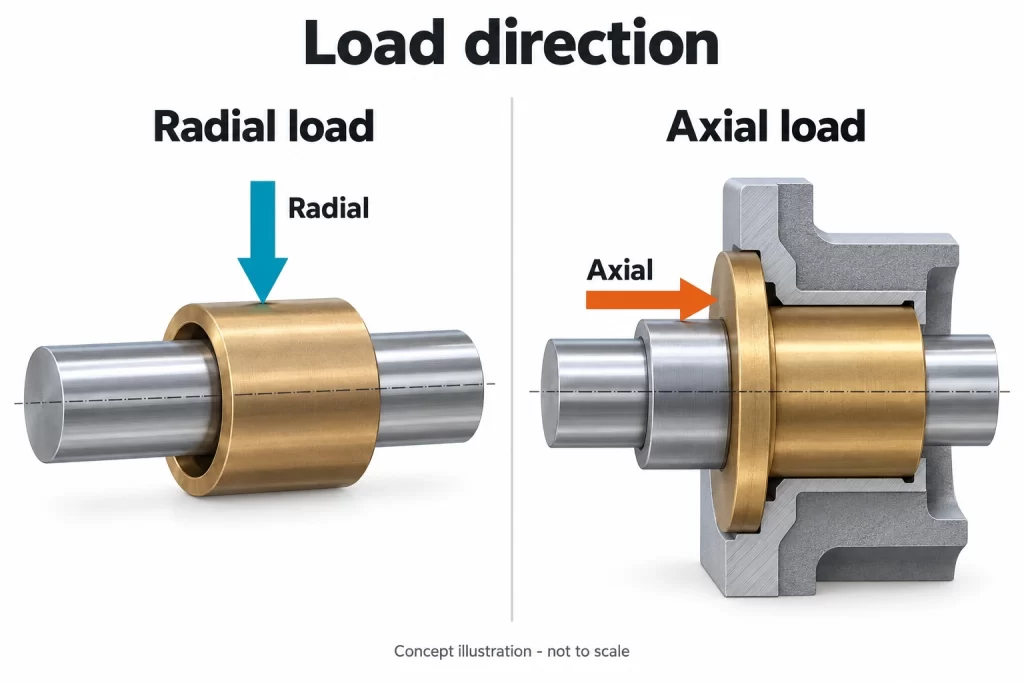
Imagine a pin supported in a bracket, with an arm turning on the pin. The force across the pin is the radial load. A plain cylindrical sleeve can provide the bearing surface for that motion. If the arm also pushes sideways against the bracket, there is an axial contact to deal with.
Now put a flange on the sleeve. You have gained a collar at one end, which can seat against the housing and, with a suitable bearing face and support, accommodate thrust. That may be exactly what the joint needs. It may also be a collar with nothing useful to do.
An application label won’t settle this. “Conveyor pivot” doesn’t tell you whether a separate guide takes the side force. “Hydraulic cylinder eye” doesn’t tell you how the pin is retained. A small section sketch is more useful than either label.
One detail I would underline on that sketch: a single flange stops the bushing moving past the housing face in one direction. Try following a force in the opposite direction on the drawing. Does the fit resist it, or is there another retainer? I would draw a separate arrow along the pin, too. Holding the sleeve in the bracket hasn’t necessarily done anything to keep that pin in place.
2.When I would keep the straight bushing
I’d leave a straight sleeve in contention where a shoulder already sets its position and an existing washer takes the thrust. In that arrangement, what would the proposed flange replace? Unless it removes a part or makes fitting easier, the change may amount to very little.
Space can settle the matter too. As a drawing exercise, add a 2 mm collar to a sleeve that previously sat flush, without moving any of the neighbouring parts. You may discover that the collar occupies space already assigned to something else. You might be able to shorten a spacer, or you might find that the neighbouring arm now fouls the collar. The flange outside diameter needs checking against the bracket as well. The 2 mm figure here is just an example for reading the drawing.
There is also the repair question. I rather like the option of replacing only a worn washer when the sleeve bore is still serviceable, provided access allows it. On another machine, handling one flanged part instead of two loose parts might save assembly time. I wouldn’t call either arrangement cheaper without counting the complete set of parts and the work needed to fit them.
3.What I would check before using a flange for thrust
First, the contact. Which moving face bears on it? Then the support behind it. A collar hanging over an oversized recess is a different proposition from one seated properly against the housing.
After that, the rating. A broad-looking flange is not a load calculation. Ask for the axial limits of the actual material and size, under the intended motion and temperature. For sustained or substantial thrust, put a separate thrust washer or another bearing arrangement alongside it for comparison.
Before crossing a washer or ring off the parts list, write down why it was there. Was the washer the surface the arm rubbed against? Was the ring keeping the pin from coming out? Those are quite different answers. A flange can sometimes simplify an arrangement containing these parts, but it has to cover the particular function being removed. There isn’t a general rule that fitting a flanged bushing lets you discard the ring.
4.A few minutes at the press
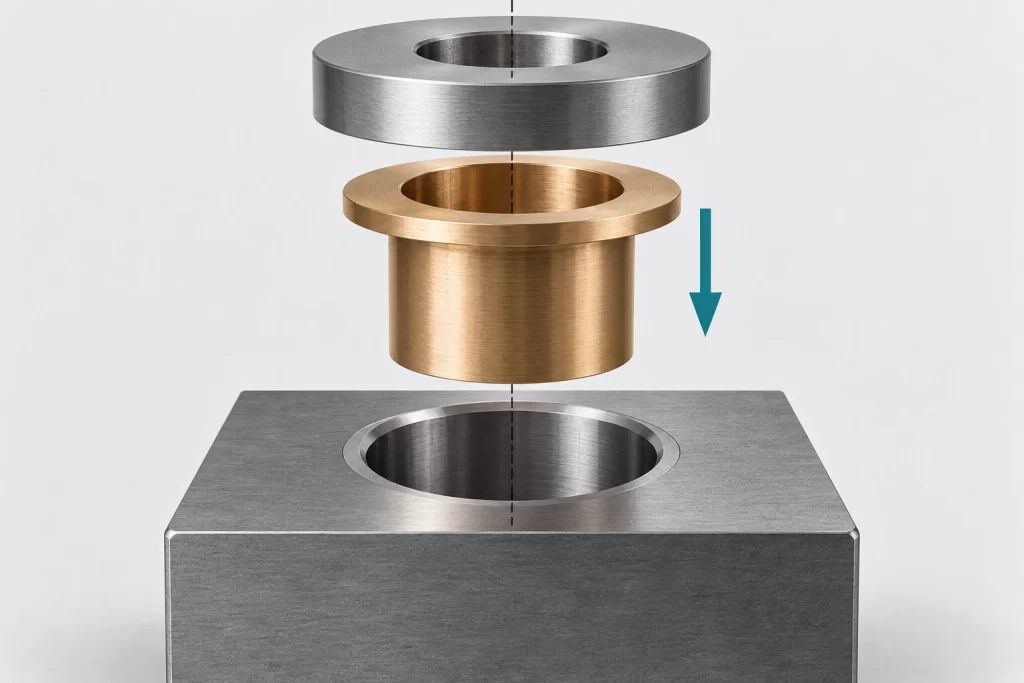
The original sleeve position should be a dimension on the drawing, not something the installer has to guess. A mandrel with a stop, a fixture or a depth measurement can place a straight bushing repeatably. There is nothing inherently blind about the operation.
A flange gives a convenient seating reference, although “press until it stops” still needs care. A burr can create a false stop. A poorly prepared housing face can leave uneven support. I would have the mounting drawing beside the press, especially for the bore-entry chamfer and the relief at the flange root. Opening up that chamfer may ease insertion at the expense of the support behind the collar.
Check the fitted condition, too. Pressing a bushing into its housing can affect the bore. Depth is a different measurement; I wouldn’t blame a tight running fit on depth alone in an otherwise uniform housing bore. And if the arm turns freely until the bolt is tightened, take another look at the spacer lengths. The bolt may be squeezing the moving member. Changing the bushing material won’t correct that stack-up.
5.About the material
The shape is only part of the specification. You can ask about straight and flanged versions within the material family that suits the duty, subject to what is actually available in the required size.
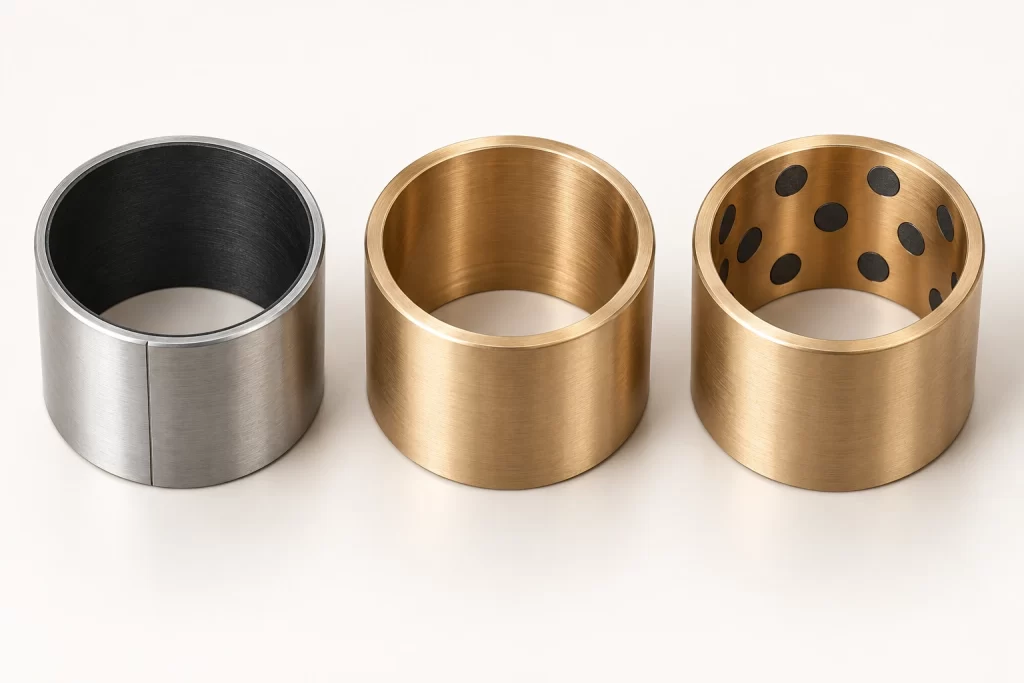
For a joint that will be difficult to grease, a steel-backed PTFE composite is worth investigating. I would ask which grade the quote covers before discussing service life. Then I’d put its published operating limits beside the duty figures and check what shaft finish the supplier specifies. The words “PTFE lining” don’t give you those answers.
With bronze, I’d start by asking which alloy and how lubricant gets to the contact. Grease-fed, oil-fed and graphite-plugged products should not be lumped together just because the metal has the same colour. “Self-lubricating” on a catalogue page doesn’t answer the questions about speed, oscillation or shock.
I would be particularly cautious with the phrase “better in dirt.” Where is the dirt entering? Is there a seal? A greasing schedule might tell you something useful here; an assumption that someone will grease it eventually tells you rather less. I’d sort out the contamination and maintenance arrangements before favouring one material for dirty service.
6.What to send MYWAY
Send the joint drawing with the dimensional enquiry. If I were putting together the email, I would begin with the unanswered question: “The arm bears against this face. Can the proposed flange take that contact under these conditions?” Then I would attach the load and movement figures. A slow reversing movement and continuous rotation are different duties, even when the dimensions match. Notes about temperature, dirt and grease access belong in that email as well. Label any figures you have had to estimate.
For the reply, I’d want a part drawing and a material designation from MYWAY that I could put beside the enquiry. “Bronze” by itself would leave me with another email to write. So would a flanged quote with no information about allowable thrust. There may be a perfectly suitable part in the range, but it needs to be identified before the design can be checked. This gives both sides something specific to discuss.
Two catalogue terms need care here. I wouldn’t take “split” as permission to spring a wrapped sleeve open around an installed shaft. Ask whether the proposed bearing is actually designed for assembly that way. With a double flange, sketch the insertion sequence: how does the second collar get past the housing? If avoiding dismantling is the reason for asking a
7.Questions before the order goes out
“There isn’t any thrust. Can I still specify the flange for easier fitting?”
Yes; you aren’t obliged to load the flange simply because it’s there. In this case the attraction is setting the sleeve position during fitting. I’d still check the collar against its neighbours, including at the ends of the arm’s travel.
“Would adding a collar cure a sleeve that won’t stay put?”
I’d want to know why it moved before ordering the replacement. An enlarged housing bore, for example, doesn’t return to size because the next sleeve has a collar. A flange may restrain movement one way; whether that’s the required fix depends on the fit and the forces in this joint.
Should a heavy load automatically mean bronze?
There’s too much missing from “heavy” to choose a material. I’d send the supplier the peak force, the normal force and the movement over a cycle, with shock events called out separately. Then we could discuss actual grades and sizes instead of trying to rank bronze against every composite bearing ever made.
8.One last look before ordering
Put the quoted part into the assembly drawing, including any washers or rings you intend to keep. I would follow the load arrows once more and walk through fitting the parts in order. A straight sleeve may leave that drawing exactly as it was; a flange may let you simplify it. Either result is useful. The awkward result is discovering, with the parts at the press, that the collar has nowhere to sit.
100000+ Types of Bushings – Contact Us for Details