
Recent Posts
Brass vs Bronze Strength and Bushing Selection
Introduction
Brass and bronze are both copper alloys, but they behave very differently when you put them under load, heat, and friction. This guide cuts through the noise: we compare brass vs bronze strength in real bushing conditions, break down where each material wins (and where it quietly fails), and show you how MYWAY sizes the right alloy to your application—so you stop replacing bushings every few months and start getting predictable service life. If you specify, buy, or maintain bronze bushings, brass bushings, or copper alloy sleeve bearings for construction, agriculture, marine, or industrial machinery, this is written for you.
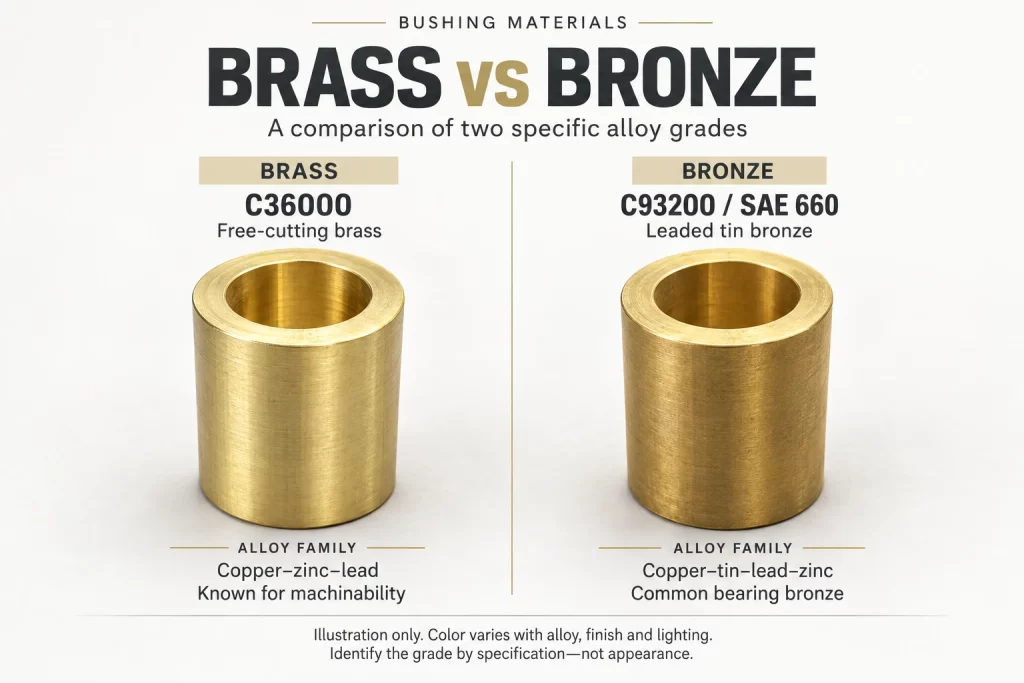
Table of Contents
1. Brass vs Bronze Strength: The Numbers Engineers Actually Use
Let’s skip the vague “bronze is tougher” talk and look at the ranges.
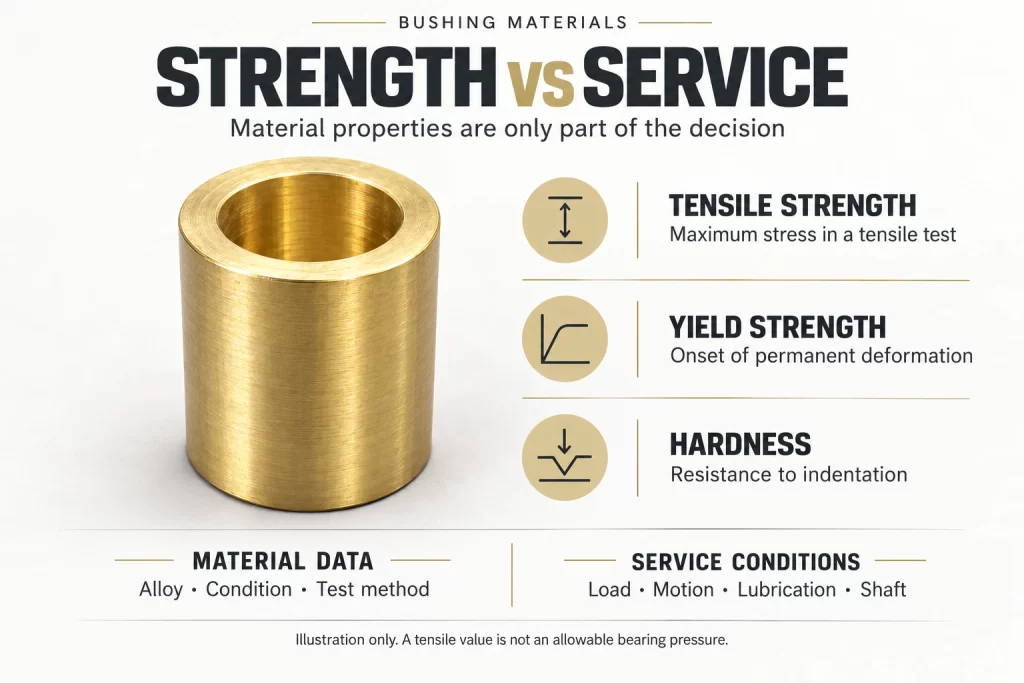
Tensile strength tells you how much pulling stress the alloy can take before it breaks. Yield strength tells you where it stops behaving elastically and starts deforming permanently. For bushings, yield strength and hardness matter more than ultimate tensile strength, because a bushing that yields under load loses its clearance and starts hammering the shaft.
Typical ranges from alloy data:
Brass: tensile strength roughly 338–469 MPa, yield strength roughly 95–124 MPa.
Bronze: tensile strength roughly 350–635 MPa, yield strength roughly 125–800 MPa depending on grade (aluminum bronze and manganese bronze sit at the high end).
That yield-strength gap is the whole ballgame. A C93200 tin bronze bushing (SAE 660) yields around 125 MPa and runs at roughly 65 HB hardness—decent for medium loads. A C86300 manganese bronze bushing jumps to 225 HB hardness and tensile strength north of 750 MPa, built for extreme load at very low speed. A generic free-cutting brass bushing, by contrast, is softer, more ductile, and starts to deform or wear through much sooner under the same load.
So when someone asks “is bronze stronger than brass?”, the honest answer is: yes, across the bearing-grade family, bronze is the stronger structural choice. Brass earns its place on cost and machinability, not on load-bearing muscle.
2. Why “Strength” in a Bushing Is Not Just Tensile Strength
A bushing doesn’t fail like a bolt. It fails by wear, galling, embedment, corrosion, or fatigue cracking. Strength feeds into all of those, but so do friction behavior and microstructure.
Bronze (especially tin bronze and aluminum bronze) has a microstructure that supports low metal-to-metal friction and good embeddability—it can swallow small dirt particles instead of scoring the shaft. That’s why bronze sleeve bearings dominate continuous sliding contact, high-load pivots, and dirty, wet, or high-temperature environments.
Brass is more ductile and machines beautifully. It’s a legitimate choice for light-duty brass bushings in low-load, low-speed, well-lubricated, non-aggressive settings. But brass is more prone to deformation and wear under heavier friction and higher loads. In seawater, standard brass is also vulnerable to dezincification—the zinc leaches out, leaving a weak, porous copper sponge. Naval brass and DZR brass resist this better, but bronze still owns the marine bearing space.
Bottom line: bronze is the safer strength bet for anything that actually carries load and moves. Brass is the efficiency play for lighter duty.
3. Load Capacity and PV: Where Bronze Bushings Separate Themselves
Bushing selection often comes down to PV—pressure × velocity. Push past the material’s PV limit and you get heat, wear, and seizure.
Solid bronze bushings can handle static specific loads up to roughly 150 MPa in suitable grades, far beyond what polymer or composite bearings tolerate. C93200 (SAE 660) is the industry workhorse for medium loads and speeds; C86300 manganese bronze is the go-to for super-high load, low speed, high-duty applications like crushers, excavator pins, and heavy-duty linkages.
Brass bushings generally sit in the light-to-moderate load range. Free-cutting brass might be rated around 45 N/mm² static and 25 N/mm² moving as a greased bushing—useful for low-load mechanisms, but not in the same league as a properly specified bearing bronze.
This is why MYWAY’s approach is alloy-first, not catalog-first. We look at your load, speed, lubrication, shaft hardness, and contamination exposure, then select from tin bronze, leaded bronze, aluminum bronze, manganese bronze, and high-strength brass families to land on a bushing that meets the PV requirement without overbuying material.
4. Corrosion and Temperature: The Hidden Strength Dividers
Strength at room temperature in clean lab air is one thing. Strength in a wet, salty, hot, or chemically aggressive machine is another.
Bronze handles harsh environments far better in bearing service. Aluminum bronze and nickel-aluminum bronze (C95800) are standard for seawater-exposed propeller shaft bearings, rudder bearings, and offshore winches. Tin bronzes comfortably handle service temperatures around 250–300°C, and aluminum bronzes can go from −200°C to +400°C in suitable grades.
Brass is “good” in mild indoor or freshwater conditions, but standard high-zinc brass can dezincify in seawater and chlorinated water. Naval brass improves this, but it’s still not the default for immersion or aggressive chemical exposure.
If your bushing sees mud, salt, chemical splash, or sustained heat, bronze’s corrosion and thermal stability are part of its strength story, not a side note.
5. Eight Reasons B2B Buyers Route Their Bushing Specs Through Us
Here’s where the material science turns into a supply decision. MYWAY has been manufacturing bronze and brass bushings, bearings, and custom copper alloy components since 2005, and we’ve built the product range around the exact pain points that make buyers switch suppliers: inconsistent hardness, bad fit, long lead times, and bushings that fail before the maintenance interval.
1. Full bronze and brass material coverage, not a one-alloy shop.
MYWAY runs standard C93200/SAE 660 bronze bushings in stock, alongside tin bronze, leaded tin bronze, high-leaded tin bronze, aluminum bronze, manganese bronze, phosphor bronze, and silicon bronze options—plus high-strength brass grades where the load and cost case supports them. You’re not forced into a single alloy because that’s what the supplier happens to cast.
2. Bushing formats that match the machine, not the other way around.
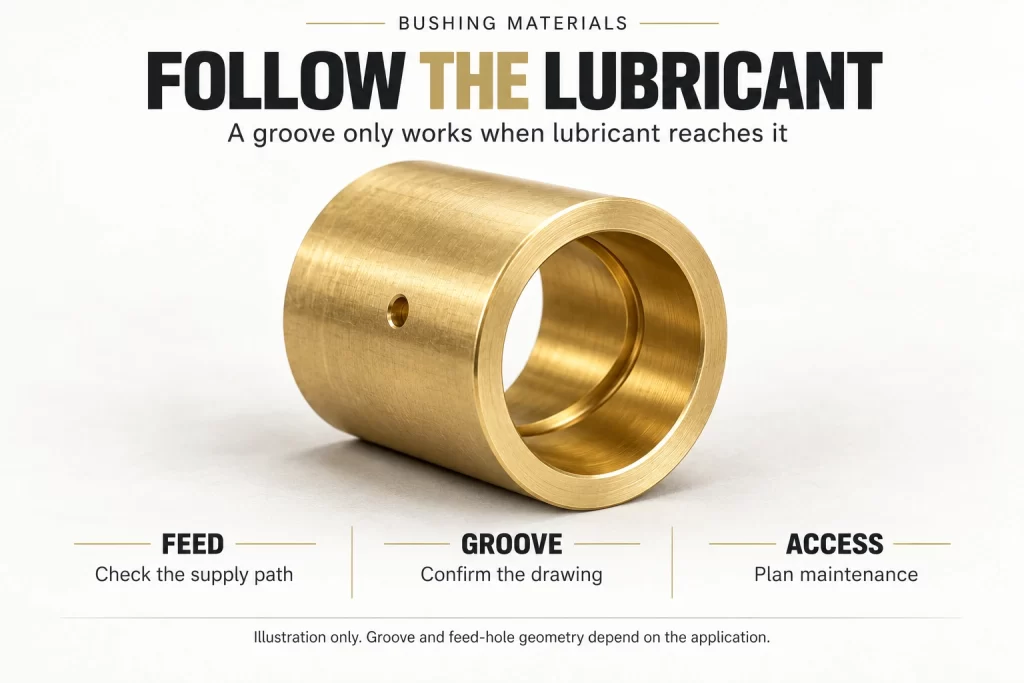
We produce plain sleeve bushings, flanged bushings, thrust washers, wear plates, graphite-embedded bushings, sintered bronze bushings, and bimetal bushings. If your housing needs a flange for axial location, an oil groove for lubrication, or a graphite plug for dry-start protection, that’s a manufacturing detail—not a reason to redesign the joint.
3. Cast and machined under one roof, so hardness and clearance stay honest.
MYWAY’s process goes from high-purity copper alloy melting → precision centrifugal casting → CNC machining → automated polishing and robotic assembly, with CMM and optical inspection verifying dimensions. That vertical control matters because bronze bushing strength is only useful if the wall thickness, interference fit, and bore clearance are actually in spec. A hard bushing with a sloppy bore will still fail early.
4. Alloy selection support based on load, speed, and environment—not guesswork.
We keep the conversation practical: what is the load, is it continuous or shock, what is the sliding speed, how is it lubricated, what is the shaft material and hardness, and what is the contamination/corrosion exposure? From there we match the grade—C93200 for general medium-duty, C86300 for extreme load at low speed, aluminum bronze for seawater, high-strength brass for cost-sensitive heavy-duty construction joints.
5. IATF/ISO-certified production and export experience across 40+ countries.
MYWAY is IATF/ISO certified and ships to 40+ countries, with experience in construction, agricultural, automotive, marine, and general industrial machinery. For B2B buyers, that means your purchasing team isn’t explaining a first-time export to a new factory; the documentation, packaging, and logistics pattern already exist.
6. Custom sizes and non-standard geometries without punishing lead times.
We hold 2000+ bushing molds and can produce large bronze bushings up to 20 inches in diameter, small precision bushings under 2 inches ID, and thin-wall aluminum bronze bushings under 2 mm wall thickness. If your drawing is non-standard, the answer is a machining plan, not a “no.”
7. Self-lubricating and low-maintenance options for hard-to-reach joints.
Bronze’s natural lubricity is a real strength advantage, but MYWAY extends it with graphite-embedded bronze, PTFE-lined bronze, and sintered bronze bushings that hold oil in a connected porosity structure. For pivot points that can’t be greased on schedule, that’s the difference between a bushing that survives and one that seizes.
8. A quote that reflects the application, not just the alloy price per kilo.
Brass is cheaper per kilogram. Bronze costs more upfront. But the cost that matters is cost per operating hour. A C86300 manganese bronze bushing that lasts four times longer under shock load can be the cheaper decision even at a higher piece price. MYWAY quotes with that lifecycle math in view—so you can defend the purchase internally.
6. Quick Selection Matrix: When Brass Wins, When Bronze Wins
| Operating condition | Brass bushing | Bronze bushing |
|---|---|---|
| Light load, low speed, intermittent motion | ✅ Cost-effective, easy to machine | Overkill for the load |
| Sustained radial load, continuous sliding | ❌ Deforms/wears faster | ✅ Bronze’s strength and wear resistance win |
| Shock load or high PV | ❌ Not the right family | ✅ Manganese bronze / aluminum bronze |
| Seawater, chemical splash, high humidity | ⚠️ Naval/DZR brass only; standard brass dezincifies | ✅ Aluminum bronze / nickel-aluminum bronze |
| High temperature (250°C+) | ⚠️ Limited | ✅ Tin bronze and aluminum bronze |
| Dry-start or infrequent lubrication | ⚠️ Needs external lube | ✅ Graphite/PTFE bronze or sintered bronze |
| Tight budget, high-volume, low-stress | ✅ Brass is the efficiency play | Higher piece price, longer life |
The pattern is clear: brass is the light-duty cost play; bronze is the load-bearing strength play. If your application sits anywhere near the “sustained load + motion + contamination” zone, bronze is the material you’ll regret not choosing the first time.
7.FAQ: Brass vs Bronze Strength and Bushing Selection
Q: Is bronze always stronger than brass?
A: In bearing-grade alloys, bronze is generally stronger, harder, and more wear-resistant than standard brass. But “strength” depends on grade: a high-strength brass like C86300 (manganese bronze) is stronger than a soft tin bronze. The useful comparison is always specific alloy vs specific alloy at specific operating conditions, not the family name alone.
Q: Can I replace a bronze bushing with a brass bushing to save cost?
A: Only if the application is genuinely light-duty—low load, low speed, good lubrication, no shock, no aggressive corrosion. In a load-bearing pivot or a continuous sliding joint, a brass substitution usually trades a lower piece price for a shorter replacement interval and more downtime. Run the cost-per-hour math before switching.
Q: Which is better for seawater, brass or bronze?
A: Bronze, without much debate. Standard brass is susceptible to dezincification in seawater; aluminum bronze and nickel-aluminum bronze are specifically used for marine bearing service. Naval brass improves corrosion resistance, but bronze remains the safer marine bushing specification.
Q: Does higher hardness always mean a better bushing?
A: No. Hardness helps wear resistance, but a bushing also needs embeddability (to swallow dirt), conformability (to forgive minor misalignment), and compatibility with the shaft. A very hard bronze running on a soft shaft can wear the shaft. That’s why MYWAY matches hardness to shaft hardness and operating conditions rather than simply quoting the hardest alloy available.
Q: What information do I need to send MYWAY for an accurate bushing quote?
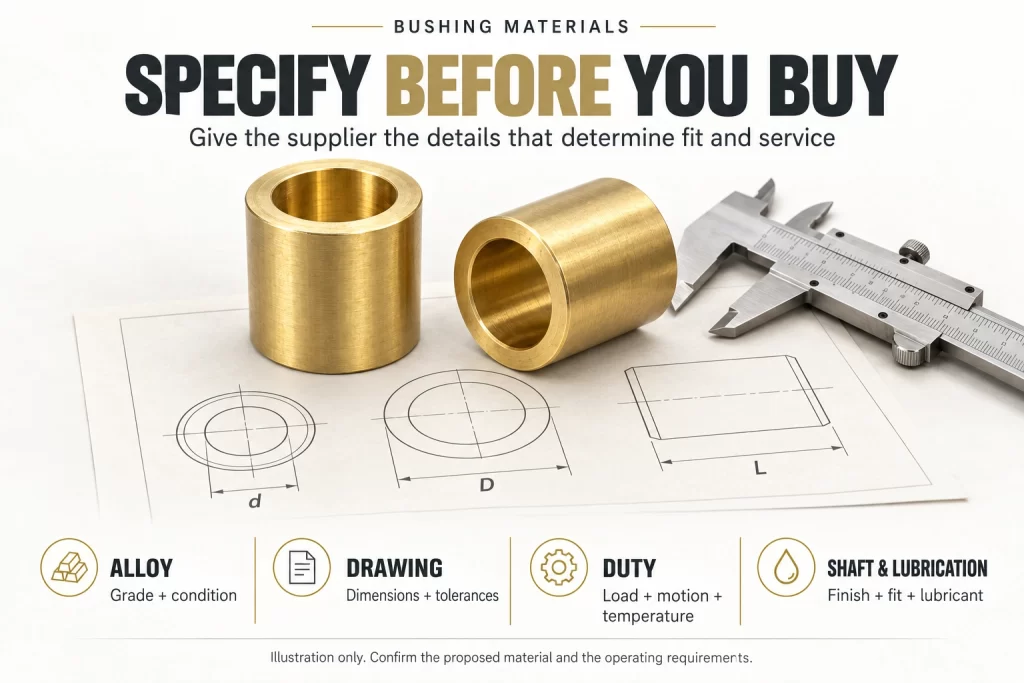
A: Send the drawing or dimensions (ID, OD, length, flange details), quantity, material preference or operating conditions, load type (radial/thrust/shock), sliding speed, lubrication method, shaft hardness, and environment (indoor/marine/chemical/high-temp). If you don’t have all of it, tell us the application and we’ll help narrow the alloy and geometry.
Ready to Stop Guessing on Bushing Strength?
100000+ Types of Bushings – Contact Us for Details