
Recent Posts
Bushing vs Bearing: Stop Guessing – Pick the Right One for Long-Lasting Performance
Introduction:
When building or maintaining machinery, one question comes up again and again: Bushing or bearing — what’s the difference, and which one is right for my application?
Here’s the honest truth: a bushing is a type of bearing. Specifically, it‘s what engineers call a “plain bearing” or “sleeve bearing.” But not every bearing is a bushing — ball bearings and roller bearings work differently, cost more upfront, and serve different purposes–. Understanding the real difference between these two categories isn’t just technical trivia — it’s the key to lower maintenance costs, fewer breakdowns, and longer equipment life.
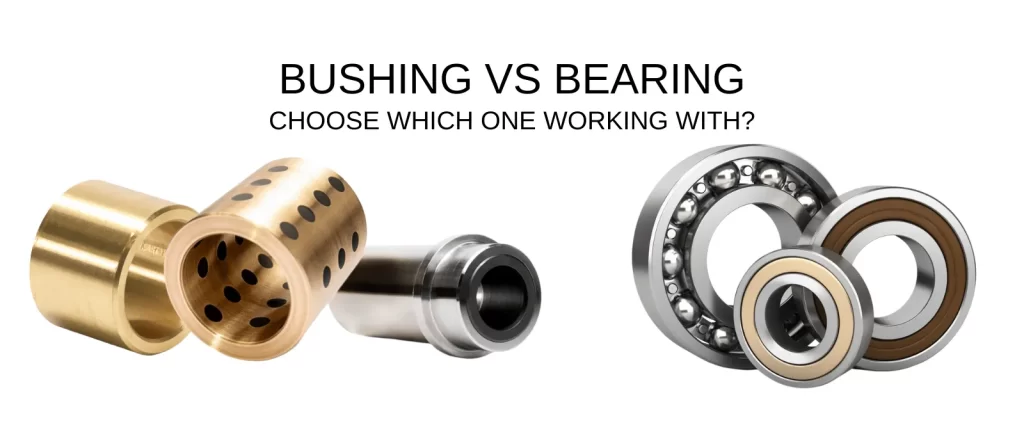
Table of Contents
1. Bushing vs Bearing – What’s Actually Different?
Bearings (Ball and Roller)
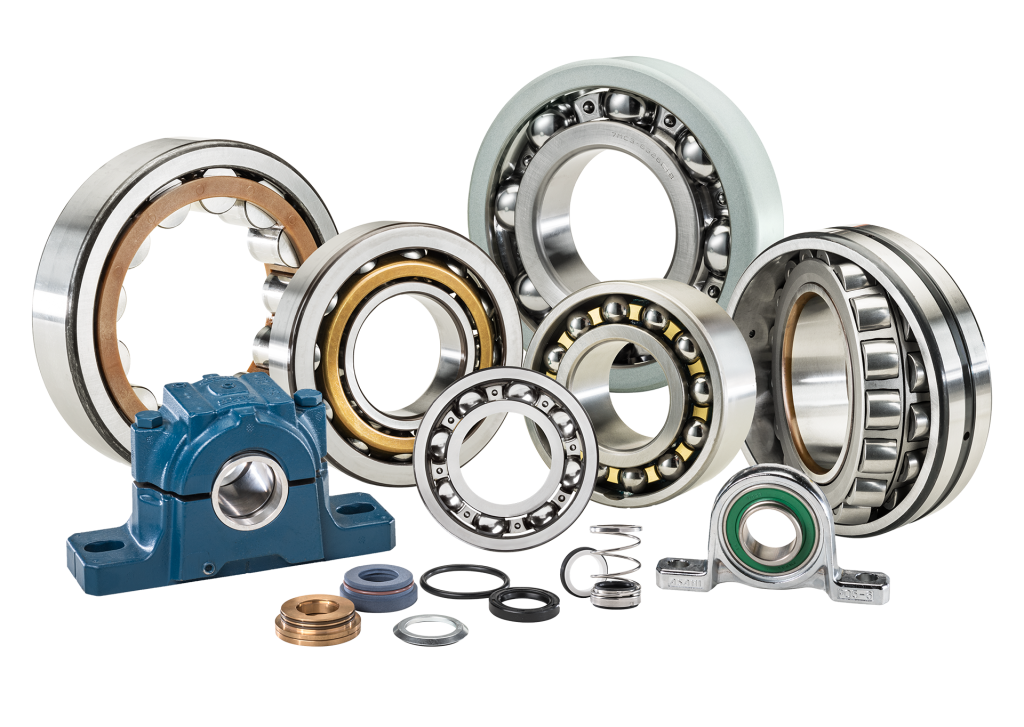
Bearings use rolling elements — steel balls or cylindrical rollers — sandwiched between an inner race and an outer race. The rolling action keeps friction incredibly low, which makes bearings excellent for high-speed applications where efficiency matters most.
Common bearing types include:
Ball bearings – great for combined radial and axial loads at high speeds
Roller bearings – stronger than ball bearings for heavy loads, thanks to line contact vs point contact
Needle bearings – thin, compact, and tough for oscillating motion in tight spaces
Tapered roller bearings – handle both radial and axial loads simultaneously
Ball bearings currently dominate the market with a 41.71% share thanks to their low cost and wide industrial use, while roller bearings remain the go-to choice in mining and construction equipment where shock loads are a daily reality
Bushings (Plain Bearings / Sleeve Bearings)
Bushings are single-piece cylindrical sleeves with no rolling parts. Instead of balls or rollers, the shaft slides directly against the bushing’s inner surface, which is specially engineered to minimize friction. Because there are no moving parts inside a bushing, the design is dramatically simpler, cheaper to manufacture, and far less sensitive to contamination–.
That said, sleeve bearings perform best in low-to-moderate speed applications with heavier loads. They can also handle shock and vibration far better than ball bearings, which can suffer from brinelling (surface damage) and premature failure under impact conditions–.
Quick Comparison Table
| Factor | Bushings (Plain Bearings) | Ball/Roller Bearings |
|---|---|---|
| Motion type | Sliding | Rolling |
| Moving parts | None (single piece) | Multiple (races + rolling elements) |
| Best for | Low speed, heavy load, shock/vibration | High speed, light-to-medium load, precision |
| Lubrication | Often self-lubricating | Usually requires external lubrication |
| Maintenance | Low to none | Regular lubrication and inspection |
| Initial cost | Low to moderate | 25–400% higher than bushings |
| Noise level | Very quiet | Can be noisier at high speeds |
| Contamination sensitivity | Low | High (dirt destroys bearings quickly) |
Introduction
2. Material Matters – What Your Bushing Is Made Of Changes Everything
Even if you decide a bushing is the right choice for your application, the material choice will make or break your results. Here’s how the most common bushing materials compare in real-world conditions.
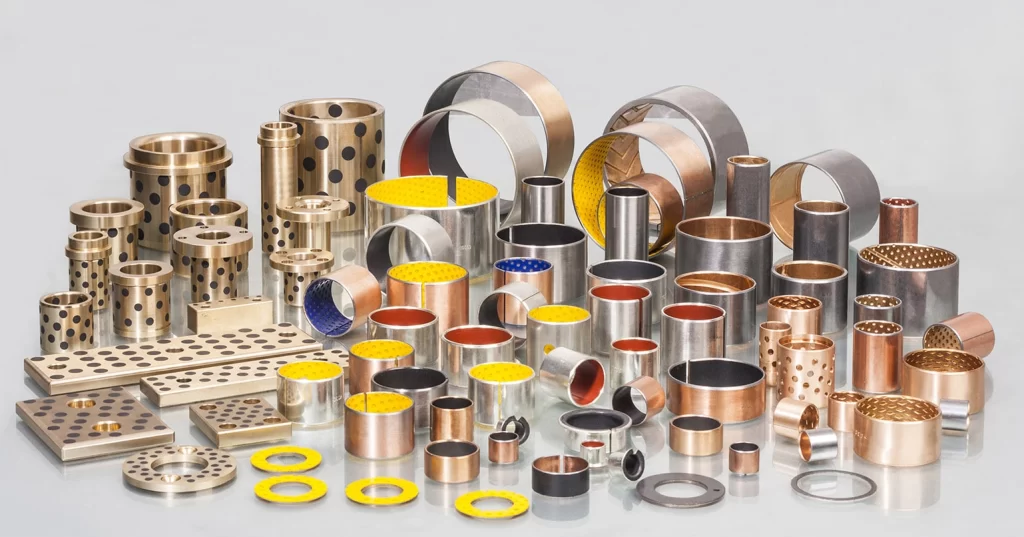
Bronze Bushings (The Heavy-Duty Classic)
Bronze bushings have been around forever because they simply work. They offer exceptional durability, high load-bearing capacity, and natural resistance to corrosion and deformation–. Alloys like CuSn8P (phosphor bronze) deliver tensile strengths of 340–490 MPa, making them suitable for high-load, low-speed industrial applications ranging from heavy machinery to marine equipment.
Downside: Bronze bushings usually require lubrication — often frequent lubrication — which adds maintenance cost, labor, and risk of contamination in clean environments.
PTFE Bushings (Low Friction, Self-Lubricating)
PTFE (polytetrafluoroethylene) — better known by its brand name Teflon™ — is the standard-bearer for low-friction, self-lubricating applications. PTFE bushings operate without external grease or oil, making them ideal for hard-to-reach assemblies and industries where lubricant contamination is a serious concern (food processing, textiles, medical equipment). They’re also chemically resistant and corrosion-proof–.
However, pure PTFE bushings wear faster under heavy loads and high temperatures compared to metal alternatives.
Metal-Polymer Composite Bushings (Best of Both Worlds)
Metal-polymer composite bushings represent a hybrid approach — typically a steel or bronze backing layered with a PTFE-based sliding surface. This design gives you the structural strength of metal and the friction-reducing, self-lubricating properties of polymer in one component. They’re maintenance-free, thin-walled, and perfect for applications where minimal friction is the priority.
Graphite-Embedded and Oil-Impregnated Bushings
These bushings are designed to lubricate themselves over an extended period. Oil-impregnated (sintered) bronze bushings use a porous metal structure that acts like a sponge — it soaks up oil and releases it gradually during operation–. Graphite-embedded bushings provide solid lubricant that continuously reduces friction even in high-temperature or low-speed conditions where grease would break down or squeeze out.
Plastic / Polymer Bushings (The Lightweight Contender)
Modern engineering plastics like nylon, POM (acetal), and UHMW PE have carved out a strong niche for lightweight, corrosion-resistant, low-maintenance applications. They’re best suited for light-to-medium loads at moderate speeds and often incorporate PTFE or other solid lubricants for self-lubricating properties.
But be careful: cheaper off-the-shelf plastic bushings can soften or permanently deform under high temperatures (such as e-painting processes) and may crack under high loads.
Material Selection at a Glance
| Material | Load Capacity | Self-Lubricating | Cost | Best For |
|---|---|---|---|---|
| Bronze | Very high | No (requires oil/grease) | Moderate | Heavy industrial, marine |
| PTFE | Low-moderate | Yes | Low-moderate | Clean/dry environments, friction-sensitive |
| Metal-polymer composite | High | Yes | Moderate | Rotating/oscillating low-friction apps |
| Graphite bronze | High | Yes | Higher | High-temp, low-speed, hard-to-reach |
| Sintered (oil-impregnated) | High | Yes (via oil) | Moderate | Automotive, general machinery |
| Engineering plastic | Low-moderate | Yes | Low | Light-duty, corrosion-prone environments |
3. Real-World Performance – Speed, Load, Environment
Choosing between a bushing and a bearing comes down to three questions:
1. Speed — fast or slow?
Ball bearings dominate high-speed applications — think electric motors, compressors, pumps, and fans operating at thousands of RPM–. Their rolling friction is roughly ten times lower than plain bearings, which translates directly into energy efficiency–.
But if your machine runs at low speeds, or worse — oscillates, starts and stops frequently, or operates in short stroke linear motion — bushings often outlast bearings. Plain bearings don‘t suffer from the “startup torque” issues or raceway damage that plague rolling bearings under frequent stop-start cycles.
2. Load — heavy or light?
Ball bearings handle light-to-medium loads well. Roller bearings step up the capacity with line contact instead of point contact. But for truly heavy loads at low speeds — especially under shock or vibration — nothing beats a well-designed bushing–.
Bushings carry load over an area rather than at rolling contact points. That distributed load path makes them far less prone to brinelling, fracture, or permanent deformation under extreme conditions. Need proof? Heavy machinery, excavators, agricultural equipment, wind turbines, and offshore rigs rely on bushings — not ball bearings — for their most critical, high-load pivot points.
3. Environment — clean or dirty? Wet or dry?
This is where bushings shine. A ball bearing exposed to dust, dirt, sand, or water will fail quickly — the rolling elements grind contaminant particles into the raceways, leading to rapid wear and seizure. Bushings, especially self-lubricating designs, are far more tolerant of contamination. Many operate successfully for years in agricultural fields, construction sites, food plants, marine environments, and even underwater applications without failing–.
Industry Applications Side-by-Side
| Industry | Common Application | Recommended Type | Why |
|---|---|---|---|
| Automotive | Engine bearings, transmissions | Bushings (plain/journal) | High loads, shock, limited space |
| Automotive | Wheel hubs, electric motors | Ball bearings | High speed, precision needed |
| Aerospace | Control linkages, landing gear | Bushings + specialty | Shock, vibration, reliability critical |
| Construction | Excavator pivots, hydraulic cylinders | Heavy-duty bushings | Extreme loads, dirty environment |
| Food processing | Conveyors, mixers, packaging | Self-lubricating bushings | No lubrication contamination, washdown-friendly |
| Wind energy | Pitch/yaw systems | Maintenance-free bushings | Remote locations, low-speed oscillation |
| Medical devices | Imaging equipment, surgical tools | Precision bushings | Quiet, clean, no external lubricants |
| Marine | Rudders, propeller shafts | Corrosion-resistant bushings | Saltwater, continuous submersion |
4. The Rise of Self-Lubricating Maintenance-Free Solutions
Ask any plant manager or maintenance engineer what they want most from their bearings, and the answer is almost always the same: less lubrication. Manual greasing costs time and labor. Contamination risk goes up every time a fitting is opened. And in hard-to-reach spots, consistent lubrication is nearly impossible.
That‘s why the industry is shifting decisively toward self-lubricating and oil-free bushing technologies.
Self-lubricating bushings incorporate solid lubricants — such as PTFE, graphite, or molybdenum disulfide — directly into the bearing material. In advanced designs, microscopic lubricant particles are embedded in millions of tiny chambers throughout the component. As the shaft rotates, these chambers release minute amounts of lubricant exactly where it’s needed, maintaining an ultra-low coefficient of friction for the entire service life without any external grease or oil.
The benefits are compelling:
Zero lubrication labor — no greasing schedules, no forgotten fittings
Cleaner operation — no oil leaks or grease contamination in food, textile, or cleanroom environments
Greater reliability — eliminates the #1 failure mode of conventional bearings (lubrication starvation)
Lower total cost of ownership — fewer spare parts, less downtime, longer intervals between replacements
Market data confirms the trend. Global bearings market size is projected to reach 158.5billionin2026(up8.8158.5billionin2026(up8.8221.5 billion by 2030 driven by automation, electric vehicles, renewable energy, and predictive maintenance. Among all bearing types, plain bearings have carved out a significant segment serving corrosive marine, chemical, food processing, and other demanding industrial applications where oil-free, low-maintenance operation is non-negotiable
5. Making the Right Choice – A Practical Decision Framework
Still unsure whether your application needs bushings or bearings? Run through this simple checklist:
 What’s your operating speed?
Over 10,000 RPM → lean toward ball/roller bearings.
Under 1,000 RPM or oscillating → bushings are likely better.- How heavy is the load?
Light-to-moderate → bearings work well.
Heavy loads, especially with shock/vibration → bushings will outlast bearings, period. - How clean is your environment?
Clean workshop → either option works.
Dusty, wet, sandy, or chemically aggressive → self-lubricating bushings will dramatically outlast rolling bearings. - Can you lubricate regularly?
Yes, and you have a maintenance team → bearings are fine.
No, or lubrication is inconsistent or messy → go with maintenance-free bushings. - What‘s your budget?
Tight upfront budget → bushings cost 25–400% less initially–.
Lower long-term TCO is the goal → self-lubricating bushings win on reduced maintenance and downtime. - Is noise a concern?
Yes → bushings are significantly quieter than ball/roller bearings
6. Why High-Quality MYWAY Bushings Might Be Exactly What You Need
Not all bushings are created equal. A cheap, off-the-shelf plastic bushing might save you fifty bucks today — but if it cracks under load, softens in high heat, or wears out in six months, the true cost of replacement labor and downtime will dwarf the initial savings.
That’s where MYWAY comes in.
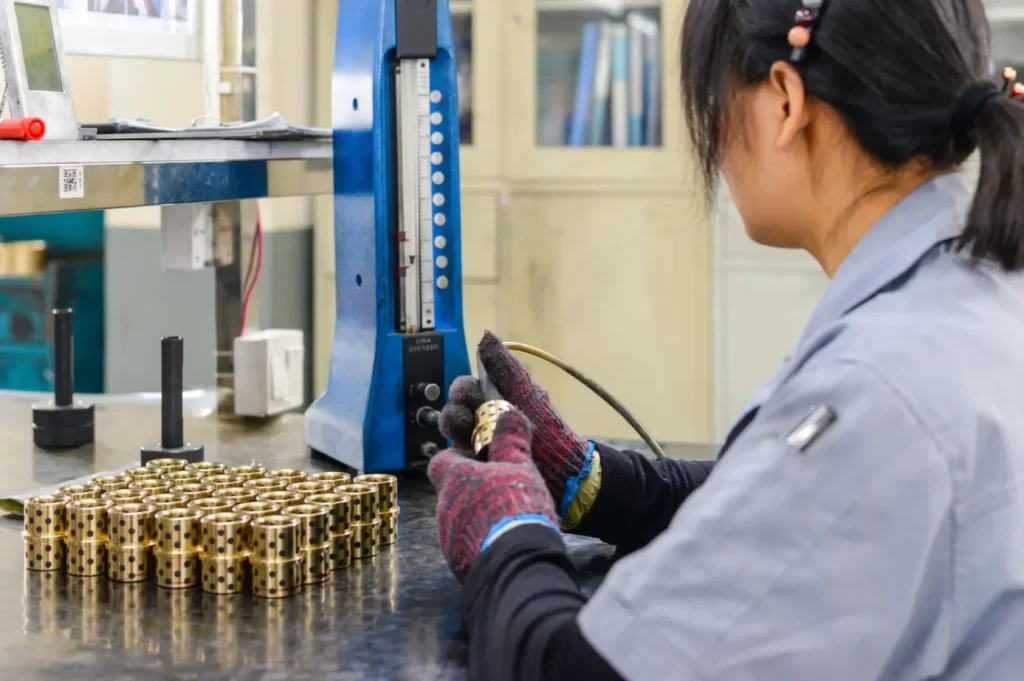
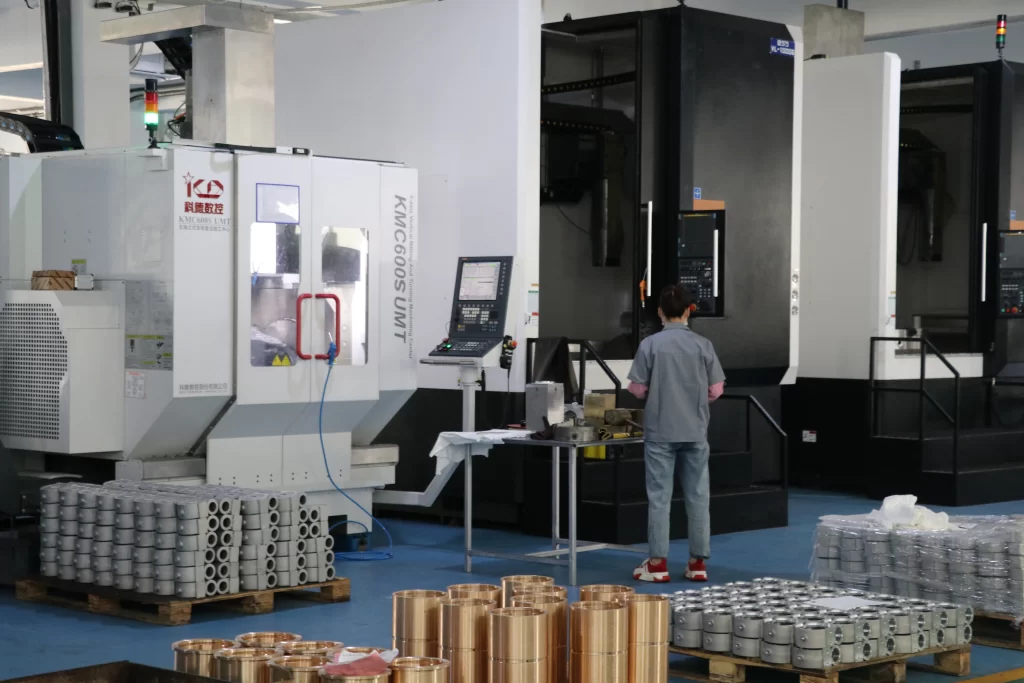
MYWAY has built its reputation on precision-engineered bushings that solve the real-world problems engineers face every day. Whether you’re designing heavy industrial equipment, maintaining agricultural machinery, upgrading a conveyor system, or building out a renewable energy installation, MYWAY offers the durability, consistency, and performance you need.
Why MYWAY Bushings Stand Out
1. Built for tough conditions – Extreme loads, temperature swings, chemical exposure, humidity, dust — MYWAY bushings are engineered from high-performance materials to take whatever your application throws at them. Bronze-backed, metal-polymer composite, graphite-embedded, and PTFE-lined options cover everything from dry-running oscillation to fully submerged marine service.
2. Self-lubricating options that truly work – MYWAY’s maintenance-free bushing designs eliminate greasing schedules, reduce contamination risk, and keep your machinery running longer between service intervals. The low-friction surface technology delivers a consistent coefficient of friction for the entire life of the component — no performance drop-off as the hours add up.
3. Quiet, reliable operation – No rattling. No stick-slip. No unpredictable torque spikes. MYWAY bushings provide smooth, controlled motion whether you’re rotating, oscillating, or making short linear strokes — all while keeping noise levels to an absolute minimum.
4. OEM-grade quality at competitive pricing – You don’t need to overpay for name-brand components that come off the same production lines. MYWAY applies rigorous quality control, precise tolerancing, and proven material science to deliver bushings that meet or exceed OEM specifications — at a price that makes sense for your bottom line.
5. Expert guidance when you need it – Not sure which material, clearance, or geometry your application requires? MYWAY‘s team of applications engineers speaks your language. They’ll help you match the right bushing to your speed, load, environment, and service-life targets — saving you from expensive trial and error.
Upgrade Your Bearings Without Upgrading Your Budget
When you spec MYWAY bushings, you’re not just buying a component — you‘re investing in reliable uptime, lower maintenance costs, and peace of mind. For applications where rolling bearings are overkill (or where they won’t survive the environment), MYWAY delivers a smarter, simpler, more robust solution.
Bronze bushings – Unbeatable for pure strength in high-load, low-speed industrial use
PTFE / polymer bushings – Clean, quiet, self-lubricating — perfect for food, medical, and electronics
Metal-polymer composites – The sweet spot: strength + low friction + maintenance-free operation
Custom sizes and configurations – Have a unique application? MYWAY works with you to get the fit and performance exactly right
7. Frequently Asked Questions
Q1: Is a bushing a bearing or not?
Technically, yes — a bushing is a type of bearing (specifically a plain bearing or sleeve bearing). The key is understanding that not every bearing is a bushing. Bushings slide; ball bearings roll.
Q2: Which is better — bushings or bearings?
There’s no universal “better” — there’s only “better for your specific application.” For high speed, choose ball/roller bearings. For heavy loads, shock, vibration, dirty environments, or self-lubricating needs, bushings are usually the better choice.
Q3: Are bronze bushings better than plastic bushings?
Depends on your requirements. Bronze handles higher loads and temperatures but typically requires lubrication. Plastic (especially PTFE/composite) is self-lubricating, lightweight, and corrosion-proof — but has lower load limits. For demanding industrial applications, bronze or metal-polymer composite bushings are often the right choice.
Q4: What does “PV rating” mean in bushing selection?
PV stands for Pressure × Velocity. It’s a material’s maximum allowable combination of load (pressure) and surface speed before excessive heat or wear occurs. Pushing beyond a bushing’s PV rating leads to rapid failure.
Q5: How do I know the right shaft tolerance and fit for my bushing?
As a general rule, aim for a shaft tolerance of h9 and a housing bore tolerance of H7. After press-fit installation, running clearance should be verified — but let your application engineer confirm the exact numbers.
Q6: Can I replace a ball bearing with a bushing?
Sometimes yes — but only if you fully understand the load, speed, and environmental differences. Bushings are not drop-in replacements for high-speed rotating applications. Consult an engineer before switching component types.
Q7: How long do self-lubricating bushings last?
Service life depends on load, speed, temperature, and environmental factors. In many oscillating and low-speed applications, a properly selected self-lubricating bushing will outlast the machine itself.
Q8: What makes MYWAY bushings different from generic bushings?
Consistency, material quality, engineering support, and real-world durability testing. MYWAY bushings are manufactured to precise tolerances with proven material formulations — not cost-cut to the minimum acceptable standard.
8. Conclusion
Bushings and bearings each have a place in modern machinery. Neither is universally superior — the only mistake is choosing without understanding your speed, load, environment, and maintenance capabilities.
If your application involves heavy loads at low speeds, significant shock or vibration, contaminated or wet conditions, or unwillingness to tolerate frequent lubrication — then bushings are not a compromise. They’re the right engineering solution.
And when you’ve decided that bushings are the way to go, MYWAY delivers the quality, selection, and technical support you need to spec with confidence.
Don’t guess. Don’t settle. Get in touch with MYWAY today — tell us about your application, and let’s find the bushing solution that keeps your machinery running reliably for years to come.
100000+ Types of Bushings – Contact Us for Details