Recent Posts
How to Choose the Right Excavator Bushing for Every Job: A Complete Material Selection Guide
Introduction
Excavator bushings are small, inexpensive components that quietly protect the most expensive parts of your machine. When they fail early, the damage cascades: pins wear, bores egg out, linkages loosen, and suddenly you’re facing a welding torch and a four-figure repair bill instead of a quick parts swap. This guide breaks down exactly how to select the right bushing for your specific working conditions. We’ll cover material science in plain language, walk through eight critical selection factors, and show you which bushing materials actually hold up in abrasive soil, heavy rock, wet coastal sites, and high-impact demolition. Whether you run a Komatsu PC200 in a sand pit or a CAT 320 breaking concrete all day, this article will help you stop guessing and start spec’ing the right bushing the first time.
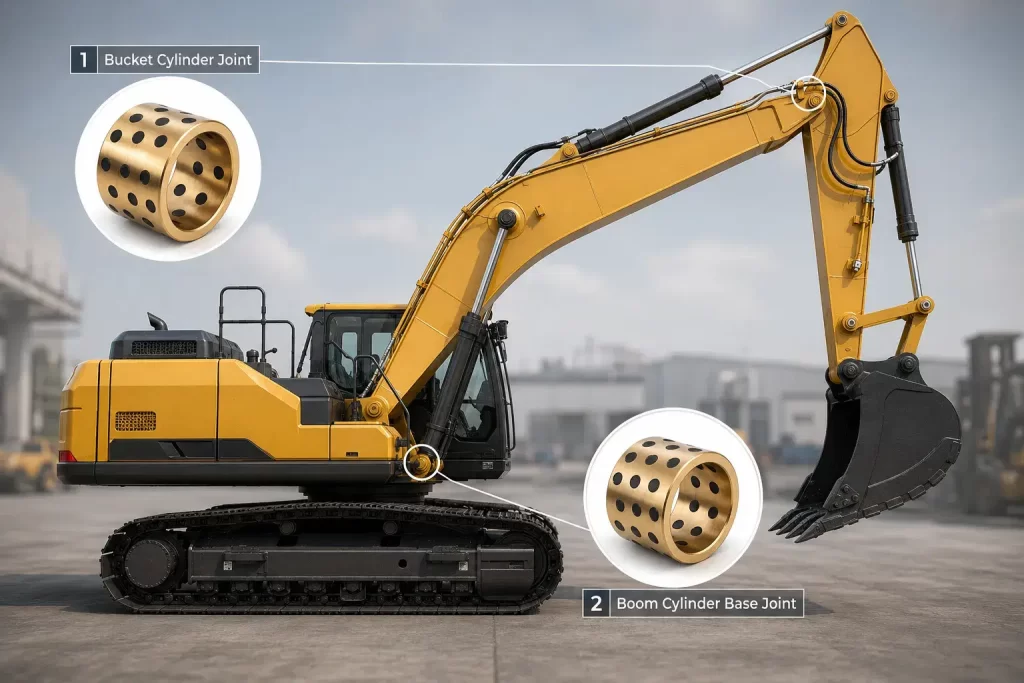
Table of Contents
1. Why the Right Excavator Bushing Matters More Than You Think
Let’s start with an uncomfortable truth: most premature bushing failures aren’t manufacturing defects. They’re selection errors. Someone ordered “a bushing” without asking what the machine actually does all day.
A bucket bushing is a cylindrical sleeve pressed into the hinge point of your bucket, stick, or boom. It sits between the pin and the bore, acting as the sacrificial wear surface. The pin rotates inside it. The bushing takes the abuse so your expensive structural components don’t have to.
When a bushing wears out, the clearance between pin and bore increases. That creates play in the linkage. Play causes impact loading. Impact loading cracks pins, deforms bores, and turns a $50 part replacement into a $5,000 line-boring job. The bushing is the cheapest component in the joint and the most important one to get right.
The cost calculus is brutal in its simplicity: you can pay $30 for a quality bushing now, or pay $300 for a cheap one that fails in 300 hours and takes a pin and a bore with it.
2. Understanding What Your Excavator Bushing Actually Does
Before diving into material specs, it helps to understand the job your bushing performs. It’s not just a spacer. A properly specified bushing does four things simultaneously:
It reduces friction. The pin pivots inside the bushing, not inside the bore. A smooth, properly lubricated bushing surface lets the pin rotate freely without galling or seizing.
It absorbs contamination. This is where material choice gets interesting. Hardened steel bushings are strong, but they have poor “embeddability.” If a grain of quartz sand gets between the pin and a steel bushing, it scores the pin like a file. Bronze bushings are softer than the pin, so they embed foreign particles instead of pushing them into the pin surface. The bushing sacrifices itself to save the pin. That’s the entire point.
It maintains alignment. Worn bushings let the bucket flop around. That’s not just annoying—it destroys digging accuracy, accelerates wear on adjacent components, and creates safety hazards.
It carries load. Different bushing materials handle different load profiles. A tin bronze bushing that works fine on a mini-excavator linkage will deform under the bucket cylinder of a 40-ton mining excavator. The load will find the weakest link.
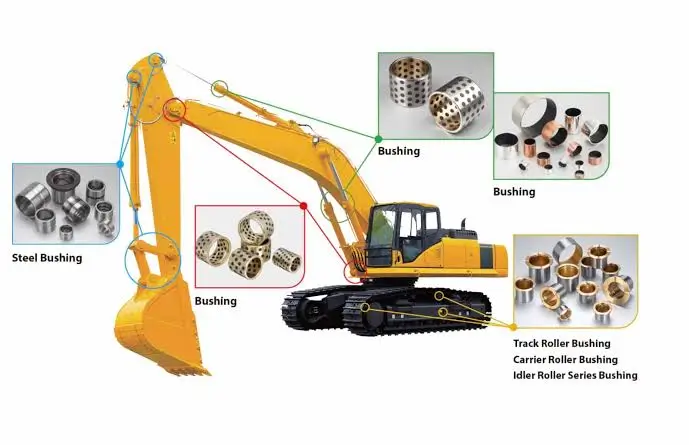
3. The Core Materials: Steel vs. Bronze vs. Specialty Alloys
Hardened Steel Bushings
Alloy steel bushings—typically 4140, 40Cr, or 45# carbon steel—are the workhorses of modern construction equipment. They offer the highest load capacity and impact resistance when properly heat-treated. The typical spec calls for case hardening to 55–62 HRC, which gives you a hard, abrasion-resistant surface with a tough, shock-absorbing core.
Where steel wins: High-impact applications where the joint takes pounding loads—hydraulic breaker attachments, demolition buckets, mining shovel linkages. Steel also wins on cost. A hardened steel bushing costs less than a comparable bronze alloy.
Where steel fails: Steel bushings need consistent lubrication. Without grease, they gall and seize. They also have zero tolerance for contamination. Sand between a steel pin and steel bushing turns the joint into a grinding mill. And steel bushings don’t forgive misalignment—edge loading will crack or spall the surface.
Tin Bronze (Leaded Tin Bronze / SAE 660)
SAE 660 is the classic bearing bronze. It’s a copper-tin-lead alloy with roughly 6–8% lead content. That lead does something important: it acts as a solid lubricant when the grease film breaks down. The material is relatively soft—around 65 Brinell hardness—which gives it excellent embeddability.
Where tin bronze wins: Moderate-load, grease-lubricated pivots. Conveyor idlers, linkage pins on smaller machines, applications where contamination is present but loads aren’t extreme. The self-lubricating property of the lead content provides a safety margin if someone misses a grease interval.
Where tin bronze fails: High-impact applications will deform tin bronze. The material’s maximum recommended dynamic bearing pressure is around 2,000 psi. Exceed that with shock loading, and you’ll see oval deformation and premature failure.
Aluminum Bronze (C95400, C95500, C63000)
This is the heavy hitter. Aluminum bronze alloys contain 10–11.5% aluminum with iron and nickel additions. They’re significantly stronger than tin bronze—tensile strength around 85 ksi versus 35 ksi for SAE 660. Hardness jumps to roughly 170 Brinell. Maximum dynamic bearing pressure exceeds 4,000 psi.
But aluminum bronze’s real advantage in excavator applications is its combination of strength, corrosion resistance, and anti-galling behavior. It handles edge loading better than hardened steel, which tends to crack under misalignment. In backhoe-loader hydraulic cylinder bushings, aluminum bronze is essentially the factory standard for the harshest positions—boom, dipper, and bucket cylinder ends.
Where aluminum bronze wins: High-load, high-impact, contaminated, and/or wet environments. Mining excavators, marine dredging, coastal construction, backhoe loaders, any joint that sees shock loading and abrasive soil.
Where aluminum bronze fails: The trade-off is embeddability. Aluminum bronze is hard enough that it won’t absorb large contamination particles the way tin bronze does. If seals are bad and the joint is packed with coarse sand, aluminum bronze can wear the pin faster than a softer bronze would. It also costs more and is harder to machine.
Self-Lubricating and Composite Bushings
These include wrapped bronze bushings with oil pockets (CuSn8), graphite-plugged bronze, and PTFE-lined steel-backed bushings. They’re designed for locations where regular greasing is impossible or impractical.
Where they win: Low-maintenance points, difficult-to-access locations, and applications where contamination is moderate but lubrication is inconsistent.
The honest caveat: “Maintenance-free” is a marketing term in earthmoving. Graphite-plugged bushings work well until mud enters the joint and turns the graphite paste into a grinding compound. Seals are still required. The bushing reduces maintenance demand; it doesn’t eliminate it
4. Matching Bushing Material to Working Conditions
This is where the theory meets the dirt. Here’s how to match material to real-world conditions.
Condition A: Abrasive Soil, Sand, and General Trenching
The problem: Fine abrasive particles work their way into the joint. The bushing becomes a lapidary wheel, grinding the pin down.
Material direction: Bronze wins here, specifically alloys with good embeddability. Tin bronze (SAE 660) or a bimetal bushing (steel backing with a leaded bronze liner) handles this well. The bronze absorbs the abrasive particles instead of embedding them into the pin.
Steel caveat: If you’re running hardened steel bushings in abrasive soil, you need excellent seal condition. Once the seal fails, the joint is on borrowed time.
Condition B: High-Impact Rock and Demolition
The problem: Every bucket slam sends a shock wave through the joint. The bushing must resist deformation and cracking under loads that spike well above the static rating.
Material direction: Aluminum bronze or hardened alloy steel. Aluminum bronze’s combination of compressive strength and toughness makes it the preferred choice for bucket cylinder and boom pivot bushings on machines that do heavy rock work. Hardened steel is also viable, provided the joint is greased religiously.
Avoid: Standard tin bronze in high-impact positions. It will pound out and deform.
Condition C: Wet, Coastal, or Corrosive Environments
The problem: Water infiltrates the joint, washes out grease, and promotes corrosion. Saltwater makes everything worse.
Material direction: Aluminum bronze or nickel-aluminum bronze (C95500, C63000). These alloys resist corrosion far better than steel or standard tin bronze. Stainless steel bushings are an option for extreme corrosion, but they’re expensive and have poorer wear characteristics than bronze in abrasive conditions.
Condition D: High-Load, Low-Speed Cylinder Pivot Points
The problem: The bucket cylinder base and rod ends carry enormous force with minimal rotation. Load capacity is the priority.
Material direction: Aluminum bronze is the factory standard for these locations on backhoe loaders and excavators. C95400 or C95500 handles the load without deformation.
Condition E: Difficult-to-Grease or Low-Maintenance Points
The problem: The joint is hard to access, the operator forgets to grease it, or the maintenance interval is stretched too long.
Material direction: Graphite-plugged bronze or self-lubricating composite bushings. But pair them with good seals. The self-lubricating property is a safety net, not a substitute for grease in heavy earthmoving
5. The Lubrication Factor: Why the Best Bushing Fails Without Grease
Here’s something the material datasheets don’t emphasize enough: a properly greased mediocre bushing will outlast a starved premium bushing every time.
The grease does three things: it separates the surfaces, it carries away heat and contamination, and it fills the clearance space to exclude abrasive particles. For excavator pin and bushing joints, the recommended grease is typically NLGI #2 with a base oil viscosity of ISO VG 220–460 for heavy loads. High-impact applications benefit from molybdenum disulfide (MoS₂) additives, which provide solid lubrication if the grease film is momentarily squeezed out.
The practical takeaway: don’t select an expensive aluminum bronze bushing and then skip the grease gun. Match your lubrication practice to the bushing’s needs. If the operator won’t grease it, buy a self-lubricating bushing and accept its limitations. If they will grease it, buy the best material for the load and contamination profile.
6. Installation and Clearance: Getting the Fit Right
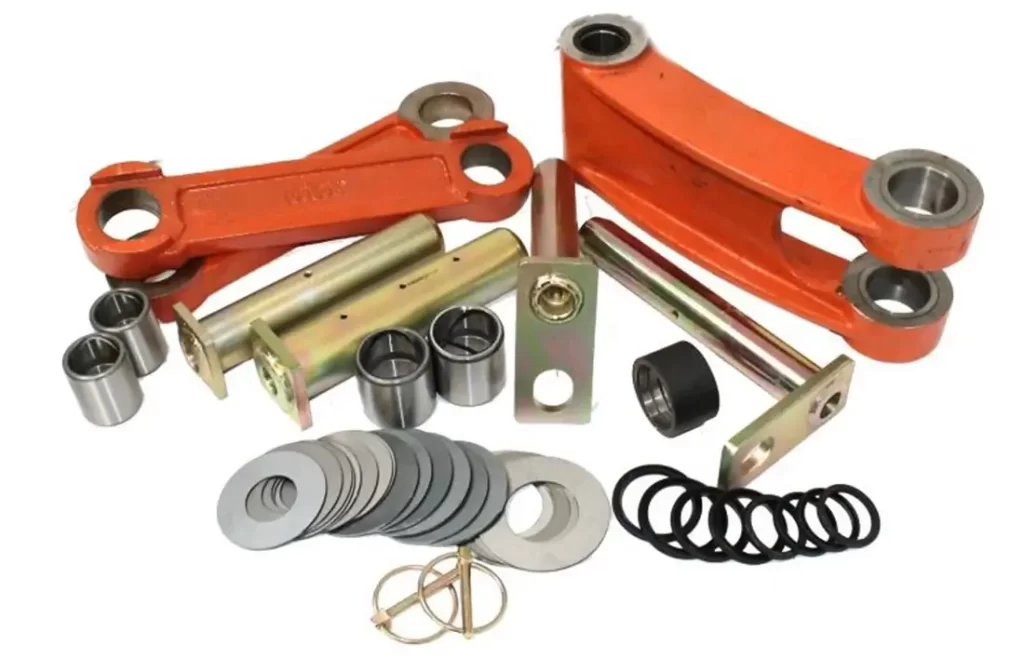
A perfect bushing installed wrong will fail. Two things matter most: interference fit and running clearance.
Interference fit: The bushing must be pressed into the bore with 0.01–0.03 mm interference for typical excavator applications. Too loose, and the bushing spins in the bore, wearing the housing. Too tight, and you risk cracking the bushing during installation or distorting the bore.
Running clearance: The gap between pin and bushing ID must be correct for the application. Too tight, and the joint runs hot and seizes. Too loose, and you get impact loading and accelerated wear. Check your service manual for the specified clearance range. When measuring a worn bushing, even 0.5 mm of excess clearance is significant.
Installation method: Use a proper driver and support. Never hammer directly on a hardened pin or bushing. Heat or cool the components as appropriate for the fit, and use anti-seize where galvanic corrosion is a concern
7. Signs Your Excavator Bushings Need Replacement
The wear process is gradual until it isn’t. Here’s what to watch for:
Excessive play in the bucket or stick. If you can rock the bucket by hand more than a few millimeters, the bushing is worn. This is the most obvious sign.
Squealing or groaning during operation. Metal-on-metal contact is happening. Grease isn’t reaching the wear surface, or the bushing has worn past the point where grease can maintain a film.
Uneven wear patterns. Oval-shaped wear or wear concentrated on one side indicates misalignment, a bent pin, or a bore that’s out of round.
Metal shavings or glitter in the grease. This means active wear is occurring. The bushing is shedding material, and the pin may be suffering too.
Inspection intervals: Light-duty machines should be inspected every 2,000–3,000 hours. Machines in intensive service—mining, demolition, heavy rock—need inspection every 1,000–1,500 hours. Field measurements on excavator undercarriage bushings show wear rates that can consume 53% of the bushing’s life by the time other components need attention, so don’t rely on scheduled replacement alone
8. How to Specify the Right Bushing for Your Machine
Here’s a practical checklist when ordering replacement bushings:
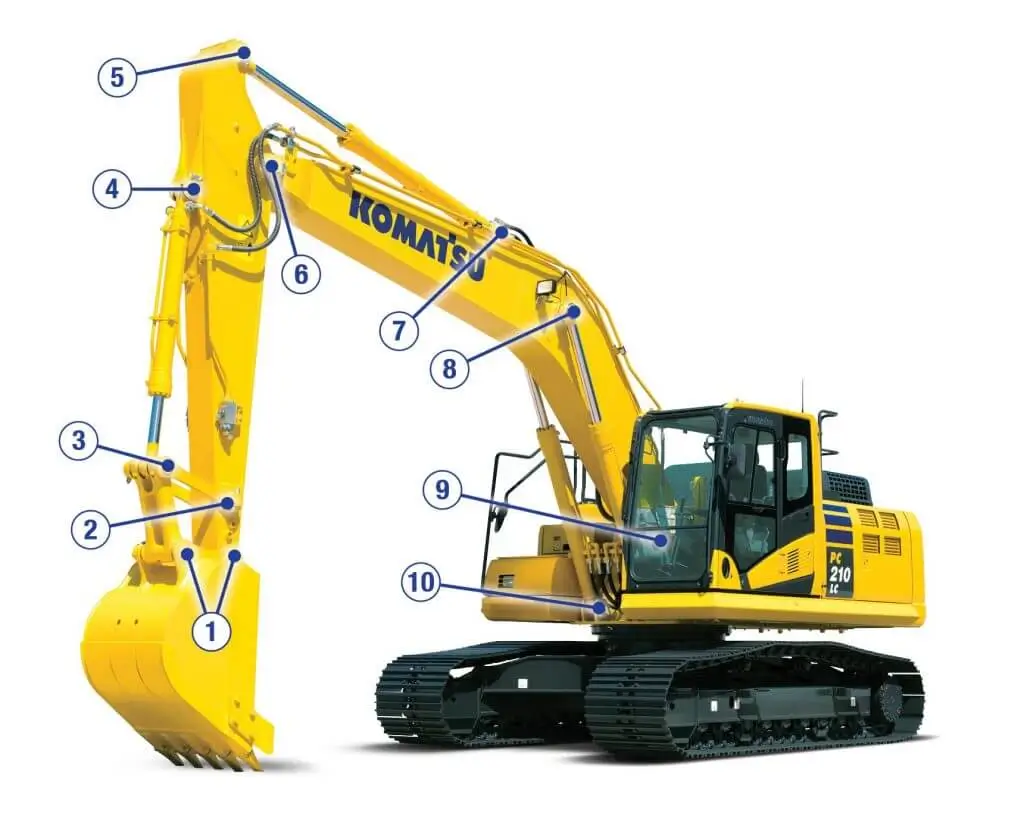
Step 1: Identify the exact location. Bucket-to-link, link-to-stick, stick-to-boom, cylinder base, cylinder rod end. Each position has different load and motion profiles.
Step 2: Get the OEM dimensions. Measure the bore ID, pin OD, bushing length, and flange thickness (if applicable). Cross-reference the OEM part number if available. A 1 mm dimensional error can destabilize the joint.
Step 3: Match the material to the job. Use the application guide above. When in doubt on a high-load joint, aluminum bronze is rarely the wrong answer. When in doubt on a contaminated moderate-load joint, tin bronze or bimetal is a safe choice.
Step 4: Verify hardness and heat treatment. For steel bushings, confirm the surface hardness (typically 55–62 HRC) and core toughness. For bronze, confirm the alloy grade—not just “bronze.”
Step 5: Check the lubrication design. Does the bushing have grease grooves or holes? Are they positioned to distribute grease across the load zone? A plain bore bushing without lubrication features is a red flag for any greased joint.
Step 6: Consider the total cost. A cheap bushing that lasts 500 hours costs more per hour than a quality bushing that lasts 2,000 hours, especially when you factor in downtime and collateral damage
Why MYWAY Bushings Belong in Your Parts Room
MYWAY manufactures bushings specifically for the conditions that destroy generic parts. We don’t sell “a bushing.” We sell a solution matched to your machine and your job site.
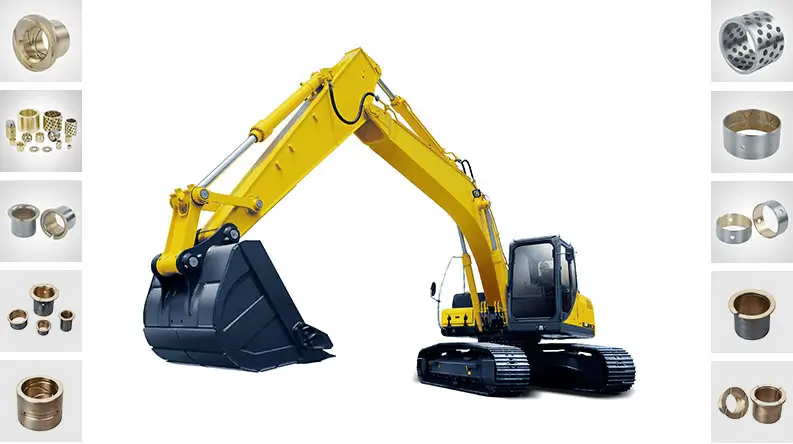
Material depth. MYWAY produces bushings in tin bronze, aluminum bronze, nickel-aluminum bronze, hardened alloy steel, and self-lubricating composite configurations. We don’t push one material for every application. We help you select the one that fits.
OEM-compatible fit. MYWAY bushings are engineered to match OEM specifications for Caterpillar, Komatsu, Hitachi, Volvo, and other major excavator platforms. If a standard size doesn’t fit your bore, we produce custom dimensions to your drawing.
Built for real earthmoving conditions. Our construction machinery bushings are designed for the upper arm, lower arm, bucket hinge, and cylinder pivot points that take the worst abuse. Mud, sand, shock loading, wet environments—we’ve seen it and we build for it.
Factory-direct pricing. Because we manufacture rather than distribute, you get premium materials without the distributor markup.
Stop replacing bushings every few hundred hours. Get the right material for your working conditions, install it correctly, and keep it greased. Then contact MYWAY for bushings that hold up long enough to make that maintenance strategy worthwhile.
Send us your machine model, the application, and your dimensions. We’ll recommend the right bushing material and quote you a price that makes sense.
FAQ: Excavator Bushing Selection
Q: What’s the difference between a bucket bushing and a pin bushing?
A: In practice, they’re often the same thing—a cylindrical sleeve at a hinge point. “Bucket bushing” typically refers to the bushing at the bucket-to-link or bucket-to-stick connection. “Pin bushing” is a more general term for any bushing that a pin runs through. The selection criteria are the same: match material to load, contamination, and lubrication conditions.
Q: Can I use aluminum bronze bushings in a mini excavator?
A: You can, but you probably don’t need to. Mini excavators have lower loads and smaller joints. Tin bronze or a wrapped bronze bushing is usually sufficient and costs less. Aluminum bronze is for the joints that actually see high stress—typically 20-ton class and above, or smaller machines doing unusually heavy work.
Q: How do I know if my bushing is bronze or steel?
A: A magnet is the quick test. Steel bushings are magnetic; bronze bushings are not. Visual inspection also helps—bronze has a yellow-gold color, while steel bushings are gray or silver. If you’re still unsure, a hardness test or spark test will confirm.
Q: Why do my bushings keep wearing out on one side?
A: Uneven wear almost always means misalignment. The pin and bore aren’t concentric, either because the bore is worn out of round, the pin is bent, or the linkage geometry is off. Replacing the bushing without addressing the alignment issue is throwing money away. Check the bore, the pin, and the surrounding structure.
Q: How often should I grease my excavator bushings?
A: More often than most operators do. For machines in abrasive or high-impact conditions, daily greasing of critical pivot points is not excessive. The grease interval should be based on working hours and conditions, not on how long it’s been since the last time someone remembered. If you’re greasing weekly in a sand pit, you’re under-greasing
Q: Are self-lubricating bushings really maintenance-free?
A: No. They’re low-maintenance, not maintenance-free. In earthmoving, self-lubricating bushings reduce the frequency of greasing, but they still need seals to keep contamination out. If mud or sand enters the joint, the self-lubricating mechanism becomes a grinding paste. For harsh conditions, conventional greased bushings with a disciplined grease routine often outlast “maintenance-free” alternatives
100000+ Types of Bushings – Contact Us for Details