
Recent Posts
Low Carbon Steel Bushings: Metallurgical Foundations and Performance Optimization for Heavy-Duty Applications
Introduction
Low carbon steel bushings represent a fundamental component category within mechanical power transmission and motion control systems. Defined by their carbon content typically below 0.30% by weight, these cylindrical sleeves serve as sacrificial wear surfaces that protect rotating shafts and housing bores from direct metal-to-metal contact. The metallurgical characteristics of low carbon steel—including its ferritic-pearlitic microstructure, case-hardening responsiveness, and cost-effectiveness—make it an indispensable engineering material across construction equipment, agricultural machinery, automotive suspensions, and hydraulic systems.
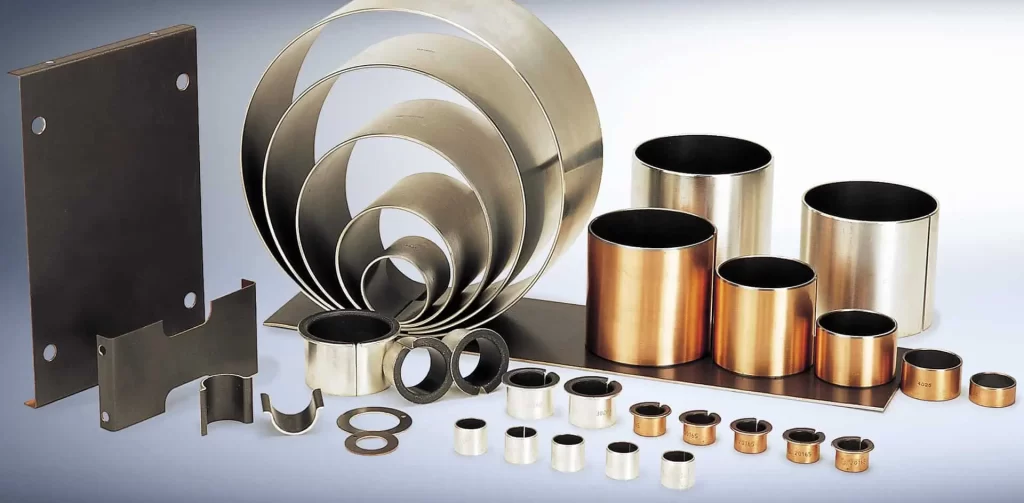
Table of Contents
1. Compositional Specifications and Metallurgical Classification of Low Carbon Steel Bushings
1. Compositional Specifications and Metallurgical Classification of Low Carbon Steel Bushings
The metallurgical identity of low carbon steel bushings is established through precise compositional control that balances machinability, formability, and hardenability. Carbon content, as the primary strengthening element, typically ranges from 0.08% to 0.25% by weight, with the majority of commercial bushing grades falling within the 0.15–0.25% C range. This carbon level ensures adequate core toughness while permitting substantial surface hardening through carburization.
Manganese, present in concentrations of 0.60–1.65%, serves as both a deoxidizer and a solid-solution strengthener, while also improving hardenability. Sulfur, often controlled at 0.15–0.35% in resulfurized grades such as AISI 1118, enhances free-machining characteristics critical for high-volume bushing production. The interplay between these elements dictates the steel’s response to thermal processing and its ultimate mechanical properties.
Table 1: Typical Chemical Composition Ranges for Low Carbon Steel Bushing Grade
| Element | AISI 1118 (wt%) | SAE 8620 (wt%) | 20CrMnTi (wt%) | SPCC (wt%) |
|---|---|---|---|---|
| Carbon (C) | 0.14–0.20 | 0.18–0.23 | 0.17–0.23 | ≤0.12 |
| Manganese (Mn) | 1.30–1.60 | 0.70–0.90 | 0.80–1.10 | ≤0.50 |
| Phosphorus (P) | ≤0.040 | ≤0.035 | ≤0.035 | ≤0.030 |
| Sulfur (S) | 0.15–0.35 | ≤0.040 | ≤0.035 | ≤0.025 |
| Chromium (Cr) | — | 0.40–0.60 | 1.00–1.30 | — |
| Nickel (Ni) | — | 0.40–0.70 | — | — |
| Molybdenum (Mo) | — | 0.15–0.25 | — | — |
| Titanium (Ti) | — | — | 0.04–0.10 | — |
The classification of low carbon steel bushings extends beyond composition to encompass microstructural characteristics. In the as-supplied condition, these steels exhibit a ferritic-pearlitic structure, with ferrite providing ductility and pearlite contributing strength. The grain size, typically controlled through aluminum or vanadium additions, influences both machinability and subsequent heat treatment response
2. Carburization: The Definitive Surface Hardening Mechanism for Low Carbon Steel Bushings
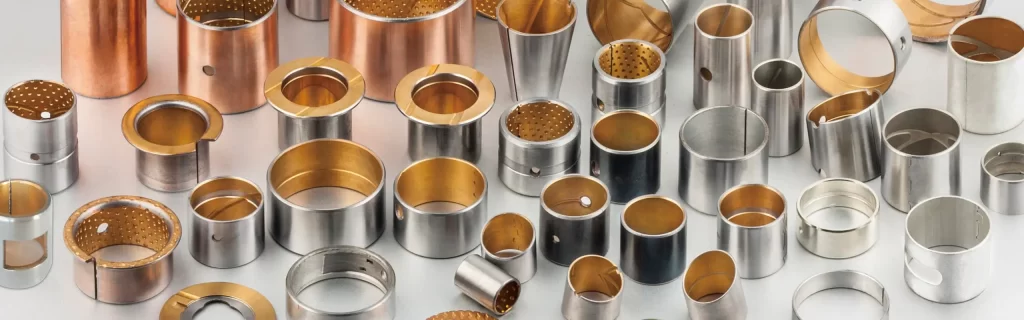
Carburization constitutes the cornerstone of low carbon steel bushing manufacturing, enabling the creation of a wear-resistant surface layer while maintaining a tough, impact-resistant core. This diffusion-controlled process introduces carbon into the steel surface at temperatures typically ranging from 900°C to 950°C, producing a carbon gradient that extends inward to depths of 1.8–4.0 mm depending on process duration and carbon potential.
The carburization sequence for track pin bushings exemplifies industrial practice: blanks undergo machining prior to heat treatment, followed by furnace loading under vacuum or controlled atmosphere. The carburizing cycle typically comprises a strong-infiltration phase with carbon potential maintained at 1.0–1.1% for approximately 7 hours, followed by a diffusion phase at 0.8–0.85% carbon potential lasting 6 hours to achieve carburization depths of 1.8–2.0 mm. This two-stage approach optimizes carbon penetration while controlling near-surface carbon concentration to prevent excessive carbide formation.
Table 2: Carburization Process Parameters for Low Carbon Steel Bushings
| Parameter | Typical Range | Notes |
|---|---|---|
| Carburizing temperature | 900–940°C | Higher temperatures accelerate diffusion |
| Carbon potential (strong infiltration) | 1.0–1.1% | Promotes rapid carbon uptake |
| Carbon potential (diffusion) | 0.80–0.85% | Controls gradient and surface carbon |
| Carburizing duration (total) | 10–42 hours | Depth-dependent; thicker walls require longer cycles |
| Carburization depth | 1.8–4.0 mm | Application-dependent (track bushings: 1.8–2.0 mm) |
| Quenching temperature | 820–860°C | Direct quench from carburizing temperature |
| Tempering temperature | 170–200°C | Low-temperature tempering for hardness retention |
The carburized case exhibits a martensitic structure with hardness values reaching 58–64 HRC at the surface, while the core retains its ferritic-pearlitic character with hardness typically 39–53 HRC. This hardness differential creates a composite structure where surface hardness provides wear resistance and the tougher core absorbs impact loads—a critical requirement for heavy machinery applications subject to shock loading and abrasive environments.
3. Advanced Heat Treatment Protocols: Quenching, Tempering, and Induction Hardening
The transformation of carburized low carbon steel bushings into finished components depends on precise thermal processing following carburization. Quenching, typically performed in oil or polymer quenchants from temperatures of 820–860°C, transforms the austenitic surface layer into martensite through rapid cooling. Controlled cooling rates are essential: excessive cooling rates may induce distortion or cracking, while insufficient rates produce bainite or pearlite with suboptimal hardness.
Tempering at 170–200°C for 3–4 hours relieves internal stresses and reduces martensite brittleness without significantly compromising surface hardness. This post-quench thermal treatment is particularly important for large-diameter bushings where thermal gradients during quenching generate substantial residual stresses. The tempering response of low carbon steel differs from high carbon equivalents due to the lower carbon content in martensite, requiring careful temperature control to achieve the desired combination of hardness and toughness.
Induction hardening, performed following carburization and tempering, enables localized surface hardening of specific bushing regions such as inner diameters or outer diameters. High-frequency induction heating (15–200 kHz) selectively raises surface temperatures to 900–950°C, followed by immediate water or polymer quenching. This process achieves hardness exceeding 62 HRC on the surface while maintaining core toughness—a particular advantage for track pin bushings where inner diameter wear resistance is paramount
4. Bimetal and Composite Bushings: Integrating Low Carbon Steel Backings
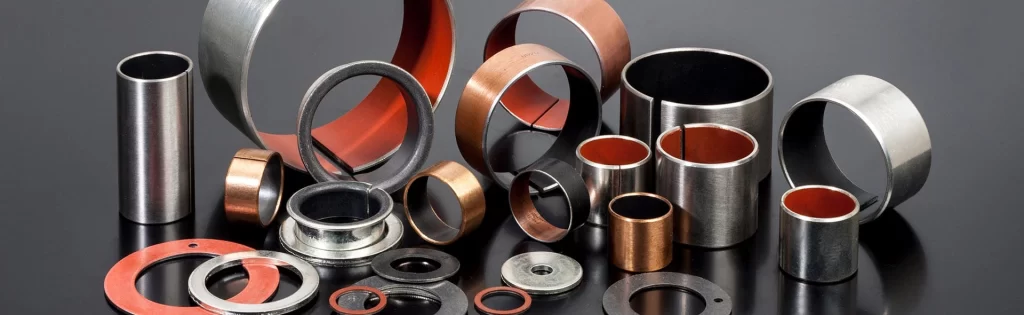
The evolution of bushing technology has produced hybrid designs where low carbon steel serves as a structural backing for advanced bearing materials. Bimetal bushings combine a low carbon steel outer shell with a sintered bronze layer, typically CuSn10Pb10, which provides both bearing properties and embeddability. This configuration leverages the strength and formability of steel with the anti-friction characteristics of bronze, creating a cost-effective solution for moderate-load, moderate-speed applications.
Tri-layer composite bushings, such as SF-1 series, extend this concept through a three-part architecture: a low carbon steel backing (0.7–2.3 mm thick), a porous sintered bronze interlayer (0.2–0.3 mm), and an overlying PTFE-based surface layer (0.01–0.03 mm). The steel backing provides structural strength and facilitates press-fit installation, while the porous bronze retains lubricant and provides conformability. The PTFE surface layer enables self-lubrication in dry or boundary-lubricated conditions, expanding operational capabilities to include high-temperature (up to 280°C) and maintenance-free applications.
Table 3: Performance Characteristics of Composite Low Carbon Steel Bushings
| Property | Value (Typical) | Test Condition |
|---|---|---|
| Max. Static Load | 250 N/mm² | — |
| Max. Dynamic Load | 140 N/mm² | — |
| PV Limit (Dry) | 3.6 N/mm²·m/s | — |
| PV Limit (Oil Lubricated) | 50 N/mm²·m/s | — |
| Speed Limit | 2.5 m/s (dry); 5 m/s (oil) | — |
| Friction Coefficient (Dry) | 0.08–0.20 | — |
| Friction Coefficient (Oil) | 0.02–0.07 | — |
| Operating Temperature Range | -195°C to +280°C | — |
| Thermal Conductivity | 42 W/m·K | — |
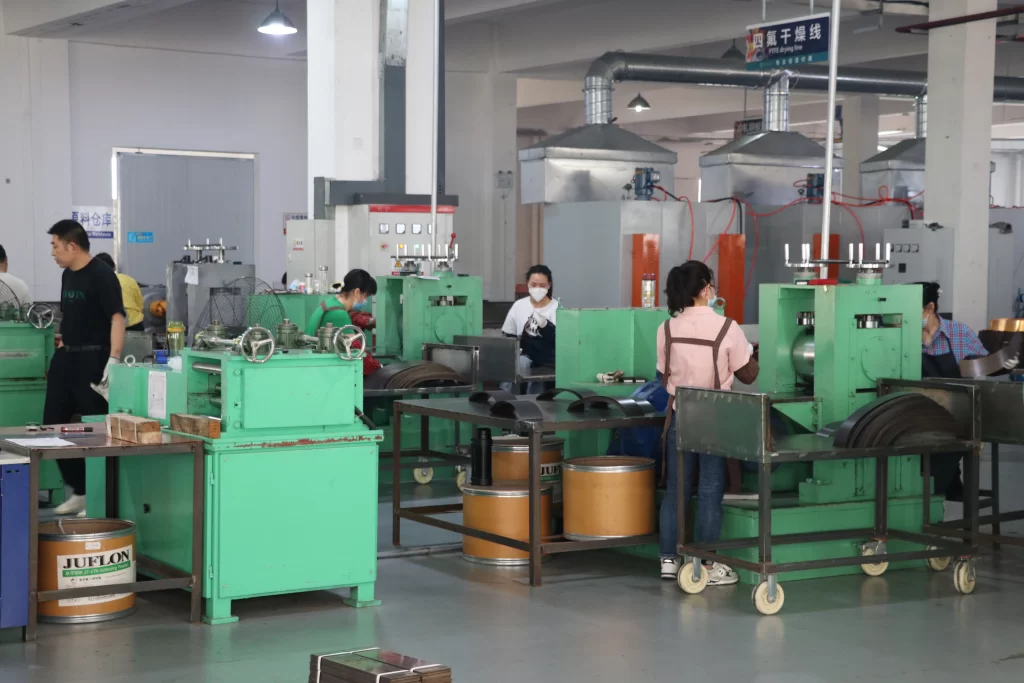
The manufacturing of such composite bushings involves precision stamping of low carbon steel blanks (often SPCC grade), followed by roll-forming into cylindrical shapes. The bronze layer is sintered onto the steel surface at temperatures exceeding 800°C, creating a metallurgical bond with exceptional peel strength. Subsequent application of PTFE compound by calendering or impregnation completes the construction, yielding a bushing capable of extended service life in demanding applications
5. Manufacturing Processes: From Steel Selection to Finished Bushing
The production of low carbon steel bushings begins with raw material selection, where the steel grade must align with service requirements and manufacturing economics. Hot-rolled seamless steel tubes represent the predominant starting material for medium-to-large diameter bushings, offering material efficiency and consistency. Cold-rolled strip, such as SPCC, serves as the feedstock for composite bushings and smaller-diameter plain bushings
Machining operations encompass turning, boring, and drilling, with machining allowances tailored to final dimensional requirements. The presence of sulfur in free-machining grades such as AISI 1118 facilitates chip breakage and extends tool life, particularly advantageous in high-volume production where tooling costs represent a significant economic factor. For case-hardening grades without sulfur additions, such as SAE 8620, tool selection and cutting parameters must be optimized to achieve acceptable machining productivity.
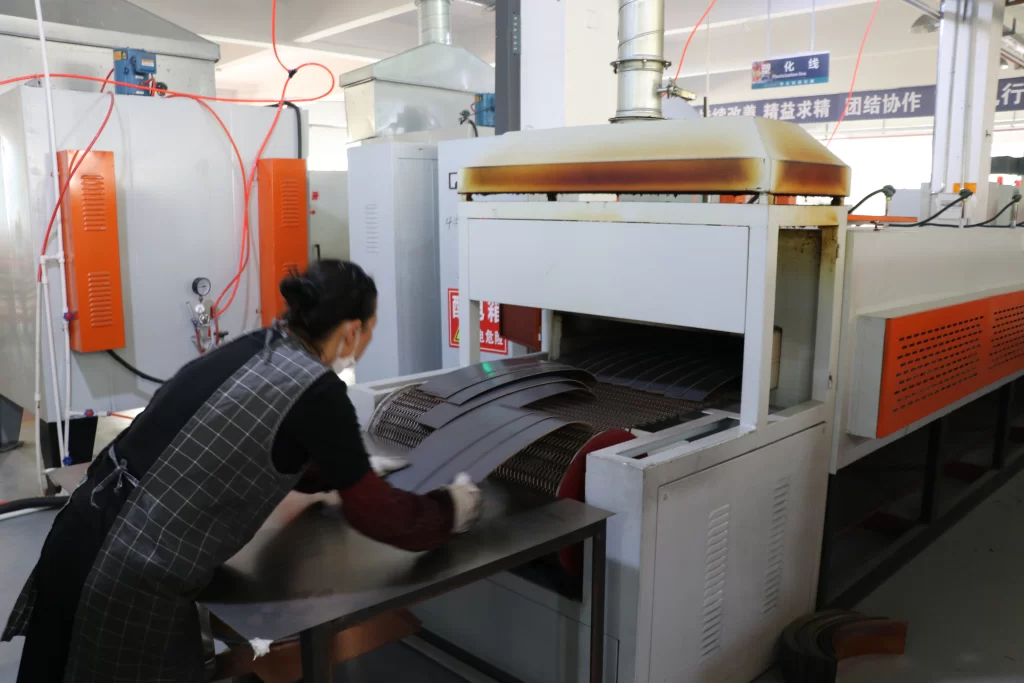
Heat treatment, as detailed in preceding sections, constitutes the critical value-adding stage where mechanical properties are developed. Carburizing furnaces—typically continuous gas-fired or vacuum types—process multiple bushing batches simultaneously, with process control systems monitoring temperature, carbon potential, and cycle timing. Quench hardening systems incorporating oil or polymer media provide controlled cooling rates essential for martensite formation.
Final finishing operations include grinding of critical surfaces, where dimensional tolerances of ±0.01 mm or better are achievable. Honing or superfinishing of bearing surfaces enhances surface finish to Ra 0.4 μm or better, reducing friction and improving lubricant film retention. Quality control measures, including hardness testing (both surface and core), case depth measurement by metallographic examination or microhardness traverse, and dimensional verification, ensure compliance with specification requirements.
6. Performance Considerations: Wear Resistance, Toughness, and Environmental Factors
The performance of low carbon steel bushings in service is governed by the interaction between material properties and operational conditions. Wear mechanisms, including adhesive, abrasive, and fatigue wear, are mitigated through case hardening, where the carburized surface exhibits resistance to metal transfer and abrasive particle cutting. The hardened surface layer, typically 1.8–4.0 mm thick, provides wear life proportional to case depth and hardness, with HRC 58–64 surfaces offering optimal wear resistance in most applications.
Toughness, essential for resisting impact loads and shock loading, is provided by the softer core structure. Track pin bushings, subject to high compressive loads and dynamic impacts, require a core hardness of 39–53 HRC, ensuring ductility sufficient to absorb operational stresses without catastrophic failure. The carbon content and alloy composition influence core hardenability, with higher alloy levels (Cr, Mn, Mo) improving through-hardening response.
Corrosion resistance of low carbon steel bushings presents a significant limitation, particularly in wet or chemically aggressive environments. Standard carbon steel bushings are susceptible to rusting and corrosion when exposed to moisture or chlorides, as documented in cases where bushings disappeared within 3–4 hours of exposure to brine at 250°F (121°C). Protective measures include plating (copper or tin), the use of corrosion-resistant overlay layers, or selection of alloy steels with enhanced corrosion resistance. For automotive suspension and shock absorber applications, bushings with PTFE overlays provide corrosion protection through barrier effects and reduced moisture retention
7. Application Domains and Industry-Specific Bushings
Construction equipment represents the largest application sector for low carbon steel bushings, particularly in track chain assemblies where pin bushings experience extreme wear conditions. Track pin bushings, manufactured from carburizing steels such as 20CrMnTi or 20CrMo, undergo carburization to depths of 2.7–3.4 mm, providing surface hardness HRC 58–62 with core toughness sufficient to withstand impact and torsion stresses. The shift toward higher-performance pin bushings has driven innovations such as boron additions for enhanced hardenability and high-frequency induction hardening of inner diameters.
Agricultural machinery leverages the cost-effectiveness of low carbon steel bushings for pivot points, linkage connections, and implement attachment points. These applications typically involve moderate loads and speeds, with lubrication regimes ranging from grease-lubricated to semi-dry. The combination of low carbon steel backing with bronze or polymer overlays provides wear resistance while maintaining the press-fit installation characteristics valued in field maintenance.
Automotive applications include shock absorber bushings, where low carbon steel-backed composite bearings accommodate both radial and axial loads while providing isolation from road-induced impacts. SF-1 series bushings, incorporating PTFE-based surface layers, are specified for their low friction and maintenance-free operation, contributing to vehicle ride quality and suspension longevity.
Hydraulic systems, including pumps, motors, and valves, employ low carbon steel bushings for piston and gear applications. SF-1T bushings, designed with specialized PTFE formulations for high-PV gear pump conditions (P=16–25 MPa, V=3.5–5 m/s), exemplify the performance requirements of hydraulic systems where boundary lubrication and high loads co-exist
8. Material Selection Criteria and Cost-Effectiveness Assessment
The selection of low carbon steel for bushing applications requires systematic evaluation of service conditions, manufacturing capabilities, and lifecycle costs. Compositional factors, including carbon equivalent and alloy content, influence hardenability, machinability, and cost. AISI 1118, with its high sulfur content for free-machining, offers lower manufacturing costs in high-volume production, while SAE 8620 provides enhanced hardenability through alloy additions of chromium, nickel, and molybdenum, enabling thicker case depths or more uniform hardening.
Case depth requirements directly influence process costs, with carburization time increasing approximately as the square of required case depth. For track bushings requiring 2.7–3.4 mm case depth, carburization cycles of 36–42 hours represent a significant cost component. Alternative approaches, such as combination carburization with induction hardening, can reduce process times while achieving comparable effective case depths.
Composite bushings employing low carbon steel backings with sintered bronze and PTFE layers command higher unit costs than plain steel bushings but offer benefits in reduced lubrication requirements and extended service intervals. For applications where maintenance access is limited (underground equipment, offshore installations) or where oil contamination must be avoided (food processing, textile machinery), the higher initial cost of composite bushings may be justified by reduced lifecycle costs.
Table 4: Cost Comparison Matrix for Low Carbon Steel Bushing Types
| Bushing Type | Material Cost | Manufacturing Cost | Lubrication Need | Typical Service Life | Application Suitability |
|---|---|---|---|---|---|
| Plain steel (carburized) | Low | Moderate | Required | High (wear-dependent) | Heavy equipment, construction |
| Free-machining steel | Low | Low | Required | Moderate | High-volume, general industrial |
| Bimetal (steel/bronze) | Moderate | High | Desirable | High (improved PV) | Medium-load, medium-speed |
| Composite (SF-1 series) | High | High | Maintenance-free | Very high | High PV, corrosion-risk |
FAQ: Low Carbon Steel Bushings
1. What is the typical carbon content range for low carbon steel bushings?
Low carbon steel bushings contain 0.08–0.25% carbon by weight, with most commercial grades in the 0.15–0.25% range. This carbon level provides adequate core toughness while allowing substantial surface hardening through carburizatio.
2. What steel grades are commonly used for low carbon steel bushings?
AISI 1118 (resulfurized for free-machining), SAE 8620 (alloyed for enhanced hardenability), 20CrMnTi (high hardenability with titanium for grain control), and SPCC (cold-rolled low carbon steel for backing applications) are widely specified.
3. Why are low carbon steel bushings carburized rather than through-hardened?
Carburization creates a hard, wear-resistant surface while maintaining a tough, impact-resistant core. This surface-core structure is essential for applications subject to shock loads, and the core toughness prevents brittle fracture that might occur with through-hardened high carbon steel.
4. What carburization depths are typically achieved for low carbon steel bushings?
Case depths range from 1.8 mm to 4.0 mm, with track pin bushings typically requiring 2.7–3.4 mm and general industrial bushings 1.0–2.5 mm depending on service requirement.
5. How does the carburization process affect bushing dimensions?
Carburization induces slight dimensional changes due to transformation stresses and carbon expansion. Machining allowances typically account for 0.1–0.3 mm growth in the carburized case, with post-heat treatment grinding used to achieve final dimensional tolerances.
6. What surface hardness is achievable after carburization and quenching?
Surface hardness of HRC 58–64 is readily achievable. The upper end of this range (HRC 60–64) is typical for applications requiring maximum wear resistance, such as track pin bushings.
7. Can low carbon steel bushings be used without lubrication?
Plain low carbon steel bushings require lubrication to prevent galling and excessive wear. Composite bushings with PTFE overlays (SF-1 series) can operate without lubrication due to the self-lubricating properties of the surface layer.
8. What are bimetal bushings and how do they incorporate low carbon steel?
Bimetal bushings consist of a low carbon steel backing with a sintered bronze surface layer (e.g., CuSn10Pb10). The steel provides structural strength while the bronze provides bearing properties and embeddability.
9. Are low carbon steel bushings corrosion-resistant?
Standard carbon steel bushings are not inherently corrosion-resistant and will rust in moist environments. Protective measures include copper or tin plating, PTFE overlays, or selection of alloy steels with enhanced corrosion resistance.
10. What is the maximum operating temperature for low carbon steel bushings?
Plain steel bushings can operate up to approximately 300°C, but tempering temperatures in excess of 200°C may reduce surface hardness. Composite bushings (SF-1 series) operate from -195°C to +280°C.
11. What is the difference between AISI 1118 and SAE 8620 for bushing applications?
AISI 1118 contains high sulfur for free-machining, making it cost-effective for high-volume production. SAE 8620 offers enhanced hardenability through Cr, Ni, and Mo alloying, enabling thicker case depths and more uniform hardening.
12. How are low carbon steel bushings manufactured?
Manufacturing involves blank selection (seamless tube or strip), machining (turning, boring, drilling), carburization heat treatment, quenching and tempering, induction hardening (optional), and final finishing including grinding and honing.
13. What is the fatigue resistance of carburized low carbon steel bushings?
Carburized bushings exhibit excellent contact fatigue resistance due to the compressive residual stresses induced by carburization and surface hardening. The transition from hard surface to tough core prevents crack propagation that might occur in through-hardened materials.
14. Can low carbon steel bushings be welded?
Welding is generally not recommended for carburized bushings due to the high carbon content in the case layer and potential for cracking. For unhardened backing applications, welding may be possible but typically requires preheating and specific filler metals.
15. What quality tests are performed on low carbon steel bushings?
Key quality tests include chemical composition verification, hardness testing (surface and core), case depth measurement (metallographic or microhardness traverse), dimensional verification, and surface finish assessment. Non-destructive testing may be specified for critical applications.
16. What is the typical service life of a low carbon steel bushing?
Service life varies widely based on application, load, speed, lubrication, and environment. Track pin bushings in construction equipment may last 1,000–5,000 hours depending on operating conditions, while agricultural and industrial bushings may last longer with adequate lubrication.
17. How does induction hardening complement carburization?
Induction hardening selectively hardens specific surfaces (inner diameter or outer diameter) after carburization, achieving higher hardness (HRC >62) on critical surfaces while preserving core toughness. This is particularly valuable for track pin bushings where inner diameter wear is a primary failure mode.
18. Are low carbon steel bushings suitable for high-speed applications?
Plain carbon steel bushings are generally limited to moderate speeds (<5 m/s). Composite bushings (SF-1 series) can operate at up to 5 m/s under oil lubrication and 2.5 m/s dry.
19. What is the role of manganese in low carbon steel bushings?
Manganese (0.60–1.65%) serves as a deoxidizer, solid-solution strengthener, and hardenability enhancer. Higher manganese levels improve hardenability and increase strength without significantly reducing toughness.
20. How do I specify a low carbon steel bushing for a new application?
Specification should include: required steel grade (AISI 1118, SAE 8620, etc.), case depth requirement, surface hardness (HRC target), core hardness, dimensional tolerances (ID, OD, length), lubrication requirement, and operating environment (temperature, humidity, corrosive factors). Consultation with manufacturers is recommended for critical applications.
100000+ Types of Bushings – Contact Us for Details