
Recent Posts
Steel Rolling Mill Technology: Core Equipment, Functional Applications, and High-Performance Component Solutions
Introduction
Steel rolling represents the principal forming process in modern metallurgy, where immense compressive forces transform raw steel into finished products that constitute the backbone of infrastructure, automotive manufacturing, construction, and countless industrial applications worldwide. Rolling mills—the sophisticated machinery at the heart of this process—have evolved from simple two-high configurations to complex multi-stand trains capable of producing everything from ultra-thin foils to heavy structural beams. Understanding the functional architecture, application contexts, and critical component requirements of these mills is essential for operators seeking to optimize production efficiency, product quality, and operational longevity.
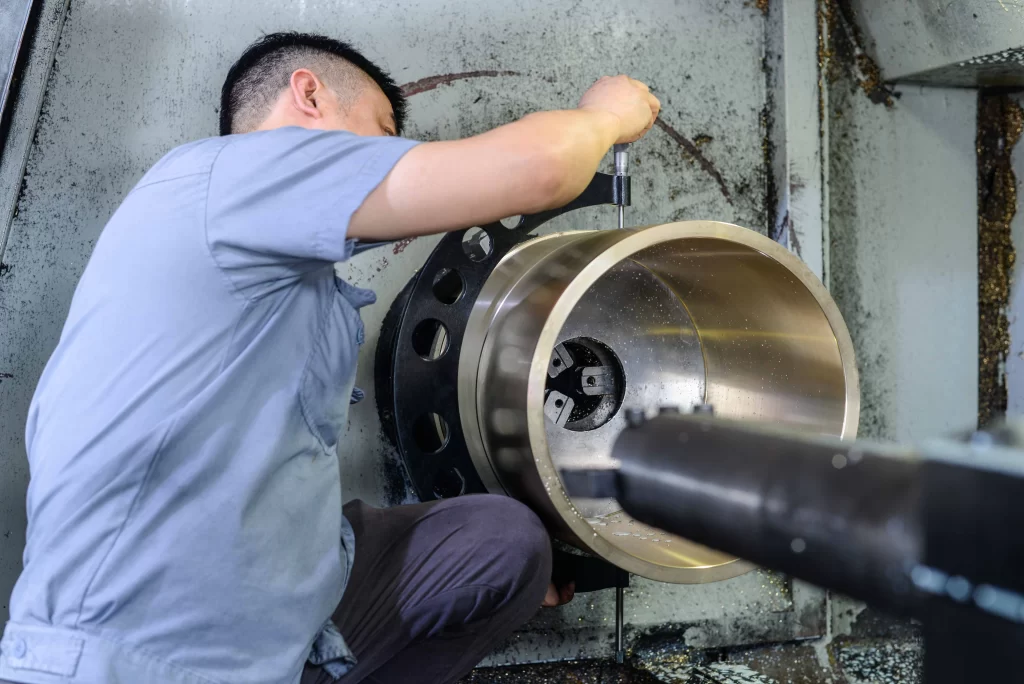
Table of Contents
1. Fundamental Principles and Functional Classification of Steel Rolling Mills
A rolling mill constitutes a machine system comprising multiple cylindrical rolls that rotate in opposing directions to reduce the cross-sectional thickness of steel workpieces through compressive deformation. The foundational principle remains consistent across all mill types: steel in ingot, bloom, billet, or slab form passes between rolls, emerging with reduced thickness, elongated length, and controlled cross-sectional geometry. Rolling is preferred over alternative forming methods for its economic efficiency, high throughput, and capability to produce consistent, high-quality products.
Rolling mills are functionally classified by the temperature at which rolling occurs, the configuration of the roll stands, and the product geometry they produce. Hot rolling occurs above the steel’s recrystallization temperature, typically between 900°C and 1250°C, enabling substantial deformation with relatively lower force requirements. Hot-rolled products commonly include sheet metal, rail tracks, truck frames, automotive wheels and rims, pipes and tubes, water heaters, agricultural equipment, metal buildings, and railroad components. Cold rolling takes place below the recrystallization temperature, usually at ambient temperature, imparting strain hardening that increases strength by up to 20% while delivering superior surface finish, tighter dimensional tolerances, and improved mechanical properties. Cold-rolled steel finds extensive application in metal furniture, filing cabinets, computer hardware, home appliances, exhaust systems, lighting fixtures, and precision components.
From a functional standpoint, rolling mills operate through distinct stages along the production train. Roughing stands perform the initial heavy reduction on incoming material, breaking down large cross-sections under substantial loads where strength and thermal crack resistance take precedence. Intermediate stands continue the reduction process, preparing the workpiece for final shaping. Finishing stands execute the final passes to achieve precise dimensions and surface quality, operating at higher speeds with lighter reductions where wear resistance and surface finish become critical
2. Rolling Mill Configurations and Architectural Evolution
The configuration of a rolling mill fundamentally determines its operational capabilities, force transmission characteristics, and suitability for specific product applications. Understanding these architectures enables informed selection and optimization of mill components, including the critical bushings and bearings that support roll assemblies.
Two-High Mills represent the most basic configuration, comprising two rolls mounted vertically in a stand. In non-reversing two-high mills, rolls rotate in a single direction, requiring the workpiece to be manually returned over the top for subsequent passes. Reversing two-high mills enable rolls to rotate in both directions, allowing the workpiece to pass back and forth through the same stand without manual handling, though this requires stopping and reversing the rolls between each pass.
Three-High Mills feature three rolls in a single stand: top, middle, and bottom. The middle roll rotates in conjunction with either the top or bottom roll, enabling continuous rolling in two directions without reversing the mill. While this arrangement improves throughput, it necessitates mechanical elevators to lift and lower the workpiece between roll pairs.
Four-High Mills incorporate two small-diameter work rolls supported by two larger-diameter backup rolls. This configuration addresses the fundamental trade-off in rolling mill design: smaller work rolls reduce contact area, lowering force and power requirements, but sacrifice stiffness. Backup rolls provide the necessary rigidity to prevent deflection under heavy loads, making four-high mills the predominant choice for cold rolling applications, wide plate hot rolling, and foil production.
Cluster Mills, including six-high, twelve-high, and twenty-high Sendzimir configurations, employ multiple backup rolls arranged in tiers to support small work rolls. These mills enable extreme thickness reductions with minimal roll deflection, essential for producing very thin gauge products and rolling high-strength materials
3. Core Functional Systems of Steel Rolling Mill Equipment
Modern rolling mills integrate multiple systems working in concert to achieve precise, efficient steel shaping. Each system places distinct demands on the components that enable their operation, including the bushings, bearings, and wear parts essential for mill reliability.
The Roll Stand and Housing provides the structural framework that contains the rolls, bearings, and adjustment mechanisms. Mill housings must withstand extreme separating forces that develop during rolling, transmitting these loads through the roll necks to the bearings and ultimately to the foundation. This high-stress environment demands robust bearing support systems that maintain precise roll positioning under heavy loads.
Work Rolls and Backup Rolls constitute the primary forming interface. Work rolls make direct contact with the steel workpiece, determining surface quality and dimensional precision. Their performance depends on appropriate hardness, wear resistance, and surface finish. Backup rolls, positioned behind work rolls in multi-high configurations, prevent deflection and maintain consistent roll gap across the strip width. The interaction between these rolls and their support bushings significantly influences mill stability and product quality.
Roll Cooling and Lubrication Systems manage the intense thermal and frictional conditions encountered during rolling. In hot rolling, work roll surface temperatures can fluctuate dramatically between workpiece contact and water spray cooling, generating thermal cycling that leads to fire cracking if not properly managed. Roll cooling systems must deliver consistent, controlled coolant application to maintain roll temperature stability while preventing thermal shock. Lubrication systems reduce friction at the roll-workpiece interface, extending roll life and improving surface quality.
Driving and Power Transmission Systems deliver the immense torque required to rotate rolls against rolling loads. Modern rolling mills employ heavy-duty electric motors, frequently with variable frequency drives for precise speed control. The choice between AC and DC motor technologies depends on specific application requirements, with AC systems offering reduced maintenance and improved energy efficiency while DC motors provide exceptional starting torque for certain applications. Power transmission through spindles, gears, and pinions subjects all connected components to significant torsional and cyclic stresses.
Coilers and Uncoilers manage the handling of coiled strip products, maintaining proper tension throughout the rolling process to prevent buckling, tearing, or accumulation.
4. Rolling Mills for Flat Products: Hot Strip Mills, Plate Mills, and Cold Rolling Facilities
Flat product rolling encompasses plate, sheet, and strip production through dedicated mill types optimized for specific thickness ranges and quality requirements.
Hot Strip Mills process slabs into coiled strip typically ranging from 1.2 mm to 25 mm in thickness. These sophisticated facilities employ multiple finishing stands arranged in tandem, with each stand progressively reducing thickness while maintaining strip temperature above the recrystallization threshold. The run-out table section, where strip cools after the final stand, requires careful water spray control to achieve desired mechanical properties. Components in hot strip mills face extreme thermal cycling, heavy loads, and abrasive scale, necessitating robust bushing and bearing solutions that maintain reliability under these punishing conditions.
Plate Mills produce heavy flat products exceeding 4.75 mm in thickness, typically supplied as discrete plates rather than coiled strip. Plate rolling requires extremely high separating forces delivered through large-diameter rolls with substantial backup support. The mill housing and roll bearings must withstand loads that can exceed 10,000 tonnes in heavy plate applications.
Cold Rolling Mills process hot-rolled pickled strip to achieve thinner gauges, improved surface finish, tighter dimensional tolerances, and enhanced mechanical properties through strain hardening. Cold rolling mills typically employ four-high or cluster configurations to achieve the required thickness reductions with minimal roll deflection. Cold rolling work rolls demand exceptionally high surface hardness, often induction-hardened to 45-105 HS, with hardened layer depths of 15-50 mm depending on roll diameter. The precision bearings and bushings supporting cold mill rolls must maintain exact alignment under high loads while accommodating the high rotational speeds characteristic of finishing stands.
Skin Pass Mills perform light cold reductions (0.5-1%) on annealed strip to improve surface appearance, eliminate yield point elongation, and impart controlled surface texture. This final processing step places premium demands on surface quality and consistency, requiring exceptionally smooth roll surfaces and precise bearing performance
5. Rolling Mills for Long Products: Section Mills, Bar Mills, Rod Mills, and Structural Mills
Long product rolling encompasses the production of structural sections, bars, rods, and wire from blooms and billets through specialized mill configurations.
Structural and Section Mills produce beams, channels, angles, rails, and other non-circular cross-sections. These mills employ grooved rolls containing machined profiles that progressively shape the workpiece through successive stands. Pass design—the arrangement of roll grooves across the rolling sequence—determines final product geometry and quality. Roughing stands perform heavy reductions on incoming blooms or billets, while finishing stands achieve final dimensions and surface quality. Grooved roll applications place unique demands on bearing systems, which must accommodate the non-uniform loading characteristic of profile rolling while maintaining precise roll positioning.
Merchant Bar Mills produce a variety of small sections including rounds, squares, hexagons, and flat bars. These mills typically feature rougher stands with larger diameter rolls followed by finishing stands with progressively smaller rolls. Modern merchant bar mills often incorporate multiple finishing strands to produce different product sizes simultaneously, enhancing flexibility and throughput.
Rod and Wire Mills convert billets into coiled rod or wire products. These high-speed mills employ specialized finishing stands with small-diameter rolls to achieve the fine reductions required for small-section products. Rod mill finishing speeds can exceed 100 m/s, demanding exceptional bearing performance to maintain precision under extreme rotational speeds. Roller guides play a critical role in rod mills, maintaining product alignment to prevent cobbles and reduce scrap.
Rail Mills produce railway rails with precise head, web, and base geometries. Rail rolling employs universal mill configurations with horizontal and vertical rolls to achieve the characteristic rail profile while maintaining dimensional consistency across the product length
6. The Critical Role of Bushings in Steel Rolling Mill Operations
Bushings serve as essential components throughout steel rolling mill equipment, providing wear protection, load support, and precise guidance while preventing direct metal-to-metal contact between moving parts. Their importance in maintaining mill reliability and operational efficiency cannot be overstated, particularly in the harsh conditions characteristic of steel production environments.
Functional Requirements of Mill Bushings
Bushings in rolling mill applications must withstand extreme operating conditions including heavy radial and axial loads, elevated temperatures, abrasive scale and debris, mechanical shock, and continuous operation with minimal maintenance intervention. They are typically installed in bearing assemblies, journal supports, entry and exit guide systems, and sliding bearing locations across the mill train. Their performance directly influences product quality by maintaining the precise alignment essential for consistent rolling, and operational efficiency by extending service intervals and reducing unplanned downtime.
Bushing Materials and Selection Criteria
Selection of appropriate bushing materials requires careful matching to specific application conditions including load magnitude, operating temperature, lubrication availability, and environmental factors such as scale exposure and cooling water quality. Multiple material categories serve rolling mill applications, each offering distinct performance characteristics.
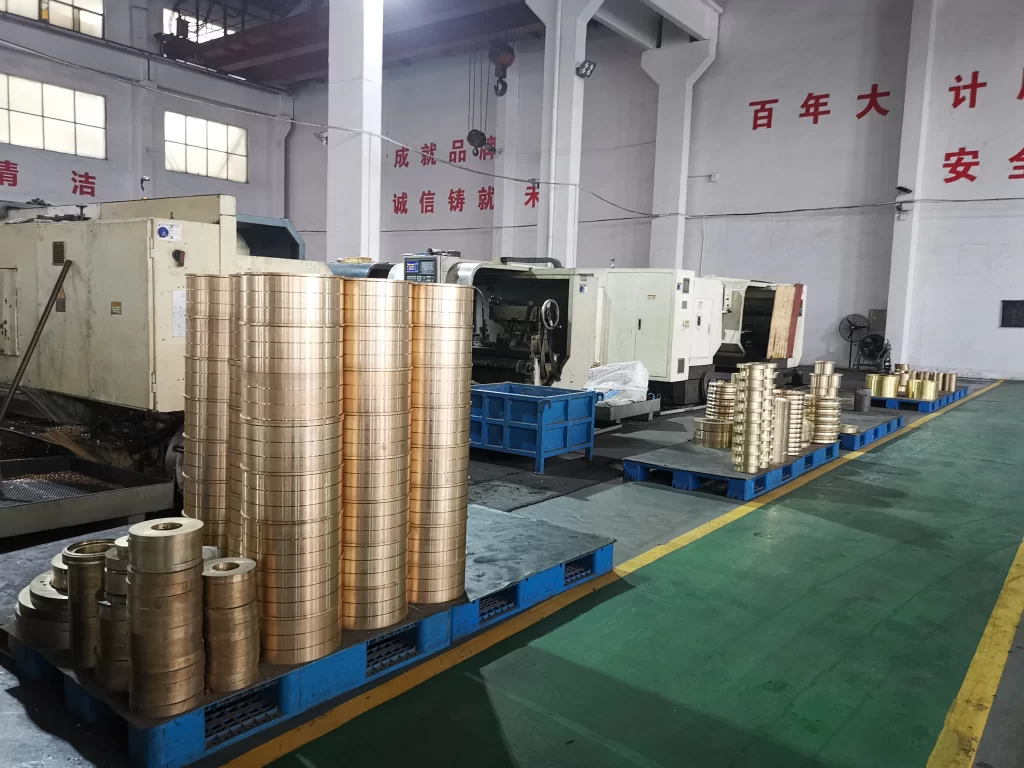
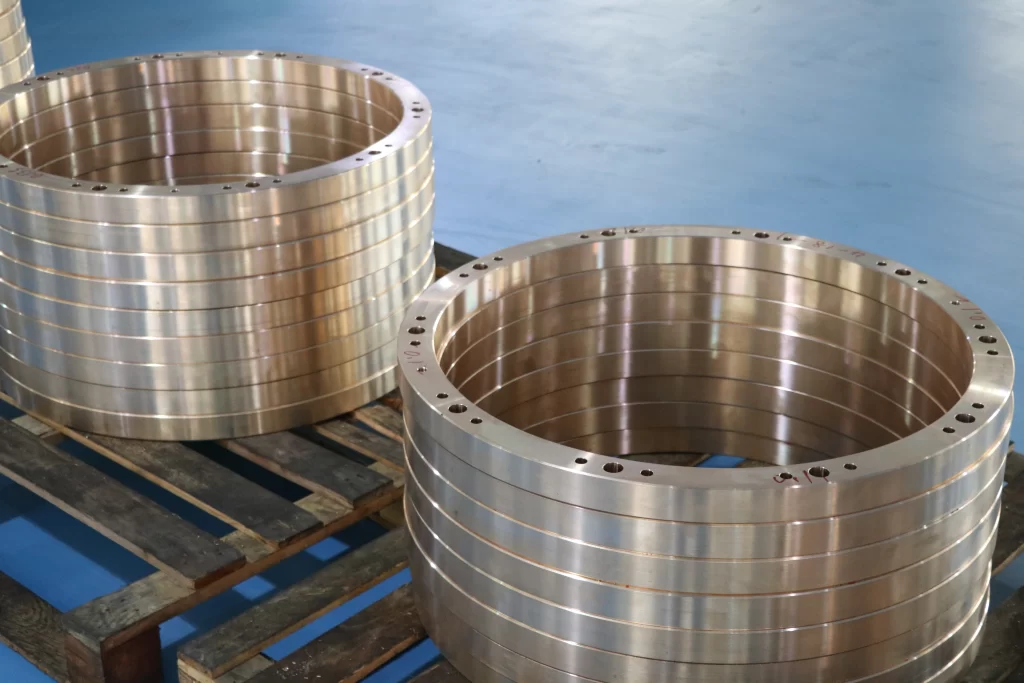
Copper Alloy Bushings, manufactured from tin bronze, aluminum bronze, lead bronze, and phosphor bronze compositions, dominate many rolling mill bushing applications. Copper alloys offer exceptional thermal conductivity approximately five times that of steel, rapidly dissipating friction-generated heat to prevent overheating, lubricant breakdown, and component deformation. Aluminum bronze grades such as CuAl10Fe5Ni5 provide outstanding wear and corrosion resistance, maintaining structural integrity under heavy loads and in high-temperature environments. These materials find extensive application in straightener press rolls, support rolls, guide rolls, and various metallurgical accessories.
Self-Lubricating Bronze Bushings eliminate the need for external lubrication through engineered material structures. Sintered bronze bushings, produced via powder metallurgy, achieve controlled porosity of 10-40% that is vacuum-impregnated with lubricating oil, providing maintenance-free operation for light-to-medium load applications. Graphite-embedded bronze bushings incorporate high-purity graphite plugs into the bearing surface, forming a self-renewing lubricant film during operation that prevents metal-to-metal contact even in high-temperature, dusty environments where conventional lubrication fails. These bushings can operate continuously at temperatures up to 400°C in graphite-embedded designs.
Cemented Carbide Bushings, manufactured via powder metallurgy using tungsten carbide with metallic binders, offer exceptional hardness, wear resistance, and thermal stability. These materials withstand the abrasive scale particles and high temperatures characteristic of steel rolling environments, significantly extending replacement intervals in high-frequency or heavy-load applications. Their composition can be tailored with elements including titanium, tantalum, niobium, nickel, and chromium to optimize specific performance characteristics such as wear resistance, high-temperature stability, or corrosion resistance.
Bimetal Bushings, combining the strength of a steel backing with a bronze working layer, provide an economical solution for heavy-duty, high-impact applications. The steel structure delivers the strength required for high load capacity, while the bronze surface provides the wear resistance and lubricity needed for sliding contact applications. This design reduces material costs compared to solid bronze alternatives while maintaining performance.
Stainless Steel and Alloy Steel Bushings serve applications requiring high strength and corrosion resistance, frequently incorporating surface treatments to enhance wear characteristics.
7. MYWAY Precision Bushings for Steel Mill Applications
MYWAY has established itself as a trusted provider of precision-engineered copper alloy bearings, self-lubricating bronze bushings, and custom metallurgical components serving steel rolling mills and related heavy industrial equipment. With a focus on application-specific engineering and material science, MYWAY delivers bushing solutions that perform reliably under the extreme conditions characteristic of steel production environments.
MYWAY Sintered Bronze Bushings represent a cost-effective solution for light-to-medium load rolling mill applications. Produced through controlled powder metallurgy processes, these bushings achieve precise porosity characteristics ensuring consistent oil retention and delivery to the bearing surface. Materials including CuSn10 and SAE841 grades provide reliable performance in applications where maintenance access is limited and consistent operation is required.
MYWAY Graphite-Embedded Bronze Bushings offer the ultimate solution for extreme rolling mill conditions where conventional lubrication is impracticable or impossible. Through precision machining of solid aluminum bronze or lead bronze blanks with controlled graphite plug insertion, MYWAY produces bushings capable of self-renewing lubrication under heavy loads and high temperatures. These components excel in steel rolling mill environments where high temperatures (up to 400°C), heavy loads, abrasive dust, and limited maintenance access preclude conventional lubrication systems.
MYWAY Bimetal Bushings combine a steel backing for structural strength with a high-grade bronze working layer, delivering heavy-duty performance with reduced material costs compared to solid bronze alternatives. Applications include gearboxes, heavy-duty truck axles, and rolling mill support equipment where high load capacity and shock absorption are essential.
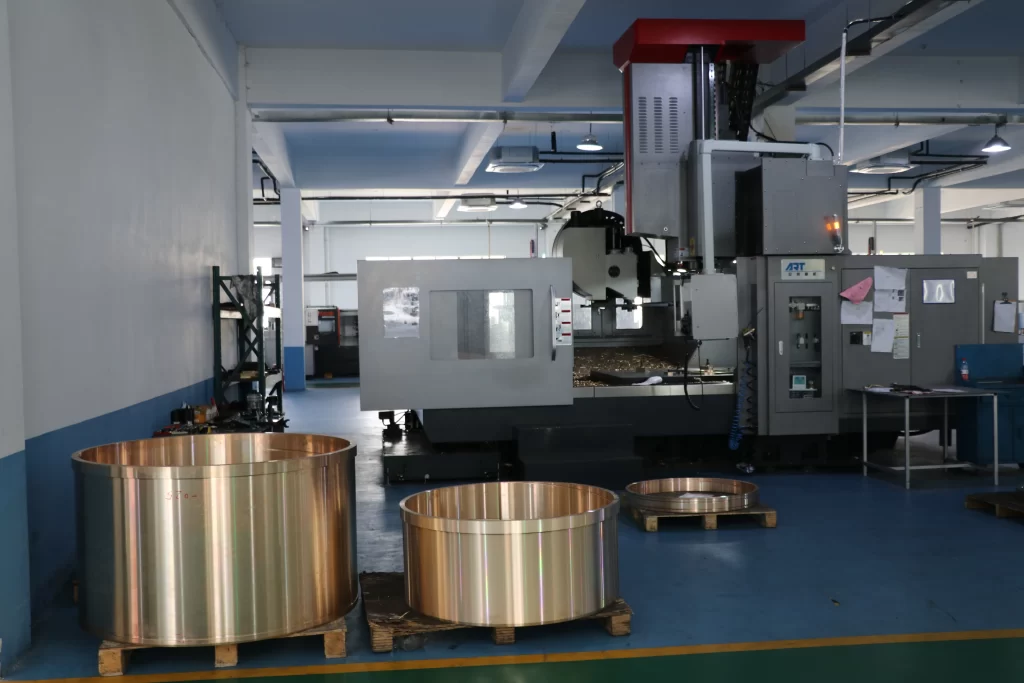
MYWAY Cast Bronze Components serve specialized rolling mill requirements including straightener press rolls, copper alloy support rolls, aluminum bronze rolls, and wear plates. Through precision sand casting and CNC machining, MYWAY delivers components with tight dimensional tolerances and excellent surface finish, tailored to the specific demands of individual mill applications.
The engineering philosophy underlying MYWAY bushing solutions prioritizes operational reliability, extended service life, and minimal maintenance requirements. This approach directly addresses the core challenges facing steel mill operators: maximizing uptime, reducing maintenance costs, and maintaining consistent product quality through reliable component performance.
8. Bearing and Bushing Performance in Rolling Mill Operating Environments
Steel rolling mills impose extraordinarily demanding operating conditions on bearings and bushings, requiring robust design, appropriate material selection, and regular condition monitoring to maintain acceptable service life.
Thermal Management Considerations
Heat generation from both rolling friction and bearing friction threatens bushing performance through accelerated wear, lubricant degradation, and potential seizure. Copper alloy bushings offer significant thermal management advantages due to copper’s exceptionally high thermal conductivity, which is approximately five times greater than steel. This property enables rapid heat dissipation from the bearing interface, maintaining lower operating temperatures and protecting against lubricant breakdown and component deformation. In hot rolling applications, where ambient temperatures near rolling stands can exceed 50°C, effective thermal management becomes critical for bushing survival.
Wear and Friction Management
The abrasive environment created by mill scale, oxide particles, and other debris demands bushing materials with superior wear resistance. Hard particles entrained in cooling water or present as airborne contaminants can rapidly damage conventional bearing surfaces, leading to clearance loss, misalignment, and ultimately component failure. Copper alloys and cemented carbide bushings provide the wear resistance necessary for extended service life under these conditions. Self-lubricating bushing designs further reduce wear through continuous lubricant film formation at the bearing interface, eliminating metal-to-metal contact even when external lubrication systems fail or are absent.
Load Management and Bushing Structural Integrity
Rolling loads impose significant forces on mill bushings and bearings, with stand loads often exceeding thousands of tonnes in heavy applications. These loads must be transmitted through support bushings to the mill housing without excessive deflection or deformation. Bushing materials must maintain structural integrity under both static and dynamic loading, providing consistent support while accommodating the cyclic nature of mill operation. The design of bushing clearance and fit significantly influences load distribution and alignment maintenance.
Condition Monitoring and Predictive Maintenance
Modern rolling mill operations increasingly employ predictive maintenance strategies to identify developing bushing and bearing issues before they result in component failure or unplanned downtime. Smart guide systems incorporating wireless monitoring provide continuous feedback on guide alignment, section height, and internal condition, enabling proactive intervention when wear or misalignment is detected. Real-time condition monitoring enables operators to schedule maintenance during planned outages rather than reacting to unexpected failures, reducing both downtime and the risk of secondary damage to adjacent mill components.
9. Operational Optimization and Service Life Extension Strategies
Maximizing rolling mill productivity requires systematic attention to bushing and bearing performance, maintenance practices, and component replacement strategies.
Proper Bushing Installation and Fit Management
Correct bushing installation significantly influences service life and mill performance. Interference fits, thermal assembly, and integration with steel sleeves ensure secure connection and proper load transmission while facilitating straightforward replacement when required. Bushings machined to mirror-like surface finishes further reduce friction and extend the service life of mating shafts and components. Installation procedures must account for thermal expansion, alignment requirements, and the specific characteristics of the bushing material to avoid damage during assembly.
Lubrication Strategy and Maintenance Optimization
Lubrication remains the most critical factor affecting bushing life in conventional bearing applications. Selection of appropriate lubricant type, application method, and replenishment schedule directly influences wear rates and failure frequency. Self-lubricating bushing designs from MYWAY eliminate the need for external lubrication, simplifying maintenance and reducing the risk of lubrication-related failures while cutting maintenance costs and downtime.
Replacement Interval Planning and Condition-Based Decision Making
Optimal bushing replacement intervals balance the cost of early replacement against the risks and costs of failure. Predictive maintenance approaches using condition monitoring data enable replacement decisions based on actual component condition rather than arbitrary schedules, extending useful life where possible while ensuring proactive replacement before failure occurs. The extended service life of premium bushing materials such as MYWAY’s copper alloys and graphite-embedded designs contributes directly to operational cost reduction through extended replacement intervals and reduced maintenance labor requirements.
Alignment and Setup Optimization
Proper alignment of rolls, guides, and support components is essential for maximizing bushing life and product quality. Misalignment creates uneven loading on bushings, accelerating wear and potentially causing premature failure. Advanced guide systems with continuous monitoring capabilities enable operators to detect and correct alignment issues before they affect product quality or cause component damage. Regular inspection and maintenance of alignment verification equipment ensures accurate setup and consistent rolling performance.
Frequently Asked Questions About Steel Rolling Mill Bushings and Operations
Q1: What types of bushings are used in steel rolling mills?
A: Rolling mills utilize various bushing types including copper alloy bushings, self-lubricating bronze bushings, cemented carbide bushings, bimetal steel-backed bushings, and stainless steel bushings. Selection depends on specific application conditions such as load magnitude, operating temperature, lubrication availability, and environmental factors.
Q2: Why are copper alloy bushings preferred for many rolling mill applications?
A: Copper alloy bushings offer exceptional thermal conductivity approximately five times greater than steel, superior wear and corrosion resistance, high load-bearing capacity, and compatibility with self-lubricating designs. These properties make them ideal for handling the extreme conditions of steel rolling, including high temperatures, heavy loads, and abrasive environments.
Q3: How do self-lubricating bronze bushings work in rolling mills?
A: Self-lubricating bronze bushings incorporate either sintered porosity vacuum-impregnated with lubricating oil or graphite plugs machined into the bearing surface. During operation, the lubricant is continuously delivered to the bearing interface through capillary action or mechanical release, eliminating the need for external lubrication systems and enabling maintenance-free operation.
Q4: What temperature range can MYWAY graphite-embedded bronze bushings withstand?
A: MYWAY graphite-embedded bronze bushings can operate continuously at temperatures up to 400°C, making them suitable for the high-temperature conditions encountered in hot rolling mills, continuous casting equipment, and other metallurgical applications where conventional lubricants would fail.
Q5: What is the difference between hot rolling and cold rolling bushings?
A: Hot rolling bushings must withstand elevated temperatures, thermal cycling, and exposure to scale and oxide particles. Cold rolling bushings face lower temperatures but may experience higher loads and speeds, with greater emphasis on precision and surface finish. Bushing material selection accounts for these distinct operating conditions.
Q6: How do rolling mill bushings differ from bearings?
A: Bushings provide sliding contact support with generally larger surface areas, distributing loads across the bushing surface. Bearings typically employ rolling elements such as balls or rollers to separate moving surfaces. Both serve critical load support functions in mills, with bushings particularly valuable in applications requiring wear resistance and simplified construction.
Q7: How long do rolling mill bushings typically last?
A: Bushing service life varies widely depending on application, load, operating conditions, and maintenance. Premium materials such as cemented carbide or self-lubricating bronze can provide service lives ranging from several months to years in appropriate applications, significantly extending replacement intervals compared to standard materials.
Q8: Can MYWAY produce custom-sized bushings for specific mill applications?
A: Yes, MYWAY specializes in custom-engineered bushing solutions tailored to individual mill requirements, including custom dimensions, material grades, and design features optimized for specific application conditions.
Q9: How do self-lubricating bushings reduce maintenance costs?
A: Self-lubricating bushings eliminate the need for external grease or oil systems, removing the associated costs of lubricant purchase, application equipment, and regular replenishment. They also reduce maintenance labor, minimize lubrication-related failures, and extend replacement intervals, significantly lowering overall operating costs.
Q10: What are cemented carbide bushings used for in rolling mills?
A: Cemented carbide bushings serve as wear-resistant protective and guiding components in areas subject to high wear, heavy loads, or requiring precise guidance—such as bearing assemblies, journal supports, and entry/exit guide systems. They effectively minimize friction and wear between shafts and equipment housings while providing guidance to prevent component misalignment.
Q11: What factors influence bushing selection for rolling mills?
A: Key selection factors include rolling mill type and configuration, product category, operating temperature, load magnitude, lubrication availability, environmental conditions including scale and cooling water exposure, and specific application requirements such as alignment sensitivity or maintenance accessibility.
Q12: What is the role of backup roll bushings in four-high mills?
A: Backup roll bushings provide rigid support to work rolls, preventing deflection under heavy rolling loads. This support maintains consistent roll gap across the strip width, ensuring uniform thickness and flatness in the final product.
Q13: How does bushing wear affect product quality?
A: Bushing wear creates clearance that can cause roll or guide misalignment, affecting product dimensional accuracy, surface quality, and uniformity. Excessive wear may also generate vibration or chatter marks on the product surface. Regular condition monitoring and timely replacement are essential for maintaining product quality.
Q14: What types of copper alloys are used in rolling mill bushings?
A: Common copper alloy bushing materials include tin bronze (CuSn10, CuSn8), aluminum bronze (CuAl10Fe5Ni5), lead bronze (CuPb10Sn10), and phosphor bronze. Each grade offers specific property profiles balancing wear resistance, load capacity, corrosion resistance, and cost.
Q15: How are bushings installed in rolling mill equipment?
A: Bushings are typically installed using interference fits, thermal assembly techniques, or integration with steel sleeves to ensure secure connection and proper load transmission. Precise installation procedures account for thermal expansion and alignment requirements to avoid damage during assembly.
Q16: What condition monitoring practices are used for rolling mill bushings?
A: Modern mills employ wireless monitoring systems that track section height, guide alignment, bearing condition, and vibration. Predictive diagnostics detect wear early, enabling maintenance planning and preventing failures that would cause unplanned downtime or safety incidents.
Q17: Are MYWAY bushings maintenance-free in mill applications?
A: MYWAY graphite-embedded and oil-impregnated bronze bushings eliminate the need for external grease or oil lubrication. Depending on load and operating conditions, these bushings typically require no maintenance for 1-3 years, though periodic inspection remains advisable for critical applications.
Q18: What is the difference between a four-high and cluster mill configuration?
A: Four-high mills employ two small work rolls supported by two larger backup rolls. Cluster mills incorporate additional backup rolls arranged in tiers, such as six-high, twelve-high, or twenty-high configurations, providing greater stiffness and enabling thinner gauge production with minimal roll deflection.
Q19: How does bushing material affect mill operating costs?
A: Premium bushing materials with extended service life reduce replacement frequency and associated downtime. Self-lubricating designs eliminate lubrication costs. Improved wear resistance minimizes scrap from out-of-tolerance product. These factors combine to significantly reduce total operating costs over the bushing service life.
Q20: What guide system functions affect bushing performance and product quality?
A: Guide systems maintain product alignment through rolling stands, preventing cobbles, reducing scrap, and improving dimensional accuracy. Bushing performance in guide systems directly affects alignment stability, wear resistance, and service life. Advanced smart guide systems provide continuous monitoring of section height, guide alignment, and internal condition, enabling predictive maintenance and quality assurance
Contact MYWAY for Your Rolling Mill Bushing Requirements
MYWAY provides precision-engineered copper alloy bearings, self-lucifying bronze bushings, and custom metallurgical components for steel rolling mills worldwide. Our bushing solutions are engineered for reliable performance under extreme conditions—heavy loads, high temperatures, abrasive environments, and continuous operation—helping mill operators maximize uptime, reduce maintenance costs, and maintain consistent product quality. Contact our engineering team to discuss your specific application requirements and discover how MYWAY bushing solutions can optimize your rolling mill performance.
100000+ Types of Bushings – Contact Us for Details