
Recent Posts
Bronze vs. Brass: A Comprehensive Technical Comparison for Industrial Bushing Applications
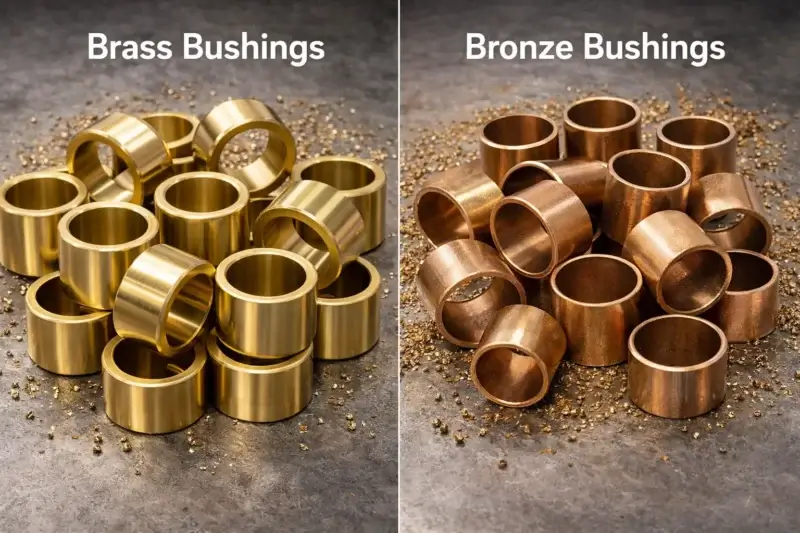
Table of Contents
1. Introduction: Two Copper Alloys, Distinctly Different
Bronze and brass represent two of the most widely utilized copper-based alloy families in industrial manufacturing. Despite their visual similarities and shared copper foundation, these materials exhibit fundamentally distinct metallurgical characteristics that dictate their suitability for specific engineering applications. For procurement engineers, maintenance managers, and design professionals engaged in bushing and bearing selection, understanding the nuanced differences between bronze and brass is not merely an academic exercise—it is a critical determinant of equipment reliability, operational longevity, and total cost of ownership.
The distinction between these alloys carries particular significance in the context of plain bearings, sleeve bushings, and wear components, where material selection directly influences friction characteristics, load-bearing capacity, and service life under diverse operating conditions. This comprehensive technical analysis examines bronze and brass through the lens of industrial bushing applications, providing actionable insights for informed material selection.
2. Metallurgical Composition: The Fundamental Distinction
2.1 Bronze: Copper-Tin Base with Strategic Alloying
Bronze is primarily defined as a copper-based alloy in which tin serves as the principal alloying element. The typical bronze composition ranges from 80 to 95 percent copper with 5 to 15 percent tin, though contemporary metallurgical practice incorporates additional elements including aluminum, phosphorus, silicon, manganese, and lead to engineer specific property profiles.
The bronze family encompasses several specialized subcategories:
Tin Bronze (Phosphor Bronze): The traditional bronze formulation, offering excellent wear resistance and fatigue strength
Aluminum Bronze: Featuring enhanced corrosion resistance and superior strength characteristics, particularly in marine environments
Leaded Bronze: Incorporating lead content to improve machinability and provide inherent lubricity
Silicon Bronze: Offering exceptional corrosion resistance combined with good mechanical properties
2.2 Brass: Copper-Zinc Alloy System
Brass, by contrast, constitutes a copper-zinc alloy system wherein zinc replaces tin as the primary alloying element. Contemporary brass compositions typically contain 55 to 95 percent copper with 5 to 45 percent zinc, frequently supplemented by lead, arsenic, phosphorus, silicon, manganese, or aluminum to modify specific properties.
Notable brass variants include:
Cartridge Brass (C26000): A 70/30 copper-zinc alloy renowned for excellent cold-working characteristics
Yellow Brass: A general-purpose alloy balancing mechanical properties with cost-effectiveness
Naval Brass: Incorporating tin to enhance corrosion resistance in marine applications
Leaded Brass (C36000): Engineered for superior machinability, often termed “free-machining brass”
2.3 The Distinction in Visual Appearance
Bronze typically exhibits a reddish-brown metallic finish, often developing a greenish-blue patina upon oxidation. Brass presents a yellow to golden hue, with higher zinc concentrations producing a silvery finish and elevated copper content imparting a more reddish tone. While visual inspection offers preliminary differentiation, material selection must be predicated upon quantitative performance metrics rather than aesthetic considerations.
3. Mechanical Properties: Strength, Hardness, and Wear Resistance
3.1 Tensile Strength and Yield Strength
Bronze alloys generally demonstrate superior tensile strength compared to brass. Bronze tensile strength values typically range from 270 MPa to 740 MPa depending on specific alloy composition and temper condition, with aluminum bronze achieving ultimate tensile strengths approaching 740 MPa. Brass tensile strength spans approximately 230 MPa to 680 MPa, with cartridge brass in H04 temper achieving approximately 520 MPa.
The yield strength differential is equally significant. Bronze offers yield strength values from 110 MPa to 380 MPa, while brass yield strengths range from 110 MPa to 570 MPa depending on composition and processing.
3.2 Hardness Characteristics
Hardness represents a critical parameter for bushing applications, directly correlating with wear resistance and load-bearing capacity. Bronze bushings exhibit Brinell hardness values typically ranging from 60 to 100 HB, with specific bronze alloys such as C932 (SAE 660) achieving 65 HB. Brass bushings demonstrate Brinell hardness of 70 to 90 HB, with C36000 brass attaining approximately 141 HB.
Industry consensus maintains that bronze bushings are harder and stronger compared with brass bushings, which are softer and thus more susceptible to deformation or fracture under load.
3.3 Wear Resistance and Durability
Bronze exhibits exceptional wear resistance, making it the preferred material for high-friction, high-load bearing applications. The tin content in bronze provides inherent lubricity and galling resistance, characteristics that prove invaluable in sliding contact applications. Bronze bushings excel in high-load, heavy-duty applications requiring wear resistance and durability.
Brass, while adequate for light to medium-duty applications, demonstrates lower wear resistance compared to bronze. Brass is more suitable for environments with relatively low friction requirements, such as low-friction bearings and decorative applications.
3.4 Fatigue Resistance
Bronze fatigue resistance exceeds that of many steel grades, a property that proves particularly valuable in cyclic loading applications common in rotating machinery and reciprocating equipment. This fatigue performance, combined with bronze’s inherent damping characteristics, contributes to extended service life in demanding operational environments.
4. Corrosion Resistance: Performance in Harsh Environments
4.1 General Corrosion Resistance
Bronze demonstrates superior corrosion resistance compared to brass across most environmental conditions. The tin content in bronze provides enhanced stability, with bronze exhibiting excellent resistance to fresh water, contaminated water, and marine environments.
Brass offers good corrosion resistance superior to non-stainless steels, yet generally inferior to bronze in aggressive environments. The zinc content in brass renders it more susceptible to dezincification—a selective leaching process in which zinc is preferentially removed, leaving behind a porous copper structure.
4.2 Seawater and Marine Environment Performance
The corrosion resistance differential between bronze and brass becomes most pronounced in seawater applications. Bronze demonstrates excellent corrosion resistance in marine environments, with aluminum bronze offering the highest corrosion resistance among copper alloys, widely utilized in seawater cooling systems, offshore fire-fighting systems, and ship valves.
Brass, while employed in marine applications in naval brass formulations, remains inherently more susceptible to galvanic corrosion when coupled with dissimilar metals in saltwater environments. The addition of tin to copper in bronze pushes the alloy more toward the cathodic end of the galvanic series, providing enhanced protection against galvanic corrosion.
4.3 Pitting and Localized Corrosion
Bronze demonstrates moderate resistance to pitting corrosion, while brass exhibits vulnerability to stress corrosion cracking in specific environments, particularly in the presence of ammonia or mercury compounds. Bronze’s susceptibility to “bronze disease”—a form of chloride-induced corrosion—represents a consideration in certain applications, though this phenomenon is generally manageable through appropriate alloy selection and environmental controls
5. Thermal and Electrical Conductivity: A Comparative Analysis
5.1 Thermal Conductivity
Thermal conductivity represents an important consideration in bushing applications where heat dissipation affects performance and service life. Brass generally exhibits superior thermal conductivity compared to bronze, with values ranging from 61 W/m·K to 120 W/m·K depending on specific alloy composition. Bronze thermal conductivity typically ranges from 26 W/m·K to 71 W/m·K.
This differential reflects the influence of alloying elements on thermal transport properties—zinc in brass imposes less disruption to the copper lattice than tin in bronze, resulting in higher thermal conductivity in brass alloys.
5.2 Electrical Conductivity
Electrical conductivity, expressed as a percentage of the International Annealed Copper Standard (% IACS), varies significantly among copper alloys. Brass demonstrates electrical conductivity ranging from approximately 28% to 56% IACS, while bronze typically exhibits 7% to 20% IACS, with certain phosphor bronzes achieving 11% to 20% IACS.
For bushing applications, electrical conductivity rarely represents a primary selection criterion, though it may become relevant in applications involving electrical grounding or stray current considerations.
6. Machinability and Workability: Manufacturing Considerations
6.1 Machinability
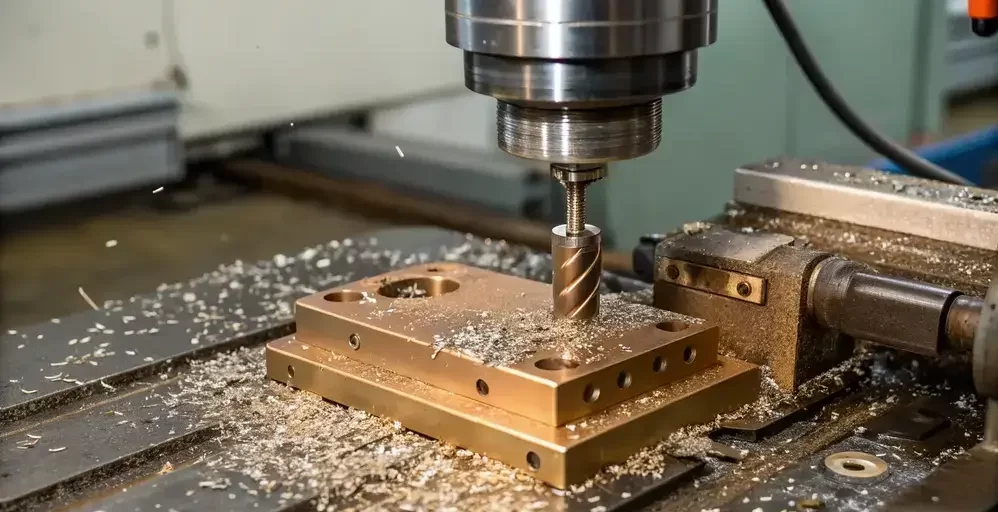
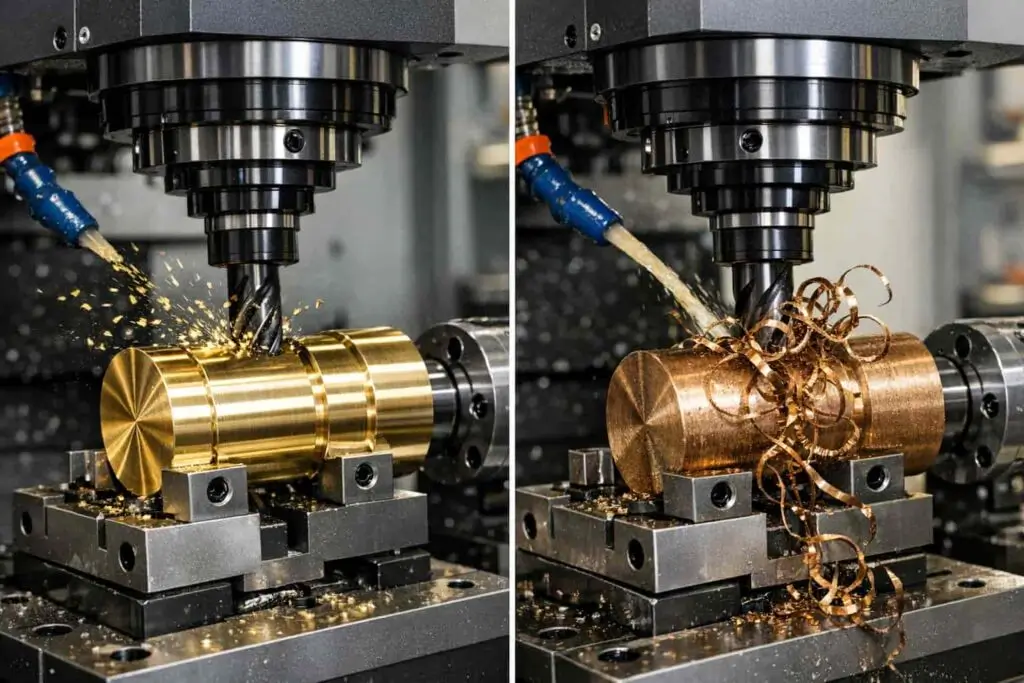
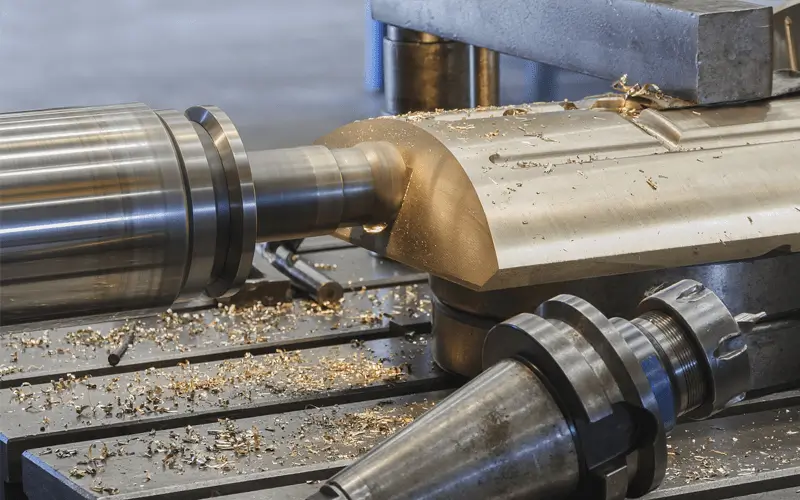
Brass offers superior machinability compared to bronze, a characteristic that significantly influences manufacturing costs and production efficiency. Leaded brass grades, particularly C36000 free-machining brass, achieve machinability ratings approaching 100% relative to free-cutting steel. Bronze, by contrast, is harder and more brittle, presenting greater machining challenges.
6.2 Malleability and Formability
Brass exhibits greater malleability than bronze, facilitating cold-working operations, forming, and shaping. This ductility advantage renders brass preferable for applications requiring complex geometries or extensive secondary forming operations. Bronze’s reduced malleability reflects its higher strength and hardness, characteristics that simultaneously confer superior wear resistance.
6.3 Casting Characteristics
Brass possesses a lower melting point (approximately 900°C) compared to bronze (approximately 950°C), rendering brass easier to cast. Bronze’s higher melting point and greater brittleness make it more challenging to cast. However, advanced centrifugal casting techniques employed by specialized manufacturers effectively address these challenges, producing bronze castings with uniform density and structural integrity
7. Bushing Applications: Bronze vs. Brass in Bearing Systems
7.1 Bronze Bushings: The Heavy-Duty Standard
Bronze bushings represent the industry standard for high-performance sliding bearings and bushings. Bronze offers excellent wear resistance, high strength, superior corrosion resistance, and good fatigue strength. These properties make bronze bushings ideal for:
Heavy machinery and construction equipment bearings
Automotive engines and suspension components
Marine propulsion systems and offshore equipment
High-load, low-speed applications where durability is paramount
Environments with high temperatures, abrasive conditions, or limited lubrication
Bronze bushings, particularly aluminum bronze variants, are favored for their strength and durability, offering superior load-bearing capacity and resistance to wear.
7.2 Brass Bushings: Light to Medium-Duty Applications
Brass bushings, while softer and more prone to deformation, offer distinct advantages in specific applications. Brass bushings are characterized by:
Excellent machinability enabling precise manufacturing and customization
Good corrosion resistance, particularly in mildly corrosive environments
Cost-effectiveness for less demanding applications
Suitability for low-load, low-speed applications
Brass bushings find application in electrical equipment, plumbing fixtures, small machinery, and scenarios where ease of machining and corrosion resistance are more important than extreme durability.
7.3 The Economic Case for Bronze
While bronze bushings command higher initial costs compared to brass, the lifecycle economics frequently favor bronze. In demanding applications, a single bronze bushing can outlast multiple brass replacements. When factoring in labor costs, downtime, and lost production, bronze often emerges as the most economical choice
8. Cost-Benefit Analysis: Initial Investment vs. Lifecycle Value
Material selection for bushing applications requires evaluating both immediate procurement costs and long-term operational economics. Bronze generally commands higher material costs than brass, reflecting its enhanced properties and more complex alloying requirements.
However, the total cost of ownership frequently favors bronze in demanding applications:
Extended service life reduces replacement frequency
Superior wear resistance minimizes maintenance interventions
Enhanced corrosion resistance prevents premature failure in aggressive environments
Reduced downtime improves overall equipment effectiveness (OEE)
For applications characterized by high loads, elevated temperatures, abrasive conditions, or limited lubrication, bronze represents the economically rational choice despite higher initial cost.
9. MYWAY Bushings: Precision-Engineered Solutions for Demanding Applications
9.1 Company Overview
Zhejiang MYWAY Co., Ltd., established in 2005, has emerged as a national high-tech enterprise specializing in the research, development, production, and sales of bushings, bearings, and related raw materials. With over 20 years of dedicated innovation and more than 400 employees, MYWAY has established itself as a leading expert in the bushing manufacturing industry.
MYWAY operates a manufacturing facility spanning 35,000 square meters, equipped with more than 2,000 precision molds, advanced sintering lines, and the latest automated machinery and inspection systems. The company holds multiple international certifications including ISO 9001:2015, IATF 16949:2016, ISO 14001:2015, and GB/T 29490-2013, ensuring products meet rigorous quality standards for export to over 40 countries worldwide.
9.2 MYWAY Bronze and Brass Bushings
MYWAY specializes in transforming premium bronze and brass into precision-engineered bushings, bearings, and custom components trusted by global industries. The company’s manufacturing process begins with smelting high-purity copper alloys, utilizing precision centrifugal casting to ensure uniform density and structural integrity, followed by CNC machining achieving micron-level accuracy.
MYWAY’s comprehensive product portfolio includes:
Cast bronze bushings and centrifugal casting bushes
Self-lubricating bushings (SF-1, JF series)
PTFE bronze bushings for challenging bearing applications
Graphite-inlaid copper bushings for solid lubrication requirements
Bimetallic bearings combining material advantages
9.3 Why Choose MYWAY for Your Bushing Requirements?
Technical Excellence: MYWAY combines cutting-edge manufacturing with deep material science to produce bushings that set the standard for performance. The company’s expertise spans the full spectrum of copper-based alloys, enabling precise material selection for specific application requirements.
End-to-End Capability: From raw material casting and sintering to finished product production, MYWAY offers comprehensive manufacturing capabilities. This vertical integration ensures quality control throughout the production chain and enables competitive pricing through manufacturing efficiency.
Global Reach: MYWAY products are exported to Germany, Italy, Japan, the United States, Canada, South Korea, and beyond, demonstrating the company’s ability to meet international quality standards and customer expectations.
Customization: With over 2,000 precision molds and extensive engineering expertise, MYWAY delivers custom bushing solutions tailored to specific application requirements—from inner diameters as small as 2 millimeters to components exceeding 1.2 meters.
Quality Assurance: Multiple international certifications, rigorous inspection protocols, and a commitment to continuous improvement ensure that every MYWAY bushing meets exacting quality standards.
9.4 Contact MYWAY
For engineering consultation, custom bushing solutions, or to request a quotation, contact MYWAY’s professional team:
Website: mybushing.com
Factory: No. 822 Taiji Road, Economic Development Zone, Guangde, Xuancheng City, Anhui Province, China
Foreign Trade Center: Building 10, Greenland Central Plaza, Gongshu District, Hangzhou City, Zhejiang Province, 310011 China
10. Frequently Asked Questions (FAQ)
Q1: Is bronze or brass better for bushings?
A: In most high-load, high-wear applications, bronze is superior. Bronze generally offers greater strength, superior wear resistance, and higher corrosion resistance compared to brass, making it more suitable for demanding bushing applications. Brass is appropriate for light to medium-duty applications where ease of machining and cost considerations take precedence.
Q2: What is the main difference between bronze and brass?
A: Bronze is primarily an alloy of copper and tin, while brass is an alloy of copper and zinc. This fundamental compositional difference results in distinct mechanical properties, corrosion resistance, and application suitability.
Q3: Why are bronze bushings more expensive than brass bushings?
A: Bronze commands higher material costs due to more expensive alloying elements (tin versus zinc) and more complex manufacturing processes. Bronze’s higher melting point and greater hardness make it more challenging to cast and machine.
Q4: Can brass bushings be used in marine environments?
A: While naval brass formulations offer improved seawater resistance, bronze—particularly aluminum bronze—provides superior corrosion resistance in marine applications. The use of brass in saltwater environments adjacent to dissimilar metals risks galvanic corrosion.
Q5: How do bronze and brass bushings differ in wear resistance?
A: Bronze bushings demonstrate significantly superior wear resistance compared to brass. Bronze’s hardness, inherent lubricity, and galling resistance make it the preferred choice for high-friction, high-load applications. Brass is more suitable for environments with relatively low friction requirements.
Q6: What industries commonly use bronze bushings?
A: Bronze bushings find application across aerospace, agriculture, automotive, construction, energy (wind turbines, hydroelectric power), food processing, industrial machinery, offshore equipment, and pumping systems.
Q7: Does MYWAY offer custom bushing solutions?
A: Yes. MYWAY specializes in custom bushing solutions with over 2,000 precision molds and comprehensive engineering capabilities. The company provides end-to-end service from material selection through finished product delivery.
Q8: What certifications does MYWAY hold?
A: MYWAY maintains ISO 9001:2015, IATF 16949:2016, ISO 14001:2015, and GB/T 29490-2013 certifications.
Q9: How does thermal conductivity affect bushing selection?
A: Brass generally exhibits higher thermal conductivity than bronze. In applications where heat dissipation is critical, brass may offer advantages. However, for most bushing applications, wear resistance and load-bearing capacity take precedence over thermal conductivity.
Q10: What is the typical service life of a bronze bushing compared to brass?
A: In demanding applications, a bronze bushing can outlast multiple brass replacements. The exact service life differential depends on specific operating conditions, load characteristics, and lubrication practices.
100000+ Types of Bushings – Contact Us for Details