
Recent Posts
MYWAY DU Bushing: The Maintenance‑Free Self‑Lubricating Solution for High‑Load & Extreme‑Temperature Applications
Introduction: A Small Component with a Big Impact
Unexpected bearing failures and frequent lubrication of hard-to-reach components lead to costly downtime and reduced productivity. A DU bushing—also known as a dry, self-lubricating, or oil‑free bushing—eliminates these issues. Engineered for maintenance‑free operation, it resists contamination and prevents unexpected failures.
When combined with the manufacturing precision of Zhejiang MYWAY Co., Ltd., DU bushings deliver reliable performance at a competitive cost.
This guide explains what a DU bushing is, how it works, its key applications, and why MYWAY DU Bushings are the preferred choice for demanding industrial and automotive environments.
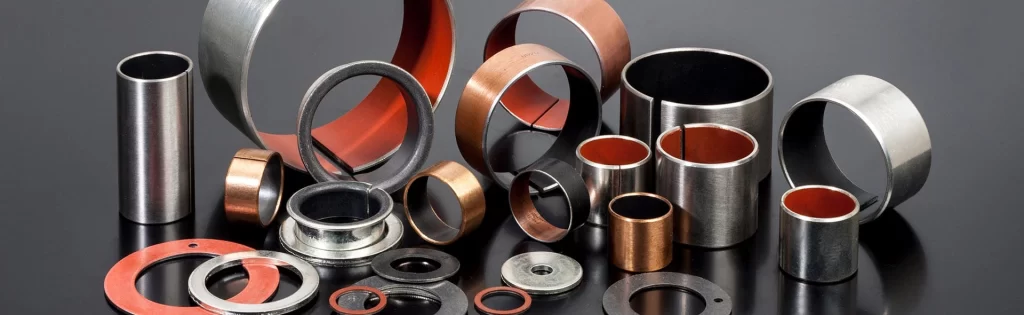
Table of Contents
1. What Is a DU Bushing?
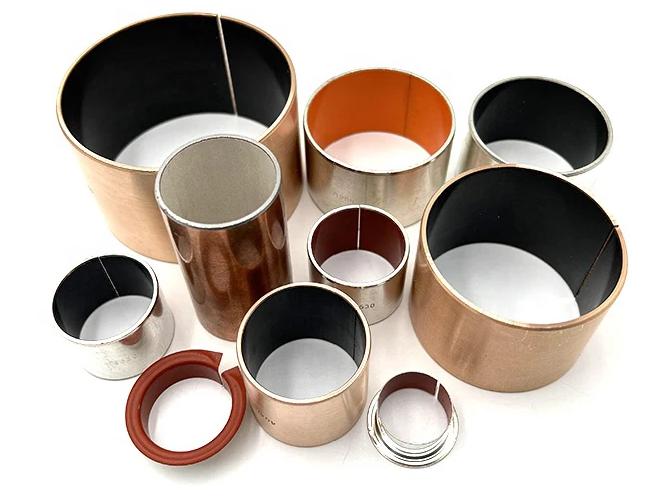
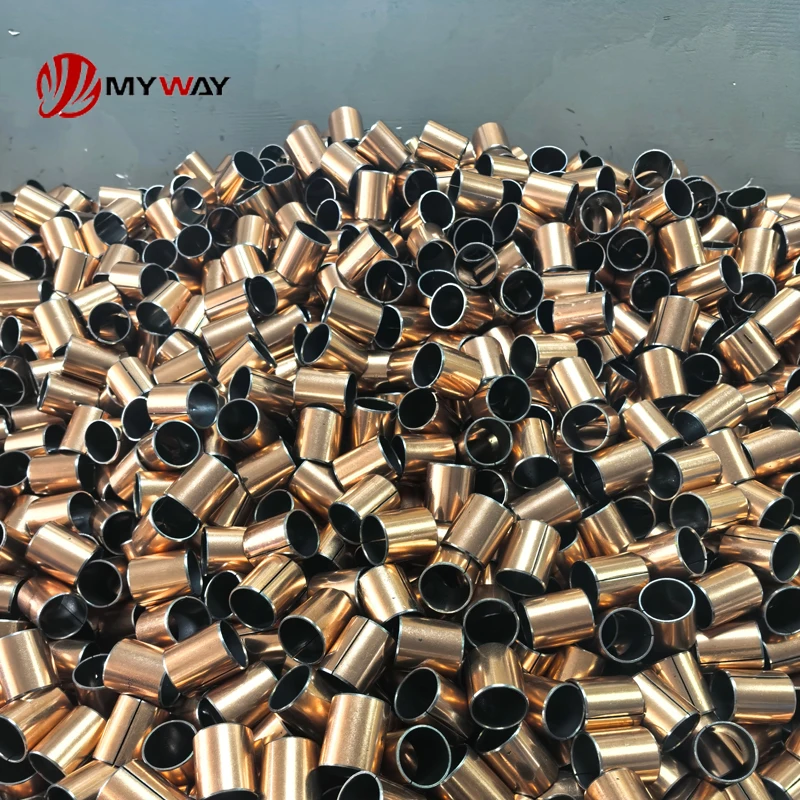
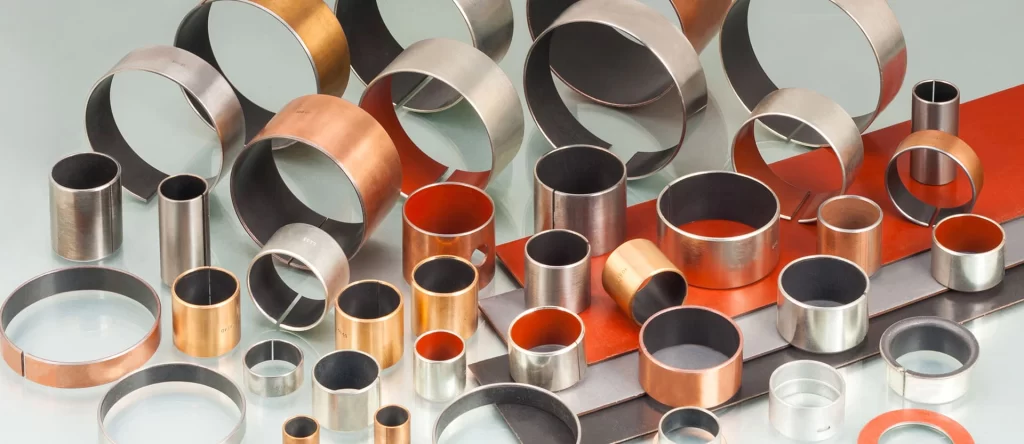
A DU bushing is a three‑layer composite sliding bearing that runs without external lubrication. The top layer contains PTFE (with or without lead), which transfers a solid lubricant film onto the mating shaft. Result: low friction, zero grease, and long service life.
| Feature | Description |
|---|---|
| Steel backing | High strength, resists deformation, dissipates heat |
| Porous bronze interlayer | Stores PTFE, improves wear resistance, helps cooling |
| PTFE‑based surface | Self‑lubricating, friction coefficient as low as 0.08 (dry) |
| Lubrication needed? | No – but adding oil improves speed and PV value |
| Typical nicknames | Dry bushing, self‑lube bushing, oil‑free bearing, SF‑1 bushing |
2. Performance That Covers a Wide Range of Conditions
One reason DU bushings are so popular is that they work well across a wide range of loads, speeds, and temperatures. You don’t need to switch materials when conditions change.
Loads: Dynamic pressures up to 140 N/mm² (about 20,000 psi). That’s high enough for hydraulic cylinders, heavy suspension arms, and construction equipment.
Speeds: Up to 2.5 m/s when running dry, and up to 5 m/s if you add a little oil or grease.
Temperature: From –200 °C all the way up to +280 °C. That means liquid nitrogen environments on one end, and hot engine compartments on the other.
Friction coefficient: As low as 0.08 when dry, and down to 0.02 when lubricated – which is extremely slippery.
For engineers, the PV value (pressure × velocity) is the real guide. MYWAY DU Bushings can run continuously at 1.8 N/mm²·m/s (50,000 psi·ft/min) and handle short peaks up to 3.6 N/mm²·m/s (100,000 psi·ft/min). In actual use with lubrication, they’ve been pushed much higher without failure.
So whether you’re designing a food processing machine that cannot use oil, or a mining vehicle that runs in dust and grit, a DU bushing is a solid choice.
3. Types of MYWAY DU Bushings
Not all bushings look the same. Depending on your assembly, you might need a simple cylinder, a two‑piece split bushing, or a flanged version that handles thrust loads. MYWAY offers all of the following forms.
| Bushing Type | Best Use Case |
|---|---|
| Cylindrical (solid sleeve) | Radial loads only – press into a housing |
| Split bushing (two halves) | Install around a shaft without disassembly |
| Flanged bushing | Radial + axial loads; prevents end movement |
| Thrust washer | Pure axial (end) loads |
| Flanged washer | Axial load with alignment |
| Sliding plate | Linear motion, slide guides |
| Custom shapes | Half‑bushings, stamped parts, deep‑drawn forms |
What this means for you: If you have a standard metric or imperial size, MYWAY probably has it in stock – with over 2,000 existing moulds. If you need something special, we can make it to your drawing. No need to redesign your assembly around a limited catalogue.
4. Where Are DU Bushings Used?
DU bushings show up in places you might not expect. They’re not just for heavy industry. You’ll find them in your car, your washing machine, and even in aircraft interiors.
Here are the most common industries and applications:
Automotive & off‑highway
Suspension control arms, shock absorbers, steering linkages, door hinges, seat adjusters, wiper systems, power steering pumps, fifth wheels, pivot pins. MYWAY is IATF 16949 certified and supplies brands like Hyundai, Honda, Toyota, Nissan, Ford, Chery, Geely, Lexus, and Mazda.
Industrial machinery
Hydraulic cylinders, pneumatic cylinders, gear pumps, vane pumps, piston pumps, compressors, fans, conveyors. In many of these, you simply cannot reach a grease fitting easily – so self‑lubrication is a lifesaver.
Agricultural equipment
Harvesters, seeders, sprayers, tillage tools. Dust and dirt are everywhere on a farm. DU bushings don’t need grease, so they don’t turn into a gritty grinding paste.
Construction & heavy equipment
Excavator linkages, loader pivot points, bulldozer blades. Shock loads and vibration are brutal on rolling bearings, but DU bushings absorb impact much better.
5. DU Bushing vs. Copper/Bronze Bushings, Steel Bushings, and Bimetal Bushings
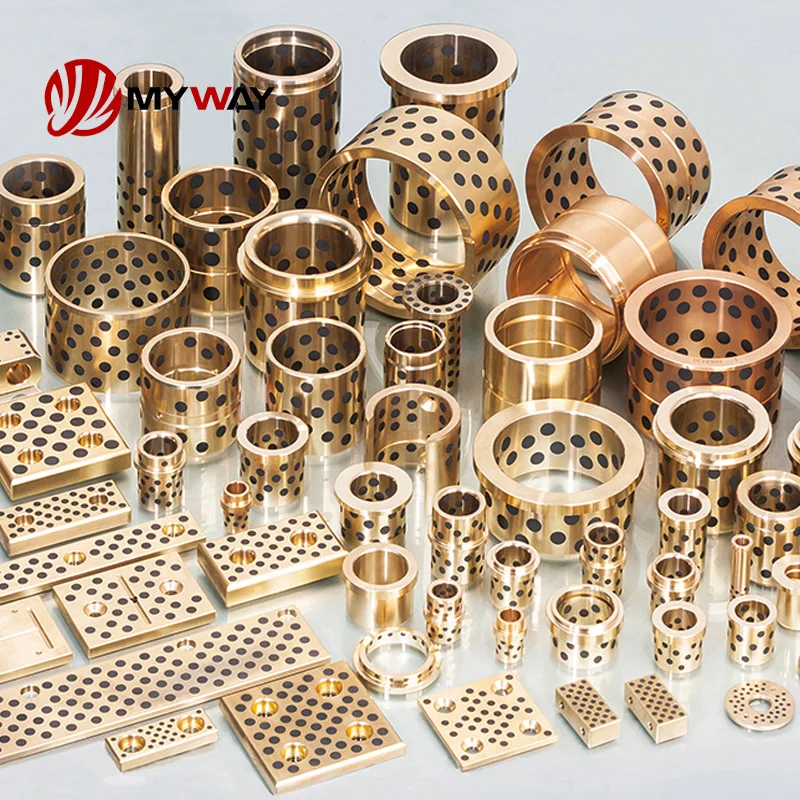
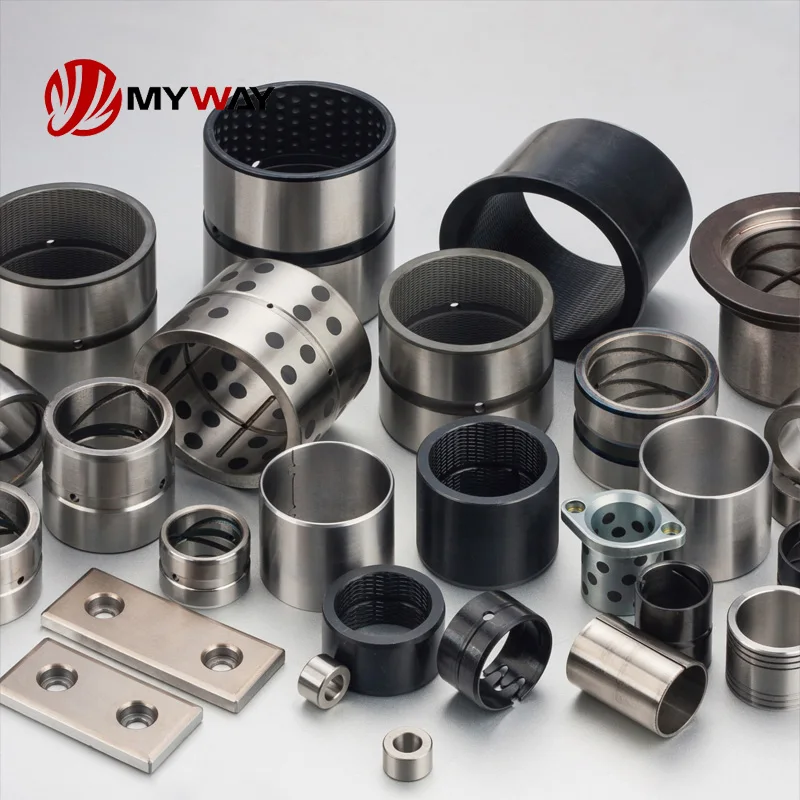
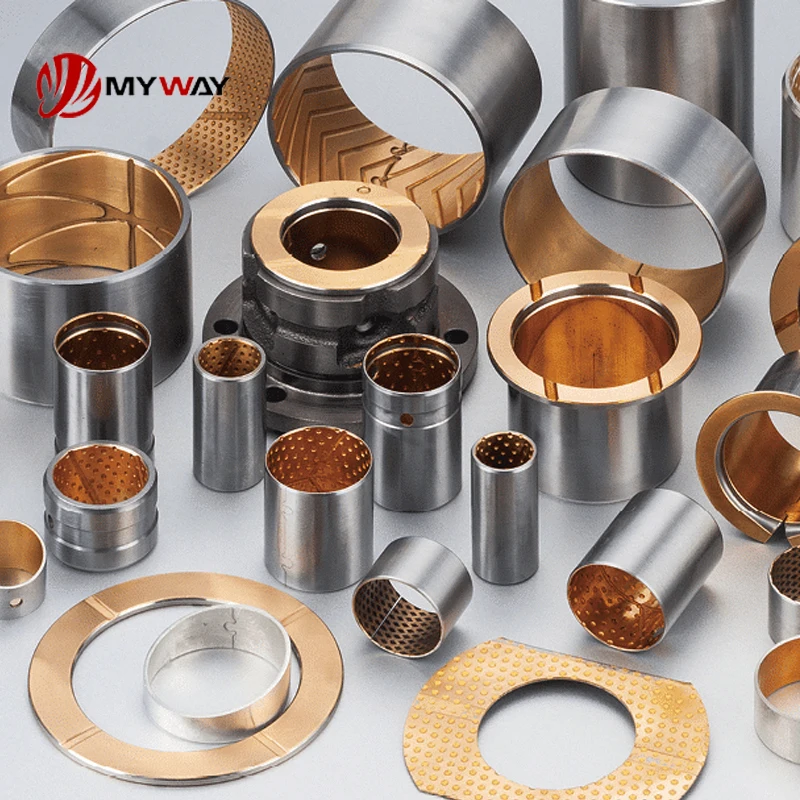
Different bushings have their own advantages and suitable applications. MYWAY manufactures and supplies the full range of products, including DU self‑lubricating bushings, copper/bronze bushings, steel bushings, and bimetal bushings. Below is an objective comparison of their characteristics to help you choose the most suitable solution based on your actual operating conditions.
Solid Copper/Bronze Bushings
Typically made of tin bronze, aluminium bronze, or brass. They offer high strength, good corrosion resistance, and excellent thermal conductivity. However, they do not have self‑lubricating properties and must operate with oil or grease lubrication. When properly lubricated, bronze bushings have a long service life and are suitable for medium‑to‑heavy loads, low‑to‑medium speeds, and applications where reliable lubrication is available.
Steel Bushings
Usually made of carbon steel or alloy steel. They have high hardness, very high load capacity, and relatively low cost. However, the coefficient of friction between steel and steel is high, so lubrication is required. Steel bushings are typically used in heavy‑duty, low‑speed applications with good lubrication conditions.
Bimetal Bushings
Made of a steel backing with a sintered bronze or copper alloy layer on the inner surface. They are thinner and stronger than solid bronze bushings, but still require external lubrication. Bimetal bushings combine the strength of steel with the wear resistance of copper, making them suitable for medium‑to‑high load applications where lubrication is available.
MYWAY DU Bushings (Self‑lubricating)
Also built on a steel backing, with a porous bronze interlayer and a PTFE‑based top layer that acts as a solid lubricant. The biggest advantage is that they can operate without oil or with minimal lubrication, offering low friction and maintenance‑free operation. They are ideal for applications where lubrication is difficult, temperatures are extreme, the environment is dusty, or regular greasing is not feasible.
The table below provides a clear comparison:
| Feature | MYWAY DU Bushing | Copper/Bronze Bushing | Steel Bushing | Bimetal Bushing |
|---|---|---|---|---|
| Self‑lubricating (dry running) | Yes – no external lubrication needed | No – requires oil/grease | No – requires oil/grease | No – requires oil/grease |
| Maintenance requirement | Maintenance‑free | Regular greasing/oiling | Regular greasing/oiling | Regular greasing/oiling |
| Max. dynamic load (lubricated) | 140 N/mm² | 50–120 N/mm² (depends on alloy) | 100–150 N/mm² | 80–120 N/mm² |
| Dry friction coefficient | 0.08–0.20 (suitable for dry running) | Not suitable for dry running | Not suitable for dry running | Not suitable for dry running |
| Lubricated friction coefficient | 0.02–0.07 | 0.05–0.12 | 0.08–0.15 | 0.05–0.10 |
| Temperature range | –200°C to +280°C | Limited by lubricant | Limited by lubricant | Limited by lubricant |
| Dirt/dust tolerance | Excellent (no grease to trap contaminants) | Fair (grease attracts dirt) | Fair | Fair |
| Wall thickness | Thin (1–2.5 mm typical) | Thicker (3–10 mm) | Medium to thick | Medium (1.5–3 mm) |
| Typical applications | Maintenance‑free, dry running, extreme temperatures | Bearing housings with reliable lubrication, gearboxes | Heavy‑duty low‑speed machinery with lubrication | Connecting rods, rocker arms, lubricated pivot pins |
6. Frequently Asked Questions
Q1: Can I really run a MYWAY DU Bushing with zero lubrication?
Yes. The PTFE layer is a solid lubricant. It works completely dry. If you add oil or grease, the performance (speed and PV value) actually improves – but it’s never required.
Q2: What shaft finish works best?
For best life, use a steel shaft with hardness above 220 HB and surface roughness Ra = 0.4–1.25 μm. A ground or hard chrome‑plated shaft is ideal. Avoid rough or soft shafts.
Q3: How long will a DU bushing last?
That depends on your PV value, temperature, and environment. In typical hydraulic or suspension applications, MYWAY DU Bushings last for millions of cycles or several years. MYWAY has tested over 1 million impact cycles with almost no wear on the PTFE layer.
Q4: Do MYWAY DU Bushings contain lead?
Standard DU contains a tiny amount of lead in the PTFE mixture. But MYWAY also offers lead‑free (Pb‑free) versions for RoHS compliance or medical use. Contact them for lead‑free specifications.
Q5: Can I use a DU bushing underwater or in chemicals?
Yes – DU bushings resist many industrial liquids, including water, oils, and mild chemicals. Avoid strong acids. For aggressive chemical environments, consult MYWAY.
Q6: What’s the difference between DU and SF‑1?
No practical difference. “DU” is the original trademark (GGB). “SF‑1” is the widely used equivalent designation. MYWAY manufactures both types to the same performance standards.
Q7: What is the minimum order quantity (MOQ)?
For standard size bushings, MOQ can be as low as 10 pieces for sample testing. For custom sizes, MOQ depends on complexity. MYWAY is flexible – just ask.
Q8: Do you have aerospace or cryogenic approvals?
Yes. MYWAY’s DU materials are tested to FAR 25.853 & 25.855 (flame resistance), ASTM E595 (outgassing), and DIN EN 1797 / ISO 21010 for oxygen compatibility up to 60°C and 25 bar.
Q9: How do I install a split bushing correctly?
Always position the split gap 90 degrees away from the main load direction. Never align the split with the load – that reduces load capacity and life.
Q10: How can I get a sample or a quote?
Contact MYWAY directly through their website, email, or B2B platform. They typically reply within one working day. Samples are available for testing and validation.
Ready to Switch to MYWAY DU Bushings?
You don’t need to overpay for a name brand. You need a bushing that works – reliably, quietly, and without constant greasing. MYWAY DU Bushings deliver the same three‑layer composite performance as premium European brands, at a fraction of the cost.
Whether you need standard cylindrical bushings, split bushings for easy installation, flanged bushings for combined loads, or fully custom shapes – MYWAY has the moulds, the materials, and the experience.
Stop wasting time on lubrication schedules. Stop worrying about grease contamination. Try MYWAY DU Bushings.
 Contact Zhejiang MYWAY Co., Ltd.
Share your size (ID, OD, length)
Tell them your load, speed, temperature, and environment
Ask for a free recommendation, a quote, and sample parts
 Established 2005 | IATF 16949 & ISO 9001 | 2,000+ moulds | Exported to 40+ countries
“Maintenance‑free shouldn’t mean expensive. With MYWAY, it means smart engineering.”
100000+ Types of Bushings – Contact Us for Details