
Recent Posts
Comprehensive Analysis of Bronze Properties: Metallurgy, Mechanical Performance, and Industrial Applications
Introduction
Bronze, one of the earliest engineered alloys in human history, remains a cornerstone material in contemporary mechanical engineering. This technical article provides a systematic examination of bronze metallurgy—primary base metals, alloying elements, and their influence on mechanical, tribological, and physical properties. The discussion encompasses historical context, classification of major bronze families (phosphor bronze, aluminum bronze, leaded bronze, manganese bronze, and silicon bronze), comparative analysis with brass and pure copper, and the specific engineering rationale for bronze dominance in high-reliability bushing and bearing applications.
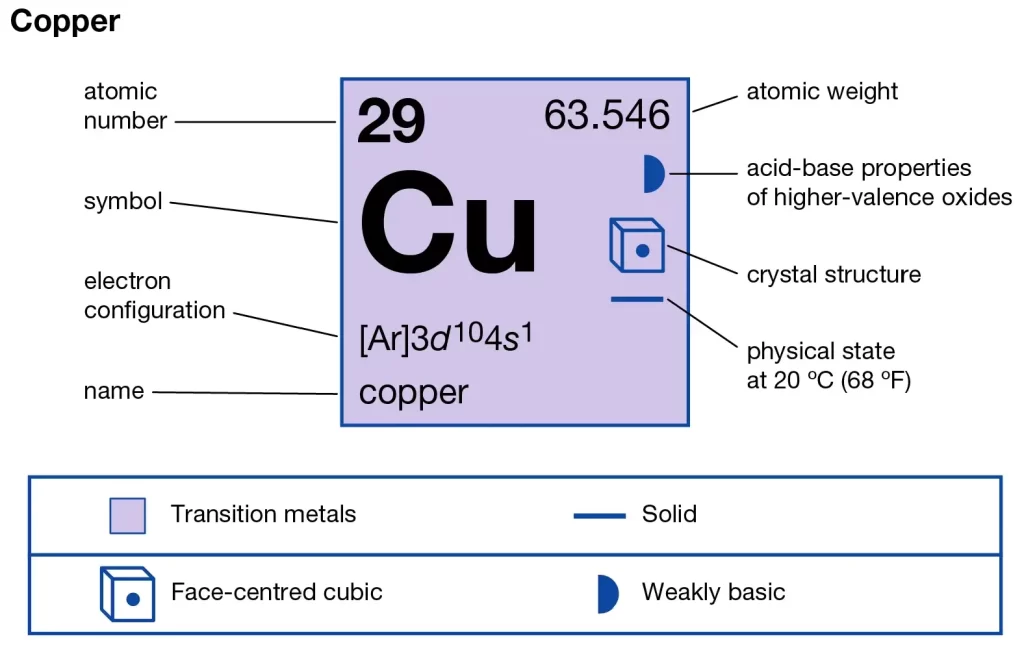
Table of Contents
1. Introduction: Defining Bronze from a Metallurgical Perspective
In industrial procurement and mechanical design, one frequently encountered question concerns the exact material composition of bronze. Unlike pure metals, bronze represents a deliberate alloy, meaning its properties derive from the combination of two or more metallic elements. Historically, the term “bronze” broadly encompasses a variety of copper-based alloys. However, in strict technical terminology, bronze refers specifically to copper-tin (Cu-Sn) alloys—the very composition that gave the Bronze Age its name.
Bronze is rarely employed as a pure binary alloy. Instead, modern industrial grades incorporate additional alloying components and additives, enabling engineers to tailor material properties for specific operational requirements. Wrought alloys typically contain phosphorus and zinc, while cast alloys incorporate lead, nickel, and iron as significant constituents. Such formulations are termed multi-component bronzes
2. Fundamental Composition of Bronze
2.1 Base Metal: Copper
All bronze alloys commence with copper (Cu) as the primary constituent. In standard industrial bronzes, copper content typically ranges from 80% to 95% by weight. Copper provides the following baseline characteristics: face-centered cubic (FCC) crystal structure offering good ductility and formability; high electrical and thermal conductivity; natural corrosion resistance in many environments including atmospheric and aqueous conditions; and a relatively low melting point (1084°C for pure copper), which facilitates casting. However, pure copper is excessively soft for load-bearing or wear-resistant applications. Its tensile strength in annealed condition reaches only 200–250 MPa, and it exhibits poor galling resistance. Alloying thus becomes essential.
2.2 Primary Alloying Element: Tin
Traditional bronze is defined by the addition of tin (Sn) to copper. The tin content in conventional wrought and cast bronzes ranges from 5% to 15%, with the most common general-purpose composition being approximately 88% copper / 12% tin. The metallurgical effects of tin include solid-solution strengthening (tin atoms dissolve into the copper lattice, creating lattice strain that increases hardness and strength); melting point depression (liquidus temperature drops to approximately 950–1020°C, improving fluidity and castability); reduced ductility as tin content increases beyond 12–14%; and improved wear resistance through formation of a harder matrix that resists adhesive and abrasive wear mechanisms.
2.3 Classification: Wrought versus Cast Bronzes
Bronze alloys are broadly classified based on processing method. Wrought alloys contain up to 8.5% tin and are suitable for hot and cold forming by rolling, pressing, and drawing processes. Cast alloys typically exhibit tin content between 9% and 12%. Hyper tin bronzes (tin up to 17%) produced by spray compacting, and bell bronzes (20% tin), represent specialty applications where acoustic or specific mechanical properties dominate
3. Mechanical Properties of Bronze Alloys
3.1 Tensile Strength, Yield Strength, and Hardness
Bronze alloys demonstrate a wide spectrum of mechanical properties depending on composition and processing. Phosphor bronze such as CuSn₆ exhibits tensile strength reaching 380 MPa with ductility up to 40%, making it suitable for bearing sleeves and fatigue-corrosion-resistant springs–. Bearing Bronze C93200 (SAE 660) delivers tensile strength of 30,000–35,000 psi, yield strength of 14,000–20,000 psi, and Brinell hardness of 65–72, offering good anti-frictional characteristics for moderate load-carrying applications. Aluminum bronze C95400 achieves significantly higher values: tensile strength of 65,000–85,000 psi, yield strength of 25,000 psi, and Brinell hardness exceeding 150. Manganese bronze C86300 represents the highest strength among common bearing bronzes, with tensile strength up to 110,000 psi, yield strength of 60,000 psi, and hardness exceeding 225 HB
3.2 Elastic Modulus and Fatigue Performance
The modulus of elasticity for bronze alloys generally ranges from 93 to 120 GPa, providing structural rigidity suitable for load-bearing components. Aluminum bronzes exhibit excellent fatigue resistance, ensuring extended service life under cyclic loading conditions. The alloys retain substantial proportion of their strength at elevated temperatures, while at cryogenic temperatures they gain strength slightly while retaining ductility.
3.3 Wear Resistance and Anti-Friction Characteristics
Bronze’s superior wear resistance stems from its harder matrix structure compared to pure copper. The material performs exceptionally well under boundary lubrication conditions. The hardness of bronze (typically 50–100 HV) is significantly lower than that of hardened steel shafts—a deliberately engineered property ensuring that the bronze bushing wears preferentially, making bushing replacement substantially more economical than shaft replacement

4. Physical Properties
4.1 Density
The density of bronze alloys varies with composition. Phosphor bronze density ranges from 8.80 to 8.86 g/cm³. C93200 exhibits density of approximately 8.8 g/cm³. C83600 (SAE 40) shows lower density at 8.4 g/cm³. Aluminum bronze C95400 density measures approximately 8.5 g/cm³.
4.2 Thermal Conductivity and Melting Behavior
Thermal conductivity of bronze alloys depends significantly on tin content. Lower-tin bronzes demonstrate thermal conductivity values of 71.9 W/m·K, while aluminum bronze C95400 exhibits approximately 59 W/m·K–. Melting points for bronze alloys typically span 830–1020°C, varying with composition. Solidus temperatures range from 830°C to 854°C, while liquidus temperatures reach 990–1040°C for certain alloys.
4.3 Electrical Conductivity
As tin content increases, electrical conductivity decreases proportionally. Bronze alloys generally exhibit 15–40% IACS (International Annealed Copper Standard), substantially lower than pure copper but adequate for many electrical and electronic applications where mechanical properties take precedence.
5. Corrosion Resistance: A Defining Attribute
5.1 Marine Environment Performance
Bronze exhibits exceptional corrosion resistance in marine environments. Aluminum bronzes form a thin, tough surface layer of alumina (Al₂O₃) that acts as a barrier to corrosion of the copper-rich alloy. These alloys often outperform many stainless steels in seawater applications. C63000 nickel aluminum bronze displays good erosion and cavitation resistance in seawater and brackish water, together with resistance to dilute sulfuric, hydrochloric, and non-oxidizing acids.
5.2 Effect of Alloying Elements
Tin decreases the corrosion rate of bronze in marine environments, while zinc increases it. Aluminum bronzes demonstrate biostatic effects—the copper component prevents colonization by marine organisms including algae, lichens, barnacles, and mussels, making them preferable to stainless steel or other non-cupric alloys in applications where such colonization is undesirable. NiAl bronze with 4.5% Mn exhibits superior corrosion resistance, with corrosion rate reduced by 67% compared to Mn-free alloy after 30 days of immersion.
5.3 Chemical and Industrial Environment Resistance
Bronze alloys resist corrosion in atmospheric conditions, showing low oxidation rates at elevated temperatures and low reactivity with sulfurous compounds and other combustion exhaust products. They are widely used in chemical, petrochemical, and desalination plants, as well as in power generation equipment
6. Major Bronze Alloy Families and Applications
6.1 Phosphor Bronze
Phosphor bronze contains copper, tin, and a small phosphorus addition (typically 0.1–0.5%). This alloy exhibits excellent spring properties, high elastic limit, and outstanding fatigue resistance. It is widely employed in electrical connectors, switch components, relay springs, and musical instruments. The alloy’s machinability rating is approximately 20 (where free-cutting brass equals 100), requiring careful attention to tooling and machining parameters.
6.2 Aluminum Bronze
Aluminum bronzes contain 4–14% aluminum, often with additions of iron, nickel, and manganese. These alloys demonstrate strength comparable to low-alloy steels, excellent corrosion resistance in seawater, favorable high-temperature properties, and good resistance to fatigue and creep. Applications include marine hardware, pump components, valve seats, gears, and wear plates in high-load environments.
6.3 Manganese Bronze
Manganese bronze features copper, zinc (22–28%), aluminum (2–4%), iron (2–4%), and manganese (2.5–5%). This alloy offers very high tensile strength (up to 110,000 psi), good shock absorption, and moderate corrosion resistance. It is particularly suitable for heavy-duty bushings and bearings in construction and mining equipment, as well as in high-pressure fluid systems.
6.4 Silicon Bronze
Silicon bronze contains 1–3% silicon, providing excellent weldability, good corrosion resistance, and moderate strength. This alloy is favored for architectural applications including door hardware, cladding, and sculptures, as well as for applications requiring spark-resistant properties. Silicon bronze exhibits the highest electrical conductivity among cast bronzes.
6.5 Leaded Tin Bronze (SAE 660 / C93200)
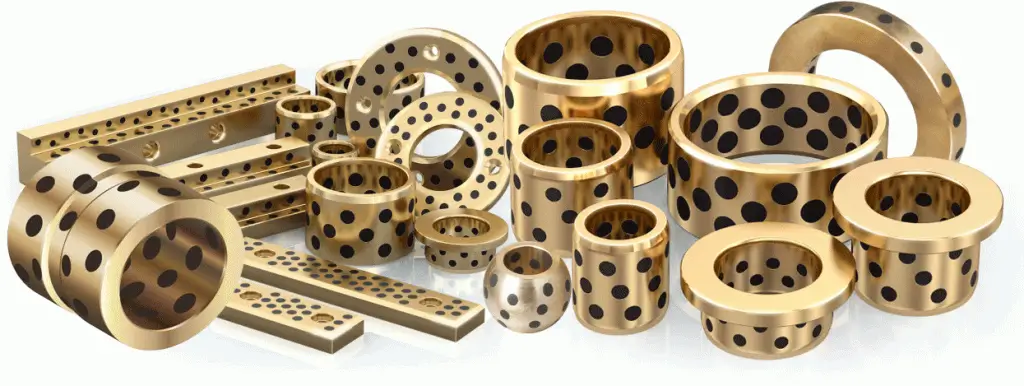
Leaded tin bronze with composition Cu 83-86%, Sn 6-8%, Pb 6-8%, Zn 2-4% represents the most commonly used bearing bronze, often termed the “workhorse” of bushing materials. This grade offers an exceptional balance of machinability (rating 70), wear resistance, load capacity, and cost-effectiveness. The lead content contributes lubricity for start-stop applications, while tin provides strength and hardness
7. Comparative Analysis: Bronze versus Brass and Copper
7.1 Compositional Differences
Copper is a pure metal with minimum 99.3% copper content. Brass is an alloy of copper and zinc (typically 5–40% Zn). Bronze is an alloy of copper and tin (typically 1–12% Sn), with optional additions of aluminum, phosphorus, or silicon.
7.2 Mechanical Property Comparison
Bronze exhibits the highest tensile strength among these three materials, typically ranging from 350–800 MPa, making it best suited for load-bearing components such as bushings and gears. Brass provides intermediate strength of approximately 300–600 MPa. Pure copper offers lower strength of 200–250 MPa, suitable primarily for non-structural applications where conductivity dominates. Hardness follows a similar trend: bronze demonstrates Brinell hardness of 80–220, brass 55–150 HB, and pure copper approximately 40 HB.
7.3 Application Distinctions
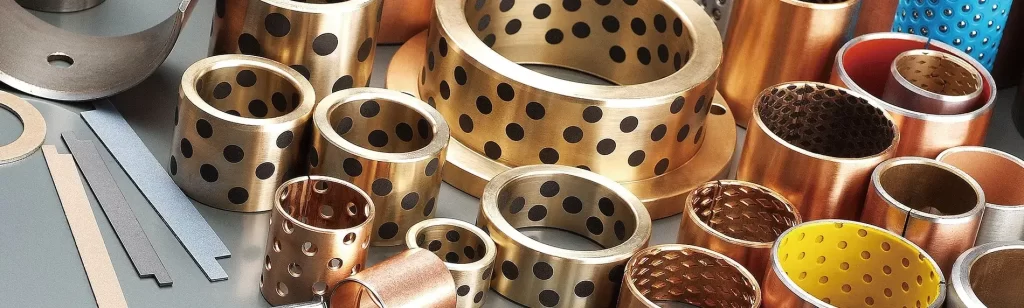
Bronze is the preferred choice for bearings, bushings, wear plates, and marine components. Brass is widely used for nuts, rivets, hinges, locks, and decorative fittings. Copper is the material of choice for electrical conductors, heat exchangers, and architectural elements where corrosion resistance and aesthetics are required.
8. Bearing Bronze: The PV Factor and Application Engineering
8.1 The PV Value Concept
For plain bearing applications, the primary limiting factor in bronze bushing design is the PV Value—the product of specific bearing pressure (P) and surface velocity (V). This parameter determines the heat generation rate at the bearing interface. Exceeding the material’s PV limit generates heat faster than dissipation capacity, potentially leading to seizure. For C93200 bronze with grease lubrication, operational PV should be maintained below 50,000; with periodic oil lubrication, values up to 75,000 are acceptable.
8.2 Operating Parameters by Alloy
| Alloy Grade | Max Surface Speed (SFM) | Max Static Load (psi) | Application Suitability |
|---|---|---|---|
| C93200 (SAE 660) | 750 | 4,000 | General-purpose, moderate loads |
| C95400 (Aluminum Bronze) | 1,200 | 4,500 | High-load, heavy-duty |
| C86300 (Manganese Bronze) | 250 | 8,000 | High-load, low-speed, shock loads |
8.3 Temperature Limitations
Bronze bushings maintain structural integrity across a wide temperature spectrum. C93200 operates effectively from -450°F to +500°F (-268°C to +260°C). Continuous operation at elevated temperatures requires consideration of mechanical property reduction above 230°C. Low-temperature performance is exceptional—bronze alloys retain toughness and ductility at cryogenic temperatures.
8.4 Lubrication Requirements
Like most metallic bushings, bronze bearings require adequate lubrication to achieve optimal performance. With sufficient lubrication, bronze bushings offer higher mechanical strength values and superior PV values compared to polymer alternatives. Oil-impregnated bronze bushings feature porous structures filled with lubricant that releases during operation under applied force, enabling maintenance-free operation in many applications
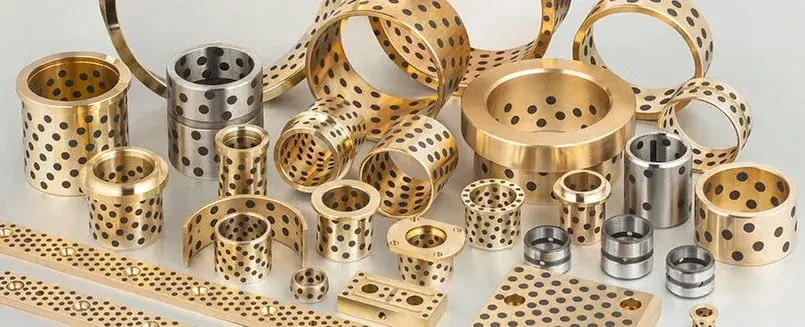
9. MYWAY Bushings: Engineering Excellence in Bronze Bearing Solutions
When performance demands the superior mechanical strength, corrosion resistance, and tribological properties that only properly formulated bronze can provide, procurement engineers and maintenance professionals require a partner they can trust. This is where MYWAY distinguishes itself as the optimal choice for precision-engineered bronze bushings and bearings.
Superior Material Specification
MYWAY manufactures bushings from premium-grade bronze alloys, including C93200 (SAE 660) bearing bronze, C95400 aluminum bronze, C86300 manganese bronze, and specialty alloys tailored to specific application requirements. Each material batch undergoes rigorous chemical composition verification through Mill Test Reports (MTR), ensuring compliance with ASTM and international standards.
Precision Manufacturing Capabilities
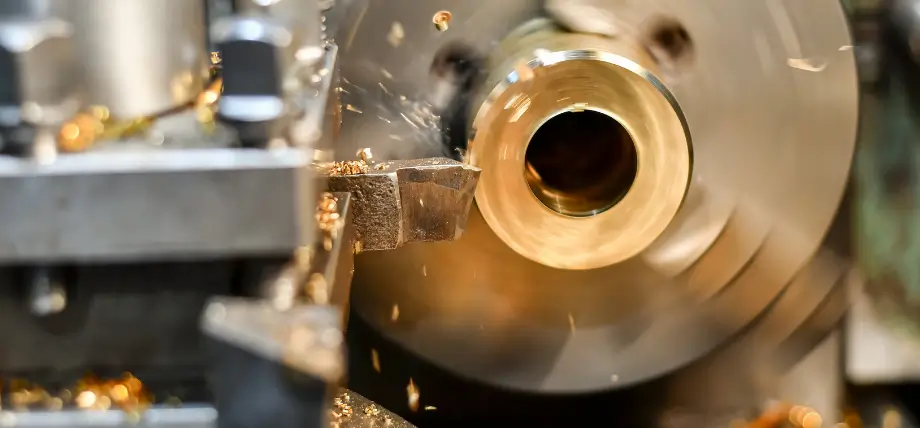
Continuous casting technology employed by MYWAY achieves high-density grain structures free from porosity, resulting in superior mechanical properties and extended service life. Precision CNC machining capabilities enable tolerances as tight as +/- 0.0002 inches on critical bore dimensions, ensuring correct clearance and optimal performance. Custom groove patterns are machined to optimize lubricant distribution to the load zone.
Application Engineering Support
MYWAY provides comprehensive technical support, including material selection recommendations based on operating conditions, PV value calculations, press-fit allowance determination, and design for manufacturing guidance. For demanding applications requiring self-lubricating solutions, graphite-plugged bronze bushings are available for high-temperature, maintenance-free operation.
Quality Assurance Protocol
Material traceability with MTRs for every heat lot
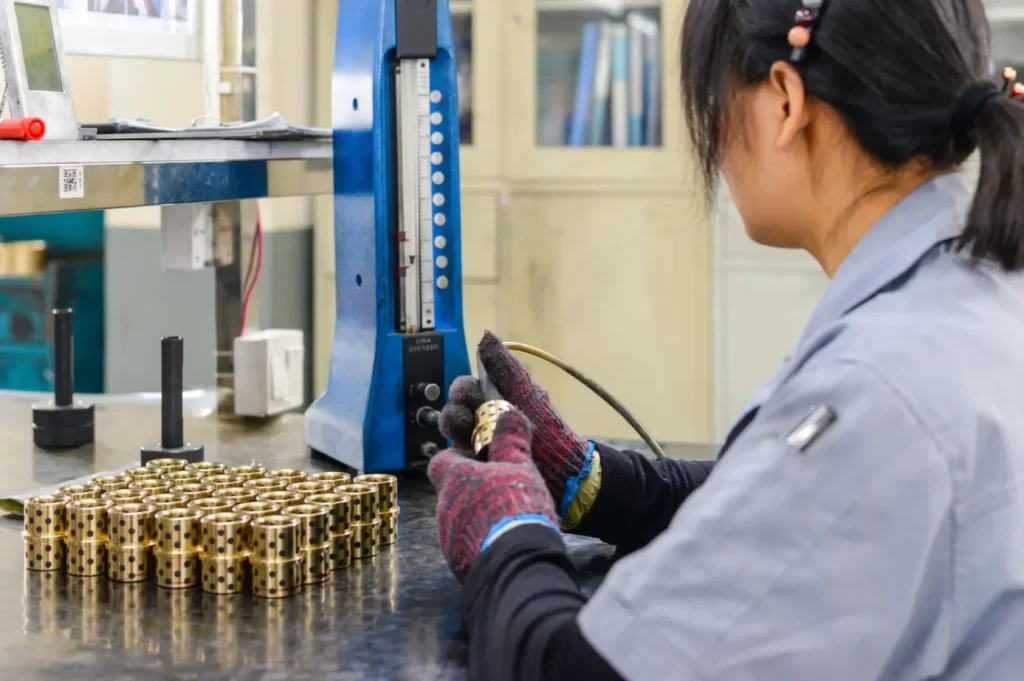
Dimensional verification using air gaging
Surface integrity inspection for casting porosity, inclusions, or machining defects
DFARS and RoHS compliance where applicable
For engineers and procurement professionals seeking reliable bronze bushing solutions that deliver consistent performance, extended service life, and cost-effective operation, MYWAY stands ready to serve as your trusted manufacturing partner.
Contact MYWAY today to discuss your specific bronze bushing requirements, request technical datasheets, or obtain a quotation for custom-manufactured components.
10.Frequently Asked Questions (FAQ)
Q1: What is the difference between bronze and brass for bearing applications?
Bronze contains copper and tin, while brass contains copper and zinc. Bronze offers superior wear resistance, higher strength, and better corrosion resistance in marine environments, making it the preferred choice for bushings and bearings. Brass is generally more machinable but lacks bronze’s tribological performance under load.
Q2: What is SAE 660 bronze and where is it used?
SAE 660 (C93200) is high-leaded tin bronze containing copper (83-86%), tin (6-8%), lead (6-8%), and zinc (2-4%). It is the most commonly used bearing bronze, suitable for general-purpose bushings, bearings, and wear plates in moderate-load applications. Its excellent machinability (rating 70) makes it cost-effective for production runs.
Q3: Can bronze bushings operate without lubrication?
While some bronze bushings are oil-impregnated and can operate maintenance-free, most bronze bearings require adequate lubrication to achieve optimal performance and prevent seizure. Oil-impregnated bronze contains porous structures filled with lubricant that releases during operation under applied force, eliminating the need for external lubrication in suitable applications.
Q4: What is the PV value, and why does it matter for bronze bushings?
The PV value (Pressure × Velocity) is the limiting design parameter for plain bearings. It represents the heat generation rate at the bearing interface. Exceeding the material’s PV limit can cause overheating and seizure. For C93200 bronze with periodic oil lubrication, values up to 75,000 are generally acceptable.
Q5: Which bronze alloy offers the highest strength for bushing applications?
Manganese bronze C86300 offers the highest tensile strength among common bearing bronzes, reaching up to 110,000 psi. This alloy is suitable for heavy-duty applications involving high loads and shock conditions, though it requires harder mating shafts and operates at lower maximum speeds.
Q6: How do I select the correct bronze grade for my application?
Selection criteria include required load capacity, operating speed, environmental conditions (corrosion exposure), shaft hardness, lubrication availability, temperature range, and cost constraints. General guideline: C93200 for general-purpose moderate loads, C95400 aluminum bronze for marine/high-strength applications, and C86300 manganese bronze for extreme load conditions.
Q7: What is the typical temperature range for bronze bushings?
Most bronze bushing alloys operate effectively from -450°F to +450°F (-268°C to +260°C). At elevated temperatures above 230°C, mechanical properties gradually decrease. Low-temperature performance is excellent—bronze retains toughness and ductility at cryogenic temperatures.
Q8: Why do bronze bushings wear preferentially compared to steel shafts?
Engineers deliberately design bronze with hardness (50–100 HV) significantly lower than hardened steel shafts (typically 300–600 HV). This ensures that the bronze component wears before the shaft, making bushing replacement substantially more economical than shaft replacement.
Q9: Can MYWAY manufacture custom bronze bushings to my specifications?
Yes. MYWAY specializes in custom-manufactured bronze bushings and bearings to customer specifications, including special sizes, tolerances, groove patterns, and configurations. Contact MYWAY with your engineering drawings or requirements for a technical consultation and quotation.
Q10: What quality certifications does MYWAY maintain?
MYWAY provides Mill Test Reports (MTRs) for all material batches, ensuring chemical composition verification. Dimensional inspection uses air gaging for critical tolerances. Products are manufactured to meet ASTM standards and applicable DFARS/RoHS requirements where specified.
100000+ Types of Bushings – Contact Us for Details