
Recent Posts
Rolling Bearings: Definition, Types, Advantages and Limitations
What Is a Rolling Bearing?
A rolling bearing is a mechanical component that reduces rotational friction between moving parts while supporting loads. Unlike plain bearings (also called sliding bearings or bushings) which rely on direct sliding contact, rolling bearings use rolling elements – balls or rollers – positioned between an inner ring and an outer ring. As the shaft rotates, these rolling elements roll along the raceways, converting sliding friction into rolling friction. Because rolling friction is substantially lower than sliding friction, rolling bearings generate less heat, consume less energy, operate at higher speeds, and achieve longer service lives under proper conditions.
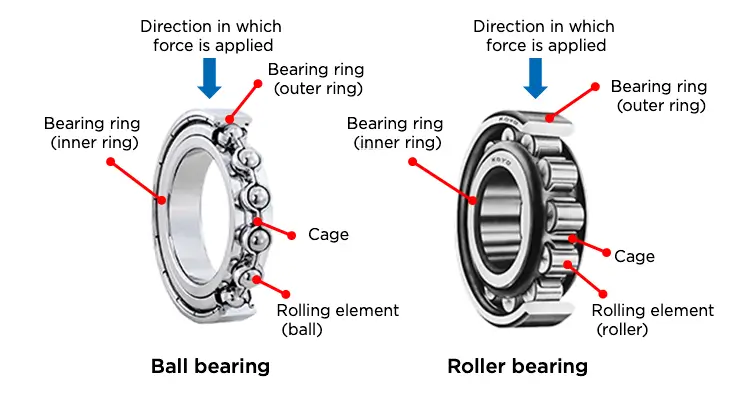
Every rolling bearing typically consists of four basic components: inner ring (mounts onto the rotating shaft), outer ring (fits into the stationary housing), rolling elements (balls or rollers that carry the load), and a cage or retainer (separates the rolling elements and maintains even spacing). Some designs also include seals, shields, or special coatings for contaminated or washdown environments.
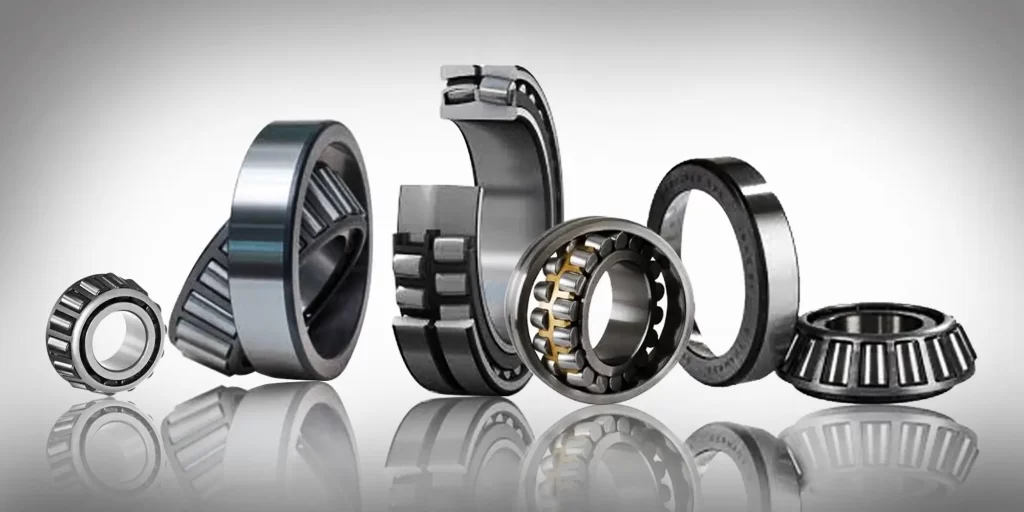
Table of Contents
1: Core Classification: Ball Bearings vs. Roller Bearings
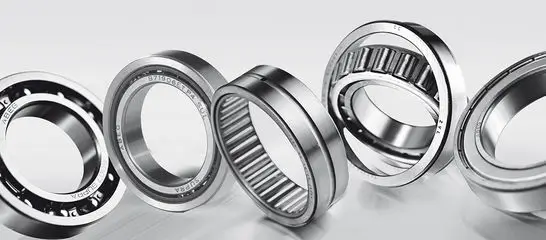
Rolling bearings fall into two broad categories based on the shape of the rolling elements: ball bearings and roller bearings.
Ball Bearings
Ball bearings use spherical balls as rolling elements. The balls make point contact with the raceways – under load, the contact point deforms into a small elliptical area. This small contact area produces very low rolling friction, enabling ball bearings to accommodate high rotational speeds. However, the same feature limits their load-carrying capacity. Ball bearings are suitable for lighter loads, low torque, and applications where speed is critical.
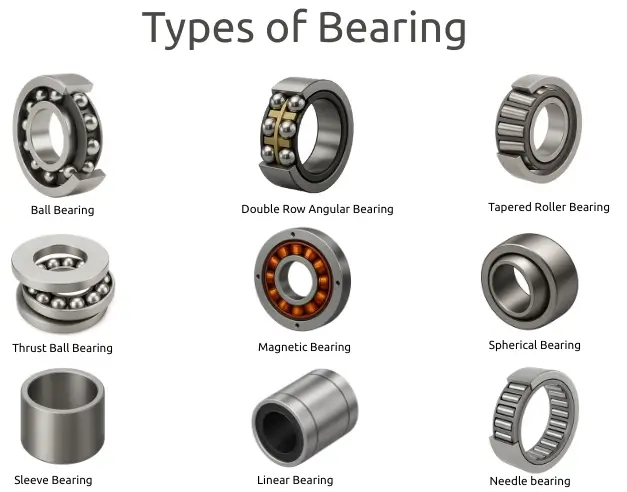
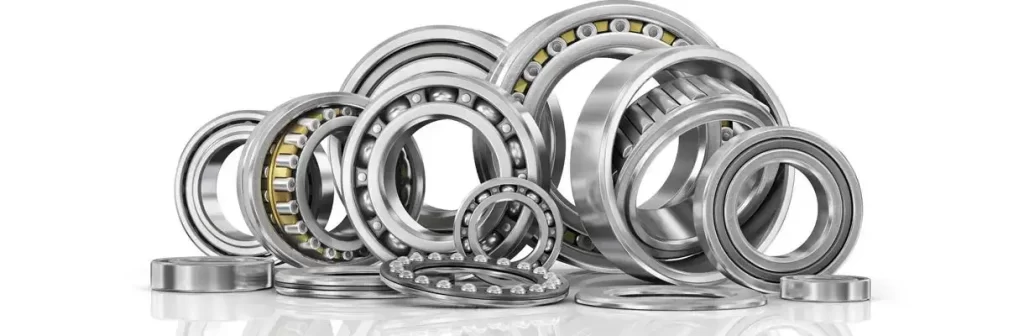
Common types include deep groove ball bearings (the most widely used type, supporting radial and axial loads in both directions), angular contact ball bearings (designed for substantial thrust loads in one direction while handling radial loads), self-aligning ball bearings (tolerate shaft misalignment), and thrust ball bearings (pure axial loads, no radial capacity).
Roller Bearings
Roller bearings use cylindrical or specially shaped rollers. The rollers make line contact with the raceways – under load, the contact region becomes rectangular. Because the contact area is larger, friction increases compared to ball bearings, but the load-carrying capacity improves significantly. Roller bearings can withstand heavier loads than ball bearings of similar size, though they operate at lower speeds.
Major roller bearing types:
Cylindrical roller bearings – high radial load capacity, moderate axial loads. Commonly used in mining, power generation, cement processing, electric motors, blowers, fans, and machine tools.
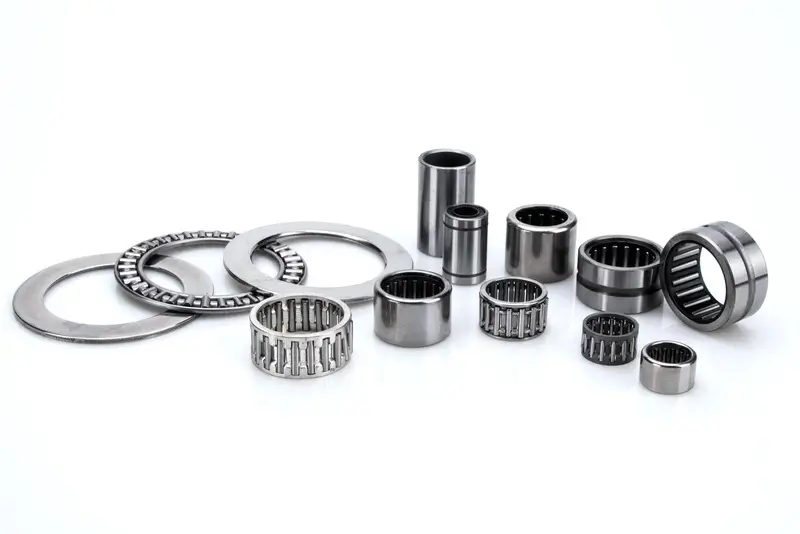
Needle roller bearings – long, thin rollers with a diameter only slightly larger than the inner ring. Ideal for compact designs where radial space is limited.
Tapered roller bearings – tapered rings and rollers that increase contact area, permitting large radial and thrust loads simultaneously. Widely used in automotive axles, gearboxes, and heavy machinery.
Spherical roller bearings – barrel-shaped rollers with self-aligning capability. Accommodate misaligned loads while handling both axial and radial forces. Found in wind turbines, crushers, and conveyors.
2: Key Application Industries
Rolling bearings serve as fundamental components in nearly every rotating machinery application across the industrial landscape.
Automotive industry – wheel hubs, transmissions, engines, axles, differentials, and steering systems. Roller bearings reduce friction and wear between moving parts, ensuring smoother operation and extending component life.
Industrial machinery – medium and large motors, generators, internal combustion engines, gas turbines, machine tool spindles, reduction gears, loading and unloading equipment.
Heavy industry and mining – agricultural, construction and mining equipment, propeller shafts, railroad axles, wind turbines, crushers, mills, and conveyors. These applications demand high load capacity and robustness.
Power generation – turbines, generators, and pumps operating under high speeds and continuous duty cycles.
Food and beverage processing – special materials and seals provide corrosion resistance and sanitary operation.
3: Technical Fundamentals: Bearing Life and L10 Rating
Rolling bearings do not last forever. Under cyclic loading, the raceways and rolling elements eventually develop rolling contact fatigue, leading to flaking or spalling. The basic rating life (L10) represents the number of revolutions or operating hours that 90% of a sufficiently large group of identical bearings will achieve or exceed before fatigue failure occurs.
The calculation differs by bearing type:
Ball bearings: L10 = (C/P)³
Roller bearings: L10 = (C/P)^{10/3}
Where C = basic dynamic load rating, and P = equivalent dynamic load. In real-world applications, L10 lives typically range from 80,000 to over 200,000 hours, depending on load, speed, lubrication, contamination levels, and maintenance quality.
4: Advantages of Rolling Bearings
Rolling bearings offer several distinct benefits that explain their widespread adoption:
Low friction and minimal heat generation, enabling higher rotational speeds compared to plain bearings.
No stick-slip effect – starting torque barely exceeds operating torque, making them ideal for precise positioning.
Low lubricant consumption – require far less lubricant than conventional plain bearings.
High rotational accuracy – preferred for precision applications such as machine tool spindles and measuring equipment.
Long service life under clean, well-lubricated conditions, with minimal wear between contacting surfaces.
Standardized dimensions – easy to source and replace globally.
5: Limitations of Rolling Bearings
Despite their advantages, rolling bearings have inherent drawbacks that engineers must consider:
High manufacturing costs – complex, multi-component designs require precise machining and assembly.
Sensitivity to contamination – dust, debris, moisture, and chemicals accelerate wear and cause premature failure. Rolling elements are particularly vulnerable.
Sensitivity to shock and vibration at standstill or low speed – false brinelling and impact damage can occur.
Limited maximum speed for certain types and sizes, especially roller bearings.
Larger radial dimensions compared to plain bushings, which can be problematic in space-constrained designs.
Higher noise levels during operation compared to plain bearings.
Finite fatigue life – regardless of maintenance quality, rolling bearings will eventually fail due to subsurface fatigue.
6: Rolling Bearings vs. Plain Bearings (Bushings): A Practical Comparison
Selecting between rolling bearings and plain bearings is a critical engineering decision. Plain bearings – also known as sliding bearings, bushings, or sleeve bearings – rely on sliding contact rather than rolling elements. They use different friction mechanisms and offer different performance profiles.
| Application Factor | Rolling Bearings (Ball/Roller) | Plain Bearings (Bushings) |
|---|---|---|
| Friction | Very low | Low to moderate |
| Speed capability | High-speed continuous rotation | Low to medium speed (≤2 m/s) |
| Load capacity | Moderate to high (line contact) | Excellent (large contact area) |
| Maintenance | Many sealed/pre-lubricated; still require eventual attention | Self-lubricating types require minimal to zero maintenance |
| Contamination resistance | Poor – vulnerable to debris and moisture | Excellent – can embed particles |
| Shock and vibration damping | Poor | Excellent |
| Environmental tolerance | Requires clean conditions | Resists corrosion, chemicals, washdowns |
| Upfront cost | Higher | Lower |
| Lifecycle cost | Higher in demanding conditions | Up to 30% lower in many applications |
When to choose rolling bearings – High rotational speeds (>5 m/s), precision applications requiring high rotational accuracy, clean operating environments, and applications where both radial and axial loads must be handled simultaneously.
When to consider plain bearings (especially self-lubricating bronze bushings) – Low to medium speeds (≤2 m/s), oscillating or start-stop motion, contaminated or washdown environments, difficult maintenance access, shock loads and vibration present, limited radial space, and applications where extended service life with minimal attention is required.
7:Where Rolling Bearings Struggle: The Case for Self-Lubricating Bronze Bushings
In demanding real-world conditions, rolling bearings often fall short. Contamination is a leading cause of rolling bearing failure – dust, water, and process chemicals penetrate seals and attack the precision surfaces. Once contamination enters, the rolling elements and raceways rapidly degrade. Maintenance-intensive environments make regular relubrication difficult or impossible. Shock loads during startup or operation can dent raceways, producing vibration and noise long before the calculated L10 life is reached.
Self-lubricating bronze bushings address these pain points directly. Manufactured through powder metallurgy, these bushings create a porous bronze matrix impregnated with solid lubricants (graphite, PTFE) or oil. During operation, the lubricant transfers to the shaft surface, forming a continuous low-friction film that requires no external grease or oil. Key benefits include:
Maintenance‑free operation – eliminate lubrication schedules, grease fittings, and the risk of over‑ or under‑lubrication.
Contamination tolerance – debris embeds into the bushing surface rather than causing catastrophic failure.
Corrosion and chemical resistance – bronze alloys withstand washdowns, moisture, and many aggressive chemicals.
Excellent shock and vibration absorption – the continuous contact surface dampens impact loads better than any rolling element design.
Compact radial dimensions – no rolling elements or cages required, so the bushing fits in a smaller envelope.
Lower total cost of ownership – reduced downtime, no lubricant purchase or disposal, and extended service life.
8: Bearing Selection Framework
Engineers and procurement professionals should evaluate the following factors systematically:
Load direction and magnitude – Radial, axial, or combined? Combined loads often point toward angular contact ball bearings or tapered roller bearings. Pure radial loads with heavy demands favor cylindrical roller bearings.
Operating speed – Ball bearings suit high-speed applications. Needle and roller bearings handle higher loads at lower speeds. For very low speeds or oscillatory motion, bushings often outperform.
Environmental conditions – Corrosive, wet, or dusty environments demand sealed rolling bearings or, better yet, self-lubricating bushings.
Space constraints – Limited radial space favors needle roller bearings or plain bushings.
Maintenance accessibility – Difficult access favors sealed rolling bearings or self-lubricating bushings.
Cost and lifecycle economics – Rolling bearings may be cost‑effective for clean, high‑speed, precision applications. In demanding conditions where rolling bearings require frequent replacement, self‑lubricating bronze bushings can significantly reduce total cost of ownership.
9: Market Trends
The global rolling bearing market continues to grow steadily. The roller bearings market reached approximately US$23.2 billion in 2025 and is projected to reach US$29.6 billion by 2030, at a compound annual growth rate (CAGR) of 5%. The automotive sector remains a major driver – global car output rose 10.2% to 76 million units in 2024. Ceramic rolling bearings represent a faster‑growing segment, valued at US$744 million in 2025 and projected to reach US$1,908 million by 2032 at a CAGR of 13.6%. Key trends include increasing demand for high‑load‑capacity bearings, adoption of advanced materials (ceramics, hybrids), extended service life requirements, and application‑specific designs.
10: FAQ – Frequently Asked Questions
Q1: What is the difference between a rolling bearing and a plain bearing?
A rolling bearing uses balls or rollers between inner and outer rings to convert sliding friction into rolling friction. A plain bearing (bushing) relies on direct sliding contact, often with a lubricant film. Rolling bearings offer lower friction and higher speeds; plain bearings offer higher load capacity, better shock resistance, and more compact radial size.
Q2: How long does a rolling bearing typically last?
Bearing life is measured using the L10 rating – the operating time that 90% of identical bearings will reach before fatigue failure. Typical L10 lives range from 80,000 to 200,000 hours, but actual service life depends on load, speed, lubrication, contamination control, and maintenance quality.
Q3: When should I use a bushing instead of a rolling bearing?
Choose bushings for low‑to‑medium speed operation (≤2 m/s), oscillating or start‑stop motion, contaminated or washdown environments, locations where maintenance access is difficult or impossible, shock load conditions, and applications with limited radial space. Self‑lubricating bronze bushings are particularly effective in these scenarios.
Q4: What is a self‑lubricating bronze bushing?
It is a porous bronze component manufactured through powder metallurgy and impregnated with solid lubricants (graphite, PTFE) or oil. During operation, the lubricant transfers to the shaft surface, creating a continuous low‑friction film that requires no external grease or oil. This design provides maintenance‑free operation and excellent contamination tolerance.
Q5: Why do rolling bearings fail prematurely?
The most common causes are contamination (dust, water, debris), improper lubrication, misalignment, overloading, and shock or vibration during standstill or low speed. Water contamination alone can reduce bearing life by up to 70% before the oil appears cloudy.
Q6: Can a self‑lubricating bushing replace a rolling bearing completely?
In many applications, yes – especially at low to medium speeds, in oscillating motion, in contaminated or wet environments, and where maintenance‑free operation is required. However, rolling bearings remain superior for high‑speed continuous rotation and applications demanding extreme rotational accuracy.
Q7: What industries use rolling bearings most heavily?
Automotive, industrial machinery, power generation, mining and construction, wind energy, food processing, aerospace, and virtually any industry that uses rotating shafts.
Why MYWAY Bronze Bushings Deliver Superior Performance in Demanding Applications
Rolling bearings excel in clean, high‑speed, precision environments. But when the operating conditions turn harsh – contamination, shock loads, limited maintenance access, oscillating motion – rolling bearings often fail long before their calculated life. That is where MYWAY self‑lubricating bronze bushings provide a better solution.
Engineered from high‑performance bronze alloys and impregnated with advanced solid lubricants, MYWAY bushings are designed to minimize downtime, extend service life, and reduce operational costs in dynamic applications where rolling bearings struggle. Key advantages include:
Zero routine maintenance – no grease fittings, no lubrication schedules, no contamination from excess grease.
Exceptional contamination tolerance – debris embeds harmlessly into the bushing surface rather than causing catastrophic failure.
Superior shock and vibration damping – protects equipment from impact loads that would dent rolling bearing raceways.
Compact design – smaller radial footprint than equivalent rolling bearings.
Lower total cost of ownership – reduced spare parts inventory, elimination of lubricant purchase and disposal, and longer service intervals.
For applications involving low‑to‑medium speeds, oscillating or start‑stop motion, washdown environments, or difficult maintenance access, MYWAY self‑lubricating bronze bushings offer a reliable, cost‑effective alternative to rolling bearings.
Get your instant quote today. Contact MYWAY to discuss your application requirements and discover how our self‑lubricating bronze bushing solutions can help you achieve maintenance‑free operation and lower lifecycle costs.
100000+ Types of Bushings – Contact Us for Details