
Recent Posts
Lead in Bronze: The Self-Lubricating Metallurgical Solution for High-Performance Bearings and Bushings
Introduction
In the domain of plain bearing engineering, few material innovations have demonstrated the enduring practicality of leaded bronze alloys. The incorporation of lead into bronze matrices represents a deliberate metallurgical strategy—one that transforms a copper-tin base into a self-lubricating, anti-seizing, and highly embeddable engineering material. Leaded bronze bushings and bearings have become foundational components across heavy machinery, automotive systems, marine equipment, and industrial transmissions, precisely because the lead phase within the alloy delivers functional advantages that no single alternative material can fully replicate
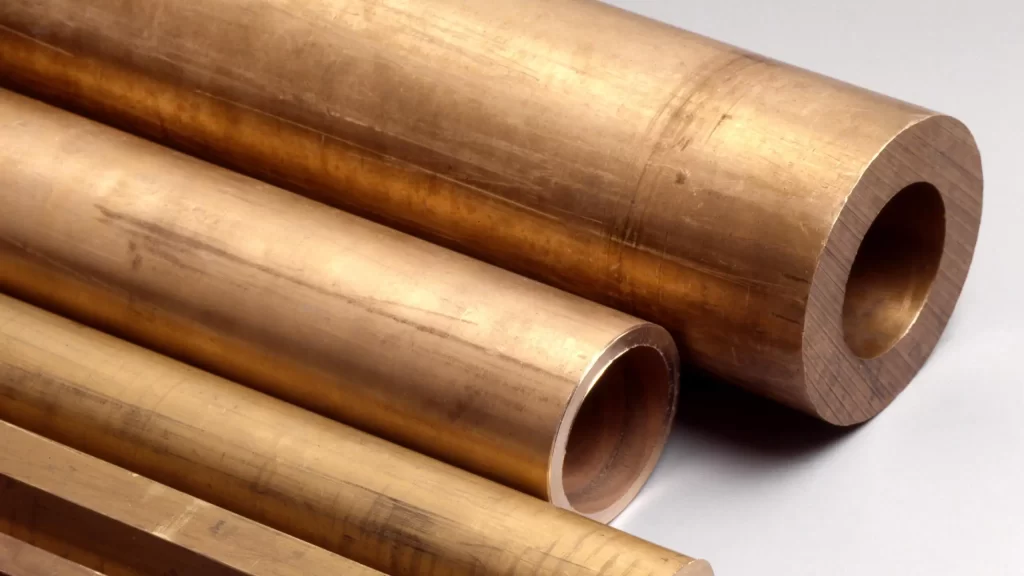
Table of Contents
1. The Metallurgical Function of Lead in Bronze Alloys
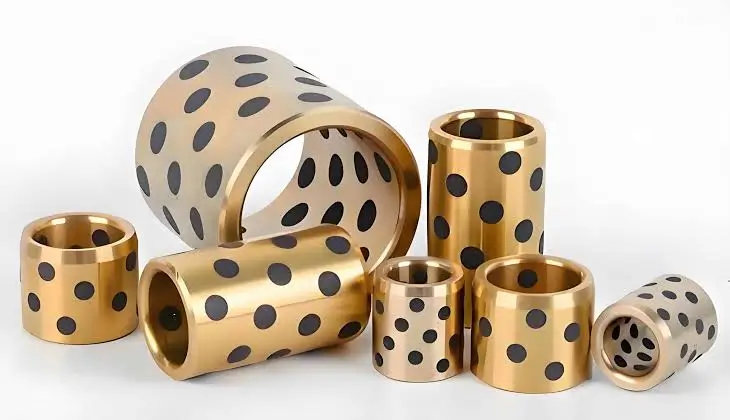
Lead is not merely a filler element in bronze metallurgy; it serves as a purposeful functional constituent. When dispersed as fine spheroids within a copper-tin matrix, lead particles remain largely immiscible with the base alloy. This microstructural arrangement is central to the alloy’s performance characteristics. During operation, these lead particles migrate to the bearing surface under mechanical pressure and thermal stress, smearing into a thin, sacrificial film that reduces friction between moving components.
This self-lubricating mechanism is particularly valuable in applications where external lubrication is intermittent, compromised, or entirely absent. The lead film functions as a solid lubricant, preventing direct metal-to-metal contact even when the hydrodynamic oil film breaks down. Additionally, lead significantly enhances the machinability of bronze alloys, allowing for precision manufacturing of complex bushing geometries with excellent surface finishes
2. Self-Lubricating Properties and Anti-Seizure Performance
The most celebrated functional attribute of leaded bronze is its inherent self-lubricating capability. Under conditions of inadequate lubrication—whether due to startup procedures, shock loads, or lubricant starvation—the lead phase activates as an emergency lubricant. Dispersed lead particles act as a solid lubricant during momentary metal-to-metal contact, preventing catastrophic seizure between the bushing and the shaft.
This anti-seizure property is not a secondary benefit but a primary design consideration for engineers specifying bearings in high-load, low-speed applications. High-leaded tin bronzes, with lead content ranging from 10% to 25%, are specifically formulated for scenarios where lubrication may be marginal or contaminated. The lead’s ability to smear and create a low-friction barrier ensures that machinery continues to operate safely even when external lubrication systems experience temporary failure
3. Embeddability: The Shaft Protection Mechanism
Embeddability represents one of the most critical functional advantages of leaded bronze bushings. In real-world industrial environments—mines, construction sites, agricultural fields—lubricants frequently become contaminated with abrasive particles such as dirt, sand, and metallic debris. With hard bearing materials, these particles become trapped between the bearing and the shaft, acting as abrasives that grind destructive grooves into expensive shaft surfaces.
Leaded bronze addresses this problem through its soft lead matrix. When contaminant particles enter the bearing interface, the soft lead phase allows them to become harmlessly embedded below the bearing surface. The bushing essentially swallows the contaminants, protecting the shaft from scoring and premature wear. This makes the bushing a sacrificial component that preserves far more costly and critical machine elements. This embeddability characteristic is why leaded bronze remains the material of choice for equipment operating in dirty, contaminated environments.
4. Conformability and Misalignment Tolerance
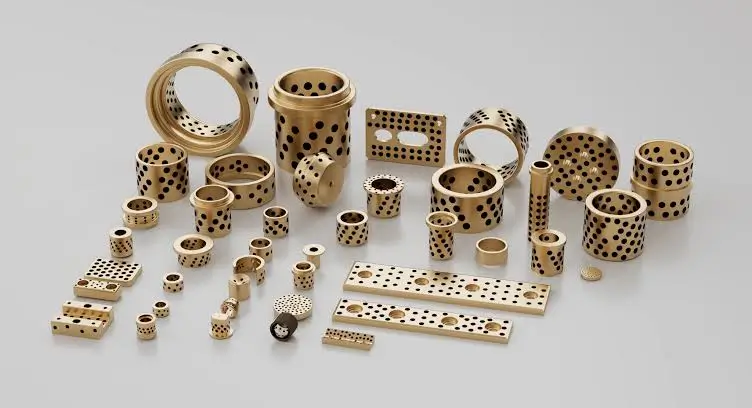
Beyond embeddability, the soft lead phase confers excellent conformability to leaded bronze alloys. Conformability refers to the material’s ability to adapt slightly to minor shaft misalignments or surface imperfections. This property promotes better load distribution across the bearing surface and facilitates improved lubricant film formation.
In practical terms, conformability reduces the risk of edge loading—a common failure mode in plain bearings where concentrated stress at the bearing edges leads to premature failure. While harder bearing materials like aluminum bronze require precise alignment and harder shafts, leaded bronze offers greater tolerance for real-world installation variations and operational deflections. This forgiving nature translates to longer service life and reduced maintenance requirements
5. Load-Carrying Capacity and Thermal Management
Despite the presence of soft lead, leaded bronze alloys maintain commendable load-carrying capacity. The tin content—typically ranging from 4% to 10% in leaded tin bronzes—provides strength, fatigue resistance, and hardness that significantly exceed what simple copper-lead alloys can offer. This combination of strength and self-lubrication makes leaded bronze suitable for bearings subjected to substantial surface pressures.
Thermal conductivity is another functional advantage. Bronze alloys efficiently dissipate frictional heat, preventing localized overheating that could degrade lubricants or cause dimensional instability–. The lead phase, while soft, does not compromise this thermal management capability. This heat dissipation is particularly important in high-speed or continuously operating applications where temperature management directly impacts component longevity.
6. Heavy-Duty Industrial Machinery Applications
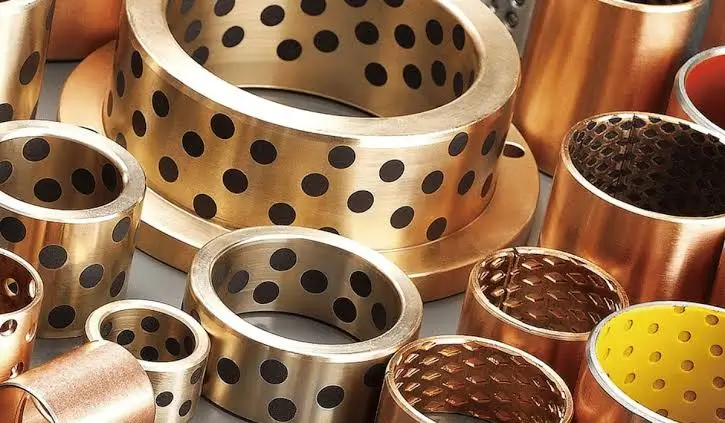
Leaded bronze bushings find extensive application in heavy industrial machinery where reliability under extreme conditions is non-negotiable. Rolling mill bearings, crusher bushings, and large press components routinely specify leaded bronze alloys for their combination of load capacity and seizure resistance.
In cone crushers, eccentric bushings are typically manufactured from high-lead tin bronze such as C93800 to ensure superior lubricity and seizure resistance. Main shaft bushings may utilize C93800 or alternative grades depending on specific load and speed requirements. The mining industry particularly values leaded bronze for applications involving high surface pressure and side pressure, such as crusher main shaft bushings.
Steel mill equipment, including mill slippers and couplings, frequently employs leaded tin bronze alloys like C91700 for their exceptional load-bearing capability and compressive strength. These applications demand materials that can withstand constant motion, high impact, and moderate corrosion while maintaining reliable performance
7. Automotive and Transportation Sector Applications
The automotive industry represents a significant application domain for leaded bronze bushings and bearings. C93200 (SAE 660) is widely used in automotive fittings, suspension components, and transmission systems. Kingpin bushings, pedal bushes, and steering gear components frequently specify leaded bronze for its wear resistance and ability to handle oscillating motion under boundary lubrication conditions.
Heavy-duty truck suspension parts, including balance suspension bushings and wheel track roller components for bulldozers, rely on leaded bronze’s high fatigue strength and load capacity. The material’s good sliding properties make it suitable for high-load, low-speed applications common in off-road vehicles and construction equipment. Internal combustion engines also utilize leaded bronze for connecting-rod bearings, valve guides, and starter components
8. Marine, Agricultural, and General Industrial Uses
Beyond heavy industry and automotive applications, leaded bronze demonstrates versatility across diverse sectors. Marine and offshore equipment benefits from the alloy’s good corrosion resistance, particularly in seawater environments. Pump sleeves, rudder bearings, and propeller components frequently specify leaded bronze for its ability to handle intermittent lubrication while resisting corrosion.
Agricultural machinery operates in environments characterized by dirt, dust, and contamination—precisely the conditions where leaded bronze’s embeddability protects critical drivetrains. General industrial applications include pumps, valves, gears, thrust washers, and machine tool bearings. The material’s reliable machinability allows for cost-effective production of custom components with precise dimensional tolerances
9. Alloy Grades and Selection Considerations
The selection of an appropriate leaded bronze grade depends on the specific demands of each application. C93200 (SAE 660) serves as the industry standard general-purpose bearing bronze, offering balanced properties of strength, machinability, and wear resistance for medium loads and speeds with adequate lubrication. Its composition of approximately 83% copper, 7% tin, and 7% lead provides reliable performance across a wide range of machinery.
For more demanding applications, high-leaded grades such as C93700 (SAE 64) and C93800 (SAE 67) offer superior embeddability, lubricity, and seizure resistance at the expense of some strength. These alloys excel in slow-speed, high-load bearings operating with contaminated lubricants. C93900, with approximately 10% lead content, delivers outstanding load-carrying capacity and anti-seizing properties for heavy-duty bushings and high-load sleeve bearings.
The engineering challenge lies in balancing load-carrying capacity against protective properties—higher lead content improves embeddability and lubricity but reduces overall strength. This trade-off demands careful consideration of operating conditions, maintenance capabilities, and shaft protection requirements.
MYWAY: Precision-Engineered Leaded Bronze Bushings
When the application demands uncompromising reliability, MYWAY delivers leaded bronze bushings engineered to exacting standards. With manufacturing expertise dating back to 2005, MYWAY combines premium copper alloys with precision machining to produce components trusted by global industries.
MYWAY’s leaded bronze offerings encompass the full spectrum of industry-standard grades, including C93200 (SAE 660) for general-purpose applications, C93700 and C93800 for high-lead demanding environments, and C93900 for heavy-duty service. Each bushing is manufactured through controlled processes that ensure consistent microstructure, optimal lead distribution, and precise dimensional accuracy.
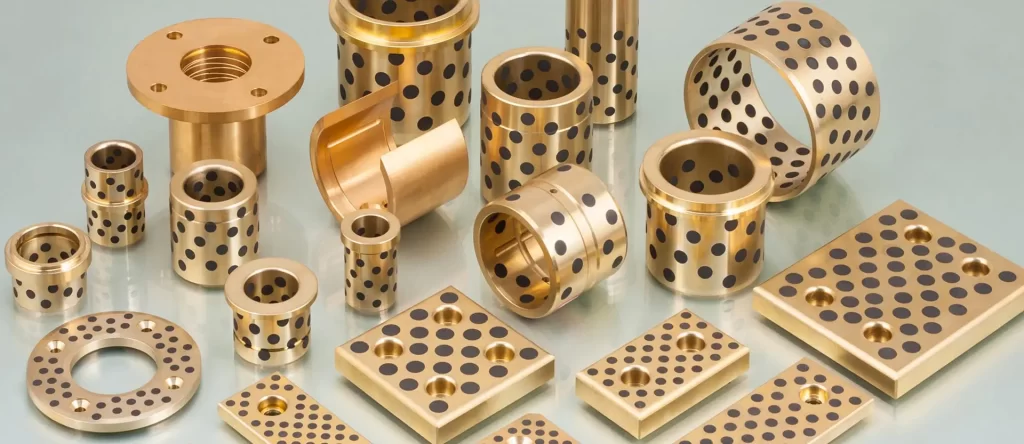
Beyond standard leaded bronze solutions, MYWAY offers advanced self-lubricating bushings featuring graphite-impregnated bronze surfaces for maintenance-free operation in the most challenging conditions. Bimetal and composite solutions combine steel backing for structural strength with bronze bearing surfaces for superior friction characteristics. MYWAY’s engineering team provides application-specific guidance to ensure optimal material selection and component design.
Industries served include construction equipment, mining machinery, agricultural implements, automotive systems, marine propulsion, and industrial transmissions. MYWAY’s components are compatible with major equipment brands including Caterpillar, Komatsu, Volvo CE, Sandvik, and Metso.
For engineers seeking reliable, high-performance bushing solutions that protect shafts, resist seizure, and extend service life under demanding conditions, MYWAY offers the technical expertise and manufacturing capability to deliver. Contact the MYWAY engineering team to discuss your specific application requirements and discover how leaded bronze bushing technology can enhance your machinery’s durability and performance
Frequently Asked Questions
Q1: What is leaded bronze and why is lead added to bronze?
Leaded bronze is a copper-based alloy in which lead is intentionally added as a functional component. The lead particles are dispersed within a copper-tin matrix and serve as a solid lubricant, reducing friction and preventing seizure during operation. Lead also enhances machinability and improves the alloy’s resistance to galling and wear.
Q2: How does self-lubrication work in leaded bronze bushings?
During operation, microscopic lead particles migrate to the bearing surface and smear into a thin, sacrificial film under mechanical pressure and heat. This film reduces friction between moving components even when external lubrication is inadequate or fails, preventing metal-to-metal contact and catastrophic seizure.
Q3: What is embeddability and why does it matter?
Embeddability is the ability of a bearing material to absorb contaminant particles into its surface. In leaded bronze, the soft lead matrix allows dirt, sand, and metallic debris to become embedded below the bearing surface, protecting the shaft from scoring and abrasive wear. This is particularly valuable in dirty operating environments like mines and construction sites.
Q4: What is the difference between C93200 (SAE 660) and high-lead grades like C93700?
C93200 is the industry standard general-purpose bearing bronze with approximately 7% lead, offering balanced strength and machinability for medium loads and speeds. High-lead grades like C93700 and C93800 contain 10–25% lead, providing superior embeddability, lubricity, and seizure resistance for slow-speed, high-load applications where lubrication may be compromised.
Q5: What applications are leaded bronze bushings best suited for?
Leaded bronze bushings excel in high-load, low-to-medium speed applications with boundary or intermittent lubrication. Typical applications include rolling mill bearings, crusher bushings, automotive suspension components, kingpin bushings, pump sleeves, marine rudder bearings, and agricultural machinery drivetrain components.
Q6: How does leaded bronze compare to aluminum bronze for bearing applications?
Leaded bronze offers superior compatibility, embeddability, and conformability, making it more forgiving of misalignment and contamination. Aluminum bronze provides higher strength and hardness but has poor embeddability and conformability, requiring harder shafts, precise alignment, and plentiful lubrication. The choice depends on specific application requirements.
Q7: Can leaded bronze bushings operate without external lubrication?
While leaded bronze provides self-lubricating properties through its lead phase, most applications still require some form of external lubrication for optimal performance and longevity. The self-lubricating capability serves as an emergency backup during startup, shock loads, or temporary lubricant starvation. For completely maintenance-free applications, MYWAY offers graphite-impregnated and PTFE-composite self-lubricating bushings.
Q8: What manufacturing processes does MYWAY use for leaded bronze bushings?
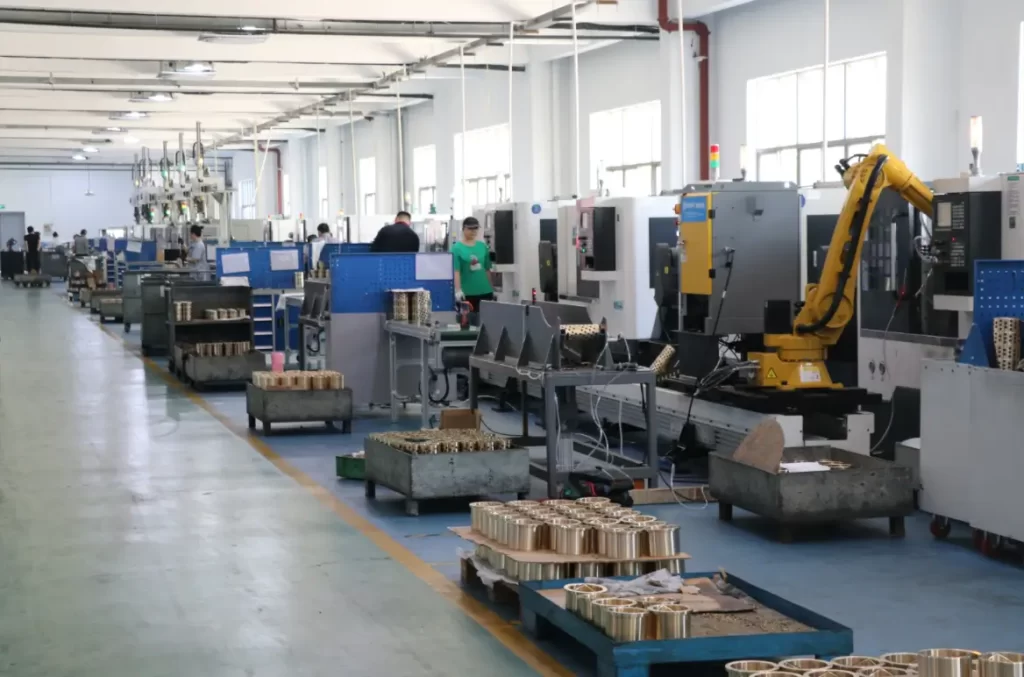
MYWAY employs precision CNC machining of solid bronze blanks and advanced casting techniques to produce bushings with consistent microstructure and precise dimensional tolerances. The company also offers graphite-plug-inserted self-lubricating bushings and bimetal solutions combining steel backing with bronze bearing surfaces.
Q9: How do I select the right leaded bronze grade for my application?
Selection depends on operating conditions including load magnitude, speed, lubrication availability, contamination levels, and shaft hardness. MYWAY’s engineering team provides application-specific guidance to ensure optimal material selection and component design. Contact MYWAY to discuss your requirements.
Q10: Does MYWAY offer lead-free alternatives?
Yes. For customers requiring lead-free solutions, MYWAY offers aluminum bronze alloys (C95400, C95500) with high strength and excellent corrosion resistance, as well as advanced self-lubricating composite bushings. The engineering team can advise on the most suitable alternative for your specific application.
100000+ Types of Bushings – Contact Us for Details