
Recent Posts
Self-Lubricating Plastic Bearing Materials: The Maintenance-Free Alternative to Metal Bearings
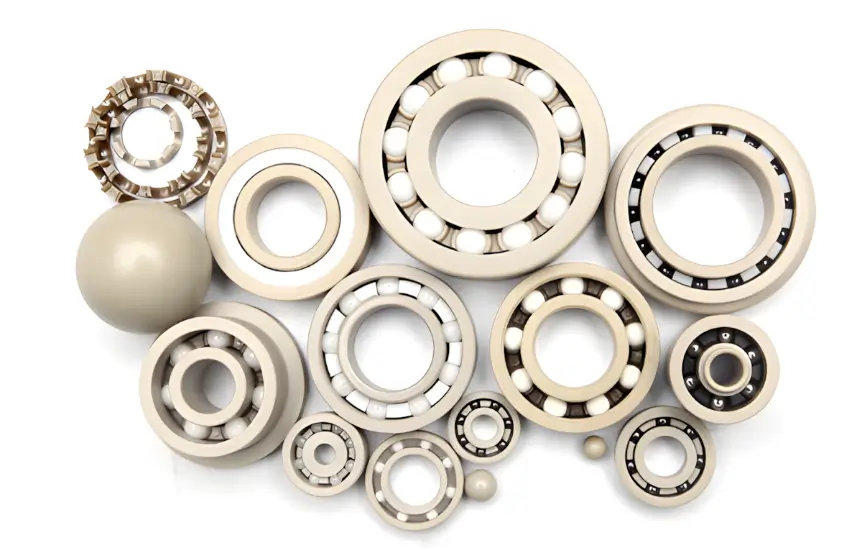
Table of Contents
1. Understanding Plastic Bearing Materials: Beyond Traditional Metal Solutions
Plastic bearing materials represent one of the most significant advancements in motion control engineering over the past several decades. Unlike conventional metallic bearings that rely on external lubrication and precise machining, engineered polymer bearings leverage advanced material science to deliver performance characteristics that often surpass their metal counterparts. These materials encompass a broad spectrum of engineering thermoplastics—including POM (Polyoxymethylene), PTFE (Polytetrafluoroethylene), PEEK (Polyetheretherketone), PA (Polyamide), and UHMW (Ultra-High-Molecular-Weight Polyethylene)—each formulated with specific reinforcing fibers and solid lubricants to address distinct application requirements.
The fundamental distinction between plastic and metal bearing materials lies in their operational philosophy. Metal bearings typically function through the formation of a hydrodynamic lubricant film or rely on embedded oil reservoirs. Plastic bearings, conversely, incorporate solid lubricants directly into the polymer matrix, enabling consistent low-friction performance throughout the component’s service life without external lubrication. This inherent self-lubricating property fundamentally transforms how engineers approach bearing design, maintenance scheduling, and system reliability.
2. Material Science Foundations: Composition and Engineering Principles
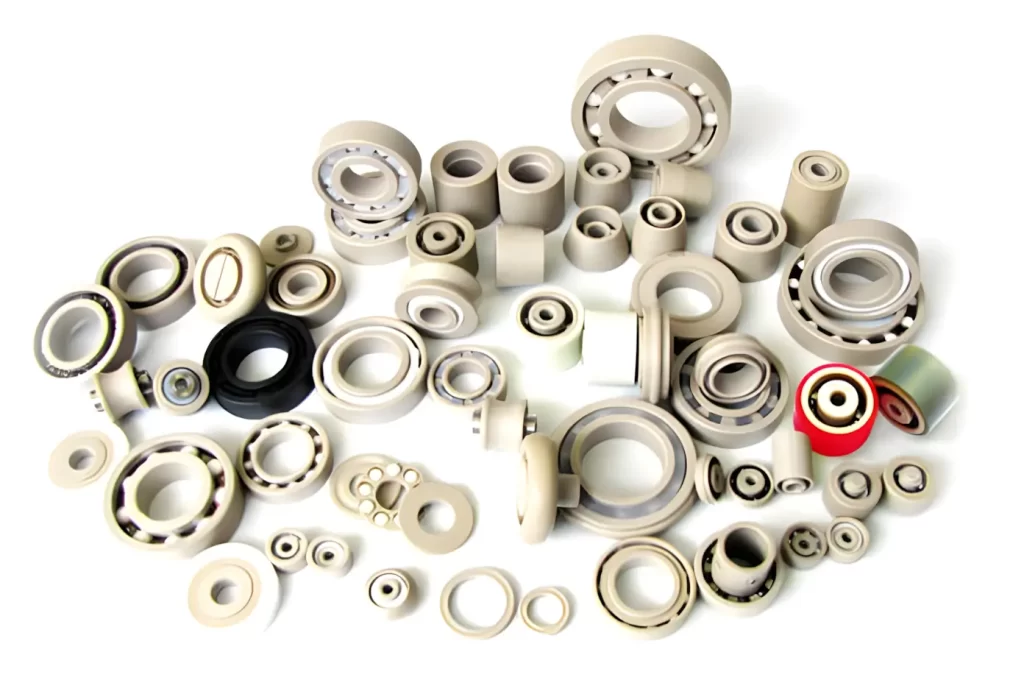
The performance of plastic bearing materials derives from sophisticated composite engineering rather than simple polymer selection. Modern engineering plastic bearings utilize a polymer matrix—typically semi-crystalline materials like POM or PA—reinforced with high-strength fibers (glass, carbon, or aramid) and impregnated with solid lubricants such as PTFE, graphite, or molybdenum disulfide. This tripartite composition addresses the three critical requirements of bearing performance: mechanical strength, wear resistance, and friction reduction.
The semi-crystalline structure of base polymers provides natural lubricity at the molecular level, while reinforcing fibers bear primary mechanical loads and prevent deformation under pressure–. Solid lubricants, strategically distributed throughout the matrix, continuously release to the bearing surface during operation, forming a protective transfer film on the counterface. This self-renewing lubrication mechanism distinguishes plastic bearing materials from coated metal alternatives, where the lubricating layer is finite and subject to depletion.
Furthermore, the homogeneous structure of engineered plastic bearings means the entire wall thickness serves as the available wear zone—a significant advantage over metal composite bearings with thin PTFE layers that, once worn through, result in metal-on-metal contact and catastrophic failure
3. Critical Material Families and Their Performance Profiles
POM (Polyoxymethylene) Bearings represent the most widely deployed plastic bearing material for general-purpose applications. Operating effectively from -60°C to 100°C, POM exhibits excellent sliding performance, wear resistance, and a low coefficient of friction. Its high surface strength, creep resistance, and dimensional stability make it particularly suitable for automotive components, office equipment, and conveyor systems. POM’s self-lubricating properties and electrical insulation characteristics further extend its utility across diverse industrial sectors.
PTFE (Polytetrafluoroethylene) Bearings deliver the lowest coefficient of friction among all polymer bearing materials, combined with exceptional chemical resistance across nearly the entire spectrum of industrial chemicals. With a service temperature range from -40°C to 200°C, PTFE bearings excel in medical equipment, chemical processing, and food-grade applications where contamination must be absolutely prevented. The material’s zero water absorption rate ensures dimensional stability in humid environments.
PEEK (Polyetheretherketone) Bearings represent the premium tier of plastic bearing materials, offering continuous operation at temperatures up to 260°C with extraordinary mechanical strength, toughness, and chemical resistance. PEEK demonstrates exceptional fatigue resistance, dimensional stability, and radiation resistance, making it the material of choice for aerospace, semiconductor manufacturing, and extreme-environment applications. Its ability to maintain mechanical properties at elevated temperatures distinguishes PEEK from all other engineering thermoplastics.
PA (Polyamide/Nylon) Bearings provide an optimal balance of mechanical strength, wear resistance, and cost-effectiveness. Commonly specified for automotive applications including gear shift linkages, seat adjustment mechanisms, and door hinges, PA bearings offer reliable performance across moderate temperature ranges
4. Functional Advantages: Why Engineers Specify Plastic Bearing Materials
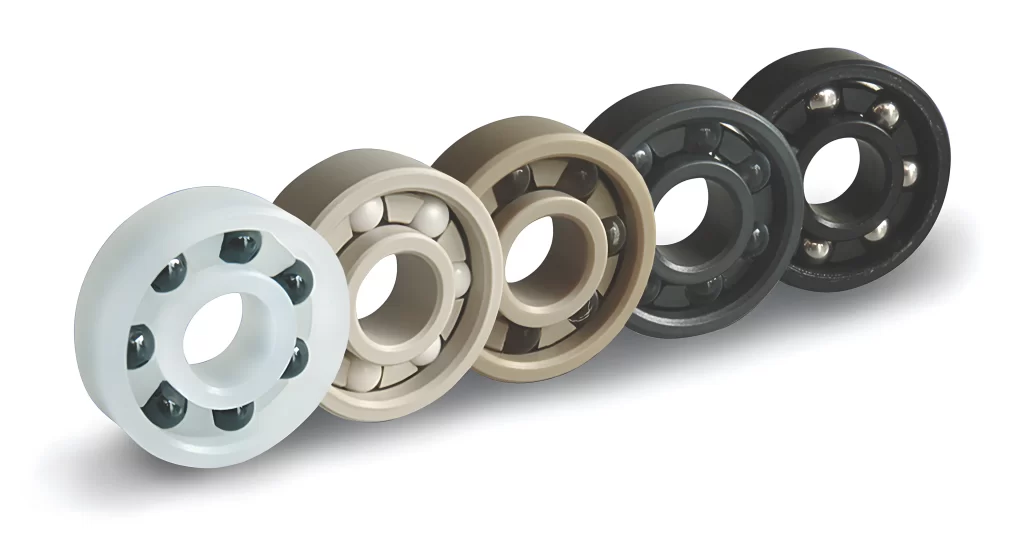
Maintenance-Free Operation stands as the foremost functional advantage of plastic bearing materials. By eliminating the requirement for periodic greasing, oiling, or lubrication scheduling, these components reduce maintenance labor, minimize downtime, and prevent the contamination risks associated with lubricant migration. This characteristic proves particularly valuable in food processing, pharmaceutical manufacturing, and cleanroom environments where lubricant contamination poses unacceptable risks.
Corrosion and Chemical Resistance differentiates plastic bearing materials from metallic alternatives in aggressive environments. Unlike steel or bronze bearings that rust, pit, and degrade when exposed to moisture, acids, alkalis, or saline solutions, engineered polymers remain virtually impervious to chemical attack. This resistance enables reliable operation in marine engineering, chemical manufacturing, oil extraction, and agricultural machinery where metal bearings would rapidly fail.
Weight Reduction delivers substantial system-level benefits. Plastic bearings weigh up to 80% less than conventional metallic bearings of identical dimensions. This weight saving translates to reduced energy consumption, lower inertia in moving assemblies, and improved overall equipment efficiency. In automotive applications, weight reduction directly contributes to reduced fuel consumption and lower emissions.
Noise and Vibration Damping represents a frequently overlooked functional advantage. Unlike metal bearings that transmit and amplify vibration, plastic materials inherently dampen oscillations, reducing operational noise and improving equipment acoustics. This characteristic has become increasingly critical with the proliferation of electric and hybrid vehicles, where the absence of combustion engine noise makes bearing-generated sounds far more perceptible.
Design Flexibility enables engineers to optimize bearing geometry for specific applications without the machining constraints of metal components. Plastic bearings can be manufactured in virtually any size or shape through injection molding, allowing complex features, integrated flanges, and custom configurations at production scales
5. Industrial Applications: Where Plastic Bearing Materials Excel
Automotive Manufacturing represents the largest and most diverse application sector for plastic bearing materials. Modern vehicles contain numerous plastic bearing points spanning seat adjustment systems, gear shift linkages, coolant pumps, door hinges, wiper systems, steering linkages, and suspension components. The combination of weight reduction, corrosion resistance, and maintenance-free operation addresses the automotive industry’s relentless pursuit of efficiency, durability, and cost optimization.
Food Processing and Packaging Equipment demands bearing materials that withstand frequent washdowns, resist chemical cleaners, and eliminate contamination risks. Plastic bearings comply with FDA regulations for food contact while delivering reliable performance in wet, high-hygiene environments. Their self-lubricating nature prevents oil or grease from migrating into food products—a critical requirement that metal bearings cannot satisfy.
Injection Molding and Die-Casting Machinery operates under extreme cyclic loads, high temperatures, and demanding precision requirements. Plastic bearings provide the dimensional stability and low friction essential for consistent production quality while withstanding the severe specific pressures and cyclical loading characteristic of these machines. Leading machinery manufacturers including Haitian Group, Chen Hsong Group, and Yizumi rely on engineered polymer bearings for critical motion control points.
Medical Equipment and Pharmaceutical Manufacturing requires bearings that operate without lubrication, generate no metallic particles, and withstand sterilization procedures. Plastic bearing materials meet these stringent requirements while delivering quiet, reliable operation in diagnostic equipment, surgical instruments, and pharmaceutical production lines.
Agricultural and Construction Machinery operates in dirty, dusty, and chemically aggressive environments where metal bearings frequently fail. Plastic bearings resist abrasion from particulates, corrosion from fertilizers and chemicals, and operate reliably without lubrication that would attract contaminants.
Pumps, Valves, and Fluid Handling Equipment benefits from plastic bearings’ exceptional chemical resistance and ability to operate in both dry and submerged conditions. These components function reliably in water, seawater, and aggressive chemical streams without degradation
6. Plastic Versus Metal: A Performance Comparison
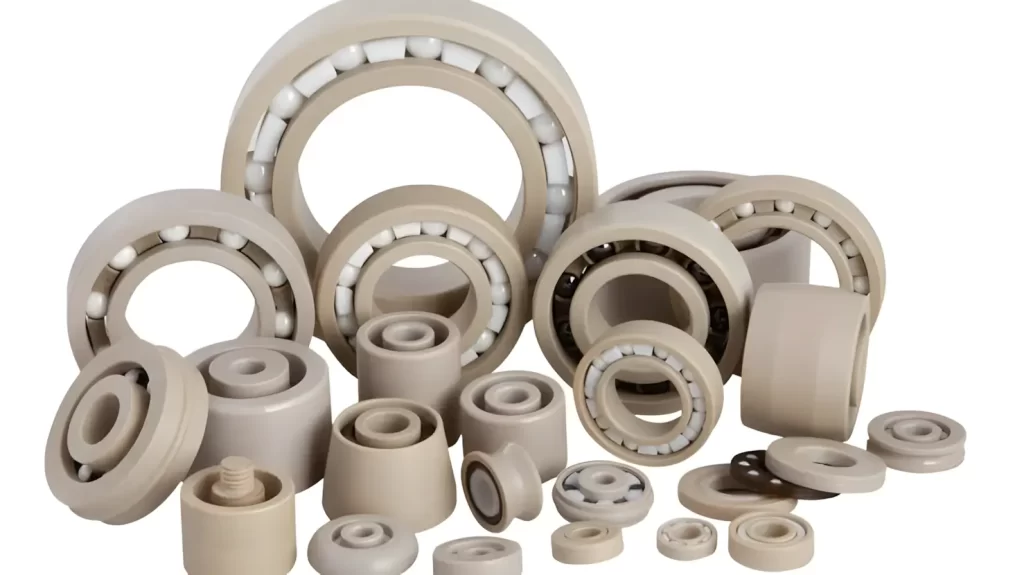
The decision between plastic and metal bearing materials hinges on application-specific requirements rather than universal superiority. Metal bearings excel in extreme high-load, high-speed applications where hydrodynamic lubrication can be maintained. However, plastic bearings offer distinct advantages across the majority of industrial applications.
Load Capacity: While traditional plastic bearings were limited to light loads, modern engineered polymers with fiber reinforcement and advanced compounding achieve load capacities that rival metal bearings in many applications. The ability to absorb edge loads without shattering—a vulnerability of brittle metal bearings—represents a significant plastic advantage.
Wear Resistance: Purpose-formulated plastic bearing compounds often outlast metals in dirty, dusty, or dry-running conditions. The self-lubricating mechanism ensures consistent wear rates throughout the component’s life, unlike metal bearings where lubricant depletion leads to progressive degradation.
Cost Considerations: Plastic bearings typically offer lower total cost of ownership despite potentially higher initial material costs. Reduced maintenance labor, eliminated lubrication expenses, longer service life, and lower manufacturing costs (injection molding versus machining) contribute to significant lifecycle savings
7. Material Selection Criteria for Plastic Bearings
Selecting the optimal plastic bearing material requires systematic evaluation of operating parameters. Temperature represents the primary constraint, as each polymer family has defined maximum continuous service temperatures—PEEK at 260°C, PTFE at 200°C, POM at 100°C. Chemical Exposure dictates material compatibility, with PTFE and PEEK offering the broadest chemical resistance. Load and Speed determine the required mechanical properties, with fiber reinforcement specified for higher loads. Environmental Factors including moisture, UV exposure, and particulate contamination influence material selection and additive requirements.
Engineers should calculate the PV value (pressure × velocity) for their application and select materials rated for the required performance envelope. Designing toward lower PV values typically extends service life. Consultation with bearing material specialists ensures optimal material specification for specific operating conditions
8. MYWAY Plastic Bushings: Engineered Excellence in Polymer Bearing Solutions
MYWAY Bushing has established itself as a leading manufacturer of precision plastic bushings and bearings, leveraging nearly two decades of engineering expertise and manufacturing excellence. Headquartered with a 35,000-square-meter manufacturing facility in Xuancheng, China, MYWAY delivers custom and standard components to customers across more than 40 countries, holding ISO 9001:2015 and IATF 16949:2016 certifications that attest to rigorous quality management systems.
The MYWAY BLR Engineering Plastic Bearing series exemplifies the company’s advanced material engineering capabilities. Manufactured using high-performance engineering plastics as the base material, these bearings incorporate high-strength fibers and specialized solid lubricants through polymer modification and compounding technology. This sophisticated formulation enhances wear resistance while maintaining the self-lubricating properties that eliminate external lubrication requirements.
MYWAY’s Plastic Compound Bushings represent the culmination of comprehensive material science expertise. Engineered from advanced polymers including POM, PTFE, and nylon, reinforced with fibers, and integrated with solid lubricants, these bushings deliver maintenance-free operation throughout their service life. The homogeneous structure ensures consistent friction and wear characteristics, with the entire wall thickness available as the wear zone—a fundamental advantage over coated metal alternatives.
The company’s product portfolio encompasses a comprehensive range of plastic bearing solutions, including straight bushings, flanged bushings, thrust washers, spherical bearings, and custom-engineered configurations. MYWAY’s precision manufacturing capabilities, combining advanced injection molding with CNC machining, enable the production of components with exceptional dimensional stability and low friction—critical attributes for consistent, high-quality production output.
MYWAY’s engineering team provides comprehensive application support, assisting customers in material selection, design optimization, and performance validation. This collaborative approach ensures that each plastic bearing solution is precisely matched to the specific operating conditions, load requirements, and environmental factors of the intended application.
9. The Future of Plastic Bearing Materials
The trajectory of plastic bearing materials points toward continued innovation in polymer chemistry, composite engineering, and manufacturing technology. Emerging developments include advanced PEEK formulations with enhanced thermal and mechanical properties, bio-based polymers for sustainable applications, and smart bearing materials with embedded sensors for condition monitoring. As industries increasingly prioritize maintenance-free operation, corrosion resistance, and weight reduction, the adoption of engineered plastic bearings will continue to accelerate across all industrial sectors.
MYWAY Bushing remains at the forefront of this evolution, continuously advancing material formulations and manufacturing processes to meet emerging application requirements. With proven performance supplying global industry leaders including XCMG, SANY, GWM, Haitian Group, Chen Hsong Group, and Yizumi, MYWAY brings engineering rigor and manufacturing excellence to every plastic bearing solution
Frequently Asked Questions
Q1: What are plastic bearing materials and how do they differ from metal bearings?
Plastic bearing materials are engineered polymers—such as POM, PTFE, PEEK, and PA—formulated with reinforcing fibers and solid lubricants to provide low-friction, wear-resistant bearing surfaces. Unlike metal bearings that require external lubrication, plastic bearings are inherently self-lubricating and operate maintenance-free.
Q2: What are the main advantages of plastic bearings over traditional metal bearings?
Plastic bearings offer maintenance-free operation, superior corrosion resistance, weight reduction of up to 80%, noise and vibration damping, design flexibility, and often lower total cost of ownership.
Q3: What industries commonly use plastic bearing materials?
Plastic bearings are widely deployed across automotive manufacturing, food processing and packaging, injection molding and die-casting machinery, medical equipment, pharmaceutical manufacturing, agricultural machinery, construction equipment, and pumps and valves.
Q4: How do I select the right plastic bearing material for my application?
Material selection requires evaluating operating temperature, chemical exposure, load and speed requirements, environmental factors, and PV value (pressure × velocity). Consulting with bearing material specialists ensures optimal specification.
Q5: Can plastic bearings handle high loads like metal bearings?
Modern engineered plastic bearings with fiber reinforcement achieve load capacities that rival metal bearings in many applications. They also absorb edge loads without shattering—a vulnerability of brittle metal bearings.
Q6: Are plastic bearings suitable for food processing applications?
Yes. Plastic bearings comply with FDA regulations for food contact and eliminate lubricant contamination risks. Their corrosion resistance withstands frequent washdowns and chemical cleaners.
Q7: What is the temperature range for plastic bearings?
Temperature ranges vary by material: PEEK operates up to 260°C, PTFE up to 200°C, POM from -60°C to 100°C, and PA from -55°C to 100°C.
Q8: Why choose MYWAY for plastic bearing solutions?
MYWAY brings nearly 20 years of engineering expertise, IATF 16949 and ISO 9001 certifications, a 35,000-square-meter manufacturing facility, and proven performance supplying global industry leaders. MYWAY provides comprehensive application support and custom-engineered solutions.
Q9: Are plastic bearings more expensive than metal bearings?
While initial material costs may be higher, plastic bearings typically offer lower total cost of ownership through reduced maintenance, eliminated lubrication, longer service life, and lower manufacturing costs.
Q10: How long do plastic bearings last?
Service life depends on application parameters including load, speed, temperature, and environmental factors. Purpose-formulated plastic bearing compounds often outlast metals in demanding conditions, with predictable wear rates throughout the component’s life.
For expert guidance on plastic bearing material selection or to discuss your specific application requirements, contact MYWAY Bushing today. Our engineering team is ready to develop the optimal polymer bearing solution for your motion control challenges.
100000+ Types of Bushings – Contact Us for Details